This Order amends the Proceeds of Crime Act 2002 (References to Welsh Revenue Authority Financial Investigators) Order 2018 (S.I. 2018/196 (W. 45)) (“the Principal Order”).
Mae’r Gorchymyn hwn yn diwygio Gorchymyn Deddf Enillion Troseddau 2002 (Cyfeiriadau at Ymchwilwyr Ariannol Awdurdod Cyllid Cymru) 2018 (O.S. 2018/196 (Cy. 45)) (“y Prif Orchymyn”).
Link:
The Proceeds of Crime Act 2002 (References to Welsh Revenue Authority Financial Investigators) (Amendment) Order 2018 / Gorchymyn Deddf Enillion Troseddau 2002 (Cyfeiriadau at Ymchwilwyr Ariannol Awdurdod Cyllid Cymru) (Diwygio) 2018
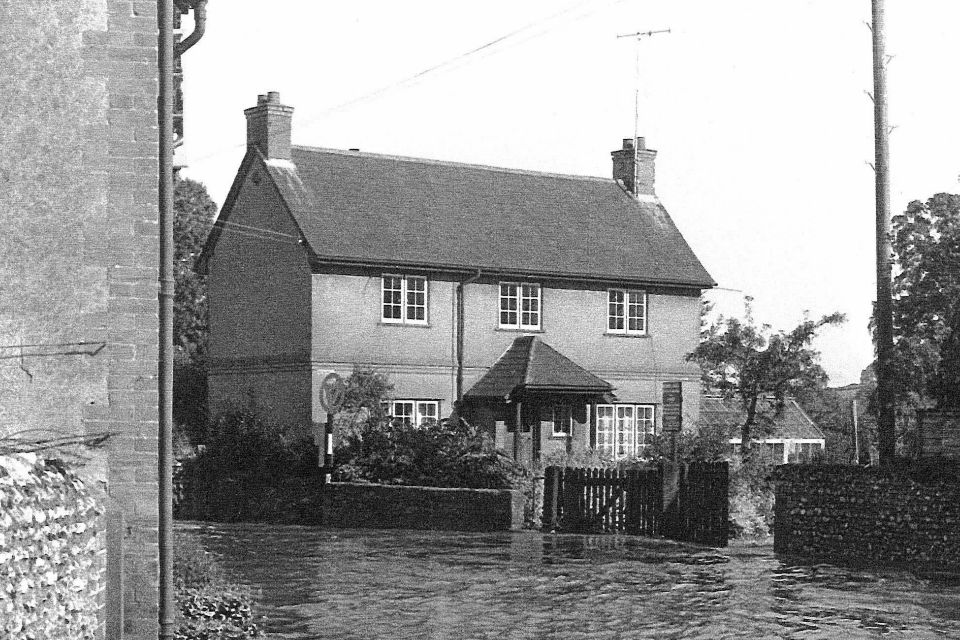
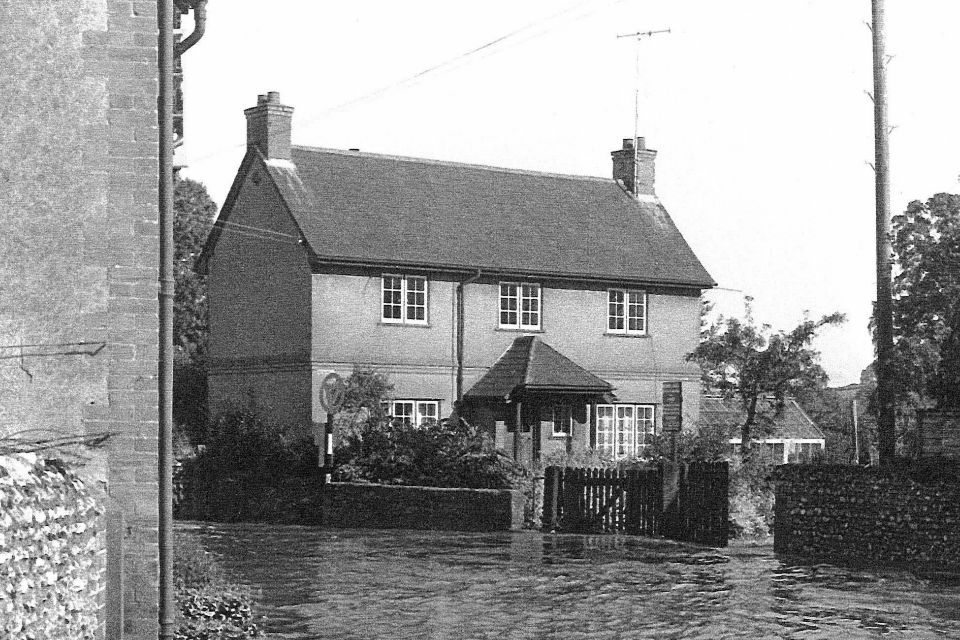
A summer storm flooded homes and businesses across the south west, thousands were driven from their homes and tragically a number of lives were lost.
The Environment Agency, together with the Sid Vale Association will commemorate the floods of July 1968 with a free exhibition of historic flood photographs and maps. They are inviting residents and visitors to come along and share their experiences or to simply view the photographs on display.
Date: 7 and 8 July 2018
Opening times: 10.30am to 4pm
Location:
Kennaway House
Sidmouth
EX10 8NG
Frogmore Road, East Budleigh, July 1968
Chris Khan, Flood Risk Officer at the Environment Agency, said
This is one of the biggest floods we have recorded in Devon. Many communities that we work with were affected. We would like as many people as possible to come along, whether they are a local resident or on holiday. We would love visitors to share memories and bring any photographs they have.
The impacts of the flood were immense; bridges collapsed causing roads to close. Sidmouth, Colyton, Honiton, Newton Poppleford, East Budleigh and Ottery St Mary all had significant flood damage whilst The Otterhead reservoir was completely washed away.
A lot has changed since 1968; similar storms still occur but people and businesses are better protected than ever before. In the last 10 years the Government has invested more than £6.1 billion in flood risk management work including many flood alleviation schemes across the south west.
There are also tools to help you reduce your own risk of flooding. The Environment Agency send targeted flood warnings to over a million people in England – giving them vital time to prepare for flooding. You can sign up for free flood warnings online or by ringing 0345 988 1188.
Around three million couples across the UK have boosted their finances with Marriage Allowance, HM Revenue and Customs (HMRC) announced today.
More than a million married and civil partnered couples are still eligible for the free tax break worth up to £238 a year. And thanks to the start of the new tax year couples can backdate their allowance and boost their payment up to £900 – just in time for the summer holidays.
Applying for Marriage Allowance is quick and easy and once an application is complete it’s processed immediately. The new online form takes fewer than ten minutes to fill out and eligible customers will receive backdated claims of up to £662 as a lump sum. Over 300,000 couples have signed up for the Marriage Allowance tax break since March 2018.
Mel Stride MP, the Financial Secretary to the Treasury, said:
It’s great news that so many couples are now benefitting from Marriage Allowance. This is a really important tax relief and reflects the social importance of marriages and civil partnerships.
And I’d urge those that haven’t yet managed to claim the money to do so right away – it’s quick and easy to apply. Just search online for Marriage Allowance and go to the GOV.UK site.
Everyone has a tax-free personal allowance of £11,850 and no tax is due on income up to this amount. The Marriage Allowance allows a spouse or civil partner who is a non-taxpayer to transfer £1,190 of it to their partner.
About four million married couples, including around 15,000 civil partnerships, stand to benefit from the Marriage Allowance, which was introduced in April 2015.
Couples have four years to claim their backdated allowance and can apply online
Highways England today paved the way for improved road building with the much anticipated release of the first suite of new design standards.
The publication of the first sections of the new ‘Design Manual for Roads and Bridges’ (DMRB) will ensure roads are designed, built and maintained to the very highest and safest standards.
Accepted as the cornerstone of the delivery and management of motorway and all-purpose trunk roads across the UK, and a respected document worldwide, the DMRB was first published in 1992.
Highways England, the Government company responsible for maintaining, operating and improving the country’s motorways and major A roads, is currently updating it to make it clearer, more consistent and easier to understand and implement. The update puts design requirements at its core and it will also make it easier to incorporate developments in design best practice. This will result in greater efficiency and innovation throughout the lifecycle of the assets, fewer departures from the requirements, and reduced time and associated cost.
Highways England Chief Highway Engineer, Mike Wilson said:
“This is an exciting time for the highways sector as we continue to successfully deliver the record £15bn investment in roads. The updated DMRB documents mark a historic moment for the design of the UK’s motorways and major A-roads.
“I would like to thank the Devolved Administrations and our supply chain who have supported this significant review, which will ensure our roads are designed, built and maintained to the very highest, safest standards for the millions of drivers that use these roads every day.”
The first four documents of the updated “Design Manual for Roads and Bridges” (DMRB) are:
Introduction to the Design Manual for Roads and Bridges
Requirements for safety risk assessment
Use of Compressive Membrane Action in Bridge Decks
Management of Corrugated Steel Buried Structures
Experts at Highways England began the task of updating the complete suite of over 350 documents and associated interim advice notes (IANs) that make up the manual in April 2017 with the review due for completion by March 2020. This is a specific requirement of the Protocol attached to the Highways England Licence as part of the Government’s Road Investment Strategy.
Changes in the updated document include:
a new structure of the volumes to be aligned to asset life-cycle stages, from appraisal to design up to disposal
new numbering systems of documents reflecting the relevant asset life-cycle stage and the specific discipline covered by the document
new style of individual clauses to make a clear distinction between requirements and advisory material
incorporation of interim advice notes (IANs) into the DMRB as relevant
consolidation of DMRB ‘A’ (advisory) documents with related ‘D’ (design) documents
introduction of National Application Annexes attached to the DMRB to cover the specific requirements of the Overseeing Organisations
Several leading UK consultants have supported Highways England with the update, and a new set of drafting rules has been used, which follows best practice from national and international standardisation organisations.
The DMRB re-drafting is being completed using a revolutionary online authoring tool purposefully built for the refresh of the document. This signals an important move to digital technology and unlocks the potential of digital innovations.
The updated DMRB documents will be released in phases with completion due by March 2020.
General enquiries
Members of the public should contact the Highways England customer contact centre on 0300 123 5000.
Media enquiries
Journalists should contact the Highways England press office on 0844 693 1448 and use the menu to speak to the most appropriate press officer.
A Cornish waste disposal company has been ordered to pay £26,500 in fines and costs for illegally handling and disposing of hazardous waste.
Glebe Quarry Limited was also ordered to pay £17,000 compensation to a local farmer after waste contaminated with asbestos was dumped on his land. The case was brought by the Environment Agency.
The company, which trades as 1st Call Skips, operates a permitted waste transfer station at Glebe Quarry near Roche, St Austell. On 6 December 2017, the company pleaded guilty to 5 separate offences at Truro Crown Court.
The offences occurred at 3 sites in Cornwall, including the company’s own waste transfer station, a nearby farm and a site operated by the china clay company, Imerys.
The Environment Agency had earlier advised the company to improve Glebe Quarry after the drainage and concreting at the site was checked and found to be ‘inadequate’. No action was taken so the Environment Agency issued an enforcement notice requesting that improvements works be carried out.
Glebe Quarry Limited appealed, but the appeal was dismissed by the Planning Inspectorate; forcing the company to carry out the improvements that were finally completed in November 2016.
Further checks by the Environment Agency revealed the company had unlawfully dumped more than 2,400 tonnes of waste, some of which was contaminated with asbestos, on land which wasn’t authorised by their site permit. Glebe Quarry Limited continued illegally dumping waste at the site despite being warned they would be committing an offence if they carried on.
In 2015, the defendant also sent waste to Imerys Minerals Ltd with waste that should have been suitable for land improvements for restoring an area of china clay spoil heaps. However, it was later found to be contaminated with asbestos.
The asbestos was discovered before the waste was spread and the loads were returned to Glebe Quarry. Nearly 50 tonnes of hazardous material was removed by Glebe Quarry Limited but was never traced as no paperwork was kept.
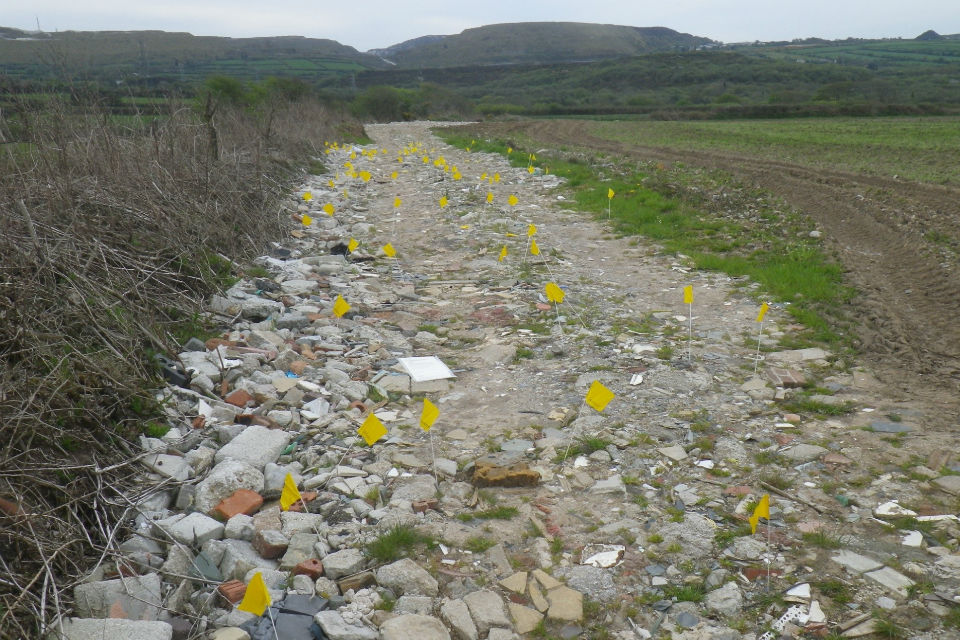
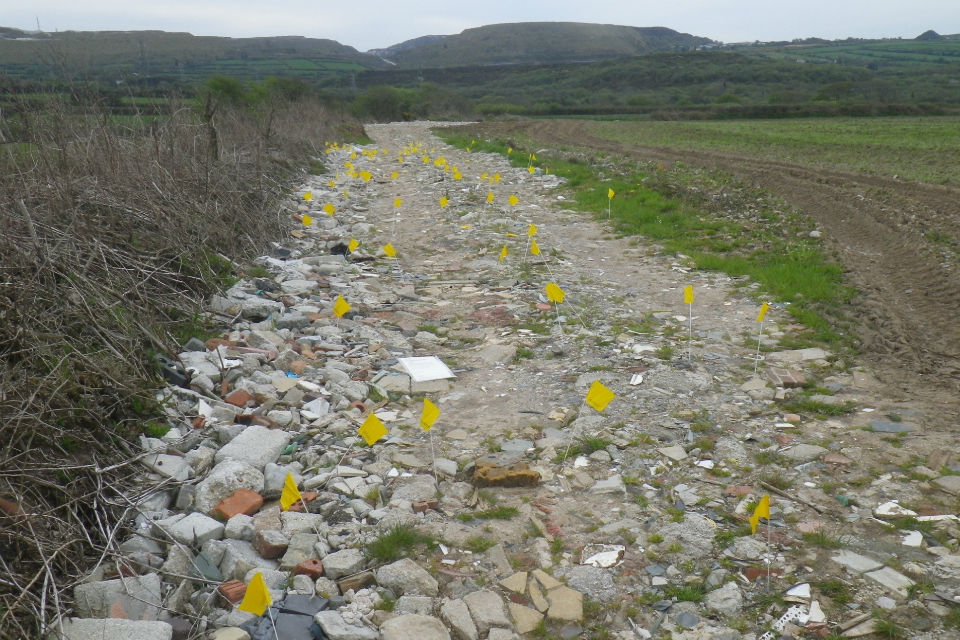
Glebe Quarry Limited also supplied waste to local farms for use in low-risk activities such as the construction of farm tracks. This was done under an exemption which is an agreement that doesn’t require a permit. The waste supplied to one farm was heavily contaminated with asbestos and cost nearly £120,000 to clean-up.
Each yellow flag in this farm track, made from waste supplied by Glebe Quarry Ltd, marks where asbestos was found
Matthew Lee of the Environment Agency said:
This case sends a clear message to those who put profit ahead of the environment and human health.
As a minimum, we expect waste companies who hold environmental permits to act legally and should set an example to others, but the behaviour in this case has fallen far short of exemplary.
Appearing before Truro Crown Court on 22 June 2018, Glebe Quarry Limited was fined £12,500 for offences under the Environmental Permitting (England and Wales) Regulations 2010, the Hazardous Waste (England and Wales) Regulations 2005, and the Environmental Protection Act 1990.
In addition to the financial penalty, the court ordered that Glebe Quarry Limited must proactively inform the Environment Agency which sites they are sending their waste to and they must also remedy the sites they have polluted.
If you see waste crime taking place report it by calling our incident hotline on 0800 80 70 60 or anonymously to Crimestoppers.