Press release: New funds to boost diversity of people working in digital and tech jobs

  • £1 million Digital Skills Innovation Fund will help people from underrepresented groups gain the skills they need to work in digital roles.
  • An additional £400,000 will help older and disabled people get life-changing digital skills.

People from underrepresented groups with the potential to become tomorrow’s tech stars are set to be given new digital skills as part of a push to improve diversity in the digital economy and address local skills challenges.
A new £1 million Digital Skills Innovation Fund is now open for bids from Local Enterprise Partnerships (LEPs) and Combined Authorities for initiatives which specifically aim to help people take up digital roles.

The funding will be used to help women, disabled people, people from minority backgrounds or those living in lower socioeconomic areas to succeed in digital roles such as data analysts, programmers, cyber security specialists, software developers and marketeers.

Research reveals 17 per cent of women make up the tech workforce and are underrepresented in the uptake of digital qualifications. Unemployed adults are five per cent more likely to lack the basic digital skills than the national average.

A new £400,000 Digital Inclusion Fund has also been launched to help older and disabled people acquire digital skills. Innovative projects are expected to include the teaching of basic skills such as booking GP appointments online, using apps to communicate with friends and family, and making the most of search engines.

The fund, which opens in September, will also harness the power of tech to get people online and support the Digital Strategy which sets out Government’s ambition to create a world-leading digital economy that works for everyone.

Minister for Digital Margot James said:

It is crucial everyone is able to take advantage of digital technology, whether it is to learn how to use the internet or develop the skills to work in a tech role.

If we want to maintain our position as a world-leading digital economy we need to work with industry, local authorities and the voluntary sector to develop solutions so no-one is left behind.

Local Enterprise Partnership Network chair and Digital Skills Partnership board member, Christine Gaskell, said:

As the rate of technological change and innovation continues, ‘tech’ is becoming increasingly integrated within every sector and industry. We share the aspiration to ensure that more people have the skills and creativity that will enable them to contribute to, and benefit from, new economic opportunities and deliver more inclusive growth.

There are huge opportunities for regions to benefit and Local Enterprise Partnerships have a vital role to play in helping people and organisations develop the skills they need to realise their potential. Any initiative with the aim to make more people tech savvy and to bring more women and young people into the sector to create new start-ups and unearth the next digital superstars has to be welcomed.

As such, we are working with Government through the Digital Skills Partnership to bring together key partners at national and local level to close the digital skills gap that currently exist.

John Fisher, Chief Executive, Citizens Online said:

We know it’s becoming increasingly important that everybody in our society has the skills and confidence to be online; yet disabled people are four times more likely to lack essential digital skills then the general population and 28 per cent of those over 60 are offline.

We’re delighted that this fund will test new ways of offering support to these marginalised groups, often with complex needs, to enable people to live better lives with the benefits that being online can offer.

These initiatives will complement Government’s existing work to boost digital skills provision across the country.
This includes £170,000 Government funding to support the Tech Talent Charter which is a commitment to ensure greater diversity in the tech workforce of the UK and implement recruitment and retention policies that will support women in digital and technology roles.

Our Digital Skills Partnership has seen Government, businesses, charities and voluntary organisations joining forces to deliver over 2.5 million free training opportunities in areas such as basic online skills, cybersecurity and coding.

In addition to this, the Government has established two Local Digital Skills Partnership pilots in Lancashire and the Heart of the South West which brings together businesses, charities, the education sector and public sector organisations to tackle local digital skills challenges to build thriving and inclusive local economies.

Notes to editors

  • Contact the DCMS Press Office on 0207 211 2210.
  • The Digital Skills Innovation Fund will open on 27 August and bids need to be received by 28 October 2018. Grants of between £200,000 and £500,000 will be available.
  • It also aims to encourage collaborative working between LEPs, local government, voluntary sector, youth organisations, charities, employers and training providers to address local skills challenges and share good practice.
  • The guidance document and application template is available on the Digital Skills Partnership GOV.UK page
  • The Digital Inclusion Fund is being managed by Citizens Online and will launch in September 2018. The pilot projects will run up to January 2020.
  • Citizens Online are digital inclusion experts, who have worked in over 50 communities across the UK since 2000. They help organisations make sure the switch to online doesn’t exclude people and are passionate about digital inclusion. Their approach is based on detailed evidence and strong, local partnerships. Further information on the fund can be found here
  • Lloyd’s Consumer Digital Index 2018 reveals older and disabled people are the slowest to adopt basic digital skills and also have the lowest internet usage.

Link: Press release: New funds to boost diversity of people working in digital and tech jobs
Source: Gov Press Releases
Press release: Theresa May to lead ambitious three-nation trip to Africa

Theresa May will lead an ambitious trip to Africa this week (24 to 26 August) on her first visit to the continent as Prime Minister.

She’ll be the first British Prime Minister to visit Sub-Saharan Africa since 2013, and the first to go to Kenya for over 30 years.

This visit comes at a time of enormous change across Africa with a unique opportunity, as the UK moves towards Brexit, for a truly Global Britain to invest in and work alongside African nations, with mutual benefits.

The Prime Minister’s central message will be focused on a renewed partnership between the UK and Africa, which will seek to maximise shared opportunities and tackle common challenges in a continent that is growing at a rapid pace – from the Sahara to South Africa.

She will use a speech on the opening day of the visit in Cape Town to set out how we can build this partnership side by side with Africa, particularly by bringing the transformative power of private sector trade and investment from the UK to a continent that is home to 16% of the world’s people but just 3% of FDI and 3% of global goods trade.

As Africa seeks to meet the needs of its growing population the visit will also emphasise that it is in the world’s interest to help secure African stability, jobs and growth because conflict, poor work prospects and economic instability will continue to encourage migration and dangerous journeys to Europe.

Because nations cannot prosper without security, the Prime Minister will also use the visit to announce further support to tackle instability across the region.

Prime Minister Theresa May said:

Africa stands right on the cusp of playing a transformative role in the global economy, and as longstanding partners this trip is a unique opportunity at a unique time for the UK to set out our ambition to work even closer together.

A more prosperous, growing and trading Africa is in all of our interests and its incredible potential will only be realised through a concerted partnership between governments, global institutions and business.

As we prepare to leave the European Union, now is the time for the UK to deepen and strengthen its global partnerships. This week I am looking forward to discussing how we can do that alongside Africa to help deliver important investment and jobs as well as continue to work together to maintain stability and security.

I am proud to be leading this ambitious trip to Africa and to become the first UK Prime Minister in over 30 years to visit Kenya.

The Prime Minister will be joined by a business delegation made up of 29 representatives from UK business – half of which are SMEs – from across all regions of the UK and its devolved administrations. The delegation shows the breadth and depth of British expertise in technology, infrastructure, and financial and professional services.

Delegates include:

  • the London Stock Exchange
  • Cardiff-based cooling technology firm Sure Chill
  • solar tech provider Northumbria Energy from North Tyneside
  • London-based start-up Farm.ink who have created a knowledge-sharing mobile platform for farmers
  • Northern Irish agri-tech leader Devenish Nutrition
  • the world-renowned Scotch Whisky Association and Midlands manufacturing giant JCB

Also travelling are Trade Minister George Hollingbery and Minister for Africa Harriett Baldwin. Secretary of State for Wales Alun Cairns will join the visit in South Africa to support the Welsh companies in the business delegation, while the Lord Mayor of London Charles Bowman is also accompanying the Prime Minister.

The Prime Minister will begin her trip in Cape Town in South Africa where she’ll see President Cyril Ramaphosa and meet young people and business leaders.

While in South Africa the Prime Minister will present the Mendi bell to President Ramaphosa in a ceremony at Cape Town’s presidential office the Tuynhuys – over a century after it was lost in a shipwreck.

Over 600 troops, the majority black South Africans, died when the Mendi tragically sank in the English Channel in 1917, on their way to join the Allied forces on the Western Front. It was the worst maritime disaster in South Africa’s history, and the Mendi has become a symbol of the country’s First World War remembrance.

In Nigeria the Prime Minister will meet President Muhammadu Buhari in Abuja and spend time in Lagos meeting victims of modern slavery – a cause Theresa May has worked passionately to tackle.

In Nairobi she will meet President Uhuru Kenyatta and see British soldiers training troops from Kenya and other African countries in the techniques needed to identify and destroy improvised explosive devices before they go to fight Al-Shabaab in Somalia.

She will also commit to helping support the next generation of energetic, ambitious young Kenyans as they seek to build a more prosperous country in the years ahead.

Link: Press release: Theresa May to lead ambitious three-nation trip to Africa
Source: Gov Press Releases

Press release: New crackdown on reckless directors

  • Directors who have dissolved companies to avoid paying workers or pensions could be disqualified or fined by authorities for the first time
  • Struggling companies to be given more time to rescue the business and help safeguard jobs
  • Boardrooms to explain to shareholders how they can afford to pay dividends alongside capital investment, workers’ rewards and pension schemes

Directors who dissolve companies to avoid paying workers or pensions could face hefty fines or be disqualified from running a business for the first time.

The government is to press ahead with new plans to safeguard workers, pensions and small suppliers when a company goes bust.

Under the shake-up, bosses will face investigation if they try to escape paying a dissolved company’s debts to their own staff and creditors.

While the vast majority of UK companies are run responsibly, there are a minority of directors who deliberately dodge debts by dissolving companies then starting up a near identical business, with a new name. The practice is known as ‘phoenixing’ or ‘bumping companies’.

Under the new powers the Insolvency Service will be able to fine directors or even have them disqualified.

Business Minister Kelly Tolhurst said:

“The UK is a great place to do business with some of the highest standards of corporate governance. While the vast majority of UK companies are run responsibly, some recent large-scale business failures have shown that a minority of directors are recklessly profiting from dissolved companies. This can’t continue.

“That is why we are upgrading our corporate governance to give new powers to authorities to investigate and hold responsible directors who attempt to shy away from their responsibilities, help protect workers and small suppliers and ensure the UK remains a great place to work, invest and do business.”

The Investment Association will be asked to investigate to see if action is needed to ensure that companies are giving their shareholders an annual vote on dividends.

The Government is further raising standards by ensuring bosses explain to shareholders how the company can afford to pay dividends alongside financial commitments such as capital investments, workers’ rewards and pension schemes.

The Government is also introducing new measures in response to its corporate insolvency consultation that will give financially-viable companies more time to rescue their business.

These include:

  • giving viable companies more time to restructure or seek new investment to rescue their business, helping to safeguard jobs
  • enabling companies in financial distress to continue trading through the restructuring process, ensuring that small suppliers and workers still get paid
  • a new restructuring plan to help rescue viable businesses and preserve jobs

The Government will also announce new measures to improve the quality of directors’ work by:

  • developing proposals to introduce new and better training for directors to make them more aware of their legal duties.
  • inviting ICSA – the Governance Institute to convene a group of investors and companies to develop a code of practice for external board evaluations;

These measures, which will be set out in further detail in the autumn, are being put forward as part of the Government’s response to the corporate governance and insolvency consultation, launched in March this year.

The proposed reforms will help to strengthen the UK’s business environment which is a key part of the UK’s Industrial Strategy – the Government’s long-term plan to build a Britain fit for the future – ensuring the UK remains one of the best places to start and grow a business and is an attractive place to invest.

Stuart Frith, President of insolvency and restructuring trade body R3, said:

“R3 welcomes the government’s announcement that it is progressing its corporate insolvency proposals, which should help to ensure that the UK’s insolvency and restructuring framework retains its world-class status.

“Our members have long raised concerns that some directors are deliberately dissolving businesses to avoid paying their debts. A strengthened disqualification regime will be an important part of ensuring that directors are less likely to walk away from their responsibilities.”

Chris Cummings, Chief Executive of the Investment Association, said:

“There is a concern among investors that some companies are utilising interim dividend payments in order to avoid shareholder approval. This removes the ability of shareholders to properly scrutinise the payment of dividends and risks undermining the strength of the UK’s corporate governance framework, which has long been a model respected around the world.

“We welcome the opportunity to study how significant the issue of companies not seeking approval for dividend payments is, and look forward to working with the Government to ensure that the investor voice continues to be a central plank in the UK corporate governance regime.”

Simon Osborne, Chief Executive of ICSA: The Governance Institute said:

“We are delighted to accept the Government’s invitation to convene a group of investors and companies to develop a code of practice for external board evaluations.

“We firmly believe that a high-quality independent board evaluation or board effectiveness review is valuable for companies, indeed organisations, of all sizes and in all sectors.

“A rigorous and reported board evaluation can also provide comfort for investors and the market as a whole that the board has the necessary skills and tools to run the organisation as effectively as possible.”

Link: Press release: New crackdown on reckless directors
Source: Gov Press Releases

Press release: Statement on the Zimbabwean elections

Minister for Africa Harriett Baldwin said:

The recent poll was an acknowledged improvement on previous Zimbabwean elections, however international observer missions highlighted significant shortcomings. Their recommendations must be addressed quickly to build much-needed confidence in Zimbabwe’s democratic process.

While polling day passed peacefully, the UK is gravely concerned by the violence and human rights violations since, particularly the deaths of six people on 1 August. The President must make it his priority to ensure these incidents are thoroughly investigated and those responsible brought to justice.

We call on President Mnangagwa to reach out to those who did not support him or his party in these elections, and work to build their confidence and trust. And we call on the opposition to play their part in the healing processes. Zimbabwe faces significant challenges. It is vital that Zimbabwe’s political leaders focus on moving the country forward, with all parties committing to eschew violence, uphold the rule of law, and put the best interests of the country first.

The UK will continue to work alongside the international community to support good governance and improvements to democracy and human rights, and we will work with political leaders from all sides in Zimbabwe to support a better future for all Zimbabweans.

Link: Press release: Statement on the Zimbabwean elections
Source: Gov Press Releases

Press release: Call for tourism industry to do more to cater for disabled people

Minister for Disabled People, Sarah Newton, and Tourism Minister, Michael Ellis, urge all leisure attractions to “follow their lead” and ensure they are catering for disabled customers’ needs.

Tourism is booming across the UK and is now worth over £66 billion a year to the economy. The sector employs 1.6 million people and creates growth across the country, from beautiful beaches and activity parks, to hundreds of thousands of heritage sites.

If the sector is to continue flourishing, it needs to ensure that facilities are accessible to all its visitors. With one in 5 people in the UK living with a disability or health condition, there is a clear business case for ensuring that disabled people’s needs are catered to. Businesses can take actions including improving training on disability awareness for staff and adapting facilities to ensure they are accessible.

On a visit to Sandcastle Water Park in Blackpool, the Minister for Disabled People, Health and Work, Sarah Newton, said:

Enjoying all the experiences the UK has to offer with family and friends should be fun and enjoyable, but for many disabled people this can be a cause for disappointment and frustration.

Many leisure businesses are already doing the right things in making sure their facilities are enjoyed by disabled people, including Sandcastle Water Park in Blackpool. Things like designated opening times, a quiet room, open-ended day tickets and ramps can make all the difference. I’m calling on others in the tourism industry to follow their lead and put visitors’ needs at the heart of their services.

On a visit to Eureka! The National Children’s Museum in Halifax, the Minister for Arts, Heritage and Tourism, Michael Ellis, said:

All over the country, our tourism industry is booming and we are a world-leading holiday destination for visitors from both at home and abroad.

However if we are to maintain this reputation and its economic and social benefits, I urge all tourism venues to follow in the footsteps of these award winners and review whether they are doing enough to cater for disabled people, to ensure they are accessible to everyone.

Examples of tourist venues leading the way in this area, and highlighted by VisitEngland’s Inclusive Tourism Award, include:

  • the Roman Baths and Pump Room in Bath
  • Mylor Sailing and Powerboat School in Cornwall
  • Cottage in the Dales in Newbiggin
  • Sandcastle Waterpark in Blackpool
  • Eureka! The National Children’s Museum in Halifax

Adaptations made by the venues include:

  • making them wheelchair accessible
  • installing Changing Places toilets
  • providing accommodation for guide dogs

The Head of Business Support at VisitEngland, Ross Calladine, said:

Our Inclusive Tourism Award winners demonstrate that providing easy access for all makes sound business sense.

By taking steps to ensure staff are disability confident, making reasonable adjustments to facilities and providing information on venue accessibility, other businesses can benefit from this valuable market.

The government has a dedicated sector champion for tourism, who works with the industry to promote the benefits of being inclusive to its disabled visitors.

Chris Veitch, Chief Executive of Tourism for All and the government’s Sector Champion for Tourism, said:

Making tourism more accessible not only improves travel opportunities for disabled people and many others with accessibility requirements, it can improve the quality of the visitor experience for everybody and help make the UK tourism offer more competitive.

There are more than 11 million disabled people in the UK with a combined spending power of their households, ‘the purple pound’, standing at around £250 billion.

More information

Annual statistics released in July revealed that a record-breaking 39.2 million visits were made by overseas tourists to the UK in 2017, and the latest domestic tourism figures showed that residents across Great Britain took a total of 120.7 million overnight visits to destinations in England, Scotland and Wales in 2017.

2018 Inclusive Tourism Award winners can be found here: www.visitenglandawards.org/about-home/winners/awards-winners-2018.

Previous winners of the Inclusive Tourism Award can be found here: www.visitengland.com/plan-your-visit/access-all.

The Scope Extra Costs Commission report can be found here: www.scope.org.uk/Scope/media/Interim-report/Extra-Costs-Commission-Final-Report.pdf.

Further information on how venues can improve their accessibility can be found here: www.visitbritain.org/providing-access-all.

Contact Press Office

Press Office

Caxton House

Tothill Street
London
SW1H 9NA

Follow DWP on:

Link: Press release: Call for tourism industry to do more to cater for disabled people
Source: Gov Press Releases

Press release: Bathing water investigation continues

Investigations are continuing into the bathing water quality of a popular North East beach.

Cullercoats in North Tyneside is currently rated as ‘sufficient’, meaning it has passed bathing water quality standards. But work to understand the reasons for its decline in quality from ‘good’ are ongoing.

On Wednesday (22 August) Environment Agency Chief Executive Sir James Bevan visited the bay to hear about the work being done by the agency and its partners at Northumbrian Water and North Tyneside Council to investigate and understand the issues.

A number of factors can impact on bathing water quality, including the impact of humans, animals and birds, misconnections of pipes going into the sea, and heavy rainfall, which can result in run off from the land going into the sea and causing a temporary drop in seawater quality.

During recent years, the Environment Agency has seen that bathing water quality at Cullercoats deteriorates towards the end of the season. A partnership working group was set up in 2017 to investigate the issues and work has continued throughout this year.

The Environment Agency is carrying out additional monitoring at suspected sources of pollution and further microbial source tracking (MST) which through DNA analysis identifies the sources of bacteria predominantly present in the seawater.

Northumbrian Water is carrying out extensive investigations on the drainage network and is working with partners to resolve any issues found. This has involved checking a previously blocked up culvert owned by North Tyneside Council that was identified as having discharged poor quality water to the beach in 2011. The working group is also investigating potential misconnections from properties discharging into the surface water outlets rather than the sewer.

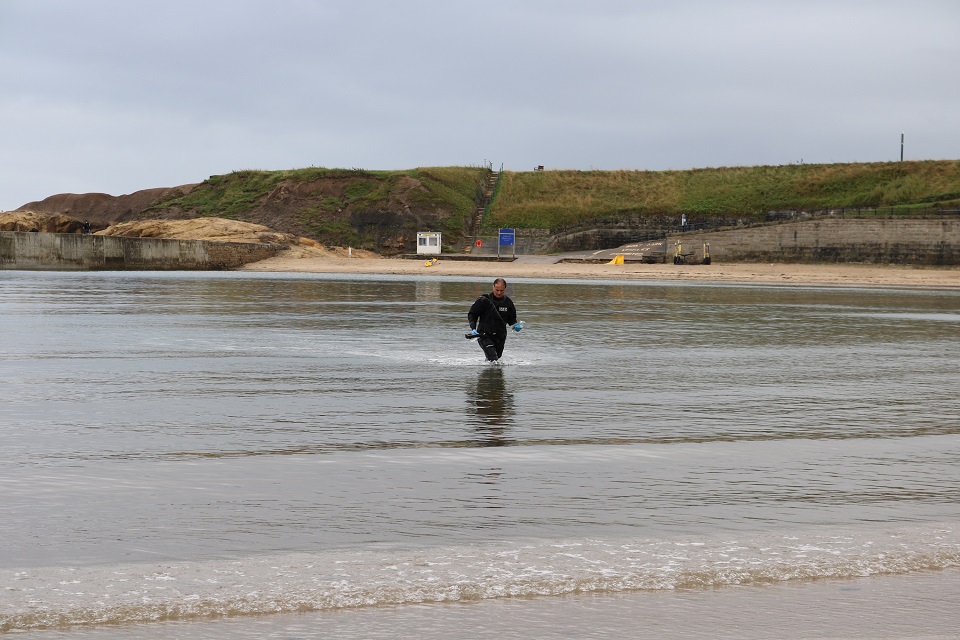
The image shows the Environment Agency's Mick Donkin collecting samples at Cullercoats
The Environment Agency’s Mick Donkin collecting samples at Cullercoats

‘Drastic improvements

The Environment Agency’s Gordon Reid, who leads on the Environment Agency’s activity in the North East, said:

The North East remains a beacon for bathing water excellence with a real success story of drastic improvements over the past 30 years. In 1988, nearly half of our bathing waters failed to meet mandatory standards, while in the most recent assessment they all passed. We’d encourage people to make the most of our wonderful coastline by getting out and enjoying it!

We work closely with our partners at local authorities and Northumbrian Water to understand what impacts on a particular bathing water’s quality and then carry out work to try to improve it, and such work has already taken place here at Cullercoats.

We remain committed to identifying all sources of pollution and a number of investigations are taking place to understand the type of bacteria in the water and where it is potentially coming from. It’s important to note that ‘sufficient’ status still means the bathing water has passed water quality standards.

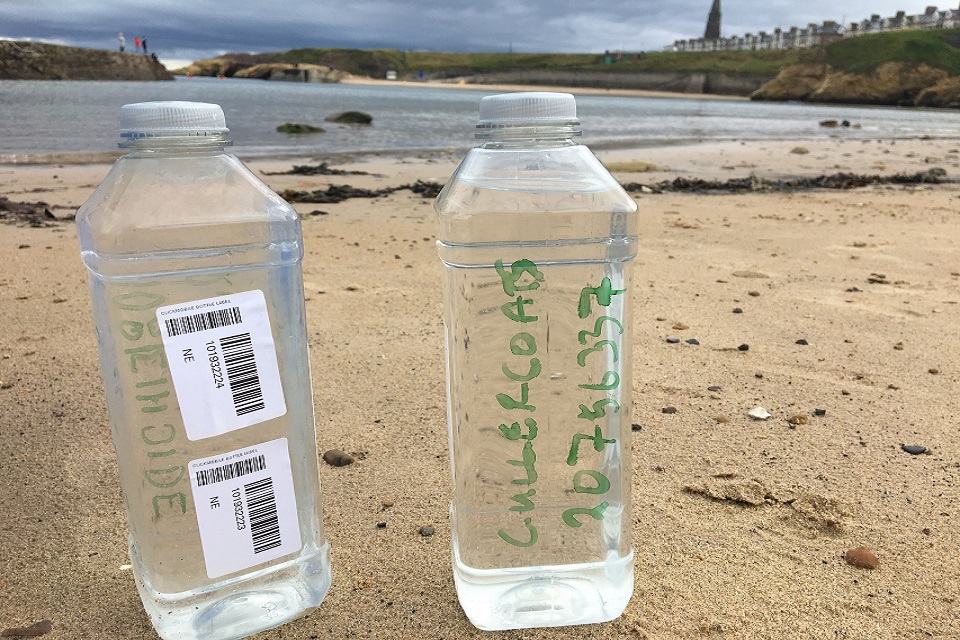
Image shows the samples collected at Cullercoats

Partnership working is important

All of the North East’s Bathing Waters passed water quality standards in the most recent assessment at the end of last year with 32 out of 34 being rated excellent or good and 2 being rated sufficient.

Compliance is based on the current and previous four years of sample data (a maximum of 80 samples per beach, from 2014 to 2017). The samples are taken by the Environment Agency between May and September each year to assess the bathing waters against the strict regulations.

Northumbrian Water’s wastewater director, Richard Warneford, said:

Looking after the environment is at the heart of what we do. We are extremely proud of the contribution we have made to protect and improve our region’s stunning coastline through both investment and partnership working and we appreciate the significant impact that beaches have on tourism, the economy and the leisure industry.

Partnership working is particularly important in understanding the issues affecting bathing water quality and to provide the improvements needed”.

Across the UK 98.3% of bathing waters tested at over 400 beaches and lakes passed tough water quality standards. Action plans are in place for all bathing waters in need of improvement.

The public have a key role to play in ensuring their local beaches are clean. They can do their bit by ensuring they #binit4beaches and take their litter home with them.

You can check for temporary warnings against bathing, or see the sampling results online

Read Mick Donkin’s blog on his role as Sampling and Collection Team Leader in the north east and his love of the north eats coast!


Link: Press release: Bathing water investigation continues
Source: Gov Press Releases

Press release: UKEF supports delivery of Rolls-Royce-powered aircraft to EL AL

The announcement comes days after the government launches its Export Strategy, setting out how the government will support businesses of all sizes to make the most of the opportunities presented by markets around the world.

International Trade Secretary, Dr Liam Fox, said:

The aerospace industry is a major driver of the UK economy and I am delighted that as we launch the government’s Export Strategy, UK Export Finance (UKEF) is backing this significant contract, which will support the continued international success of Rolls-Royce.

This delivery is part of Rolls-Royce’s contract to supply engines for 16 Boeing 787 Dreamliner aircraft for EL AL Israel Airlines – the largest single export deal the UK has had with Israel, and a marker of the strength of the trade relationship between the two countries.

British goods remain in global demand – this is the first time that UKEF has supported an aircraft delivery to EL AL and clearly shows the value of support from the UK’s award-winning export credit agency to the UK’s aerospace engineering sector.

UKEF has provided EL AL Israel Airlines with export credit support to finance the sale of a Rolls-Royce-powered Boeing 787 aircraft. This is the sixth aircraft to be delivered of a fleet of 16 Dreamliners with Rolls-Royce engines.

Dganit Palti, CFO, EL AL Israel Airlines said:

We are very delighted with the delivery of the sixth Boeing 787 Aircraft. The transaction was financed by Citibank and supported by UKEF. On the special event of Israel’s 70th independence and the company’s 70th anniversary, the aircraft’s retro livery commemorates the 70 years of EL AL’s performance as Israel’s leading Airline.

We are delighted that the UK government has chosen to support this financing as it showcases the continuing strong relationship between our two countries.

Dominic Horwood, Chief Customer Officer for Civil Aerospace at Rolls-Royce, said:

The UK Government’s support, through UK Export Finance, has played an important role in supporting this delivery for Rolls-Royce.

Citi’s Managing Director, Munawar Noorani, said:

UKEF has been at the forefront of supporting exports in innovative ways. Citi has a long-standing relationship with EL AL and we are delighted to have been selected by them for their first ever financing through UK Export Finance.

Extension of the programme is under consideration, with further support for future deliveries of Rolls-Royce-powered Boeing aircraft to EL AL.

Background

  1. UK Export Finance is the UK’s export credit agency and a government department, working alongside the Department for International Trade as an integral part of its strategy and operations.
  2. It exists to ensure that no viable UK export should fail for want of finance or insurance from the private market. It provides finance and insurance to help exporters win, fulfil and ensure they get paid for export contracts.
  3. Sectors in which UKEF has supported exports include: aerospace, construction, oil and gas, mining and metals, petrochemicals, telecommunications, and transport.
  4. UKEF has a regional network of 24 export finance managers supporting export businesses.
  5. Find UKEF’s latest country cover positions.
  6. UKEF supports exporters with a range of products that include:
  • Bond insurance policy
  • Bond support scheme
  • Buyer & supplier credit financing facility
  • Direct lending facility
  • Export insurance policy
  • Export refinancing facility
  • Export working capital scheme
  • Letter of credit guarantee scheme

Rolls-Royce

Rolls-Royce powered the very first Boeing 787 test flight in December 2009, the first 787-8 to enter service in October 2011, and the first 787-9 to enter service, in 2014. Rolls-Royce is the only engine manufacturer on the 787 to be supported by UKEF.

Media enquiries: Claire Lynch, Media Relations Officer

Link: Press release: UKEF supports delivery of Rolls-Royce-powered aircraft to EL AL
Source: Gov Press Releases

Press release: Commission announces class investigation into independent school charities

The Charity Commission, the independent regulator of charities in England and Wales, has opened a class statutory inquiry into The Martin Foundation (registered charity number 1110184), and The Collegiate Charitable Foundation (registered charity number 1012924). The inquiry was opened on 22 January 2018.

The charities provide bursaries to enable students to attend independent primary and secondary schools; provide advertising, facilities and equipment for the schools, and assist the local community, however The Martin Foundation is not currently carrying out any activity.

After receiving a complaint from the public and information from other regulators the Commission engaged with the charities in respect of a number of regulatory concerns. Our engagement established that there were clear and ongoing serious regulatory issues relating to the administration of the charities by the trustees. These included the management of conflicts of interest, protecting and properly accounting for the charities’ assets, and potential unauthorised trustee benefit.

The inquiry is examining:

  • The extent to which potential conflicts of interest and connected party transactions have been properly managed
  • The extent to which there has been any unauthorised trustee benefit
  • Whether the charities operated for exclusively charitable purposes

In order to protect the assets of the charities, the Commission has issued orders to the trustees and the charities’ bank under section 76(3) of the Charities Act 2011. These are temporary orders and will be reviewed on a regular basis in line with normal procedures.

Due to the seriousness of its regulatory concerns the Commission also appointed Geoff Carton-Kelly and Tom McLennan of FRP Advisory as joint interim managers of the charities on 13 August 2018.

The interim managers are appointed with all the powers and duties of trustees and will act to the exclusion of the current charity trustees. These are temporary appointments and will be reviewed on a regular basis in line with normal procedures.

It is the Commission’s policy, after it has concluded an inquiry, to publish a report detailing what issues the inquiry looked at, what actions were undertaken as part of the inquiry and what the outcomes were. Reports of previous inquiries by the Commission are available on GOV.UK.

Notes to Editors

  1. The Charity Commission is the regulator of charities in England and Wales. To find out more about our work see the about us page on GOV.UK.
  2. Search for charities on our check charity tool.
  3. Section 46 of the Charities Act 2011 gives the Commission the power to institute inquiries. The opening of an inquiry gives the Commission access to a range of investigative, protective and remedial legal powers.
  4. The Interim Manager appointment is a temporary and protective power that will be reviewed at regular intervals. It will continue until the Commission makes a further Order for its variation or discharge.

Press office

Link: Press release: Commission announces class investigation into independent school charities
Source: Gov Press Releases