
Press release: Further consultation launched on proposed changes to A303 Stonehenge upgrade

Taking on feedback from a consultation earlier this year Highways England has adjusted some of the design detail of the planned £1.6bn scheme which will improve journeys on the busy route and create a much-needed bypass for Winterbourne Stoke while preserving the Outstanding Universal Value of the World Heritage Site.

The changes, which seek to further enhance the famous landscape and reconnect the two halves of the 6,500-acre World Heritage site (WHS), include:

  • removing the previously proposed link between Byways 11 and 12 in the Stonehenge WHS to avoid affecting the setting of the Normanton Down barrow group and tranquillity of the site in this area
  • widening the green bridge proposed near the existing Longbarrow roundabout to improve the physical and visual connection between the northern and southern parts of the WHS
  • moving the proposed modification of Rollestone crossroads to provide a more compact layout

Derek Parody, Highways England Project Director for the A303 Stonehenge scheme, said:

We had a great response to our earlier consultation and have acted on the feedback. We now want to get people’s views on our proposed changes to our original consultation.

The further feedback we get will allow us to make sure we have got the best scheme before we make our application later this year to build the scheme.

Meanwhile we continue to work with heritage groups including Historic England, English Heritage, the National Trust, and experts in the field, including the Stonehenge Scientific Committee – a body of leading independent archaeologists – to ensure a new route is built sensitively to the World Heritage site.

Highways England received more than 5,000 responses to consultation on improving the A303 route past Stonehenge, between Amesbury and Berwick Down, which includes a tunnel at least 1.8 miles long, a free-flowing dual carriageway and a much-needed bypass north of Winterbourne Stoke.

Consultation will run from 17 July to 14 August, with two public information events (details available on the consultation page).

During the consultation, Highways England will also clarify its public rights of way proposals accompanying the scheme, which will help people explore and enjoy the World Heritage site and enable them to walk or cycle unobstructed between Amesbury and Winterbourne Stoke.

As part of its £15 billion road strategy – the biggest investment in roads in a generation – the Government is committed to upgrading all remaining single carriageway sections of the A303/A358 between the M3 and M5 to dual carriageway standard.

The A303 at Stonehenge, the A303 between Sparkford and Ilchester, and the A358 between the M5 Taunton and the Southfields Roundabout on the A303 are the first three schemes in that strategy.

The A303 Stonehenge upgrade will deliver major benefits to the World Heritage Site by reuniting the landscape and restoring tranquillity to the setting of one of our most famous cultural icons. At the heart of many of Highways England’s proposed refinements to the scheme is the protection of the WHS and its Outstanding Universal Value.

The scheme will also support a major boost to the South West economy, currently lagging 24% behind the national economy, by providing an effective transport link, and reducing the traffic blight on local communities.

Further details of the proposed changes will be available during the supplementary consultation and in the meantime, anyone wanting further information on the scheme or anyone who wants to respond to the consultation visit the consultation page or the scheme web page, where they can sign up for updates about the scheme.

General enquiries

Members of the public should contact the Highways England customer contact centre on 0300 123 5000.

Media enquiries

Journalists should contact the Highways England press office on 0844 693 1448 and use the menu to speak to the most appropriate press officer.

Link: Press release: Further consultation launched on proposed changes to A303 Stonehenge upgrade
Source: Gov Press Releases
Press release: £1m culvert repair work to reduce flood risk set to begin

The £1million culvert repair project is due to start on Monday 23 July and is expected to take 13 weeks to complete.

Environment Agency contractors, JBA Bentley, will be on site to carry out the work in the Lancashire town to make Victoria Clough culvert structurally sound.

Culverts are structures which carry water underground. They were often built to allow development to take place around them such as roads, homes and businesses. Many people live and work near culverts and may not even know they are there.

A new culvert will be installed beneath the disused railway embankment to replace the existing one which has collapsed. The team will also re-line or replace a number of sections along the length of the culvert at locations under Victoria Road and the A56 Skipton Road.

A new and improved trash screen will also be fixed at the inlet of the culvert, to help reduce the risk of it becoming blocked with debris and making it easier and safer to clear when water levels are high.

During the period of work there will be disruption to traffic using the A56 and Victoria Road. There will need to be road closures on Valley Road and New Road with local diversions and temporary traffic lights put in place, and some parking restrictions on Victoria Road.

Paul Swales flood risk advisor at the Environment Agency said:

Earby has suffered devastating flooding over recent years, most notably the Boxing Day 2015 flood. We’re pleased to be starting this repair work which will bring significant flood risk benefits to homes and businesses.

We understand that this traffic management could cause some inconvenience so we will do all we can to minimise this disruption as much as possible. We’d like to thank residents and businesses for their patience and understanding while we carry out this essential work to reduce flood risk.

Funding for the project comes from £813k of Grant in Aid and £200k of Yorkshire Local Levy.

Since the floods of Boxing Day 2015, the Environment Agency has worked in partnership with Pendle Borough Council, Lancashire County Council and Yorkshire Water to develop schemes to reduce flood risk in Earby.

Options explored

The Environment Agency continues to explore other options to reduce flood risk from all sources in and around Earby. Over the next 12 months, the team will investigate the options in more detail, which include flood storage areas on Earby Beck, the New Cut and Victoria Clough and installing a flood defence wall at Boot Street.

The Environment Agency is looking for volunteer flood wardens to play a key part in keeping Earby prepared and informed before, during and after a flood. Anyone interested in becoming a flood warden can email heather.cottrill@environment-agency.gov.uk to find out more.

By signing up to the Environment Agency’s free Flood Warning service residents and businesses can receive flood alerts and flood warnings for Earby Beck and/or Earby New Cut directly to their phone and emails, 24/7. Find out if you’re at risk and register for free flood warnings.

Link: Press release: £1m culvert repair work to reduce flood risk set to begin
Source: Gov Press Releases

Press release: Coventry rapist has sentence increased after Solicitor General’s referral

A man who sexually abused a severely autistic person has today had his sentence increased after the Solicitor General, Robert Buckland QC MP, referred his sentence to the Court of Appeal for being too low.

Alex Jordan Waddoups, now aged 24, anally raped a severely autistic person on multiple occasions. He made threats against the victim and their family if they were to tell anyone what had happened.

Waddoups was originally sentenced at Warwick Crown Court in April, where he was given 7 years’ imprisonment, ordered to sign the sexual offenders register for life, and had to pay a £120 victim surcharge. Today, after the Solicitor General’s referral, the Court of Appeal increased his sentence to 10 years’ imprisonment.

Commenting on the sentence increase, the Solicitor General said:

“Waddoups targeted a vulnerable individual he knew he could dominate both physically and mentally. While it is important to recognise the mental health of the offender, we cannot let this distort our judgement when it comes to protecting members of the public, and as such I am pleased that the Court of Appeal has agreed with my referral.”

Link: Press release: Coventry rapist has sentence increased after Solicitor General’s referral
Source: Gov Press Releases

Press release: Environment Agency warns of illegal waste being dumped empty commercial units

Empty industrial units across the country are being targeted by waste criminals to dispose of thousands of tonnes of illegal waste.

The growing trend sees criminals pose as legitimate tenants to rent properties used to store illegal waste. Once discovered, landlords, property managers and farmers are burdened with thousands of pounds in clear up costs and face possible criminal prosecution, fines and even custodial sentences for failure to operate without an environmental permit.

The waste, mainly made up of potentially hazardous materials, poses a serious pollution and fire risk and undermines legitimate business.

With hundreds of commercial properties across the country thought to be empty, the Environment Agency is calling for landlords to be extra vigilant when letting out their properties. The regulator is also calling on businesses, organisations and individuals to manage their waste responsibly to prevent it from getting into criminal hands in the first place.

During the period Dec 2016 – Nov 2017 the Environment Agency investigated the dumping of 18,244 bales of waste – each bale being approximately 1 ton. It’s estimated that at a low end price of £70 per bale this would amount to £1,277,000 for correct deposal of the waste.

The Environment Agency reveals the top four land types which are most susceptible to illegal dumping. The land type descriptions key dump sites are:

  • Farms 34%
  • Industrial Unit 24%
  • Abandoned factory 10%
  • Derelict site 7%

Nicky Lawton, Deputy Director – National Enforcement Service, said:

Unsuspecting landlords and property managers are failing foul of waste criminals and as a result are being made to pick up hefty bills to clear up the waste – often running into the hundreds of thousands of pounds.

Landlords can avoid this by carrying out checks to prospective tenants to ensure their sites will not be used as part of an illegal waste operation.

Waste crime, which costs the economy £604 million a year, is a serious problem that we’re using all our available resources and powers to curb.

Landlords and property managers are urged to take the following steps to avoid being a victim of waste crime:

  • Carry out rigorous checks on prospective new tenants.
  • Check any empty land and property regularly and make sure it is secure.
  • It is illegal to store waste on your land without the required permits. You may be committing an offence by allowing waste to be stored on your land or property without the relevant permissions and you could be liable to prosecution and the cost of removing the waste.
  • Landlords should check before signing a contract that the contract complies with regulations. You can view whether a potential tenant holds the correct permit to carry out waste operations at public register
  • The offer of payment to temporarily store waste is a scam, the waste will likely never be collected.
  • Be vigilant and report any unusual behaviour. If you are suspicious of prospective tenants please contact us for more information and advice.
  • If you are approached to store baled waste, even on a short term basis, refuse the material and call Crimestoppers anonymously on 0800 555 111.

The Environment Agency’s Prevention & Disruption teams are working hard to address waste crime, exercising new regulatory powers to lock up and block access to illegal waste sites.

Link: Press release: Environment Agency warns of illegal waste being dumped empty commercial units
Source: Environment Agency

Press release: Brand new x-ray technology set for production in the UK

Developed by the Defence, Science and Technology Laboratory (Dstl), the new technology produces higher resolution images while simplifying product design.

The first product to take advantage of the new technology will be the Axi-Tek CSI-100 which will make the inspection of aircraft components quicker and easier due to its reduced size and weight. Future products will cater for applications as wide-ranging as factory in-line and in-field industrial inspection, to security and bomb disposal.

The new technology improves the mechanism used to control an x-ray beam. Called a collimator, just as a lens focuses light, a collimator directs and filters x-rays to ensure objects are correctly illuminated. This novel design of collimator is much lighter, provides a more consistent beam, and is mechanically simpler to implement.

The CSI-100 will use the advanced technique of detecting reflected x-rays (backscatter) to image objects. This has the advantage that access to only one side of an object is required, allowing operators to inspect, identify and verify the internal structure and contents without needing access to all sides or needing to move it.

Nick Fox, Managing Director of Axi-Tek commented:

We are excited to have secured this novel technology as it now paves the way for a new line of portable backscatter x-ray imaging products. We expect to see the first CSI-100 available to the aviation industry in quarter 4 next year, with specialist security variants coming online early the following year.

Ploughshare’s CEO, James Kirby, added:

This licence deal with Aki-Tek further demonstrates how Ploughshare maximises the investments Dstl has made in Science & Technology by taking defence innovations and finding commercial uses for them. Aki-Tek’s unique products will benefit their operators, assist with the public’s safety and security, and also create jobs and prosperity.

The technology will be suitable for the inspection of carbon fibre aircraft wings where it can detect impact damage hidden deep in a wing structure. The CSI-100 will initially be tailored for this non-destructive inspection application for both reinforced carbon and glass fibre components in aircraft structures.

It could also be used in the security industry and will allow operators to quickly investigate the contents of objects and suspicious packages.

Initially funded by a grant from Innovate UK, the CSI-100 is based on more than three years of collaborative research with a team from Axi-Tek, University College London, QinetiQ and Rolls-Royce.

About Axi-Tek Limited

Axi-Tek is a UK based specialist SME working in the field of the development of hi-tech x-ray solutions for the industrial and security sectors. Since its formation in 2013, the highly experienced team at Axi-Tek have work in close collaboration with both industrial and academic partners to identify and commercialise emerging technologies taking them from the laboratory to the market place. Exploitation of the resultant products is either through Axi-Tek’s sister company, Metrix NDT Limited, or where direct 3rd party commercial sponsorship has been provided, exploited by Axi-Tek’s clients.

Email: n.fox@axi-tek.com or n.fox@metrixndt.com

About Ploughshare Innovations

Ploughshare Innovations is the technology transfer organisation for the UK Ministry of Defence (MOD). It turns ‘swords into ploughshares’ by enabling businesses to gain access to defence and security technology developed by leading government laboratories. Ploughshare ensures Government technology is put to good use and benefits the UK, society as a whole, and humanity by applying innovative technology to improve people’s lives. Since its creation in 2005, the company has licensed 125 technologies and attracted £140 million of investment.

Email info@ploughshareinnovations.com

Link: Press release: Brand new x-ray technology set for production in the UK
Source: Gov Press Releases

Press release: Milestone for managing seas in South of England reached

The Government has now adopted England’s South Marine Plan, which brings a new approach to managing the seas between Kent and Devon.

The new marine plan provides a policy framework which will be used to help inform decision-making on what activities take place in the marine environment and where how the marine environment is developed, protected and improved in the next 20 years. It will inform and guide decisions by regulators managing the development of industry in marine and coastal areas, while conserving and enhancing the environment and recognising leisure uses.

The marine plan, produced by the Marine Management Organisation (MMO) on behalf of the Department for Environment, Food and Rural Affairs, is the culmination of around 5 years of engagement with business, charities, representative organisations and individuals.

The plan will help business realise the economic benefits available from the Marine Plan area whilst ensuring the marine environment remains protected. Covering an area of approximately 1,700 kilometres of coastline and over 21,000 square kilometres of sea, the plan stretches from Felixstowe in Kent to the River Dart in Devon. This is a very dynamic marine area incorporating 9 world heritage sites and some of the busiest shipping channels in Europe.

The MMO is now working with Local Authorities in the area to ensure successful implementation of the new Plan.

Environment Minister Thérèse Coffey said:

The South Marine Plan is a significant milestone in our ambition to create healthy and biologically diverse seas and oceans, as outlined in our 25 Year Environment Plan.

Stretching from Kent to Devon, this is one of the most complex areas of the English coast and this plan will allow us to safeguard our sea life while supporting a more sustainable marine economy.

John Tuckett, Chief Executive Officer at the Marine Management Organisation, said:

This is a significant milestone for one of the most complex and used areas of the English coastline.

The South Marine Plan will help ensure that when activities take place, they happen in the best location and in the right way within the marine environment. We are now working closely with decision makers and stakeholders along the coast to ensure that the Plan is understood and used effectively.

By 2021 all English marine area will have marine plans in place. The South Marine Plan is the second to be adopted following the introduction of the first English marine plan established in the East of England in 2014.

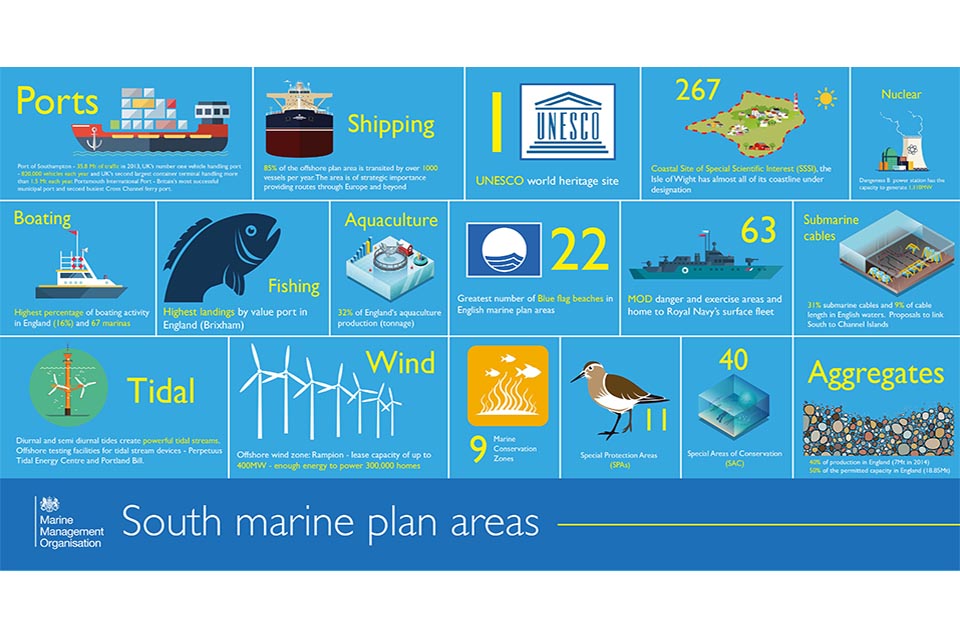
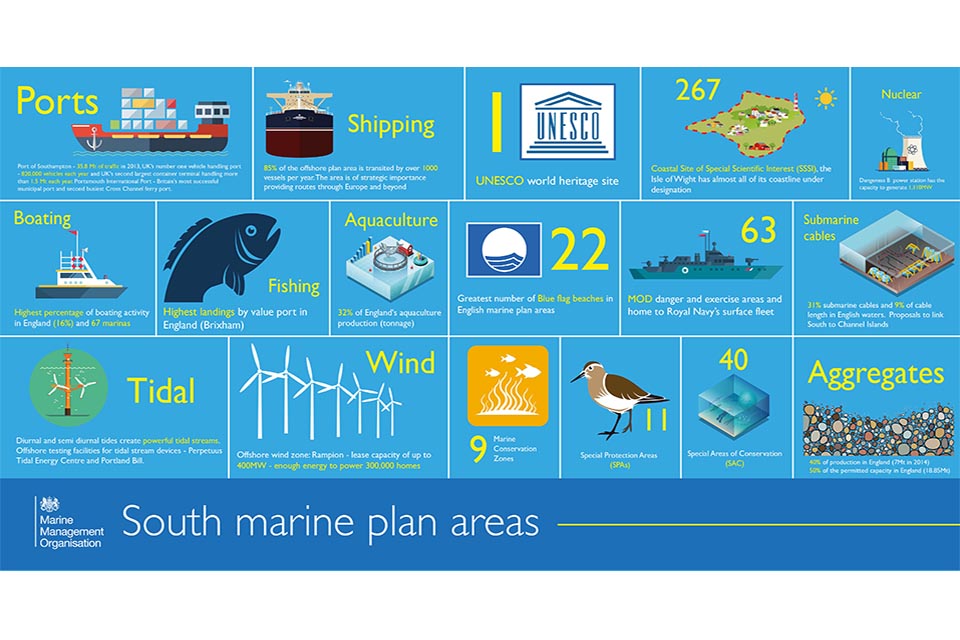
South marine plan infographic

Notes to editors

short animation film to explain marine planning

Further background on marine planning:

  • There are 11 English marine plan areas, including inshore and offshore areas. Work continues to produce plans for the South East, South West, North East and North West, the target for adoption of the remaining plans is before March 2021.
  • Marine planning addresses the key issues for the marine area, including the coast, estuaries and tidal waters, as well as developments that impact on these areas. The plans will include a vision, objectives and detailed policies on how these objectives will be achieved.
  • Marine plans are used by public authorities as part of the decision making process for all new activities and developments in or affecting the marine area.
  • Marine plans build on the requirements of the Marine and Coastal Access Act and the Marine Policy Statement.

More information on marine plans is available elsewhere on GOV.UK

How will marine plans be used?

The plan is brought into effect through its use in decision-making. All public bodies are legally required to make all authorisation and enforcement decisions which are likely to affect the marine areas in accordance with marine plans, unless an exception states otherwise.

Such decisions vary widely and include The Crown Estate leasing the seabed for renewable energy, Environment Agency permitting of flood and coastal defence works and water discharges, Local Planning Authorities (LPAs) determining planning permissions, to Inshore Fisheries and Conservation Authorities (IFCAs) making fisheries byelaws.

The MMO will implement the adopted marine plans across all decision-making functions, including:

  • Marine licensing
  • Marine compliance and enforcement
  • Fisheries management and effort control
  • European Fisheries Funding
  • Coastal operations

The MMO is working to support other relevant authorities to adopt/implement the South Marine Plan in their decision-making processes.

The plans aren’t an enforcement tool as such, more a policy framework for the future use of the sea. (It’s not a law change in that people aren’t being expected to change currently occurring activity to comply with the plan.)

Will the plans result in activities being banned?

The plans are not a list of prohibited activities, but a strategic vision for the sustainable use of shared marine environment seeking to maximise opportunity and encouraging co-existence between many differing marine activities.


Link: Press release: Milestone for managing seas in South of England reached
Source: Gov Press Releases