
Committees on Arms Export Controls looks at the UK’s arms export licensing process
Link: Amnesty International, Oxfam and Saferworld give evidence on arms exports
Source: Parliamentary News
Committees on Arms Export Controls looks at the UK’s arms export licensing process
Link: Amnesty International, Oxfam and Saferworld give evidence on arms exports
Source: Parliamentary News
The Environment Agency is reminding anglers of the importance of having a rod licence after successfully prosecuting fourteen men last month.
The anglers were caught committing the offences in 14 separate incidents across the North East in July, August and September last year, including three in Hexham, and one each in Bellingham, Harlow Hill and Wylam. They received combined fines of £3,749, including £1,784 in costs and £300 victim surcharge. All pleaded guilty with the exception of two who were found guilty in their absence.
Rachael Caldwell, Enforcement Team Leader at the Environment Agency, said:
We’ve started the year as we mean to go on – taking strong action against illegal fishing.
The majority of anglers fish legally and purchase a rod licence. Those that don’t are cheating their fellow anglers and endangering the future of the sport. In addition rod licence cheats risk a criminal conviction, a significant fine and could lose their fishing equipment.
The Environment Agency carries out enforcement work all year round. Fisheries enforcement work is intelligence-led, targeting known hot-spots and where illegal fishing is reported.
All income from rod licence sales is used to fund Environment Agency work to protect and improve fish stocks and fisheries, including improving habitats for fish and facilities for anglers, tackling illegal fishing and working with partners to encourage people to give fishing a go.
Buying a rod licence is quick and easy – you can buy them online at Gov.uk.
Anyone witnessing illegal fishing incidents in progress can report it directly to the Environment Agency hotline on 0800 80 70 60. Information on illegal fishing and environmental crime can also be reported anonymously to Crime stoppers on 0800 555 111.
Link: Press release: Fourteen men fined for fishing without a licence
Source: Gov Press Releases
The Information Commissioner’s Office has executed a search warrant as part of an investigation into a person suspected of posing as an ICO officer to commit criminal offences.
Link: ICO executes search warrant at home of suspected ‘imposter’ who wanted exam results altered
Source: ICO .org.uk
This Order makes provision in connection with the trade restrictions against North Korea specified in Council Regulation (EU) No 2017/1509 of 30 August 2017, as last amended by Council Implementing Regulation (EU) No 2018/87 of 22 January 2018 (OJ No. LI 16I, 22.01.2018, p.1) (“the North Korea Regulation”). This Order revokes articles 4 to 16 of the Export Control (North Korea Sanctions and Iran, Ivory Coast and Syria Amendment) Order 2017 (S.I. 2017/83).
Link: The Export Control (North Korea Sanctions) Order 2018
Source: Legislation .gov.uk
Link: The Wales Act 2014, Sections 16 and 19 (Disapplication of UK Stamp Duty Land Tax and UK Landfill Tax) (Appointed Date) Order 2018
Source: Legislation .gov.uk
Defence Committee questions Gavin Williamson MP on the Modernising Defence Programme
Link: Secretary of State questioned on departmental priorities
Source: Parliamentary News
These Regulations amend regulation 61 of the Financial Services and Markets Act 2000 (Benchmarks) Regulations 2018 (S.I. 2018/135) (“the 2018 Regulations”). The 2018 Regulations implement parts of Regulation (EU) No 2016/1011 of the European Parliament and of the Council of 8 June 2016 on indices used as benchmarks in financial instruments and financial contracts or to measure the performance of investment funds (OJ L171, 29/06/2016 p.1) and amending Directive 2008/48/EC (OJ L133, 22/05/2008 p.66) and 2014/17/EU and Regulation (EU) No 596/2015 (OJ L173 12/06/2014 p.1).
Link: The Financial Services and Markets Act 2000 (Benchmarks) (Amendment) Regulations 2018
Source: Legislation .gov.uk
This Order is made by the Welsh Ministers and makes amendment to the Regulation of Investigatory Powers (Directed Surveillance and Covert Human Intelligence Sources) Order 2010 (“the Principal Order”).
Mae’r Gorchymyn hwn wedi ei wneud gan Weinidogion Cymru ac mae’n diwygio Gorchymyn Rheoleiddio Pwerau Ymchwilio (Gwyliadwriaeth Gyfeiriedig a Ffynonellau Cuddwybodaeth Ddynol) 2010 (“y Prif Orchymyn”).
Link:
Source: Legislation .gov.uk
The Ordnance Survey’s use of cutting edge satellite imagery and digital data collection to map over 200,000 miles of England’s farmland and the CROPROTECT app which helps farmers protect crops from pests, weeds and diseases are among the technological innovations improving farming and food production that were hailed today (21 February 2018) in a speech by Business Secretary Greg Clark as he set out his ambition for a revolution in agri-farming, as part of the government’s Industrial Strategy.
In a keynote speech to the National Farmers’ Union conference, the Business Secretary highlighted how new technology is boosting farmers’ earning power and making agri-businesses more productive and profitable than ever before.
To make it easier for farmers and agricultural supply-chain businesses to embrace technology and innovation, Mr Clark today announced £90 million of new funding to bring together the UK’s world-class agri-food sector with expertise in robotics, AI and data science.
The funding, delivered as part of the new the Industrial Strategy Challenge Fund, will make it easier for food and agri-business to embrace technology and innovation that will be critical to meeting the increasing food demands of a growing population, fuel rural growth and create high-skilled jobs.
Business Secretary Greg Clark said:
As someone who has known all my life that farming is foundational not just to our economy, but to our country. Providing the food and drink we live on and stewarding the countryside that is so much part of our national and local identity means there is no more essential industry.
The agricultural sector is the biggest industrial sector in the UK, Employing almost 4 million people and larger than the automotive and aerospace sectors combined.
For your unique role in stewardship and in feeding the nation like big industry, you need to be profitable and we need to help make the conditions right for investment in the future.
With the technological revolution that is happening, the skills of the farming workforce need to keep pace. New technologies require new abilities and today’s modern British farmer is a Swiss-Army-Knife of skills. An engineer, an environmentalist, a data scientist a biochemist, an energy producer, a tourism entrepreneur, and an investor too.
As part of the Industrial Strategy, we announced a Transforming Food Production Challenge and I’m delighted to announce the government will invest £90 million to make this challenge a reality.
This will include the creation of ‘Translation Hubs’ bringing together farmers and growers businesses, scientists and Centres for Agricultural Innovation to apply the latest research to farming practice.
Today’s investment forms part of the government’s Industrial Strategy which sets out a long term plan to boost the productivity and earning power of people throughout the UK. Through this strategy government is working with industry to help businesses create better, higher-paying jobs as well as setting a path for Britain to lead in the high-tech, highly-skilled industries of the future.
The announcement follows the government committing, through the Industrial Strategy, to raise public and private investment in UK research and development to 2.4% of GDP by 2027. This will be the UK’s biggest ever increase in research and development investment and help to make Britain’s economy the most innovative in the world.
Government investment will help build on the strengths of the UK’s booming agri-food sector, which employs around 4 million people across the UK, and support it by:
UK farmers, agri-tech companies and research centres are already leading the way in this area, using technology like data, robotics and AI to help create new technologies and herald innovative new approaches, including:
The funding forms 1 of 8 key areas that the government, together with business and academia, has identified through the Industrial Strategy Challenge Fund (ISCF), as being priority areas where research and innovation can help unlock markets and industries of the future in which the UK can become world-leading.
In the Industrial Strategy white paper, the government announced £725 million of investment through the fund in cutting-edge technologies to create jobs and raise living standards.
Other areas set to receive government support through the ISCF in 2018 to 2019 includes early diagnosis and precision medicine to help detect life-changing diseases earlier, new products and services that support older people in the UK to remain active and independent, and new smart energy systems that deliver cleaner, cheaper energy for consumers and their communities.
UK Research and Innovation (UKRI) will shortly open a new expressions of interest call for more industry-led challenges that will form part of the next wave of the ISCF.
This third wave of programmes will invest in further ground-breaking ideas to tackle our major industrial and societal challenges, boost our productivity and delivery economic growth.
Professor Sir Mark Walport, Chief Executive of UKRI, which is responsible for the ISCF said:
Developing and effectively utilising the latest technologies and research methods will revolutionise the way we produce our food. Right across the agricultural sector, we can make the process more efficient, more productive and more sustainable to deliver benefits for growers, producers and consumers. This is precisely why the ISCF was created.
We are now launching the process for businesses and researchers alike to come together to identify both pressing problems in food production and farming and opportunities that could benefit from the next wave of ISCF funding. I want to strongly encourage everyone in the sector to respond to our call for expressions of interest.
Link: Press release: Business Secretary calls for new tech revolution in agriculture
Source: Gov Press Releases
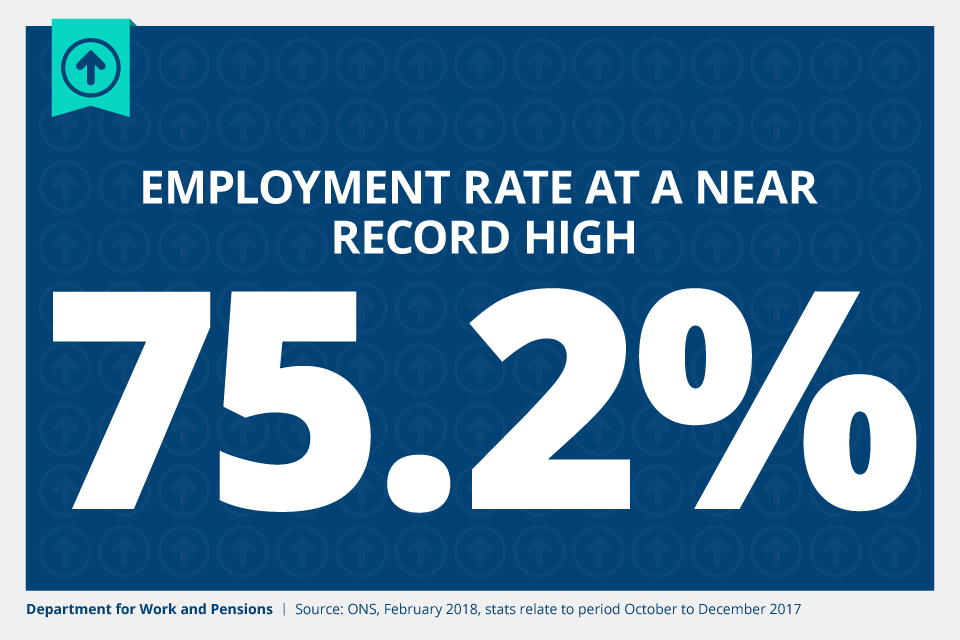
Today’s figures also show that groups across society are accessing new job opportunities:
Minister for Employment Alok Sharma said:
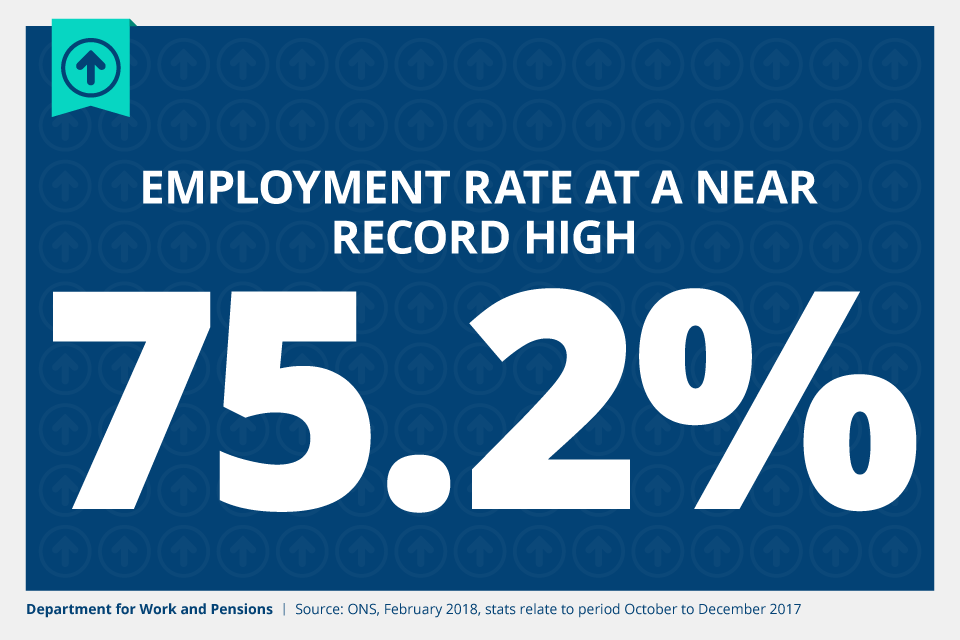
High employment rates are a reliable feature of today’s economy – and this is an incredible achievement. It is equally important that across society everyone has the opportunity to get a good job and get on in life.
Today’s figures show that this government is building a fairer economy that supports people from all backgrounds to get into work. We are closing the BAME and gender employment gaps, and people across the country are accessing new opportunities.
Separate figures out today showed that 730,000 people are now on Universal Credit. Of these, 40% were in employment (290,000).
Read the Labour Market Statistics – February 2017 from the Office for National Statistics.
Caxton House
Tothill Street
London
SW1H 9NA
London Press Office (national media and London area enquiries only – not questions about personal claims)
020 3267 5144
Out-of-hours (journalists only)
076 59 108 883
England and Wales (local media enquiries)
029 20 586 then 097 or 098 or 099
Scotland (local media enquiries)
0131 310 1122
Follow DWP on:
Link: Press release: Employment remains at near-record high
Source: Gov Press Releases