
Press release: Environment Secretary streamlines support for farmers

Support for farmers will be simplified under plans announced by Environment Secretary Michael Gove today, with the country’s decision to leave the EU providing a once in a lifetime opportunity to refocus how we support farmers and landowners.

Speaking at the Country Land and Business Association’s (CLA) annual Rural Business Conference, the Secretary of State set out how Defra will make practical and pragmatic changes to existing farm support systems, streamlining the process to free up farmers to focus on what they do best.

Speaking after the conference, Environment Secretary Michael Gove said:

Today I have set out plans to improve our current schemes, starting with simplifying support for farmers to protect and enhance our landscapes and countryside.

But these measures are just the beginning – the first steps towards a simplified system of support. Over the coming weeks and months, we’ll be working closely with our farmers to make sure we listen to what they want as we design a new approach and realise our vision for the future of UK food and farming outside the EU.

Acknowledging the daily challenge farmers face within the EU’s burdensome Common Agricultural Policy (CAP), the Secretary of State said the current system of farm support is inefficient, ineffective, inequitable, and environmentally harmful. He outlined the need to change the way we invest in our countryside so farmers can more readily access support to protect wildlife, enhance the environment and improve land use.

As a first step, the Environment Secretary announced simplifications to the Countryside Stewardship scheme through the creation of four new streamlined offers which will launch in January next year. These new offers will have a much simpler application process – half as much paperwork as before – so it will be easier for farmers and land managers to apply and deliver environmental benefits on their land. Further details on this will be shared later this week.

CLA President Tim Breitmeyer said:

Farmers and landowners want to continue providing the country with high quality, affordable food while protecting the environment and supporting wildlife. We welcome the Secretary of State’s commitment to streamlining and focusing support into the areas most needed, and we look forward to working with him to drive up participation in crucial schemes to protect and enhance landscapes and the environment.

Jenna Hegarty, Head of Land Use Policy at RSPB said:

We welcome the Secretary of State’s ambition to make Countryside Stewardship more effective, which will allow more farmers to help wildlife on their land. This is a crucial step towards realising his aim to refocus agriculture policy to provide clear benefits for people, nature and the future of farming.

The Secretary of State also spoke about the opportunities for UK farmers and food producers to take advantage of changing consumer tastes and reap the rewards of quality and provenance in production. He celebrated measures set out in the government’s Industrial Strategy to work towards a food and drink sector deal and announced further support including a further £45 million top up to the RDPE Growth Programme to help rural business development, food processing and rural infrastructure projects.

The government will look to publish an Agriculture Bill in 2018 and will consult with all those who have an interest in the success of the UK food and farming industry in the New Year.

We have already pledged to match the support farmers currently receive from the CAP until the end of this parliament and set out the intention to go on supporting farmers where the environmental benefits of that spending are clear.

Link: Press release: Environment Secretary streamlines support for farmers
Source: Gov Press Releases
Press release: MHRA reclassifies Viagra Connect tablets to a Pharmacy medicine

The Medicines and Healthcare products Regulatory Agency (MHRA) has today announced Viagra Connect (containing sildenafil 50mg) will be formally classified from a prescription only medicine (POM) to a pharmacy medicine (P). This means it could be available without prescription for use by men over 18 who have erectile dysfunction.

This decision was made following a reassuring assessment of the safety of the Viagra Connect, advice from the Commission on Human Medicines, and a public consultation earlier this year with positive outcome.

If marketed, the medicine will be sold from pharmacies following a discussion with the pharmacist. Pharmacists will be able to determine whether treatment is appropriate for the patient and can give advice on erectile dysfunction, usage of the medicine, potential side effects, and if further consultation with a general practitioner is required.

Viagra Connect will not be sold to those with severe cardiovascular disorders; at high cardiovascular risk; liver failure; severe kidney failure; or taking certain interacting medicines. Use of Viagra Connect in these groups of men must continue to be under the supervision of a doctor.

Making this medication more widely available will help direct men who might not otherwise seek help into the healthcare system and away from the risks that come with buying medicines from websites operating illegally.

Erectile dysfunction medicines are a popular target for criminals selling unlicensed and counterfeit medicines. Over the past 5 years, investigators from MHRA have seized more than £50 million of unlicensed and counterfeit erectile dysfunction medicines.

Mick Foy, MHRA’s Group Manager in Vigilance and Risk Management of Medicines, said:

This decision is good news for men’s health. The move to make Viagra Connect more widely accessible will encourage men to seek help within the healthcare system and increase awareness of erectile dysfunction.

Erectile dysfunction can be a debilitating condition, so it’s important men feel they have fast access to quality and legitimate care, and do not feel they need to turn to counterfeit online supplies which could have potentially serious side effects.

Media enquiries

News centre
MHRA

151 Buckingham Palace Road

Victoria
London
SW1W 9SZ

Office hours are Monday to Friday, 8:30am to 5pm. For real-time updates including the latest press releases and news statements, see our Twitter channel at https://www.twitter.com/mhrapress

Link: Press release: MHRA reclassifies Viagra Connect tablets to a Pharmacy medicine
Source: Gov Press Releases

Press release: People of Mytholmroyd can vote on design of flood wall

People living in Mytholmroyd are being urged to vote on which wall finish they would prefer as part of the new £30m flood alleviation scheme in their village.

Information leaflets about the consultation on the section of wall between Caldene Avenue Bridge and Whitehouses are being delivered to around 2,000 households along with a token they can use to choose which of 2 design options they prefer.

Sample panels of the 2 stone wall finishes have been built by stone masons for residents to view in the carpark outside Mytholmroyd community centre.

Boxes will be placed at the local post office and community centre in the village for people to post their token to indicate their choice.

The 2 alternative finishes were put together following discussions with a landscape group, made up of local residents and interested parties, helping to shape the scheme.

Helen Batt explains why residents are being consulted

Helen Batt, Environment Agency director for the flood schemes in the Calderdale area, said:

Our project team has worked closely with the landscape stakeholder group and architects to come up with these two designs following feedback that residents would prefer us to use natural, traditional materials which are in keeping with the local environment. We thought it would be good to let the whole village choose between the two options and have a say on the final design.

The consultation will run from Monday 4 December to Sunday 10 December. Three drop-in sessions are being held at Mytholmroyd community centre during the consultation for residents to talk to the project team. The sessions are planned for Monday 4, Wednesday 6 and Thursday 7 December, between 3pm and 8pm.

The final decision will be submitted as part of the planning application for area F of the scheme which stretches from Caldene Bridge to Hawksclough Bridge.

The Environment Agency provides free warning of the risk of flooding from rivers. Sign up for this service, find out if your home is at risk and keep up to date with the latest situation by visiting www.gov.uk/flood or call Floodline on 0345 9881188.

To know what to do when you receive a flood warning and view our three point flood plan visit floodsdestroy.campaign.gov.uk

Link: Press release: People of Mytholmroyd can vote on design of flood wall
Source: Environment Agency

Press release: Overseas Territories Joint Ministerial Council: 28 November 2017

A Downing Street spokesperson said:

The Prime Minister welcomed leaders from 10 British Overseas Territories to Downing Street for the start of their annual Joint Ministerial Council meeting. She opened by setting out the Government’s desire to cement the enduring partnership that exists between the UK and the Overseas Territories, and the UK’s ambition to support their diverse economies and natural heritage.

The PM reiterated the UK’s commitment to long-term reconstruction efforts following the devastating consequences of Hurricanes Irma and Maria, and invited Territory leaders of the islands worst affected – including Anguilla, the British Virgin Islands and Turks and Caicos – to speak of their experiences. As part of the UK’s continued efforts, the Prime Minister confirmed a new £70 million package of recovery and reconstruction support, supplemented by up to £300 million of UK loan guarantees for territories that need support to access finance. The leaders welcomed the financial commitment, and reiterated their appreciation for the UK’s rapid response that offered support within hours of the disaster.

The Prime Minister took the opportunity to update the leaders on the progress of our discussions with the European Union, and invited leaders to express their views so they could be properly reflected in our strategy for Brexit negotiations.

She also raised the issue of financial services, noting the increased focus on taxation and transparency that have come to the fore since the recently leaked Paradise Papers. The PM recognised that a lot of work had been done following the Panama Papers last year. She thanked the Territories for the leadership they have already shown, including steps they have already taken to implement international standards, and asked for similar leadership to show what more can be done to make further progress on the issue.

Link: Press release: Overseas Territories Joint Ministerial Council: 28 November 2017
Source: Gov Press Releases

Press release: Prestigious award for Highways England’s ‘Road to Growth’

Highways England’s plan setting out how the country’s motorways and major A roads will unlock economic growth and support development for decades to come has been recognised by a leading independent professional body of economists.

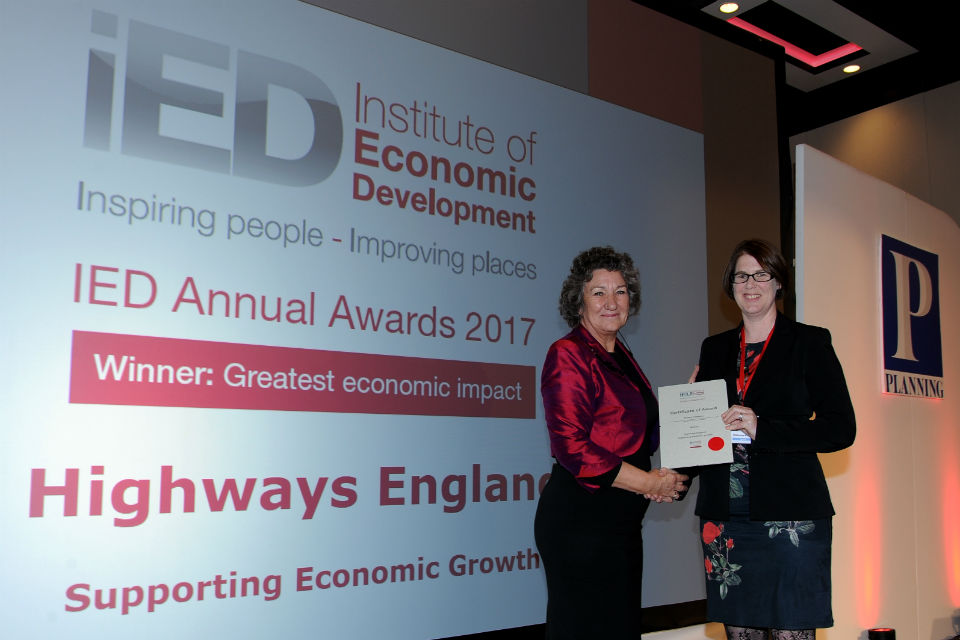
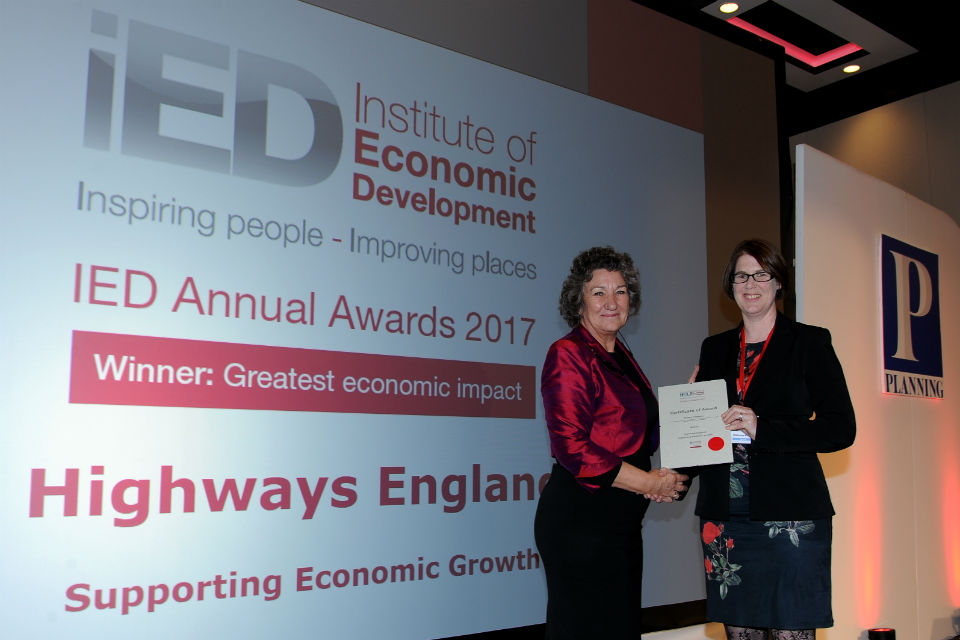
The Institute of Economic Development (IED) hailed the company’s strategic economic growth plan, “The Road to Growth” as “greatest economic impact’’ at their 2017 annual awards.

The plan includes Highways England’s Innovation, and Growth and Housing Funds.

Highways England’s Executive Director of Strategy and Planning, Elliot Shaw, said:

It is a great achievement to have been recognised by the Institute of Economic Development for our innovative approach to unlocking economic growth. While we continue to successfully deliver the Government’s Road Investment Strategy, we are actively looking ahead to 2020 and beyond. It is this strategic and innovative thinking that is showing the difference we are making.

Image showing Senior Strategic Implementation Manager Alice Darley receiving the award
Highways England’s Senior Strategic Implementation Manager Alice Darley receiving the award

Announcing the award Bev Hurley, Chair, Institute of Economic Development, said:

We would like to congratulate Highways England as the first winner of our Greatest Economic Impact award. The Road to Growth is the first strategic economic growth plan for Highways England and draws upon extensive research, consumer and stakeholder feedback. It is closely aligned with the Government and Department of Transport’s vision for a high performing road infrastructure that positively impacts the economy, employment and housing markets.

Highways England has made ‘supporting economic growth’ one of its five strategic priorities and at the same time has set funding aside for innovation, some strategic projects that could unlock growth and produced a planning guide setting out how to work with the organisation. Whilst the overall approach may not yet be fully measurable, it was considered clear from the documents submitted that this shift to concentrate on economic growth can make a considerable difference to the economic growth of locations across England.

The Road to Growth and details of Highways England’s Growth and Housing Fund can be found on our web page.

General enquiries

Members of the public should contact the Highways England customer contact centre on 0300 123 5000.

Media enquiries

Journalists should contact the Highways England press office on 0844 693 1448 and use the menu to speak to the most appropriate press officer.


Link: Press release: Prestigious award for Highways England’s ‘Road to Growth’
Source: Gov Press Releases

Press release: Couple ordered to pay over £62,000 for River Leadon pollution

The Bennions of Rosehill Farm, Dymock, were each fined £5,500 and each ordered to pay £25,798 in costs along with a victim surcharge of £170.

More than 15,200 fish were killed as a result of the incident in which hundreds of tonnes of digestate were discharged into the river. Fish killed including brown trout, chub, eel, dace, roach, lamprey, and bream. The Bennions are the sole partners of the partnership that own and run Rose Hill Farm.

The incident, on the 22 July 2016, occurred when an employee was instructed by Mark Bennion to fertilise one of the orchards. The employee turned on the irrigation system designed to take the digestate fertiliser from a lagoon to the orchard.

However, he had not physically checked and therefore did not know that the valve linked to the standpipe in another field was partly open. As a result, when the fertiliser entered the irrigation system, it discharged out of the standpipe, across the field and into the Preston Brook.

The discharge pump operates at 100 tonnes an hour, therefore a very large amount of polluting digestate entered the watercourse. The discharge was the worst in 10 years in the area.

Mark Bennion liaised with Environment Agency officers and submitted a proposal for dredging the brook in order to remove all contaminates. This was completed on 12 August 2016.

Surveys conducted after the incident show the fish population within the watercourse have been significantly adversely impacted. The Leadon is an important habitat for eels and a significant number of adults were lost as a result of the pollution.

In passing sentence, the Magistrates sought to achieve a balance between the major adverse impact on the watercourse and the powerful mitigation put forward on the defendants’ behalf. The Bennions were both previously of good character, with no previous convictions, and co-operated with the Environment Agency immediately after the incident. Their remorse was evident throughout the investigation and court hearing.
Since the incident the Environment Agency have restocked the river with more than 15,000 fish. The restocking process will continue over the next 4 years.

Speaking after the case an Environment Agency spokesperson said:

Agriculture uses 70% of the land in England and farmers have a major impact on the environment. Most farmers act responsibly and we work with the industry to respond to incidents, tackle the root causes of pollution and promote good practice.

But where farmers are responsible for serious pollution incidents, we will not hesitate to take enforcement action, including prosecution. Agriculture is the single biggest source of serious pollution incidents and all farmers have a duty to prevent it.

This was one of the worst pollution incidents on a watercourse in the Herefordshire and Gloucestershire area in the last 10 years. It significantly affected a stretch of the River Leadon catchment.

We are pleased that the court has accepted the seriousness of the case and imposed appropriate penalties.

We appreciate reports from the public to the Environment Agency’s Incident Hotline on 0800 80 70 60 which allows our staff to respond swiftly to protect people, wildlife and the environment – and also to investigate environmental offences which may have occurred.

Link: Press release: Couple ordered to pay over £62,000 for River Leadon pollution
Source: Environment Agency

Press release: First joint exercise with the fire service in the south west to test flood defence barriers

Environment Agency field operatives will roll out up to 120 metres of temporary defence barriers, in partnership with Dorset and Wiltshire Fire and Rescue Service officers. This will be the first joint exercise of its kind in the south west, although the fire service has previously helped deploy barriers during live incidents.

The exercise will take place at the Ashley Road recreation ground, next to the River Avon, from 10am to 1pm. Teams will deploy 3 types of barriers and seepage pumps to practise their joint response to flooding.

Robbie Williams, Environment Agency Operations Manager for the Wessex Area, said:

We are investing to reduce flood risk in Salisbury as part of a £2.5 billion investment nationally to better protect 300,000 homes by 2021.

Salisbury is at risk from flooding from 5 rivers running into the city and their close proximity to homes and businesses, so it’s important we limit the overall impact and extent of flooding, and keep people safe.

Joint exercises like this will help us be better prepared for any future incidents as we’ll be able to deploy the barriers more quickly and efficiently when flooding is expected, helping to protect communities and the local economy.

Jason Moncrieff, Station Manager for Salisbury, Wilton and Amesbury, said:

Across our area, Dorset and Wiltshire Fire and Rescue Service has a number of communities at high risk of flooding. It is great to have this opportunity to work closely with Environment Agency colleagues, both to test how we can support them when flooding is expected, but also to better understand how they work and the defences they have available.

The exercise site is 1 of 4 areas in the city where temporary defence barriers would be deployed in a real life river flooding incident.

These measures are supported by the Salisbury Operating Flood Working Group, which launched a multi-agency flood plan outlining the city’s emergency response last year. Volunteer wardens were also recruited by Salisbury City Council to act as the eyes and ears of the community for any flood risks.

Partner agencies and some schools have been invited to observe the exercise, including Wiltshire Council, Salisbury City Council, Wiltshire Police and wider members of the Wiltshire and Swindon Local Resilience Forum.

One of the Environment Agency’s new Incident Command Vehicles will also be on site recording footage of the exercise. The WiFi-enabled vehicle acts as a mobile incident room and a temporary headquarters for staff out in the field, enabling better site management, situational awareness and visibility in flood risk communities.

Local residents will be informed about the exercise in advance and invited to stop by to find out more. Ashley Road and the formal footpath around the edge of the recreation ground will still be accessible to users.

Residents can sign up to receive flood alerts by phone, email or text message. Residents can register online or by calling the 24-hour Floodline on 0345 988 1188.

Notes to editors

There are 3 types of barriers. The Innero and Geodesign barriers are aluminium frames which expand into shape before being lined with plastic sheet to create a waterproof wall, with the Floodstop barrier being a plastic structure linked together for more specific deployments.

Three teams of 8 people (6 Environment Agency, 2 fire service) will rotate on the hour between each barrier type, overseen by site controllers.

The Salisbury Operational Flood Working Group members are Salisbury City Council, Wiltshire Council, the Environment Agency, Salisbury Cathedral, Salisbury BID (Business Improvement District) and Highways England.

Media opportunity

The media are invited to attend the exercise at 11am on Tuesday 5 December and carry out a brief tour of the site and carry out photo/filming/interview opportunities with approved spokespeople from the Environment Agency and Dorset and Wiltshire Fire and Rescue Service. Please confirm your attendance with the Environment Agency press office by emailing communications_wessex@environment-agency.gov.uk.

On arrival the media should report to the information stand on site, to be signed in and given high visibility jackets for safety and identification purposes. Press officers will assist with this process. Please note, the Environment Agency cannot accept any liability if health and safety procedures are not followed.

Link: Press release: First joint exercise with the fire service in the south west to test flood defence barriers
Source: Environment Agency

Press release: Better Broadband Scheme extended for another year

  • Scheme offers immediate assistance to those in hardest to reach places
  • More than 10,000 UK homes and businesses have already had their broadband speeds boosted through the initiative

The “Better Broadband Scheme” provides a subsidy of up to £350 to enable access to an affordable basic broadband service to those people unable to get broadband speeds of at least 2Mbps.

Minister for Digital, Matt Hancock said:

Thanks to the UK Government’s rollout of superfast broadband, more than 94 per cent of the UK can now access superfast broadband speeds and thousands more homes and businesses are being reached every week.

There is still more to be done to get decent broadband to all and the Better Broadband Scheme helps people with the very worst broadband, to provide immediate assistance to those most in need. I’m delighted to say we are extending the scheme to help people in some of the most rural and hard to reach areas of the country.

Already more than 10,000 homes and businesses have benefitted from the Scheme, with subsidies that are worth over £3 million in total. Originally due to conclude at the end of 2017, the steadily growing popularity of the scheme means that it will now be extended until the end of 2018.

Households and businesses that are eligible to take advantage of the Scheme are provided with a unique code by the Government that they can use to obtain an affordable basic broadband connection. The code does not have a specific fixed value but the subsidy contributes towards the installation and hardware costs to ensure that the customer’s first year costs are no more than £400.

ENDS

Notes to Editors

  1. Taking out a broadband service under this Scheme will not prevent your premises from being considered for superfast broadband in the future.
  2. People can check what broadband services are already available to them by using the GoSuperfast checker , and what their current broadband speed is, using the ADSL availability checker.
  3. If, after making these checks, they believe their speed is less than 2 Mb per second and they have no other options available enter your postcode below to find out how to apply for help.

Link: Press release: Better Broadband Scheme extended for another year
Source: Gov Press Releases

Press release: Social mobility in Great Britain: fifth state of the nation report

A stark social mobility postcode lottery exists in Britain today where the chances of someone from a disadvantaged background succeeding in life is bound to where they live, the Social Mobility Commission’s ‘State of the nation’ report, published today (Tuesday 28 November) has found.

The report uncovers a striking geographical divide with London and its surrounding areas pulling away from the rest of the country, while many other parts of the country are being left behind economically and hollowed out socially.

It warns that Britain is in the grip of a self-reinforcing spiral of ever-growing division and calls on government to increase its proportion of spending on those parts of the country that most need it. Estimates suggest that the North is £6 billion a year underfunded compared to London.

At the heart of the report is the Social Mobility Index, which ranks all 324 local authorities in England in terms of their social mobility prospects for someone from a disadvantaged background. It uses a range of 16 indicators for every major life stage, from early years through to working lives, to map the nation’s social mobility hotspots and coldspots. A similar, but not comparable, approach has been taken for Scotland and Wales.

The report debunks the assumption that a simple north-south divide exists. Instead, it suggests there is a postcode lottery with hotspots and coldspots found in almost every part of the country. London dominates the hotspots, while the East and West Midlands are the worst performing regions. The best performing local authority area is Westminster and the worst performing area is West Somerset.

The index finds that the worst performing areas for social mobility are no longer inner city areas, but remote rural and coastal areas, and former industrial areas, especially in the Midlands. Young people from disadvantaged backgrounds living in these areas face far higher barriers than young people growing up in cities and their surrounding areas – and in their working lives, face lower rates of pay; fewer top jobs; and travelling to work times of nearly four times more than that of urban residents.

There is also no direct correlation between the affluence of an area and its ability to sustain high levels of social mobility. While richer areas tend to outperform deprived areas in the index, a number of places buck the trend. Some of the most deprived areas in England are hotspots, including most London boroughs – such as Tower Hamlets, Hackney and Newham. Conversely, some affluent areas – such as West Berkshire, Cotswold and Crawley – are amongst the worst for offering good education, employment opportunities and affordable housing to their more disadvantaged residents.

The report highlights that local policies adopted by local authorities and employers can influence outcomes for disadvantaged residents. But it also warns that there is a mind-blowing inconsistency of practice in how to improve social mobility outcomes, with little pooling of experience or evidence-based strategies.

The Rt Hon Alan Milburn, chair of the Social Mobility Commission, said:

The country seems to be in the grip of a self-reinforcing spiral of ever-growing division. That takes a spatial form, not just a social one. There is a stark social mobility lottery in Britain today.

London and its hinterland are increasingly looking like a different country from the rest of Britain. It is moving ahead as are many of our country’s great cities. But too many rural and coastal areas and the towns of Britain’s old industrial heartlands are being left behind economically and hollowed out socially.

Tinkering around the edges will not do the trick. The analysis in this report substantiates the sense of political alienation and social resentment that so many parts of Britain feel. A new level of effort is needed to tackle the phenomenon of left behind Britain. Overcoming the divisions that exist in Britain requires far more ambition and far bigger scale. A less divided Britain will require a more redistributive approach to spreading education, employment and housing prospects across our country.

Key findings include:

  • London accounts for nearly two-thirds of all social mobility hotspots
  • The Midlands is the worst region of the country for social mobility for those from disadvantaged backgrounds – half of the local authority areas in the East Midlands and more than a third in the West Midlands are social mobility coldspots
  • Some of the worst performing areas such as Weymouth and Portland, and Allerdale, are rural, not urban
  • Coastal and older industrial towns – places such as Scarborough, Hastings, Derby and Nottingham – are becoming entrenched social mobility coldspots
  • Some of the richest places in England, such as West Berkshire, Cotswold and Crawley, deliver worse outcomes for their disadvantaged children than places that are much poorer such as Sunderland and Tower Hamlets
  • Apart from London, English cities are punching below their weight on social mobility outcomes. No other city makes it into the top 20%
  • Early years – disadvantaged children are 14 percentage points less likely to be school ready at age 5 in coldspots than in hotspots: in 94 areas, under half of disadvantaged children reach a good level of development at age 5
  • Schools – 51% of London children on free school meals achieve A* to C in English and maths GCSE compared to an average of 36% of children on free school meals in all other English regions: in the best place (Westminster), 63% get good English and maths GCSEs whereas in the worst (Isle of Wight), only 27% do
  • A critical factor in the performance of top local authorities is the number and quality of teachers available. A secondary teacher in the most deprived area is 70% more likely to leave
  • Schools in rural and coastal areas are isolated and lack partnerships with other schools. In Lancashire and West Yorkshire only 19% of all schools are either in a multi-academy trust or an equivalent trust compared to 35% in north east London and the East of England
  • Youth – In Kensington and Chelsea, 50% of disadvantaged young people make it to university, whereas in Hastings, Barnsley and Eastbourne, the university participation rate for this group falls to just 10%
  • One quarter of young people are NEET (not in education, employment or training) in the worst local authority area a year after GCSEs (South Ribble), compared to 1% in North Hertfordshire
  • Working lives – In 71, largely rural areas, more than 30% of people earn below the voluntary living wage: average wages in the worst performing area, West Somerset, are £312 a week, less than half of the best performing areas of London such as Wandsworth, Richmond upon Thames and Westminster
  • In Bolsover, just 17% of residents are in jobs that are professional and managerial positions, compared to 51% in Oxford
  • City residents face barriers in their working lives with high housing costs and high rates of low paid work compared to commuter belt residents who benefit from higher rates of the top jobs and with more families owning their homes
  • In Blaby, Rochford and Harborough, 80% of residents own their homes whereas in Tower Hamlets it is just 18%

Key recommendations:

  • Every local authority should develop an integrated strategy for improving disadvantaged children’s outcomes and Pupil Premium funds should be invested in evidence-based practice
  • Local authorities should support collaboration between isolated schools, subsidise transport for disadvantaged young people in isolated areas and encourage Local Enterprise Partnerships (LEP) to follow the North East LEP’s approach to improving careers support for young people
  • Local authorities should all become accredited Living Wage employers and encourage others in their communities to do likewise
  • Central government should launch a fund to enable schools in rural and coastal areas to partner with other schools to boost attainment
  • Regional School Commissioners should be given responsibility to work with universities, schools and Teach First to ensure that there is a good supply of teachers in all parts of their regions
  • The Department for Business, Energy and Industrial Strategy should match the Department for Education’s £72 million for the opportunity areas to ensure there is a collaborative effort across local education systems and labour markets
  • Central government should rebalance the national transport budget to deliver a more equal share of investment per person and contribute towards a more regionally balanced economy
Notes for editors

1.The Social Mobility Commission is an advisory, non-departmental public body established under the Life Chances Act 2010 as modified by the Welfare Reform and Work Act 2016. It has a duty to assess progress in improving social mobility in the United Kingdom and to promote social mobility in England. It currently consists of four commissioners and is supported by a small secretariat.

2.The commission board currently comprises:

  • Alan Milburn (chair)
  • Baroness Gillian Shephard (deputy chair)
  • Paul Gregg, Professor of Economic and Social Policy, University of Bath
  • David Johnston, Chief Executive of the Social Mobility Foundation

3.The functions of the commission include:

  • monitoring progress on improving social mobility
  • providing published advice to ministers on matters relating to social mobility
  • undertaking social mobility advocacy

Social Mobility Commission Communications Team

Link: Press release: Social mobility in Great Britain: fifth state of the nation report
Source: Gov Press Releases