A Bill to require the Secretary of State to report annually on the representativeness in respect of relevant postcode districts of weather stations designated for the purpose of calculating cold weather payments and to conduct a study of alternative methods of calculating cold weather in each postcode district; and for connected purposes.
People who live, work and travel across Kent, Thurrock, Essex and beyond are being invited to shape plans for Britain’s biggest road tunnel as Highways England hosts the first of 60 public engagement events on the multi-billion pound Lower Thames Crossing project today (Tuesday 16 October).
A consultation was launched last week into updated proposals for the project, a new 14.5 mile road linking the M2 in Kent with the M25 in Essex, including a 2.4 mile tunnel under the river. Starting this week, the project team are taking to the road to meet local people, explain the plans and answer questions.
Today’s event, at Orsett in Essex is one of 25 public information events being held over the coming weeks, along with pop up stalls and visits by the team’s mobile visitor centre to various locations across Essex, Thurrock and Kent.
Businesses and organisations from across the region have welcomed the plans, which will nearly double road capacity across the Thames while halving some journey times at the existing Dartford Crossing, where traffic will be reduced by almost a quarter.
Highways England Project Director for the Lower Thames Crossing, Tim Jones, said:
The Lower Thames Crossing will be among the biggest and most complex new roads ever built in the UK, and we are providing a wide range of information about the project, its impacts and benefits. We want to help people understand the proposals and have their say to help shape the plans. These events are an excellent opportunity to do just that.
People will be able to see the changes we’ve made since the preferred route was announced last year, and how we’ve responded to the feedback we’ve received. And of course they will be able to put questions directly to members of the project team. I encourage anyone with an interest to come along to one of our events to make sure their voice is heard in this once-in-a-generation opportunity for Britain’s roads.
Councils and business and industry groups from across the region have reiterated support for the project as the consultation gets underway.
Leader of Medway Council, Cllr Alan Jarrett, said:
We fully support the proposal for an additional crossing and investment in the wider road network. A Lower Thames Crossing will not only reduce congestion on the Dartford Crossing, but it will also bring with it economic benefits to both sides of the river; it will bring more visitors into the south-east and would benefit commuters.
Medway is fast becoming known as the new economic powerhouse for the south-east, and although we already have great transport connections, such as a high speed rail service into central London, a new crossing will be a major catalyst to drive further economic development.
We will be submitting a response to Highways England’s consultation and would encourage residents and businesses to attend a consultation event to find out more about the proposal and how the crossing would affect them, as well as provide their feedback.
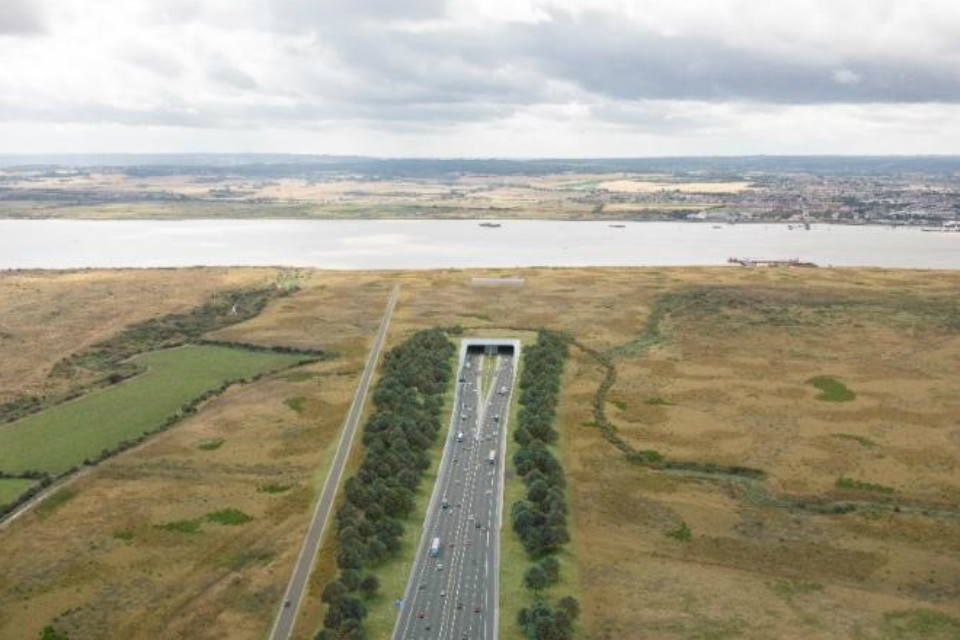
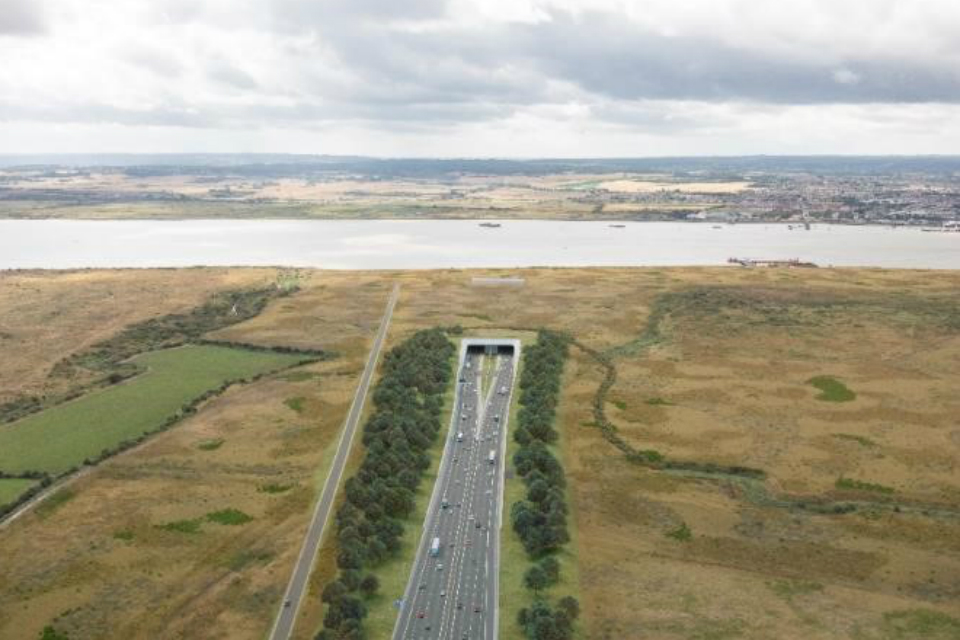
How the northern portal of the Lower Thames Crossing, in Essex, will look
Cllr Peter Fleming, Leader of Sevenoaks District Council, said:
“The importance to the Sevenoaks District of the Lower Thames Crossing cannot be underestimated. The potential reduction in HGV movements both in and through the District and the subsequent reductions in congestion and improvement in air quality are just some of the benefits that will accrue our communities and businesses after the crossing is delivered.”
Cllr Roy Whitehead, leader of Chelmsford City Council said:
Chelmsford City Council welcomes the opportunity to comment on Highways England’s latest consultation on the Lower Thames Crossing. Providing another strategic crossing of the River Thames is crucial in relieving the existing congested bottleneck at the Dartford Crossing and will provide a catalyst for further economic growth in Chelmsford and across Essex.
Cllr Teresa O’Neill OBE, leader of the London Borough of Bexley said:
The Thames Gateway is poised to help the country and the capital prosper and grow. Transport infrastructure – including river crossings – it essential for this to happen, so I welcome this consultation and the prospect of investment in this important project.
Christian Brodie, Chair of the South East Local Enterprise Partnership (SELEP), said:
This marks the important next step for this urgently needed and game changing project which will help us drive forward the economy of the South East. I would urge every business to back this vital investment in infrastructure and participate in the consultation.
Denise Rossiter, Chief Executive Officer of Essex Chambers of Commerce, said:
We are extremely pleased that this important Consultation has been launched for a ten-week period. Essex Chambers have strongly supported the need for a Lower Thames Crossing from the very start. The time now is for businesses to have their say and we would encourage you to visit the Lower Thames Crossing website to learn more about this fantastic project that will help Essex prosper economically, logistically and be a global leader.
Jo James, Chief Executive Officer of Kent Chambers of Commerce, said:
The Lower Thames Crossing will open up new opportunities, enabling businesses across Kent and the wider South East to achieve their growth potential and will have a significant impact on our future prosperity.
As the ten-week consultation opens, I would strongly urge businesses to put their views forward by responding to the consultation.
Malcolm Bingham, the Freight Transport Association’s Head of Road Network Policy, said:
FTA, which represents more than 17,000 logistics businesses, urges government to press ahead with construction of the Lower Thames Crossing as soon as possible to ease congestion and improve road capacity in this area. Traffic congestion at the Dartford Crossing is already unbearably high and it is predicted to return to pre-Dart Charge levels by 2020. The M2/M25 route is a vital cog in the country’s freight machine and it must continue to work as smoothly as possible to ensure that British companies can trade without delays both domestically and internationally.
Richard Christian, Head of Policy and Communications, Port of Dover, said:
The UK’s reliance upon continued frictionless trade at the Port of Dover has been accepted at the heart of Government. So has the need to preserve it. For a port handling £122bn or 17 per cent of the UK’s trade in goods, and with half of that trade moving beyond London to keep factories busy and shops full in the Midlands and the North, the Lower Thames Crossing is an investment in the long-term economic success of the UK as a whole. The Port continues to press hard for a Government commitment to other complementary strategic investments such as the dualling of the A2 to Dover which, together with the Lower Thames Crossing, will help protect jobs and livelihoods, keep traffic flowing and prices low for British consumers.
Stobart Group is proud to support this visionary and important infrastructure project. It will make a major contribution to sustainable growth and significantly enhance mobility for both people and goods across the river. We look forward to working with colleagues in the Lower Thames Crossing team to help deliver this transformational scheme.
Since the preferred route announcement by Transport Minister Chris Grayling MP in April 2017, changes were made to reflect feedback including:
making the whole route three lanes, not two
introducing a new rest and service area west of East Tilbury
a new design for the Tilbury junction, removing the proposed Tilbury link road to reduce traffic on the local road network
extending the tunnel so the tunnel entrance in Kent is 600 metres further south to reduce the visual impact and protect access to a community church
lowering road by five to six metres in places to reduce its visual impact
moving the road 80 metres further east where is passes Chadwell St Mary to increase the distance from residential properties
on average, house prices have risen by 0.2% since July 2018
an annual price rise of 3.2%, which makes the average property in the UK valued at £232,797
England
In England, the August data shows house prices have risen on average by 0.2% since July 2018. The annual price rise of 2.9% takes the average property value to £249,748.
The regional data for England indicates that:
the East Midlands experienced the greatest monthly price rise, up by 1.5%
the East of England saw the most significant monthly price fall, down by 1.1%
house prices in London fell by 0.2% in the year to August 2018
Price change by region for England
Region
Average price August 2018
Monthly change % since July 2018
East Midlands
£194,718
1.5
East of England
£292,107
-1.1
London
£486,304
-0.5
North East
£133,538
1.4
North West
£163,487
0.0
South East
£329,264
0.1
South West
£257,659
-0.4
West Midlands
£199,000
0.5
Yorkshire and the Humber
£163,964
1.2
Repossession sales by volume for England
The lowest number of repossession sales in June 2018 was in the East of England.
The highest number of repossession sales in June 2018 was in the North West.
Repossession sales
June 2018
East Midlands
39
East of England
14
London
42
North East
75
North West
121
South East
53
South West
47
West Midlands
51
Yorkshire and the Humber
100
England
542
Average price by property type for England
Property type
August 2018
August 2017
Difference %
Detached
£375,773
£363,088
3.5
Semi-detached
£234,174
£223,857
4.6
Terraced
£202,162
£196,312
3.0
Flat/maisonette
£230,459
£230,443
0.0
All
£249,748
£242,628
2.9
Funding and buyer status for England
Transaction type
Average price August 2018
Annual price change % since August 2017
Monthly price change % since July 2018
Cash
£234,912
2.8
0.1
Mortgage
£257,227
3.0
0.2
First-time buyer
£209,745
2.7
0.3
Former owner occupier
£283,215
3.1
0.0
Building status for England
Building status*
Average price June 2018
Annual price change % since June 2017
Monthly price change % since May 2018
New build
£307,553
6.6
2.1
Existing resold property
£241,647
2.8
0.6
*Figures for the 2 most recent months are not being published because there are not enough new build transactions to give a meaningful result.
London
London shows, on average, house prices have fallen by 0.5% since July 2018. An annual price fall of 0.2% takes the average property value to £486,304.
Average price by property type for London
Property type
August 2018
August 2017
Difference %
Detached
£907,317
£904,655
0.3
Semi-detached
£590,981
£579,880
1.9
Terraced
£506,845
£501,173
1.1
Flat/maisonette
£426,856
£432,209
-1.2
All
£486,304
£487,085
-0.2
Funding and buyer status for London
Transaction type
Average price August 2018
Annual price change % since August 2017
Monthly price change % since July 2018
Cash
£509,986
-0.4
-0.9
Mortgage
£479,068
0.0
-0.4
First-time buyer
£425,299
-0.4
-0.5
Former owner occupier
£548,993
0.1
-0.5
Building status for London
Building status*
Average price June 2018
Annual price change % since June 2017
Monthly price change % since May 2018
New build
£504,305
4.1
1.5
Existing resold property
£479,739
0.0
0.5
*Figures for the 2 most recent months are not being published because there are not enough new build transactions to give a meaningful result.
Wales
Wales shows, on average, house prices have risen by 1.9% since July 2018. An annual price rise of 6.2% takes the average property value to £162,374.
There were 57 repossession sales for Wales in June 2018.
Average price by property type for Wales
Property type
August 2018
August 2017
Difference %
Detached
£241,030
£229,969
4.8
Semi-detached
£157,283
£146,810
7.1
Terraced
£126,861
£118,292
7.2
Flat/maisonette
£117,111
£111,972
4.6
All
£162,374
£152,859
6.2
Funding and buyer status for Wales
Transaction type
Average price August 2018
Annual price change % since August 2017
Monthly price change % since July 2018
Cash
£156,605
4.9
1.2
Mortgage
£165,809
7.0
2.3
First-time buyer
£140,634
6.5
2.3
Former owner occupier
£187,598
6.0
1.4
Building status for Wales
Building status*
Average price June 2018
Annual price change % since June 2017
Monthly price change % since May 2018
New build
£212,007
10.2
3.4
Existing resold property
£153,947
4.2
1.3
*Figures for the 2 most recent months are not being published because there are not enough new build transactions to give a meaningful result.
UK house prices rose by 3.2% in the year to August 2018, down from 3.4% in the year to July 2018.
The UK Property Transaction Statistics for August 2018 showed that on a seasonally adjusted basis, the number of transactions on residential properties with a value of £40,000 or greater was 99,120. This is 2.6% lower compared to a year ago. Between July and August 2018, transactions increased by 1.3%.
House prices grew fastest in the East Midlands region increasing by 6.5% in the year to August 2018, followed by the West Midlands region which increased by 5.1% over the year. House prices in London fell by 0.2% in the year to August 2018. Annual growth in London house prices has been around zero for the last 6 months.
The UK House Price Index (HPI) is published on the second or third Wednesday of each month with Northern Ireland figures updated quarterly. The September 2018 UK HPI will be published at 9.30am on Wednesday 14 November 2018. See calendar of release dates.
We have made some changes to improve the accuracy of the UK HPI. We are not publishing average price and percentage change for new builds and existing resold property as done previously because there are not currently enough new build transactions to provide a reliable result. This means that in this month’s UK HPI reports, new builds and existing resold property are reported in line with the sales volumes currently available.
The UK HPI revision period has been extended to 13 months, following a review of the revision policy (see Revisions to the UK HPI data). This ensures the data used is more comprehensive.
Sales volume data is also available by property status (new build and existing property) and funding status (cash and mortgage) in our downloadable data tables. Transactions involving the creation of a new register, such as new builds, are more complex and require more time to process. Read revisions to the UK HPI data.
Revision tables have been introduced for England and Wales within the downloadable data. Tables will be available in csv format. See about the UK HPI for more information.
Data for the UK HPI is provided by HM Land Registry, Registers of Scotland, Land & Property Services/Northern Ireland Statistics and Research Agency and the Valuation Office Agency.
The UK HPI is calculated by the Office for National Statistics (ONS) and Land & Property Services/Northern Ireland Statistics and Research Agency. It applies a hedonic regression model that uses the various sources of data on property price, in particular HM Land Registry’s Price Paid Dataset, and attributes to produce estimates of the change in house prices each month. Find out more about the methodology used from the ONS and Northern Ireland Statistics & Research Agency.
The UK Property Transaction statisticsare taken from HM Revenue and Customs (HMRC) monthly estimates of the number of residential and non-residential property transactions in the UK and its constituent countries. The number of property transactions in the UK is highly seasonal, with more activity in the summer months and less in the winter. This regular annual pattern can sometimes mask the underlying movements and trends in the data series so HMRC also presents the UK aggregate transaction figures on a seasonally adjusted basis. Adjustments are made for both the time of year and the construction of the calendar, including corrections for the position of Easter and the number of trading days in a particular month.
UK HPI seasonally adjusted series are calculated at regional and national levels only. See data tables.
The first estimate for new build average price (April 2016 report) was based on a small sample which can cause volatility. A three-month moving average has been applied to the latest estimate to remove some of this volatility.
Work has been taking place since 2014 to develop a single, official HPI that reflects the final transaction price for sales of residential property in the UK. Using the geometric mean, it covers purchases at market value for owner-occupation and buy-to-let, excluding those purchases not at market value (such as re-mortgages), where the ‘price’ represents a valuation.
Information on residential property transactions for England and Wales, collected as part of the official registration process, is provided by HM Land Registry for properties that are sold for full market value.
The HM Land Registry dataset contains the sale price of the property, the date when the sale was completed, full address details, the type of property (detached, semi-detached, terraced or flat), if it is a newly built property or an established residential building and a variable to indicate if the property has been purchased as a financed transaction (using a mortgage) or as a non-financed transaction (cash purchase).
Repossession sales data is based on the number of transactions lodged with HM Land Registry by lenders exercising their power of sale.
For England, this is shown as volumes of repossession sales recorded by Government Office Region. For Wales, there is a headline figure for the number of repossession sales recorded in Wales.
The data can be downloaded as a .csv file. Repossession sales data prior to April 2016 is not available. Find out more information about repossession sales.
Background tables of the raw and cleansed aggregated data, in Excel and CSV formats, are also published monthly although Northern Ireland is on a quarterly basis. They are available for free use and re-use under the Open Government Licence.
HM Land Registry’s mission is to guarantee and protect property rights in England and Wales.
HM Land Registry is a government department created in 1862. It operates as an executive agency and a trading fund and its running costs are covered by the fees paid by the users of its services. Its ambition is to become the world’s leading land registry for speed, simplicity and an open approach to data.
HM Land Registry safeguards land and property ownership worth in excess of £4 trillion, including around £1 trillion of mortgages. The Land Register contains more than 25 million titles showing evidence of ownership for some 85% of the land mass of England and Wales.
We, the G7 Foreign Ministers, of Canada, France, Germany, Italy, Japan, the United Kingdom, the United States of America, and the High Representative of the European Union, affirm our commitment to defending freedom of expression and protection of a free press.
We remain very troubled by the disappearance of prominent Saudi journalist Jamal Khashoggi. Those bearing responsibility for his disappearance must be held to account.
We encourage Turkish-Saudi collaboration and look forward to the Kingdom of Saudi Arabia conducting a thorough, credible, transparent, and prompt investigation, as announced.
Further information
Follow the Foreign Secretary on Twitter @Jeremy_Hunt
This Order revokes and replaces the Ecclesiastical Exemption (Listed Buildings and Conservation Areas) Order 1994 for Wales.
Mae’r Gorchymyn hwn yn dirymu ac yn disodli Gorchymyn Esemptiad Eglwysig (Adeiladau Rhestredig ac Ardaloedd Cadwraeth) 1994 ar gyfer Cymru.
Link:
The Ecclesiastical Exemption (Listed Buildings and Conservation Areas) (Wales) Order 2018 / Gorchymyn Esemptiad Eglwysig (Adeiladau Rhestredig ac Ardaloedd Cadwraeth) (Cymru) 2018
The Charity Commission says it continues to have concerns about systemic underreporting of serious incidents by domestic and international charities, as it publishes the findings of its interim taskforce on safeguarding.
The task force – one of a suite of measures announced by the Commission – was set up to respond robustly and consistently to the significantly increased volume of serious incident reports on safeguarding matters submitted by charities following the safeguarding revelations involving Oxfam and Save the Children in February.
Charities submitted a total of 2,114 reports of serious incidents relating to safeguarding incidents or issues between 20 February and 30 September 2018, compared to 1,580 serious incident reports about safeguarding received in the whole of 2017-18, and 1,203 received in 2016-17.
The Commission says that it is vital that charities, whether they work domestically or around the world, report serious incidents to the regulator. Doing so provides reassurance that trustees are responding appropriately and as the public would expect to the issue itself. The Commission says data on serious incident reporting also allows it to better understand risks facing the sector and take appropriate action.
The taskforce also undertook a ‘deep dive’ of the regulator’s records relating to safeguarding concerns dating back to April 2014 to identify any potential failure in full and frank disclosure by charities, and to ensure charities and the Commission had taken appropriate follow-up actions to deal with the incident reported.
Analysis of reports
The regulator undertook detailed analysis of safeguarding reports it received between 1 February and 31 May 2018 (1228 in total) to better understand the nature of the incident being reported and the type of charity making the report.
This found that:
The top 5 types of charity that submitted reports during that time were: overseas aid/ famine relief (29%), disability (12%), religious activities (12%), education /training (12%) and younger people (11%)
The majority of reports related to incidents of or concerns about potential harm to individuals, including but not limited to sexual abuse or harassment
In cases where an individual was identified as having allegedly been harmed, 47.5% related to a child, and 32% related to an adult (in the remainder the age of the individual could not be identified from the initial report).
Significant and systemic underreporting
The Commission’s report finds that, despite recent increases in serious incident reporting, there is significant and systemic underreporting of incidents by charities working at home and abroad:
only 1.5% of registered charities have submitted any kind of serious incident report since 2014
only 0.9% of charities have reported a safeguarding incident since 2014
it is concerned in particular that there may be certain groups of charities in which under-reporting is especially prevalent
Sarah Atkinson, Director of Policy, Planning and Communications at the Charity Commission, said:
The public rightly expect charities to demonstrate the highest standards of ethical behaviour and attitude. That includes taking action when something has gone badly wrong, or when there’s been a near miss. Making a serious incident report to the Commission is not in itself an admission of wrongdoing or failure. Quite the reverse: it demonstrates that a charity is responding properly to incident or concern. So we welcome the increase in reporting by some charities, especially international aid charities that appear to have improved their reporting since February’s revelations. But we’re not convinced that we’re seeing everything we should be. Working with charities, we need to bring about a culture change on reporting to ensure charities are safe places, better able to make a difference to people’s lives.
The Commission has already updated its guidance in reporting serious incidents and is now taking a number of further steps:
in light of its commitment, set out in its new strategy to better understand the wider context in which charities work and to help shape the environment in which they operate, the Commission is now conducting further analysis on the patterns of reporting types or groups of charities where under-reporting may be especially prevalent
developing a new digital tool for reporting serious incidents to help make it easier for charities to provide the information the Commission needs at the outset.
creating checklists to sit alongside its existing guidance to help better inform trustees about the key information required in any serious incident report. These checklists will be available in the next few weeks.
further reviewing its guidance on reporting serious incidents to ensure it is as clear and user friendly as possible
working with the sector and other government departments to raise awareness of the importance and benefits of reporting serious incidents and target under-reporting
“No major concerns” about historic reports of serious incidents
As part of its ‘deep-dive’, the taskforce reviewed over 5,500 historic records relating to safeguarding concerns dating back to 2014. The purpose of this work was to identify any possible gaps in full and frank disclosure in charities and to determine, based on the information in the regulator’s records, whether the Commission and charities had responded appropriately to each incident.
Today’s report makes clear that, based on the information recorded at the time, there are no historic cases giving rise to serious or urgent concerns about either the Commission’s handling at the time, or a charity’s response.
The taskforce identified only one case in which it was not clear, from the records, whether a potentially criminal matter had been reported to the police. The taskforce took quick action to ensure that the matter had been reported.
Sarah Atkinson said:
This deep-dive was an important, but limited exercise designed to interrogate our records and establish whether there are any red flags arising from the way a charity reported an issue to us, or from the way we responded at the time. I am reassured by the findings of this work, but would stress that any charity that may not yet have reported a historic serious incident to us, or may have concerns about the information they provided to us in a historic report, to take urgent action to remedy this by getting in touch with us.
Improved whistleblowing guidance
As part of its response to the safeguarding revelations, the Commission also committed to reviewing its approach to whistleblowing – reports from individuals currently involved in a charity as a staff member or volunteers.
The Commission has now published updated guidance that helps people better understand when, and how, they can report possible wrongdoing to the regulator so that it is as easy as possible for people who make what is often a brave decision to come to the Commission with concerns. The Commission is also providing further training for front line staff and managers on the knowledge and skills needed to handle whistleblowers and the concerns they raise effectively. It also plans to pilot a dedicated helpline service for whistleblowers starting later this year.
Updated guidance on reporting serious incidents by charities
The Commission has also updated its guidance to charities on reporting serious incidents, clarifying a number of areas where charities have indicated that it was not clear enough. For example, the Commission has provided additional guidance on when and how to report potential criminal offences that may have taken place abroad.
The regulator continues to review this guidance to ensure it is as clear and user-friendly as possible.
Ends
Notes to editors
The Commission is the registrar and regulator of charities in England and Wales. We regulate over 168,000 charities working domestically and internationally.
The Charity Commission has an important regulatory role in ensuring that trustees comply with their legal duties and responsibilities in managing their charity. In the context of safeguarding issues, we have a specific regulatory role which is focused on the conduct of trustees and the steps they take to protect beneficiaries and other persons who come into contact with the charity.
Our aim is to make sure that charities that work with or provide services to vulnerable beneficiaries comply with their legal duties, and take reasonable steps to protect them from harm and minimise the risk of abuse.
Safeguarding has been a priority regulatory risk issue for the Commission since 2010 and this will continue. We have increased and intensified our regulatory interventions on safeguarding, including on a number of high profile cases, and our joint work with the Department for International Development and law enforcement agencies.
Our remit requires us to work effectively with other UK specialist authorities. The Commission is not an inspectorate or agency, similar to CQC or Ofsted. We are not a criminal prosecuting authority, nor an arm of the police, which means we should not be expected to gather information for or report on charities’ behalf to the police or other regulators or agencies.
Regardless of our specific remit and role, the number of incidents we are dealing with is increasing, and demand on our services in almost every area is growing. With around 350 permanent staff, dealing with 100,000 contact requests a year, regulating 950,000 trustee roles and 168,000 registered charities, we are limited in the proactive engagement we can have with individual charities and trustees.
Over 6,000 civil servants to move into Canary Wharf as part of an effort to save money and reduce Whitehall office buildings.
Public-sector staff from eight departments are now operating from UK financial district including HMRC, OfGem and MoJ.
The UK Government officially opened its Canary Wharf Hub today as part of its long-term Civil Service transformation to reduce fragmented government office buildings from 800 to 200, by 2030.
Moving departments into the new Canary Wharf hub will result in £24 million of savings per year. Furthermore, the average cost per sq/m in the Canary Wharf building is £700, compared to £950 for Whitehall buildings.
The Government Property Agency is expected to deliver £3.6 billion worth of savings over 20 years. Of which, £2.5 billion will be delivered by the Hubs Programme. HM Revenue and Customs (HMRC) is the largest occupier of the Government Hub, with 2,000 of its people benefiting from the flexible, collaborative work environment.
Oliver Dowden, Minister for Implementation, said:
It’s great to see public and private sector staff rubbing shoulders here in Canary Wharf. This hub is one of 14 across the country already announced which will use cutting-edge design and innovative technology to deliver smarter public services that reduce vacant space across the government estate.
The government has saved £300m per year in running costs, through the disposal of over a thousand properties since 2014. By the end of this Parliament, we will have established a network of around 20 multi-agency government hubs across the UK that utilise efficient smarter working practices and are accessible to the communities they serve.
The Canary Wharf building had previously been used by Barclays PLC and was selected as a Government Hub due to its excellent transport links, which will be further enhanced by the opening of Crossrail in the future.
Steven Boyd, HMRC’s Estates Director, said:
I am pleased that HMRC is delivering Phase 1 of the Government Hubs Programme, including being commissioned to deliver the Canary Wharf Hub with Government Property Agency. More than 2,000 of our London-based people are already benefitting from the facilities the hub has to offer; including modern, flexible workspaces with great IT and excellent transport links. Bringing our teams from across London together in Canary Wharf is already showing the benefits of collaboration and modern ways of working.
Through smarter property management, and the uptake of modern, more efficient working practices, vacant space has been reduced across the government estate by 73% since 2014.
This forms part of the Government Estate Strategy, published earlier this year, which seeks to provide a government estate that works for everyone. It aims to drive growth and opportunity by moving government jobs to centres of excellence in areas across the UK with particular strengths and skills, to house the Civil Service in modern, flexible workspaces. This will open up the workplace to a more diverse Civil Service that better reflects the people it serves and the places where they live.
Note to editors
For more information please contact the Cabinet Office Press Office on: 0207 276 7545.
The hubs programme is part of the government’s broader SmarterGov campaign, launched to drive innovation, savings and public service improvement across government and wider public sector.
A youth who attacked a woman outside her home has today had his sentence increased after it was referred to the Court of Appeal by the Solicitor General, Robert Buckland QC MP, for being too low.
The 15 year old youth approached the lone victim outside her Sheffield home, putting a blade to her throat and demanding her belongings. The victim feared for her life and attempted to escape, but the youth pursued her and stabbed her 5 times, one of which pierced her heart. The offence has had a significant, life-long impact on the victim.
The youth was sentenced at Sheffield Crown Court in August, where he was given a total of 5 years imprisonment. Today, after the Solicitor General’s referral, the Court of Appeal added a 3 year licence extension period to his sentence, making it equivalent to 8 years imprisonment.
Commenting on the sentence increase, the Solicitor General said:
“This was an unprovoked attack using a weapon, which has left a long-term physical and psychological impact on the victim. I hope that the Court of Appeal’s decision today can bring her some comfort.”