
Press release: Newton’s Space Saplings; can you give them space to grow?

The apple pips were taken to the International Space Station on the British ESA astronaut’s Principia mission, where they spent six months floating in micro gravity as part of the ‘Pips in Space’ project.

Newton’s space saplings: can you give them space to grow?

Now the UK Space Agency, the National Trust and Kew, who worked together on the project, have teamed up with South Kesteven District Council (SKDC) in Lincolnshire to launch a competition to find partners that share a commitment to inspire future Newtons to host the trees.

The bidding was launched today (12 September) at Newton’s birthplace, Woolsthorpe Manor, during the media launch of this month’s SKDC-backed Gravity Fields Festival, the only event in the UK combining the discoveries of Newton with interpretations of his legacy.
Organisations can bid for one of the 8 remarkable saplings, explaining how they will give them space to grow, engage new audiences and promote curiosity.

Science Minister Sam Gyimah said:

From gravity to Granny Smiths, Sir Isaac Newton has captured our imagination for more than 300 years.

Inspiring the next generation of scientists is at the core of our modern Industrial Strategy and now partners across the country have the chance to do just that by getting their green fingers on these special space saplings.

The pips were taken from the iconic Flower of Kent tree at Woolsthorpe Manor, Isaac Newton’s family home near Grantham, Lincolnshire, which is cared for by the National Trust.

The tree, which still bears fruit every year was said to have prompted Newton to question why the apple fell, leading to his world-changing work around gravity. His landmark work, called Principia Mathematica, was chosen as the name of Tim Peake’s mission to acknowledge the debt of all space travellers to Newton’s work.

Jeremy Curtis, Head of Education and Skills at the UK Space Agency, said:

We are thrilled that our friends at Kew have managed to nurture these precious young trees to the point where they can begin independent lives.

Now we need to find good homes for them across the UK to help as many people as possible find out about the intertwined stories of Newton, gravity, physics, space travel and horticulture. Maybe one of the trees will one day inspire the next Newton!
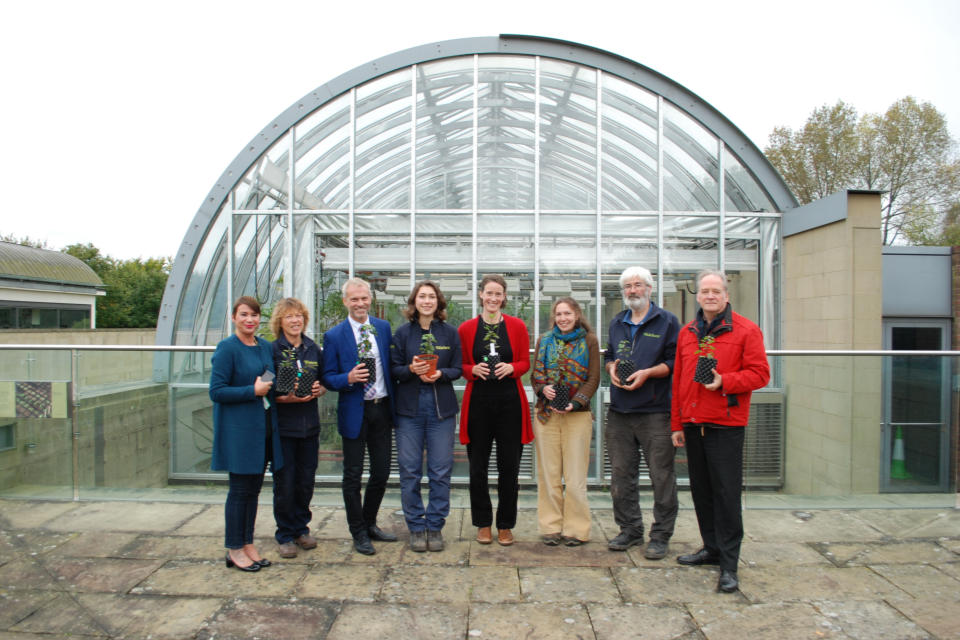
From left, Jannette Warrener, Joanna Walmisley, Jeremy Curtis, Eliana Van Der Schraft, Anne Visscher, Cristina Blandino, David Cleeve, Hugh Pritchard holding the space saplings
From left, Jannette Warrener, Joanna Walmisley, Jeremy Curtis, Eliana Van Der Schraft, Anne Visscher, Cristina Blandino, David Cleeve, Hugh Pritchard.

Jannette Warrener, Partnerships Manager, Woolsthorpe Manor, said:

As partners of the UK Space Agency and The Royal Botanic Gardens, Kew, the National Trust is looking forward to seeing how the space saplings might inspire the next generation of future Newtons.

Newton’s passion for scientific endeavour and study never waned. At Woolsthorpe Manor we want to keep that passion for scientific discovery alive and we would like these saplings, as they mature and grow, to light a fire of discovery in the next generation of scientists.

On their return from space in 2016, the well-travelled pips went to Wakehurst Place, part of the Royal Botanic Gardens, Kew, where they spent 90 days sitting on a bed of agar jelly at 5 C to simulate the winter cold needed to trigger germination. Spring arrived for them in May 2017 when they were warmed to 15 C and the young seedlings started to emerge. They have now been nurtured into ‘space saplings’.

Dr Anne Visscher, Career Development Fellow, Royal Botanic Gardens, Kew, said:

We are delighted to be part of such an important project. The seeds taken from the apple tree that inspired Newton have been on an amazing journey. Since their return they have been grown and monitored at Kew’s Wakehurst site in Sussex where we will continue to care for them until they find new homes around the country to tell the story of Newton, space travel and seed science.

Gravity Fields Festival (26-30 September) takes place in and around Grantham, including events at Woolsthorpe Manor. The story of the ‘Pips in Space’ will be told during Gravity Fields Festival on Sunday, 30 September, at 2.45 at Woolsthorpe Manor.

Cllr Matthew Lee, the Leader of South Kesteven District Council, whose portfolio includes culture and arts, said:

As a district we are extremely proud of our connections with Sir Isaac Newton, born and educated here, and, as a council we are equally proud to be delivering our fourth Gravity Fields Festival.

Our festival build up is the perfect launch pad for the space saplings project, with its ability to captivate young minds and encourage the scientists of the future.

The UK Space Agency, National Trust, and Kew will be undertaking a rigorous selection process from bidders, and are looking for national partners who share their commitment to inspire future Newtons, attract the most visitors and offer a legacy route for maximum impact. Apply for a space sapling.

The winners will be announced in early 2019 with a handover of trees at Woolsthorpe Manor.

Link: Press release: Newton’s Space Saplings; can you give them space to grow?
Source: Gov Press Releases

Online Forums

A Bill to make administrators and moderators of certain online forums responsible for content published on those forums; to require such administrators and moderators to remove certain content; to require platforms to publish information about such forums; and for connected purposes.

Link: Online Forums
Source: Public Bills

Press release: PM’s Zero Emissions Vehicle Summit roundtable: 11 September 2018

A Downing Street spokesman said:

The Prime Minister hosted a roundtable for a number of leading supply chain companies at the UK’s first Zero Emissions Vehicle Summit in Birmingham today.

During the discussions she set out the government’s plan for all new cars and vans to be zero emissions by 2040 and they discussed how to drive international investment in the growing sector.

On Brexit, the Prime Minister set out how the proposals in the Chequers plan would protect manufacturing jobs by ensuring frictionless trade could continue with the EU.

The International Trade Secretary Liam Fox added that we were working positively and constructively towards a deal with the EU and outlined how the Implementation Period we have already agreed will provide certainty for businesses on both sides.

The meeting concluded with the Prime Minister reaffirming her commitment to the sector and reiterating the importance of continued collaboration between government and the automotive industry.

Link: Press release: PM’s Zero Emissions Vehicle Summit roundtable: 11 September 2018
Source: Gov Press Releases

Press release: UK fingerprinting kits to help in fight against illegal wildlife trade

Foreign Office Minister Mark Field visited the London office of the International Fund for Animal Welfare (IFAW) today for the official handover of 100 forensic fingerprinting kits to fight the illegal wildlife trade.

The kits, specially designed to lift fingerprints from ivory, have been donated by IFAW and will be distributed to countries attending the upcoming London Illegal Wildlife Trade Conference in October.

The new fingerprinting technique, developed by the Metropolitan Police and King’s College London, can reveal prints up to 28 days after poachers have touched the ivory, compared to the two or three days with current conventional powders. This will significantly increase the chances of identifying the criminals behind the illegal ivory trade.

The innovative technology will be used by law enforcement agencies around the world to test illegally traded wildlife products for fingerprints and bring criminals to justice. The Foreign Office has been working with IFAW to build links with priority countries and to share training and expertise with local law enforcement officers and rangers.

Foreign Office Minister Mark Field said:

These new fingerprinting kits are a fantastic example of British innovation and technology being used by law enforcement agencies around the world to put criminals involved in the illegal wildlife trade behind bars. The Foreign Office and IFAW have partnered up to distribute kits and boost training for rangers and police in countries in Africa and Asia already, and we hope these additional kits will be put to good use by those countries who will pledge to take action at our upcoming conference.

The illegal wildlife trade is devastating endangered species populations around the world, from the African elephant to the Asian pangolin. This is a serious organised crime, depriving local communities of sustainable livelihoods and lining the pockets of corrupt middlemen and criminal gangs. We must act now if we are to stop it in its tracks and save endangered species before it is too late.

These kits are already making a real difference in the fight against the illegal wildlife trade. When the original trial kit was put into use in Kenya, it helped to secure evidence in four cases, which ultimately resulted in 15 arrests, including five police officers, and the seizure of 11 elephant tusks and 50 pieces of worked ivory.

Philip Mansbridge, UK Director at IFAW, said:

These pioneering ivory fingerprinting kits will aid wildlife crime investigators on the frontline in Africa and Asia, providing them with an additional tool in their vital work to catch elephant poachers, thus helping to safeguard elephants and other threatened wildlife from poaching for future generations.

This ground-breaking new method of fingerprinting ivory uses a small-scale magnetic powder, meaning it is now possible to detect fingerprints on an elephant’s tusk for up to a month after it has been handled, as opposed to just 24-48 hours using traditional techniques.

Working with Kings College and the Metropolitan Police, IFAW has so far deployed around 100 ivory fingerprinting kits in 23 countries to help gather evidence to stop elephant poachers. This is just one part of IFAW’s global efforts to protect elephants and the places they call home. We are grateful to the Rt. Hon Mark Field MP and the Foreign and Commonwealth Office for helping us showcase and distribute these kits to attendees of the upcoming London Conference on the Illegal Wildlife Trade in October.

Notes to editors

  • The ivory fingerprinting kit was researched and developed by the Metropolitan Police Forensic Imaging Team and Fingerprinting Department and also with Dr Leon Barron from the Forensic Department at King’s College London, so is a London based partnership between the International Fund for Animal Welfare (IFAW), the Metropolitan Police and King’s College London.
  • The success of the new kit relies on the reduction in size of the powder used, which requires less sweat residue for the powder to adhere to and enhances the marks, giving better definition. It is also inert and allows DNA samples to be taken from the fingerprints and could become a vital tool in stopping the illegal wildlife trade. Further tests have shown it also works on hippo ivory, polished rhino horn, lion and tiger teeth and claws and even pangolin scales.
  • The illegal wildlife trade is a serious organised crime with revenues worth up to £17bn a year, more than the combined income of the Central African Republic, Liberia and Burundi.
  • Around 20,000 African elephants are killed by poachers each year. Savanna elephant numbers have declined by a third from 2007 to 2014 and over 1,000 rhinos were poached in South Africa last year alone. Wildlife in many parts of Africa is at crisis levels.
  • The UK will be hosting a conference on 11-12 October this year, bringing together leaders from both supply and demand countries so we can work together to stamp out the illegal wildlife trade for good. The conference will agree action to tackle IWT across three broad themes:
    • Tackling IWT as a serious organised crime, including increasing collaboration across continents to tackle IWT-associated illicit financial flows and corruption;
    • Building coalitions, particularly through increased engagement with the private sector, NGOs and academia, and;
    • Closing markets, by sharing successful approaches for reducing the demand for illegal wildlife products, including ivory.

Further information

Media enquiries

For journalists

Link: Press release: UK fingerprinting kits to help in fight against illegal wildlife trade
Source: Gov Press Releases

Press release: Unemployment down by over 1.1 million since 2010

Britain’s unemployment rate has not been lower since the mid-1970s, as official figures released by the Office for National Statistics show it’s fallen to 4.0%, with 1.15 million fewer unemployed people since 2010.

The UK saw a sixth continuous month of real terms pay increases, with regular wages up by 2.9% in July, or 0.5% against CPIH inflation.

Meanwhile the employment rate remains high, at 75.5%, with over 3.3 million more people in work since 2010 and youth unemployment at a record low, falling by over 45% since 2010.

1.45 million more children are living in a home with all adults in work, and the proportion of children living in a household with no working adults has fallen by 33% in the UK since 2010, reaching a record low and taking tens of thousands of children out of poverty.

The Secretary of State for Work and Pensions, Esther McVey, said:

Since 2010 we have delivered significant growth in jobs, and in the last 6 months we’ve seen real terms wage growth.

We haven’t had a lower unemployment rate for over 40 years and I’m especially proud that youth unemployment is at a record low, falling by over 45% since 2010 – opening up career opportunities for our next generation.

In the EU we see unemployment rates over double those of the UK. This government is transforming this country into a great working nation. Ready and prepared for the future challenges after Brexit.

Minister of State for Employment Alok Sharma said:

With unemployment rate still at its lowest level in 43 years, it is good to see that for the sixth month in a row wages have grown faster than inflation helping to put more money in people’s pockets. In the last quarter regular pay is up by 2.9%, 0.5% above inflation.

Households across the country are benefiting from the security of being in work, and with increasing wages and GDP growth of 0.6% last quarter we are delivering an economy that supports working people.

We’ve taken millions out of paying income tax altogether, and by raising the National Living Wage have helped deliver the fastest pay rise for the lowest earners in 20 years.

Today’s (11 September 2018) figures also show:

  • older workers also continue to find work as the number of workers aged 50 and over is at a record high of 10.25 million
  • the female employment rate remains at a near record high at 71.0%
  • since 2010, the vast majority of jobs have been in full-time, permanent roles
  • since 2010, there has been an increase of 3.75 million in private sector jobs

Contact Press Office

Media enquiries for this press release – 020 3267 5162

Press Office

Caxton House

Tothill Street
London
SW1H 9NA

Follow DWP on:

Link: Press release: Unemployment down by over 1.1 million since 2010
Source: Gov Press Releases