
Statement in the Commons expected at 1.15pm
Link: Statement on Stamp Duty Land Tax: 26 April 2018
Source: Parliamentary News
Statement in the Commons expected at 1.15pm
Link: Statement on Stamp Duty Land Tax: 26 April 2018
Source: Parliamentary News
Statement in the Commons expected at 12.15pm
Link: Statement on Artificial intelligence sector deal
Source: Parliamentary News
Question expected at 10.30am in the House of Commons
Link: Urgent Question on removal targets in the Home Office
Source: Parliamentary News
These Regulations set out requirements for the retention of petroleum-related information and samples (as defined in section 27(1) of the Energy Act 2016 (c.17) (“the Act”)) by certain relevant persons (as defined in section 18(1) of that Act). The Regulations apply to information or samples which are held on the date the Regulations commence or which are acquired or created on or after that date (regulation 2).
Link: The Oil and Gas Authority (Offshore Petroleum) (Retention of Information and Samples) Regulations 2018
Source: Legislation .gov.uk
Lords Science and Technology Committee publish report on Life sciences and the industrial strategy
Link: Government must do more to implement the Life Sciences Industrial Strategy
Source: Parliamentary News
The deal between government and industry, announced by Business Secretary Greg Clark and Digital Secretary Matt Hancock today (Thursday 26 April 2018), also includes more than £300 million of newly allocated government funding for AI research to make the UK a global leader in this technology.
Building on the commitment made in the government’s modern Industrial Strategy and its AI Grand Challenge, the deal marks the first phase of a major innovation-focused investment drive in AI which aims to help the UK seize the £232 billion opportunity AI offers the UK economy by 2030 (10% of GDP).
The AI Sector Deal follows record levels of investments into UK tech in 2017 and today’s deal includes new investments such as:
Secretary of State for Digital, Culture, Media and Sport Matt Hancock said:
The UK must be at the forefront of emerging technologies, pushing boundaries and harnessing innovation to change people’s lives for the better.
Artificial Intelligence is at the centre of our plans to make the UK the best place in the world to start and grow a digital business. We have a great track record and are home to some of the world’s biggest names in AI like Deepmind, Swiftkey and Babylon, but there is so much more we can do.
By boosting AI skills and data driven technologies we will make sure that we continue to build a Britain that is shaping the future.
The deal will help establish the UK as a research hotspot, with measures to ensure the innovators and tech entrepreneurs of tomorrow are based in the UK, with investment in the high-level post-graduate skills needed to capitalise on technology’s huge potential.
It includes money for training for 8,000 specialist computer science teachers, 1,000 government-funded AI PhDs by 2025 and a commitment to develop a prestigious global Turing Fellowship programme to attract and retain the best research talent in AI to the UK.
This will make sure every secondary school has a fully qualified computer science GCSE teacher to give the next generation the skills they need to develop and capitalise on future technology.
As part of the deal, the accountancy firm Sage have also committed to delivering an AI pilot programme for 150 young people across the UK.
The Government will build on its reputation as an international hub for AI innovation and provide £20 million of funding to help the UK’s service industries, including law and insurance, with new pilot projects to identify how AI can transform and enhance their operations.
The Government has also pledged £21m of funding to create Tech Nation, a new UK-wide organisation working across the country to create a high-growth tech network for ambitious entrepreneurs. One of Tech Nation’s new goals will be to establish an internationally-respected programme for mid-stage AI companies to help bring them to scale.
The deal highlights government work to ensure all AI developments in Britain are conducted to the highest ethical standards by establishing a world-leading Centre for Data Ethics and Innovation.
The £9 million Centre will be an important part of plans to make the UK the best place in the world for businesses developing AI to grow and thrive. It will address the challenges posed by the adoption of AI and advise on the measures needed to enable and ensure safe, ethical and innovative uses of data-driven technologies, while helping protect consumers.
Business and Energy Secretary Greg Clark said:
Artificial intelligence provides limitless opportunities to develop new, efficient and accessible products and services which transform the way we live and work. Today’s new deal with industry will ensure we have the right investment, infrastructure and highly-skilled workforce to establish the UK as a driving force in the development and commercial use of artificial intelligence technologies.
As with all innovation there is also the potential for misuse which puts the whole sector under scrutiny and undermines public confidence. That is why we are establishing a new world-leading body, to ensure the ethical use of data in AI applications for the benefit of all.
International Trade Secretary, Dr Liam Fox said:
Today’s announcement reaffirms the UK’s place as a world leader in artificial intelligence. This government is determined that British businesses should now take the next steps to build on the growing global opportunities provided by the advancement of AI, changing the lives of millions of people.
As an international economic department, we will help UK companies in the AI sector to forge new trading ties that will boost exports, investment and provide jobs to every part of the country.
The new sector deal is the focal point of the government’s Artificial Intelligence Grand Challenge, a key part of the government’s modern Industrial Strategy which sets out a long-term plan to boost the productivity and earning power of people throughout the UK. The AI Grand Challenge aims to put the UK at the forefront of the AI and data revolution ensuring the vast social and economic benefits of this technology are felt in every corner of Britain.
The Industrial Strategy set out four Grand Challenges to put the UK at the forefront of the industries of the future. AI and Data is one of these and this sector deal provides the blueprint for delivery.
The government’s modern Industrial Strategy sets out a long term plan to boost the productivity and earning power of people throughout the UK. It sets out how we are building an economy fit for the future – how we will help businesses create better, higher-paying jobs in every part of the UK with investment in skills, industries and infrastructure.
Dame Wendy Hall said:
It is very exciting to see the recommendations in the AI Review turned into reality through this bold and ambitious Sector Deal for AI. We are at a pivotal point in the application of AI across many different sectors of industry and I truly believe the U.K. can take a leadership role in developing the use of AI in industry in a safe and ethical way that will be of benefit to everyone.
The AI sector deal will make Britain the go to place for AI and make sure this technology is used as a force for good to benefit people, from government’s investment in early diagnostics and precision medicines projects that will use AI to help diagnose chronic illnesses, to a commitment to establishing Data Trusts between government, industry and academia to ensure data sharing is safe and secure.
To better understand the ethical and security implications of data sharing and privacy breaches, the Engineering and Physical Sciences Research Council (EPSRC) is investing £11 million in eleven new research projects, led by universities, to analyse the important challenges for people and businesses that use data and those that allow access to their data.
Neil Crockett, Chief Digital Officer, Rolls-Royce, said:
At Rolls-Royce, we believe that AI is central to unleashing huge value for our customers and from within our own business, and in achieving our goal of pioneering the power that matters.
This MoU signals an exciting new phase in Rolls-Royce’s relationship with The Alan Turing Institute. We believe this collaboration will further strengthen Rolls-Royce’s reputation as a world-leading adopter of AI technologies in an industrial context. At the same time, it will support the institute’s position, and thus the UK’s position, as a global centre of excellence for data science and AI.
Marc Waters, Managing Director (UK & Ireland), Hewlett Packard Enterprise said:
Artificial intelligence presents a significant opportunity to create competitive advantage for the UK economy with benefits for companies, workers and consumers.
The opportunity exists not only to harness the power of AI for innovation and scientific discovery but to improve productivity and provide economic growth.
The AI sector deal will not only support new adopters of AI, it will help the UK’s trailblazing companies who are already embracing this tech and using it to create clusters of expertise, high-skill jobs and investing in developing this technology.
Companies and bodies in the UK actively embracing AI in what they do include:
This comes as UK start-up backer Founders Factory welcomes four new AI firms to its London accelerator centre. They’ve also launched the first AI business in its business incubator – Chosen.AI which has developed a process to replicate the expensive and inefficient process of talent recruitment.
Their four new AI firms are:
The Exchequer Secretary to the Treasury, Robert Jenrick said:
Artificial intelligence will enable us to work smarter, boost our productivity and make the country richer.
“From search engines to self-driving cars, this technology will be at the heart of our new economy. That’s why we continue to back our AI innovators in order to cement the UK’s position as a world-leader in this cutting-edge technology.
Marc Waters, Managing Director (UK & Ireland), Hewlett Packard Enterprise said:
Artificial intelligence presents a significant opportunity to create competitive advantage for the UK economy with benefits for companies, workers and consumers.
The opportunity exists not only to harness the power of AI for innovation and scientific discovery but to improve productivity and provide economic growth.
However, many UK enterprises are still struggling to find viable use cases for their business and take tangible, near-term steps toward making these a reality. To help fill this gap, HPE is investing in and providing these organisations with the specialised AI expertise and supercomputing infrastructure needed to support AI applications.
Professor Michael Denham, Chief Executive and Co-Founder of Mindtrace Ltd said:
Just as computing technology has served us well by allowing us to make complex computations which are far beyond human capabilities, AI technology will increasingly support us in our ability to make complex and timely decisions, in healthcare, transportation, manufacturing, security, and many other areas, with super-human levels of accuracy, speed and efficiency, enhancing our lives in ways which we are only beginning to understand.
Antony Walker, deputy CEO, techUK said:
The UK has an impressive track-record on AI. But we must keep pace and as the scale of innovation continues to accelerate, we need to ensure that the UK stays at the forefront in the development and application of these powerful new technologies.
The Government’s AI Sector Deal provides a clear blueprint for how the UK can become a world-leader in innovative, responsible and ethical AI. The sector deal focuses on the key issues of maintaining leadership and driving uptake, building the skills pipeline and ethics. Success will depend upon AI companies being deeply engaged in the process.
Gerard Grech, CEO Tech Nation, said:
One of the biggest changes the UK faces over the next 10 years is technological
and the development of Artificial Intelligence will be at the forefront of it. The UK needs to embrace it and shape it. As a recognised global centre of AI expertise with companies like DeepMind, Improbable and 5AI, the UK is in a great position, and by building strong networks of shared knowledge and expertise, we can make it even stronger.Tech Nation cannot wait to get started on shaping its first programme for the UK’s fastest-growing AI companies next year, which will help those who have proven their potential to reach the next level.
Hugh Milward, Senior Director, Corporate External and Legal Affairs, Microsoft UK, said:
>
> The UK is poised to do great things in the field of AI. If the Sector Deal can ensure that the development of AI is ethical, inclusive and responsible then the UK, as the home of the father of AI Alan Turing, will have a bright future as a world leading centre for AI.
Accurate fruit farming
Berry Gardens Growers Ltd based in Lincoln
The company is working with the University of Lincoln at the cutting edge of agri-food to use advanced autonomous systems in the production of fruit. The project will deploy novel digital technologies including vision systems, robotics and autonomous systems in order to detect, locate and measure the size and colour of fruit in real time, and aims to directly stimulate new markets and supply chains in the production of systems to support agricultural producers.
Turning customer feedback into tangible insights
Hertizan based in Cornwall
Hertzian are a technology company founded in 2015 as part of the Falmouth University Launchpad programme. Since their launch they have become a key player in Cornwall’s diverse and thriving tech community. Hertzian have built their own artificial intelligence (AI) powered free-text analysis platform and their software helps businesses around the world find actionable insights inside large amounts of customer feedback. Through the use of Hertzian’s AI technology, businesses are able to identify consistent issues affecting their customers, monitor the impact of their marketing material and lead data-driven product improvements.
UK AI tracking illegal gold mining in Colombia
UK Space Agency and Satellite Applications Catapult based at Harwell
The UK Space Agency is investing £3 million in a project that uses satellite technology and artificial intelligence to help detect illegal jungle gold miners in Colombia. Working with the Satellite Applications Catapult, a non-profit research company based at Harwell in Oxfordshire, the project will feed data pulled from a pair of European Union Sentinel-1 satellites into a computer algorithm that can automatically spot the characteristic patterns of deforestation that are linked to illegal gold mining. The project is one of 10 that will use space technology and satellite data to deliver innovative solutions to problems facing developing countries.
Using AI to verify identity
Onifido based in Covent Garden, London
Onifido uses a machine-learning system to compare facial biometrics of the user, which then gets cross- referenced against an identity document like a drivers licence. One the users identity is verified and the document is checked for tampering the user is machine searched against global databases for any issues, this system operates over 132 countries.
GP at Hand
Babylon Health, London
Babylon Health technology allows users to have virtual consultations with a GP via video messaging and text. By February 2018, their Fulham health centre partnership was providing about 2,000 10 minute video consultations a week, 30% outside normal 8am-8pm GP.
Link: Press release: Tech sector backs British AI industry with multi million pound investment
Source: Gov Press Releases
Talented people from all backgrounds across the legal profession will be given greater support to apply to become a judge, Lord Chancellor David Gauke announced today (25 April 2018).
A new online learning platform will enable candidates from all legal backgrounds to develop their understanding of the role and skills required of a judge, and how their legal experience has prepared them for judicial office, prior to making an application.
The Pre-Application Judicial Education (PAJE) programme is a joint initiative from the Judicial Diversity Forum, which is made up of MOJ, Judiciary, Judicial Appointments Commission, Bar Council, Law Society and Chartered Institute of Legal Executives and coordinates action to remove barriers to candidates from underrepresented groups applying to be judges.
Additional, targeted support will be available to those applicants from groups that are underrepresented in the judiciary via discussion sessions led by judges. This will give potential candidates insight into the realities of the role and offer an opportunity to address any perceptions they may have on barriers to judicial office.
Development of the programme will be funded by the MOJ, with Forum partners contributing to further running costs.
PAJE is the first initiative delivered jointly by all members of the Judicial Diversity Forum and partners will continue to work together on actions to drive diversity.
Lord Chancellor, David Gauke said:
Becoming a judge is a crucial form of public service at the very heart of our society.
From my time as a solicitor I know there are excellent candidates from right across the legal profession, and we want to make it easier for people from all backgrounds to aspire to these roles.
We have seen improvement in diversity in recent years, and it is clear that widening the talent pool from which judges are drawn can only make our world-renowned justice system even stronger.
Lord Chief Justice, Lord Burnett of Maldon said:
I am committed to working to further improve judicial diversity. This programme of work is an important opportunity to offer practical assistance to underrepresented groups.
I hope that this scheme, which the judiciary and particularly the Judicial College is taking a leading role in devising and delivering, will widen the pool of applicants to ensure that the best candidates, from a wide range of backgrounds, apply for judicial posts.
Lord Kakkar, Chairman of the Judicial Appointments Commission and the Judicial Diversity Forum, said:
The Commission warmly welcomes this initiative which will give candidates from the widest range of backgrounds the opportunity to better understand, prepare and develop themselves for a future judicial role.
We look forward to reporting on its impact in future years and hope that it will encourage talented candidates from underrepresented groups to consider applying for judicial appointment at the right stage in their career.
The online education programme will be available from early 2019, with the discussion groups to follow and MOJ will work with partners to increase awareness amongst practising legal professionals.
The initiative builds on our £1 billion investment to reform our courts service, to modernise processes and improving the environment and working conditions for those who work within it, including judges.
Link: Press release: Lord Chancellor announces drive to increase judicial diversity
Source: Gov Press Releases
The Sentinel-3B satellite, which features systems built in the UK, will join six other satellites monitoring and measuring the Earth’s environment from space.
The majority of information they collect is freely available to anyone in the world so it can be used for anything from agriculture to urban planning, as well as tackling global issues like climate change.
Ahead of the satellite’s launch from Russia’s Plesetsk Cosmodrome due just before 7pm today (25 April), the European Space Agency announced the UK has secured a number of contracts for future work in the Copernicus programme.
Between Airbus UK and Thales Alenia Space, the UK has secured more than €12 million worth of contracts, including important work on two missions, Land Surface Temperature and the Polar Microwave Imaging.
Sam Gyimah, Science Minister, said:
“The UK space sector is a success story and our capabilities in Earth observation satellite technology are second to none. These latest contracts confirm the vital role of British research, innovation and industry to Copernicus.
“We’ve been clear that we want our companies and universities to continue participating in key EU space programmes, as long as they can take part on a fair and open basis. Our leading role in the European Space Agency will not change as we leave the EU, and this Government will ensure the UK thrives in the commercial space age through our modern Industrial Strategy.”
The UK is also involved in three other missions; the L-band SAR mission, which measures soil moisture and crops for food security and precision farming, the Polar Ice and Snow Topographic Mission and the Anthropogenic CO2 Monitoring Mission.
George Eustice, Agricultural Minister, said:
“I am delighted about today’s launch of Sentinel-3B, which will further increase the ability of Copernicus to monitor changes in sea level, marine pollution, and biological productivity. This closely follows the launch of the British-built Sentinel-5P in October, and reflects the growing success of the programme as the world’s leading Earth Observation satellite system.
“The UK has one of the largest concentrations of Copernicus data users in Europe. The satellite data is increasingly used by the UK Government, especially the Department for Environment, Food and Rural Affairs, to monitor water and air quality, support flood recovery efforts, and deliver farming support, for example. It could also prove to be an immensely valuable tool in the delivery of our 25 year Environment Plan – a strategic priority for the UK Government.
“As the programme looks to the future, it is great to see UK companies and users successfully driving the development of Copernicus as it continues to grow in importance.”
Sentinel-3B is the seventh satellite in the Copernicus programme and features several instruments, measuring colour and surface temperature over the land and ocean. It will measure the temperature, colour and height of the sea surface as well as the thickness of sea ice. These measurements are used to monitor changes in sea level, marine pollution and biological productivity.
Ben Olivier, CEO of Thales Alenia Space in the UK, said:
“The importance of the Copernicus missions in securing our ability to understand and help manage the impacts of the climate on our environment, economy and sustainable development cannot be over-stated.
“Thales Alenia Space in the UK is pleased to have secured the lead role in the next expansion mission such as CO2 monitoring. This reflects the engineering and scientific skills that the UK contributes to collective progress and security.”
Over land, this innovative mission provides information to monitor wildfires, map the way land is used, observe vegetation state and measure the height of rivers and lakes – complementing the high-resolution measurements of its Sentinel-2 sister mission.
The satellite features systems built in the UK, including the battery and propulsion system, and draws on UK scientific expertise and experience in helping to calibrate and analyse the data obtained.
Completing the constellation of the first set of Sentinel missions, it follows the launch of Sentinel-5P in October 2017, which was built by Airbus UK, and features state of the art sensors from Teledyne E2V in Chelmsford at the core of the Dutch-built TROPOMI instrument.
Andy Stroomer, UK Business Development Director for space at Airbus, said:
“The Copernicus programme provides a hugely important contribution towards global monitoring of the environment. Airbus in the UK has been a major player in the development of satellites, ground systems and services supporting Copernicus. Contributions include: leadership of the Sentinel-5P atmospheric chemistry mission; the cornerstone radar instrument electronics for Sentinel 1; and cryogenic coolers underpinning the performance of this Sentinel 3 mission. We look forward to continuing to play key roles in future Copernicus missions.”
In orbit Sentinel-3B will join its twin, Sentinel-3A, which was launched in 2016. This pairing of satellites provides the best coverage and data delivery for Copernicus. The two Sentinel-1 radar satellites and two Sentinel-2 optical satellites operate in a similar way. Sentinel-5P is unique in the Copernicus constellation in that it is a single-satellite mission, but its extremely wide swath covers Earth every 24 hours.
Link: Press release: New space contracts for UK companies as Sentinel satellite lifts off
Source: Gov Press Releases
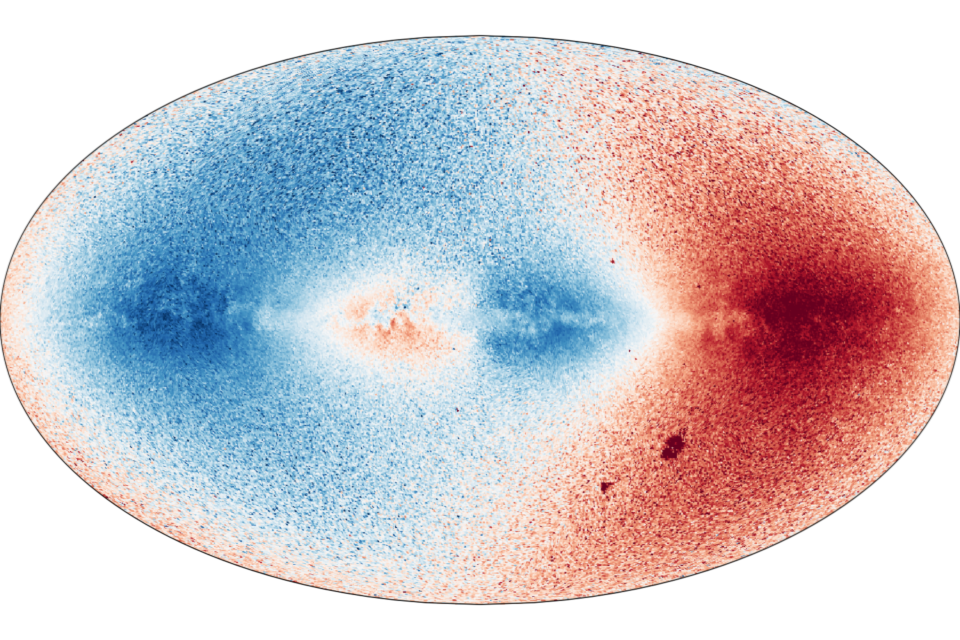
The detailed information of this census of over one billion stars, which comes from the Gaia mission, allows their positions and distances to be mapped to unprecedented precision giving us a 3-dimensional map of our Milky Way Galaxy.
This new release of information shows us 600 times more stars than previously available, covering a volume 1,000 times larger than Gaia’s own first data release two years ago, with precision some one hundred times improved. These results allow improved study of almost all branches of astronomy: from traces of the formation of the Solar System; through how stars evolve; through the current structure, the assembly and evolutionary history of the Milky Way; to mapping the distribution of Dark Matter in the Galaxy; to establishing the distance scale in the Universe; to discovery of rare objects.
This second data release allows progress in all these studies by providing not only distances and apparent motions across the sky for 1.3billion sources, but also very precise measurements of brightness and colour for an even larger catalogue of 1.7billion sources. Seven million stars have their line of sight velocities measured, providing full 6-dimensional – three space positions, 3 space motions – information, determining full orbits for those stars in the Milky Way. This is the information needed to weigh the Galaxy, and determine the distribution – and perhaps the properties – of Dark Matter, the mysterious substance which dominates the mass of the Galaxy and the Universe.

The mission is reliant on the work of UK teams at the Universities of Cambridge, Edinburgh, Leicester, Bristol, the Mullard Space Science Laboratory (MSSL) at UCL London and the Science and Technology Facilities Council’s (STFC) RAL Space facility, all of whom are contributing to the processing of the vast amounts of data from Gaia, in collaboration with industrial and academic partners from across Europe.
Professor Gerry Gilmore from the University of Cambridge, UK Principal Investigator for the UK participation in the Gaia Data Processing and Analysis Consortium, and one of the original proposers of the mission to ESA, said:
“The combination of all these unprecedented measures provides the information for astronomers to take the next big steps in mapping the formation history and evolutions of stars and our Milky Way Galaxy. There is hardly a branch of astrophysics which will not be revolutionised by Gaia data. The global community will advance our understanding of what we see, where it came from, what it is made from, how it is changing. All this is made freely available to everyone, based on the dedicated efforts of hundreds of people. There are so many exciting things to do better with the exquisite Gaia data we anticipate new science papers appearing every day after this release.”
UK participation in the European Space Agency mission itself has been funded by the UK Space Agency and scientists and engineers from around the UK played key roles in the design and build of Gaia.
The UK Space Agency has already contributed £15 million to Gaia and is committed to spending a further £4 million on processing and analysing the data.
Dr Graham Turnock, Chief Executive of the UK Space Agency, said:
“We’re working with industry and academia to support cutting-edge science that will lead to new discoveries about our Galaxy.
“The UK involvement in this exciting mission shows that our academics and engineers are world leaders in the space sector. As part of ESA we will continue to be at the forefront of research and deeply involved in missions such as ExoMars, with its Airbus-built rover, and the BepiColombo mission to Mercury.”
One of the new aspects of the Gaia data released today are radial velocities derived from Gaia spectra. Gaia releases radial velocities for some 7million stars, many times more than have been measured in the history of astronomy up to now, with vastly more to come in future releases.
Professor Mark Cropper leads the team at Mullard Space Science Laboratory/UCL that made the UK contribution to this spectroscopic processing effort and said:
“Spectra provide the critical information to complement Gaia’s astrometry, providing line of sight (radial, Doppler-shift) velocities and precise measures of stellar chemical element abundances. Gaia measures huge numbers of individually low-signal spectra – nearly 20 billion separate spectra to date – which must be carefully combined to deliver their full value. This demanding process is worth the effort! The remarkable map of the changing average radial velocity as we look around the sky is direct evidence of the rotation of our Galaxy.”
Dr Floor van Leeuwen from the University of Cambridge has been Project Manager for the UK and European photometric processing work, and is a leading co-author on the example science papers illustrating Gaia’s impact on our knowledge of star clusters and satellite galaxies in the outer Milky Way. Speaking of the new findings he said “Groups of dwarf galaxies, including the Magellanic Clouds, can now be observed to be moving around in very similar orbits, hinting at a shared formation history. The accurate observed motions and positions of the globular clusters and dwarf galaxies provide tracers of the overall mass distribution of our galaxy in a way that has not been possible with this level of accuracy before.”
STFC helped the set-up of the data applications centre for the project and STFC’s current support involves the UK exploitation of the scientific data that is now being yielded from the mission. In addition the photometric data processing software to which STFC contributed, as part of the UK-led team, offers the ability to precisely measure the brightness of the billion objects that Gaia is observing, while contributions from the rest of Europe are charting the positions, distances and movements of those one billion stars.
Professor Ian McCrea, Space Physics and Operations Division Head at STFC’s RAL Space said:
“Four years into the Gaia mission and it is incredible to see that our work in the UK on developing the photometric data processing software, that precisely measures the brightness of the billion objects that Gaia is seeing, is now successfully giving us comprehensive and detailed information that helps us better understand our true place in the Milky Way, our home galaxy. With this new data release and those that will follow, I am excited to see what new celestial objects, such as extra-solar planets, brown dwarfs, supernovae, asteroids, and of course, things that we have not even imagined have now been recorded.”
Gaia orbits the sun at a distance of 1.5 million kilometres from the earth and was launched by the European Space Agency in December 2013 with the aim of observing a billion stars and revolutionising our understanding of the Milky Way. During its expected five-year lifespan, Gaia will observe each of a billion stars about 70 times.
A special aspect of the Gaia mission is that the teams involved do not keep the results for their own science interests. Instead the Gaia data is released with free access to everyone for analysis and discovery.
Link: Press release: UK astronomers open new window on the Universe
Source: Gov Press Releases
Subjects for debate chosen by the Opposition
Link: MPs debate school funding and social care
Source: Parliamentary News