Press release: Government bolsters crackdown on extremism in prisons

A second separation centre to house the most subversive prisoners has opened as the Government redoubles its efforts in the fight to stamp out extremism – amid a surge in numbers jailed for terrorism-related offences.

The centre, at HMP Full Sutton, delivers on our commitment to curtail the influence of the most disruptive inmates, with a third such facility set to be in operation by the end of the year. The first opened at HMP Frankland in July 2017.

In addition, a new intelligence unit has been established while thousands of staff have received specialist training to spot signs of radicalisation, with every new prison officer enrolled on the programme.

It follows a 75% increase in prisoners convicted of terrorism-related offences in the last three years, resulting from the Government’s unprecedented action to counter extremism, radicalisation and terrorism.

With 700 prisoners considered a risk due to their extremist views, and foreign fighters returning from Syria and Iraq hardened and dangerous, the Government is meeting the challenge of confronting and countering the spread of poisonous ideology within prisons.

We have significantly increased our resources to tackle extremism in prisons, appointing 100 counter-terrorism specialists and training up more than 13,000 frontline staff to ensure they can identify, report and tackle extremist behaviour in all its forms.

The new intelligence unit will boost the ability of prison officers to target those who present the greatest extremist threat.

Justice Secretary David Gauke said:

As a result of the Government’s unprecedented action to protect the public from extremists, we have seen a 75 per cent rise in terrorism-related prisoners over the last three years.

That means we need to do more than ever before to confront and counter the threat, including the spread of all forms of poisonous ideology within prisons – and we are meeting that challenge.

With thousands of prison staff now trained to deal with extremism, an enhanced intelligence capability and separation centres for the most subversive prisoners, we are well equipped to deal with this threat.

The second centre will allow more offenders to be separated from the mainstream prisoner population, providing a crucial provision in tackling extremism. Offenders are placed in the centre if they are involved in planning terrorism or are considered to pose a risk to national security. Those seeking to influence others to commit terrorist crimes, or whose extremist views are undermining good order and security in prison, can also be placed there.

Notes to editors

  • HMPPS created Separation Centres within the high security estate to allow greater separation and specialised management of extremists who pose the highest risk to other prisoners. The first of these opened in July 2017 at HMP Frankland.
  • More than 13,000 staff – including all new prison officers – have completed ASPECTS training in the last year alone, providing them with the expertise needed to tackle extremist behaviour.
  • In April 2017 we also established a joint HMPPS and Home Office Extremism Unit to drive our approach to tackling the threat of extremism in prisons.

Link: Press release: Government bolsters crackdown on extremism in prisons
Source: Gov Press Releases

Press release: Rent boost for millions of claimants moving onto Universal Credit

New Universal Credit claimants already getting support with their housing costs will continue to receive Housing Benefit for 2 weeks after their claim ends, to help them transition onto Universal Credit.

This non-recoverable extra support is worth an average £233 and is set to help around 2.3 million people when they move onto Universal Credit.

Work and Pensions Secretary of State Esther McVey said:

Universal Credit has been specifically designed to be simpler and provide better personalised employment support. It ensures all benefits get paid in one monthly payment, so you won’t be getting separate amounts from different agencies for housing or tax credits.

However, we understand that moving onto Universal Credit can be a big change for those used to the previous benefits system – especially the monthly payment, designed to reflect the world of work. So this week, extra rent support is being made available to allow people to adjust from fortnightly Housing Benefit payments to monthly Universal Credit ones.

Universal Credit removes the barriers which prevented people from taking up work in the past, most notably the 16 hour cut off rule and the prohibitive tax rates should someone start work. Instead, Universal Credit ensures it pays to take on extra hours of work, and provides additional employment support to not only help get you into a job but also progress up the career ladder.

This extra help with housing costs, worth £550 million, is part of a wider £1.5 billion package of improvements for people when they first move onto Universal Credit. This includes:

  • extending the repayment of advances from 6 to 12 months, and allowing people to receive 100% of their payment upfront from January 2018
  • from February 2018, abolishing the 7 waiting day period to reduce the wait for payment so no one has to wait 6 weeks for their first Universal Credit payment

Other measures that will come in soon include:

  • Universal Credit claimants will be able to have their temporary accommodation costs met by Housing Benefit – this will enable local authorities to recoup more money they spend on temporary accommodation directly from the Department for Work and Pensions (DWP), which will prevent losses to them of more than £70 million in 2018 to 2019
  • extended partnership working with Citizen’s Advice, to provide more face to face support to Universal Credit claimants
  • making it possible for people to apply for advances online from spring 2018, making it even easier for a claimant to access an advance if they need it

Contact Press Office

Press Office

Caxton House

Tothill Street
London
SW1H 9NA

Follow DWP on:

Link: Press release: Rent boost for millions of claimants moving onto Universal Credit
Source: Gov Press Releases

Press release: Former FTSE 250 oil chiefs disqualified for breach of duties

The court recently ordered that Osman Shahenshah (56), the former chief executive of Afren PLC, and Shahid Ullah (59), the former chief operating officer, each be disqualified from running companies for 14 years, effective from 2 April 2018.

Afren was a former FTSE 250 listed independent upstream oil and gas exploration and production company, with operations across Africa and the Middle East, before it went into administration in July 2015 with an estimated deficiency of $1,754,614,564.

Shahenshah and Ullah’s disqualifications focus on their failure to declare to the Afren board that they had a vested interest in a number of high-value transactions.

One transaction concerned payments totalling $300m by Afren to a joint venture partner that resulted in a 15% fee payable through an ‘Oilfield Development Optimisation Services Agreement’ with a British Virgin Islands company controlled by the two directors and their families.

But neither the agreement nor the $45m fee had been disclosed to Afren’s board. Shahenshah received $9.2m and Ullah received $7.9m, while $8.2m was paid to other Afren Group senior employees.

A second series of transactions worth $170m, with a different joint venture partner, was also looked at by investigators. Again, the two directors failed to declare to the board their interest as they were also negotiating a potential 30% ownership of that company after a management buy-out.

Both transactions took place after Afren’s shareholders had capped what they deemed as ‘excessive’ benefits packages for senior executives.

The disqualifications prevent Shahenshah and Ullah from directly or indirectly becoming involved, without the permission of the court, in the promotion, formation or management of a company for the duration of their bans.

David Brooks, Group Leader at the Insolvency Service, said:

Afren PLC’s shareholders had expressed clear opposition for a number of years to benefits packages for senior executives in their company, which they viewed to be excessive. They capped such benefits shortly before the events in question.

Shahenshah and Ullah have clearly then reacted to that decision by negotiating secret benefits for themselves. Their decision to agree an undisclosed contract via a BVI company, while receiving the funds via a Bermudan company of exactly the same name, best illustrates the cloak and dagger nature of their actions referred to in Chief Registrar Briggs’ judgment.

I welcome the long period of disqualification given by the court, which underlines the gravity of directors breaching their fiduciary duties to a company and its shareholders.

Notes to editors

Afren PLC (CRO No. 05304498) was incorporated on 3 December 2004 and traded from Kinnaird House, 1 Pall Mall East, London SW1Y 5AU.

Osman Shahenshah’s date of birth is in January 1962 and he has resided in recent years in London.

Shahid Ullah’s date of birth is in February 1959 and he has resided in recent years in Texas, USA.

Court evidence

Osman Shahenshah and Shahid Ullah breached their duties to Afren PLC by failing to declare an interest in a proposed transaction, and a potential conflict of interests, prior to the transfer of $300M by Afren PLC to a joint venture partner from August to November 2013. As a result, again without disclosure to Afren PLC, benefits totalling $45M were charged to the joint venture partner by a company directly or indirectly controlled by Mr Shahenshah and Mr Ullah:

  • On 4 July 2012, Afren PLC and the joint venture partner entered into a contract, effectively agreeing a $100M interest free advanced payment.
  • On 23 August 2013 they entered into a second contract, by which $180M was paid by Afren PLC on 27 August 2013 and $120M on 1 November 2013.
  • Afren PLC had received criticism from shareholders that its executive remuneration policies had led to excessive pay, and they had voted 80% against the proposed remuneration plan in 2013. A new remuneration policy was proposed in the 31 December 2013 annual report which capped executive bonuses to 200% of base salary for the CEO and 160% for other executive directors.
  • Mr Shahenshah and Mr Ullah had been in negotiations with the joint venture partner from at least May 2013 that it would pay a fee to a British Virgin Islands (“BVI”) registered Special Purpose Vehicle (“SPV”) directly or indirectly controlled by Mr Shahenshah and Mr Ullah. An ‘Oilfield Development Optimization Services Agreement’ was entered into with the BVI SPV on 25 October 2013, including a 15% fee on net cashflows. Neither the negotiations nor the contract were disclosed to the Afren PLC board.
  • On 8 December 2013 and 6 March 2014, the SPV invoiced the joint venture partner 15% fees based directly on the above payments from Afren PLC of $180M and $120M. Payments of $27M on 19 January 2014 and $18M on 11 March 2014 were made to a Bermudan company, which had the same name as the BVI SPV. Subsequently $9.2M was paid from this account to Mr Shahenshah, $7.9M to Mr Ullah and $8.2M to other Afren Group senior employees. Neither the invoices nor the payments were disclosed to the Afren PLC board.
  • An internal investigation into potential listings breaches led to discovery of these communications and transactions by the AFREN Board in July 2014. The subsequent reporting of the dismissal of Mr Shahenshah and Mr Ullah for gross misconduct was a contributory factor to Afren PLC’s insolvency and $8.1M is unpaid from a $20.1M settlement agreement between Afren PLC and Mr Shahenshah and Mr Ullah.

Mr Shahenshah and Mr Ullah breached their duties to Afren PLC by failing to declare an interest in a proposed transaction and a potential conflict of interests, both before and after agreements were made on 11-13 December 2013 with a project partner, by which Afren would pay $100M, and grant a bank guarantee of $70M. Mr Shahenshah and Mr Ullah failed to declare to the Afren PLC Board that they had been directly facilitating a management buy out within the project partner from at least May 2013, by which they would take a direct or indirect ownership interest of 30% in the purchasing SPV:

  • On 11 December 2013, Afren PLC agreed an amended and restated production and technical services agreement with the project partner, as well as a resolution agreement, agreeing $100M as settlement for disputes over tax allowances. Afren PLC also agreed on 13 December 2013 to guarantee a bank loan to the project partner up to $70M.
  • Afren PLC had received criticism from shareholders that its executive remuneration policies had led to excessive pay, and they had voted 80% against the proposed remuneration plan in 2013. A new remuneration policy was proposed in the 31 December 2013 annual report which capped executive bonuses to 200% of base salary for the CEO and 160% for other executive directors.
  • Mr Shahenshah and Mr Ullah had been in negotiations with a director of the project partner from at least 29 May 2013, on which day a personal email proposed that they facilitate the director’s proposed management buy out of the project partner. This included Afren PLC paying $100M for a 20% interest in the new company, and a further $100M as a tax settlement, with an SPV to receive bonus equity of 10% linked to these payments. A further 25% interest in the new company was proposed for the SPV. These negotiations, which reduced the total SPV fee to 30%, and the directors’ subsequent personal involvement in the buy-out on 20 December 2013, were not disclosed to the Afren PLC Board prior to its above agreements with the project partner. On 23 September 2013, Mr Shahenshah sent an email to Mr Ullah with a draft of the proposed Board paper recommending the transactions, in which he additionally stated “I’m not sure about mentioning the buyout”.
  • Planning for a 30% stake in the SPV continued after the management buy out and Mr Ullah received an email on 24 February 2014 attaching a proposed restructure for the project partner and its new owning SPV. This set out that 30% of the SPV would be owned itself by an “Offshore corp”. The proposed ultimate part-ownership of the project partner was not disclosed to the Afren PLC Board.
  • An internal investigation into potential listings breaches led to discovery of these communications and transactions by the Afren PLC Board in July 2014. The subsequent reporting of the dismissal of Mr Shahenshah and Mr Ullah for gross misconduct was a contributory factor to Afren PLC’s insolvency.

Case updates on the Serious Fraud Office’s investigation into Afren PLC can be found here. The trial arising from the investigation is due to take place on 3 September at Southwark Crown Court.

About disqualifications

A disqualification order has the effect that without specific permission of a court, a person with a disqualification cannot:

  • act as a director of a company
  • take part, directly or indirectly, in the promotion, formation or management of a company or limited liability partnership
  • be a receiver of a company’s property

In addition that person cannot act as an insolvency practitioner and there are many other restrictions are placed on disqualified directors by other regulations.

Further information on director disqualifications and restrictions can be found here.

The Insolvency Service administers the insolvency regime, investigating all compulsory liquidations and individual insolvencies (bankruptcies) through the Official Receiver to establish why they became insolvent. It may also use powers under the Companies Act 1985 to conduct confidential fact-finding investigations into the activities of live limited companies in the UK. In addition, the agency authorises and regulates the insolvency profession, deals with disqualification of directors in corporate failures, assesses and pays statutory entitlement to redundancy payments when an employer cannot or will not pay employees, provides banking and investment services for bankruptcy and liquidation estate funds and advises ministers and other government departments on insolvency law and practice.

Further information about the work of the Insolvency Service, and how to complain about financial misconduct, is available.

Contact Press Office

Media enquiries for this press release – 020 7637 6498 or 020 7596 6187

Press Office

The Insolvency Service


4 Abbey Orchard Street
London
SW1P 2HT

This service is for journalists only. For any other queries, please contact the Insolvency Enquiry line on 0300 678 0015.

For all media enquiries outside normal working hours, please contact the Department for Business, Energy and Industrial Strategy Press Office on 020 7215 1000.

You can also follow the Insolvency Service on:

Link: Press release: Former FTSE 250 oil chiefs disqualified for breach of duties
Source: Gov Press Releases

Press release: Charity Commission opens statutory inquiry into The Save the Children Fund

The Charity Commission, the charity regulator for England and Wales, has opened a statutory inquiry into The Save the Children Fund (registered number 213890) over concerns about the charity’s handling, reporting and response to serious allegations of misconduct and harassment against senior staff members in 2012 and 2015.

The Commission was in regulatory engagement with The Save the Children Fund in 2015-16, after the charity reported a serious incident relating to allegations of misconduct and harassment against a senior staff member; the regulator also received an anonymous complaint about the charity’s response to further allegations against senior staff members. At that time, the Commission met with the Chair and instructed the charity to provide it with the findings of its independent review. It received direct assurance from trustees that all of these recommendations had been accepted and were being urgently acted upon.

The Commission re-engaged with the charity in February 2018 when they were responding to further public scrutiny about the 2015 issues. At this time, the charity announced a new review into workplace culture at the charity, which amongst other things will assess whether recommendations from a previous review have been fully and effectively implemented.

As a result of that more recent engagement with the charity, alongside new information from other sources that has recently come into the regulator’s possession, the Commission is concerned about:

  • whether the charity adequately reported the full extent and nature of allegations to the Commission in 2015/16
  • how the charity handled various complaints in 2012 and 2015 and, as a result, the extent of any reviews conducted at the time by the trustees into the charity’s response to the allegations
  • the charity’s decision making since February 2018 on its public position regarding these allegations

As a result, the Commission opened a statutory inquiry into the charity on 4 April 2018. The new investigation will examine, among other matters, whether trustees have:

  • adequately discharged their duties in handling the allegations at the time, and in fulfilling their duty of care towards their employees
  • ensured the charity has implemented measures about operating to appropriate standards of work place conduct and staff safeguarding – including testing staffing misconduct allegations, complaints or incidents received by the charity since 1 January 2016
  • made decisions around public handling and reputation management on the historic allegations appropriately
  • disclosed fully, frankly and accurately, serious incidents relating to staffing matters to the Commission

The inquiry is confined to the issues of safeguarding in the context of misconduct and harassment of the charity’s staff; it is not examining safeguarding in the context of The Save the Children Fund’s programme delivery for beneficiaries.

Michelle Russell, Director of Investigations and Enforcement at the Charity Commission said:

This inquiry centres specifically on how the charity handled complaints in 2012 and 2015 about senior members of staff, and how the charity responded to and managed public and media scrutiny of those events in 2018.

Opening a formal investigation does not necessarily mean that we have concluded that there has been wrongdoing by the trustees of The Save the Children Fund. However, we do have questions that must be answered, and we need to hold the charity formally accountable for providing them in a clear and timely manner.

It is the Commission’s policy, after it has concluded an inquiry, to publish a report detailing what issues the inquiry looked at, what actions were undertaken as part of the inquiry and what the outcomes were. Reports of previous inquiries by the Commission are available on GOV.UK.

Notes to editors

  1. The Charity Commission is the independent regulator of charities in England and Wales. To find out more about our work, see the about us page on GOV.UK.
  2. Search for charities on our check charity tool.
  3. Section 46 of the Charities Act 2011 gives the Commission the power to institute inquiries. The opening of an inquiry gives the Commission access to a range of investigative, protective and remedial legal powers.
  4. The Commission recently announced a new suite of measures on safeguarding including the establishment of a dedicated safeguarding task force.
  5. The Commission will not seek to conduct work already commissioned by the charity in March 2018 in an Independent Review of Workplace Culture. The terms of reference of the Workplace Culture Review is wider, focused on understanding the current workplace cultures and levels of trust in the organisation. The Workplace Culture Review is however, looking at the implementation of the 2015 recommendations – considering the effectiveness of the implementation and actions identified in the 2015 review. The inquiry will expect to engage directly with the Independent Review of Workplace Culture on these aspects.

Press office

Link: Press release: Charity Commission opens statutory inquiry into The Save the Children Fund
Source: Gov Press Releases

Press release: PM announces £70 million to transform Birmingham stadium for 2022 Commonwealth Games

Prime Minister Theresa May will today announce that £70 million of investment will be earmarked to transform Alexander Stadium into a world-class athletics venue for the Birmingham 2022 Commonwealth Games.

The stadium will host athletes from across the Commonwealth competing in track and field, as well as the opening and closing ceremonies.

The Prime Minister, whose visit comes as Birmingham gets ready to take on the baton from the Gold Coast at the closing of the Commonwealth Games this Sunday, will announce the investment while visiting Alexander Stadium, where she will meet young athletes hoping to be the stars of future Games.

Prime Minister Theresa May said:

Birmingham’s dynamism, diversity and ambition capture exactly what it is to be part of the Commonwealth and I’m sure that in four years’ time, the people of this city will host an incredible event which showcases the very best of Britain to the world.

The investment I am announcing today will transform the stadium into a state-of-the-art facility benefitting the local community and the region well beyond 2022.

Birmingham was awarded the right to host the Commonwealth Games last year after the city impressed the Commonwealth Games Federation with its ambitious bid to create a lasting sporting legacy with its focus on inspiring young people and celebrating the diversity of the Commonwealth.

Plans are underway for Alexander Stadium’s capacity to increase from 12,700 to 40,000 in time for the Commonwealth Games, and to retain 20,000 permanent seats after the event.

The revamped stadium will also include new community sports facilities within the new stand, a permanent warm-up track and a new conference meeting space created to host business and cultural events after the Games.

Link: Press release: PM announces £70 million to transform Birmingham stadium for 2022 Commonwealth Games
Source: Gov Press Releases

Press release: PM meeting with Prime Minister Costa: 10 April 2018

A Downing Street spokesperson said:

The Prime Minister held a bilateral meeting with Portuguese Prime Minister António Costa at Downing Street earlier today.

The Prime Minister said that the UK deeply values our long-standing alliance with Portugal and wanted to maintain and strengthen those ties in future across a range of areas, including science, defence, and trade and investment.

They discussed the recent attacks in Syria and Salisbury and agreed that the international community needed to come together to uphold the worldwide prohibition on the use of chemical weapons.

They also discussed Brexit and the progress of negotiations. The Prime Minister underlined the value she placed on the contribution of the Portuguese community in the UK. Prime Minister Costa also welcomed the contribution of UK nationals in Portugal and expressed his desire to maintain a close relationship with the UK after exit.

The Prime Minister also noted that yesterday marked the centenary of the First World War battle of La Lys where the Portuguese suffered their greatest loss of life, and she paid tribute to the bravery of the Portuguese forces.

Link: Press release: PM meeting with Prime Minister Costa: 10 April 2018
Source: Gov Press Releases

Press release: PM phone call with President Trump and President Macron: 10 April 2018

A Downing Street spokesperson said,

The Prime Minister held separate telephone conversations earlier today with the US President Donald Trump and the French President Emmanuel Macron.

They agreed that reports of a chemical weapons attack in Syria were utterly reprehensible and if confirmed, represented further evidence of the Assad regime’s appalling cruelty against its own people and total disregard for its legal obligations not to use these weapons.

They agreed that the international community needed to respond to uphold the worldwide prohibition on the use of chemical weapons.

They agreed they would continue working closely together and with international partners to ensure that those responsible were held to account.

Link: Press release: PM phone call with President Trump and President Macron: 10 April 2018
Source: Gov Press Releases

Press release: Secretary of State reaffirms commitment of UK Government to Belfast Agreement

Speaking after her bilateral meeting this afternoon with An Tánaiste, Simon Coveney TD, the Secretary of State reaffirmed the commitment of the United Kingdom Government to the 1998 Agreement.

Secretary of State for Northern Ireland, Rt Hon Karen Bradley MP said:

The Agreement reached on 10 April 1998 offered the prospect of a new beginning for relationships within Northern Ireland; between Northern Ireland and Ireland; and throughout these islands.

On this, the 20th anniversary of that historic Belfast Agreement, the United Kingdom Government welcomes the peace and stability that has been achieved in Northern Ireland. The bilateral relationship between the United Kingdom and Ireland has never been stronger.

The 1998 Agreement and its successors have been the bedrock of political progress in Northern Ireland over the past two decades. The UK Government remains committed to working together with the Irish Government, in full accordance with the well-established three-stranded approach to Northern Ireland affairs, to ensure that the Agreement is fully protected and implemented.

This means upholding the core principles that there can be no change in the constitutional status of Northern Ireland without the consent of a majority of people who live there; inclusive devolved government; North-South co-operation and the strongest bilateral relationship between the UK and Ireland; and the protection of people’s rights, culture and identity.

The current political impasse in Northern Ireland and the absence of a fully functioning devolved Executive and Assembly is deeply regrettable. The UK and Irish Governments remain fully committed to the restoration of devolved government at the earliest possible opportunity and will do whatever we can, in accordance with the three-stranded approach, to achieving that.

A huge amount has been achieved in Northern Ireland over the past twenty years: politically, socially, economically, and of course in respect of the security situation. There is, however, still much work to be done. Today, we take inspiration from those who took enormous risks, on all sides, to reach an accommodation twenty years ago.

The UK Government reaffirms its commitment to building a shared society in Northern Ireland that works for everyone. We also remember those who were killed or injured during the Troubles. We also recall the sacrifice of the Royal Ulster Constabulary and the Armed Forces in upholding democracy and the rule of law. We will never forget the debt that we owe them.

The UK Government continues to believe that the best way we can honour them, as well as discharge our obligations to this and future generations, is through the full implementation of the Belfast Agreement, along with its successors, to achieve a stronger, more prosperous and united Northern Ireland. We want to build a Northern Ireland that is fit for the future.

Link: Press release: Secretary of State reaffirms commitment of UK Government to Belfast Agreement
Source: Gov Press Releases

Press release: Free tyre checks at fire charity car wash

In a national project being trialled in the North West, Highways England is working with fire and rescue services to offer free tyre safety checks and advice alongside a long-running programme of fire station charity car washes. As part of the pilot project, Cheshire Fire and Rescue Service, Lancashire Fire and Rescue Service and The Fire Fighters Charity have allowed Highways England traffic officers and other staff to run the tyre checking service at several car wash events – with the latest at Lancashire’s Fulwood fire station on Saturday (14 April).

Highways England is working to reduce the number of people killed or seriously injured on England’s motorways and major A roads by 40 percent by 2020 and says focusing on tyre safety will make an important contribution. The tie-up with firefighters and the established charity car wash events is seen as a friendly and informal way of reaching drivers to spread the tyre safety message.

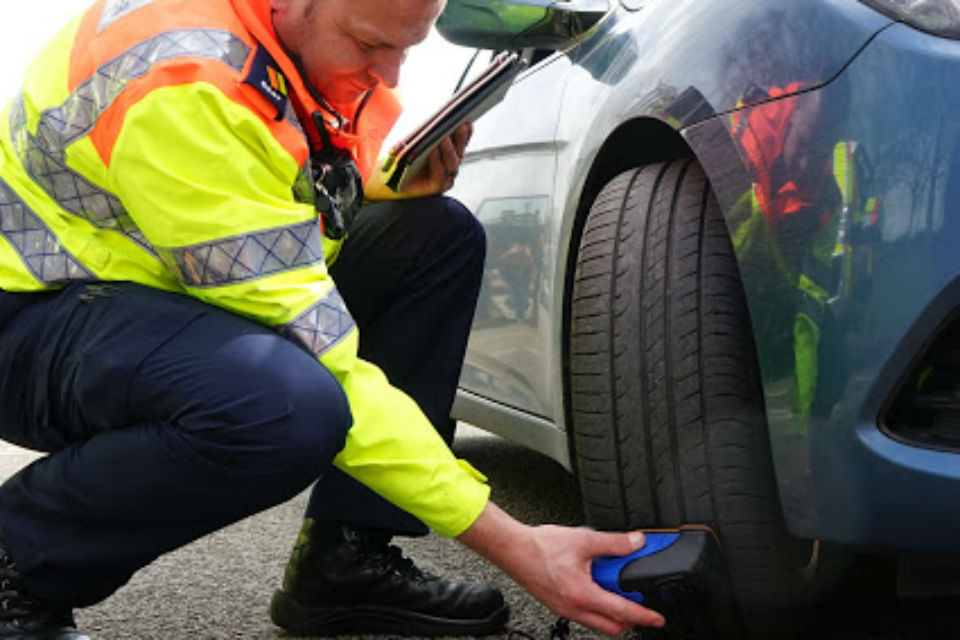
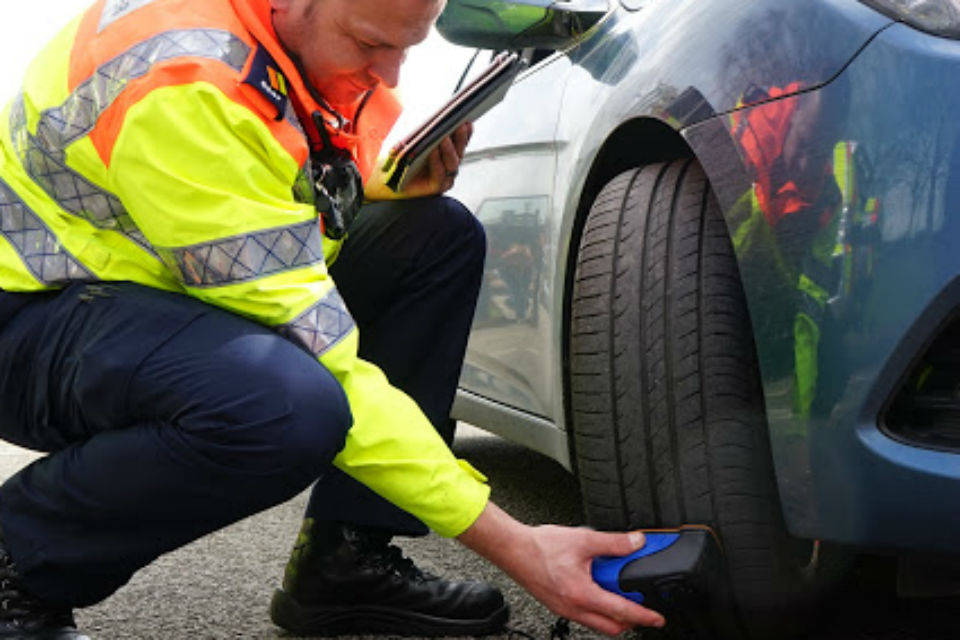
Traffic officer checking a tyre
Highways England traffic officer Neil Waring, from Knutsford outstation, checking car tyres at one of Cheshire’s charity car wash events last month

Stuart Lovatt, Highways England’s Road Safety Lead, said:

Highways England and fire and rescue services have a mutual interest in reducing the number of incidents caused by poorly-inflated or damaged tyres which could be picked up by simple and regular checks. The Fire Fighters Charity’s National Car Wash programme is now huge – involving some 20,000 vehicles across more than 600 events annually. We think it’s a great way of reaching out to potentially thousands of drivers to check their tyres for free and give them safety advice while they wait for their cars to be washed.

The feedback from the first 2 events we’ve run at Frodsham and Ellesmere Port fire stations last month has been really positive and after Saturday’s visit to Fulwood we’ll be assessing whether we can extend the idea right across the country.

Firefighters are among the emergency service workers called out to tyre-related incidents on the motorway and major A road network while Highways England traffic officers and colleagues have to manage the congestion caused by breakdowns, punctures and road traffic collisions. Statistics show:

  • there were 80,000 tyre incidents on England’s network of motorways and major A roads between 2013 and 2015
  • Lancashire Fire and Rescue Service was called out to over 4,500 vehicle incidents between 2015 and 2017
  • Cheshire Fire and Rescue Service was called out to 2,866 vehicle incidents over the same period
  • 27% of vehicles have at least one illegal tyre (Tyresafe 2016)
  • 40% of road traffic accidents caused by vehicle defects are tyre related (DfT 2015)
Hi-tech scanning device checking tyres
Hi-tech scanners are being used to carry out the free tread and pressure checks

Tony Crook, an Area Manager at Lancashire Fire and Rescue Service, said:

We attend over a thousand road traffic collisions each year and some of these could have been prevented if the vehicles involved were fitted with legal tyres.

Our firefighters see first-hand the dangers of driving poorly-maintained vehicles and we hope that this new partnership with Highways England will result in preventing crashes and even saving lives.

Watch Manager Andy Gray, a Road Safety Officer at Cheshire Fire and Rescue Service, said:

Tyre treads are designed to give good grip on wet roads. As the tread wears down the tyre loses the ability of good grip. It is essential that people regularly check their tyres. Many tyres only get checked at their yearly MOT inspection and then subsequently fail, resulting in a vehicle that could well have been driving with unsafe tyres for some time.

This partnership not only benefits people immediately with the tyre checks but crews will show and educate them on how to check their tyres in the future. The Fire Fighters Charity also benefits from the public’s kind donations from the car wash events. These are positive events where you can meet multiple partners who want to engage with you and help keep you safe on the roads.

Drivers attending Saturday’s car wash event can get a free hi-tech check of their tyres from 3D tyre tread checking scanners linked to an app on a smart device. The scanners allow a quick and easy way to check tyre tread levels and provide instant feedback and advice to motorists, via a print out.

More information about the Fire Fighters Charity can be found on their website.

General enquiries

Members of the public should contact the Highways England customer contact centre on 0300 123 5000.

Media enquiries

Journalists should contact the Highways England press office on 0844 693 1448 and use the menu to speak to the most appropriate press officer.


Link: Press release: Free tyre checks at fire charity car wash
Source: Gov Press Releases