
Statement to be made by the Secretary of State in the House of Commons
Link: Statement on Withdrawal Agreement between the UK and the EU
Source: Parliamentary News
Statement to be made by the Secretary of State in the House of Commons
Link: Statement on Withdrawal Agreement between the UK and the EU
Source: Parliamentary News
Home Affairs Committee publishes follow-up report into UK-EU security cooperation after Brexit
Link: Brexit negotiators putting public safety at unnecessary risk
Source: Parliamentary News
The Environment Agency has stepped up its incident response to tackle the impacts of continued dry weather, following the driest June since 1925.
Record-breaking temperatures and very low rainfall throughout May, June and much of July is taking its toll on the environment, with wildlife suffering as river levels drop. EA teams have responded to 44 significant environmental incidents since the end of June including moorland fires, algal blooms, dry boreholes, low river flows and fish rescues.
The National Drought Group (NDG), chaired by Sir James Bevan, Chief Executive of the Environment Agency convened today (Monday 23 July) to discuss the operational approach to managing water supplies and review preparation for the pressures ahead.
The group is made up of 30 organisations including water companies, regulators and environmental groups. During the meeting, water companies explained how they were implementing activity set out in their drought plans and increasing efforts to reduce leakage.
NDG members set out how they had stepped up activity on all fronts and urged everyone to reduce water use and wastage to conserve supplies and protect the environment.
See the NDG’s full position statement GOV.UK
Sir James Bevan, Chief Executive Environment Agency said:
The water that comes from the tap is taken from our rivers and reservoirs and the amount we use has a direct effect on people and the environment around us.
As we prepare for drought in the North West and dry weather continues around the country, we have stepped up our response to minimise wastage and tackle the impacts of low river flows on wildlife.
We all have a part to play to protect this precious resource. I expect water companies to step up their efforts to ensure supplies are well-managed and people at home should use water wisely.
The lack of rain has led to a rapid decline in reservoir levels in the North West. The EA is preparing for drought in the region and United Utilities have announced a hosepipe ban affecting 7 million people from early August. The company have applied for 2 drought permits and 1 drought order across Cumbria, which the EA are now considering. The company is preparing a further 3 drought permits to be submitted before the end of July.
Dry weather is also affecting a number of sectors, notably agriculture with concerns about water supplies needed for irrigation and potentially lower yields. The EA is meeting with affected groups to provide practical advice about conserving water and planning for drought, should the dry weather continue.
Further action the EA is taking includes:
Around the country, water companies have enough water to maintain supplies if resources are managed properly and if the public use water wisely but a dry end to the summer and dry autumn could see the risk of restrictions and further environmental impacts spread across the country.
Reducing the amount of water we use helps protect the environment and conserves supplies during extended periods of dry weather. There are a number of ways the public can use water wisely including:
You can find more water saving tips at waterwise
Link: Press release: Environment Agency responds to impacts of dry weather
Source: Environment Agency
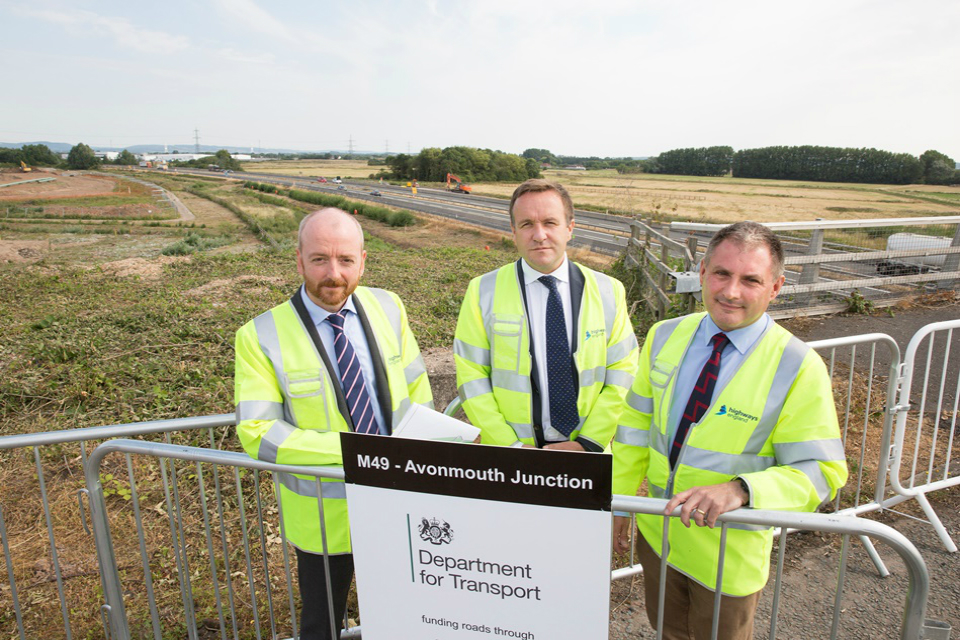
A new junction Highways England is creating on the M49 will improve road access and provide a much-needed connection into the Avonmouth and Severnside Enterprise Area from the motorway network.
The junction, which comprises two bridges, will also promote economic growth in this area of Bristol, and reduce the numbers of HGVs and other vehicles on the local road network.
At a groundbreaking ceremony, key regional business leaders joined Highways England, the company responsible for the country’s motorways and major A roads, and local authorities to welcome the £49 million scheme, which calculations are forecasted to help create 14,000 jobs in the area.
Nick Aldworth, Highways England’s South West Regional Delivery Director said:
We’re delighted to be breaking ground on this strategically and economically important scheme for the South West and Bristol area.
Every £1 invested in this scheme will bring more than £30 into the local economy, generating more than 14,000 jobs in the long term.
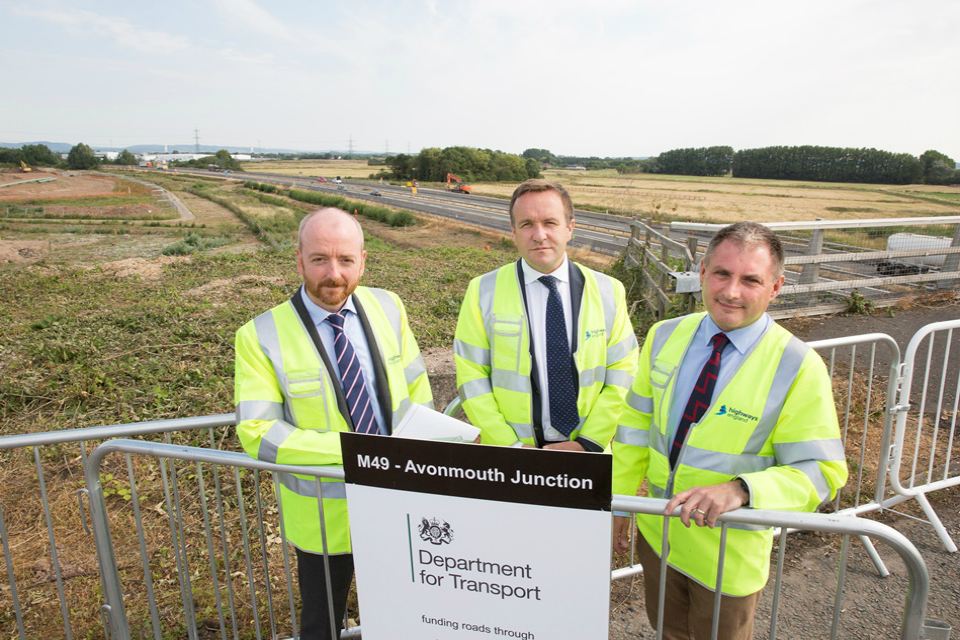
Highways England is working with partners, including South Gloucestershire Council, Bristol City Council and the West of England Local Enterprise Partnership, on the scheme which involves using the existing bridge at Farm Lane with a second bridge being built immediately next to it.
Located to the south of the Western Approach Distribution Park and west of the village of Easter Compton, the two bridges will be incorporated into a single roundabout spanning the motorway with new access and exit slip roads connecting fully with both northbound and southbound traffic.
The scheme has also been welcomed by joint venture partners Robert Hitchins Ltd and Harrow Estates plc, who own the neighbouring 300-acre Westgate employment site.
Simon Tothill, Property and Development Director for Robert Hitchins, said:
We have worked closely with Highways England for the last three years to enable the opening up of this area and are delighted to see progress being made.
This project is all about the creation of jobs and economic growth. We have absolutely no doubt that it will be a huge boost to the region, deliver significant new investment into the area and unlock the large and incredibly well-located Westgate site, which already benefits from planning permission for employment uses.
SevernNet, who represent business and residents in the Severnside area, added:
SevernNet is delighted with Highways England’s commitment to construct the M49 intermediate junction for Severnside – a direct link to the strategic road network will support those businesses already established and facilitate further growth within the Avonmouth Severnside Enterprise Area, and also relieve congestion in and around Avonmouth.
At the ceremony, Jack Lopresti, MP for Filton and Bradley Stoke, was joined by Peter Mumford, Highways England Executive Director of Major Projects, and Highways England Regional Investment Programme Director David Haimes, together with construction partners Galliford Try, South Gloucestershire Council, Bristol City Council and West of England LEP representatives.
The new M49 junction project is the first Road Investment Strategy scheme to start construction in the South West, one of six multi-million pound road schemes aimed at boosting the economy, tourism and heritage in the region.
Another key milestone in the South West within the next six months includes next steps in the planning process for the A303 Stonehenge tunnel and dualling scheme and the A30 Chiverton to Carland Cross dualling scheme in Cornwall.
The upgrades are funded by the Government’s biggest-in-a-generation £15 billion investment in motorways and main A roads, and delivered by Highways England.
Construction of the new M49 junction is due to be completed by December 2019 and local communities and business will be kept informed on progress by the Highways England project team and construction partners Galliford Try.
Duncan Elliott, Managing Director of Galliford Try’s Highways business, said:
We’re delighted to get cracking on a much-needed scheme that will bring far-reaching benefits. We have considerable experience of motorway work from our participation in the Smart motorways programme and will bring this to bear on the Avonmouth junction scheme. We will keep any disruption to a minimum and keep road users updated about progress.
For more information visit the M49 Avonmouth scheme web page.
Members of the public should contact the Highways England customer contact centre on 0300 123 5000.
Journalists should contact the Highways England press office on 0844 693 1448 and use the menu to speak to the most appropriate press officer.
Link: Press release: Business leaders hail M49 junction construction as boost to economy
Source: Gov Press Releases
Peers discuss preparations connected with EU withdrawal
Link: Lords debates Brexit negotiations
Source: Parliamentary News
Mandatory full fibre broadband for all new build homes and a new priority to connect hard-to-reach rural areas are key measures proposed in a national, long-term strategy for UK telecommunications.
The new approach is aimed at driving large-scale commercial investment in the fixed and wireless networks that are vital for the UK to remain globally competitive in a digital world.
The Future Telecoms Infrastructure Review (FTIR), announced as part of the government’s modern Industrial Strategy, proposes the changes that are needed to give the majority of the population access to 5G, connect 15 million premises to full fibre broadband by 2025, and provide full fibre broadband coverage across all of the UK by 2033. Full fibre infrastructure is vital to underpin 5G coverage.
At its heart is an emphasis on greater consumer choice and initiatives to promote quicker rollout and an eventual full switch over from copper to fibre.
DCMS Secretary of State, Jeremy Wright said:
We want everyone in the UK to benefit from world-class connectivity no matter where they live, work or travel. This radical new blueprint for the future of telecommunications in this country will increase competition and investment in full fibre broadband, create more commercial opportunities and make it easier and cheaper to roll out infrastructure for 5G.
The FTIR’s analysis indicates that, without change, full fibre broadband networks will at best only ever reach three quarters of the country, and it would take more than twenty years to do so. It also indicates that 5G offers the potential for an expansion of the telecoms market, with opportunities for existing players and new entrants.
Key recommendations from the FTIR include:
The FTIR will drive competition and commercial investment in full fibre networks across as much of the UK as possible. However there will be some parts of the country where it will be unlikely that that the market will be able to deliver alone.
Nationwide availability of full fibre is likely to require additional funding of around £3 billion to £5 billion to support commercial investment in the final c.10% of areas. These, often rural areas, must not be forced to wait until the rest of the country has connectivity before they can access gigabit-capable networks.
The Government will therefore pursue an “outside-in” strategy, meaning that while network competition serves the commercially viable areas, the Government will support investment in the most difficult to reach areas at the same time. We have already identified around £200 million within the existing Superfast broadband programme that can further the delivery of full fibre networks immediately.
Sharon White, Ofcom Chief Executive, said:
We welcome the Government’s review, and share its ambition for full-fibre and 5G networks to be rolled out right across the UK. The Government and Ofcom are working together, and with industry, to help ensure people and businesses get the broadband and mobile they need for the 21st century.
We will shortly publish consultations on legislative changes to streamline wayleaves and mandate fibre connections in new builds. The conclusions of the Review will also form the basis of the government’s Statement of Strategic Priorities (SSP) to Ofcom, setting out the strategic objectives and outcomes that the regulator must have regard to in the exercise of its regulatory functions.
Link: Press release: Forging a full fibre broadband and 5G future for all
Source: Gov Press Releases
Two world-leading innovation centres in the North of England will lead the world in developing the technologies needed for future manufacturing, boosting local growth and creating highly-skilled, quality jobs, as part of the government’s modern Industrial Strategy, Business and Energy Secretary Greg Clark will announce today.
On a visit to Newcastle Mr Clark will confirm that the Onshore Renewable Energy Catapult in Blythe and the Centre for Process Innovation in Redcar, part of the High Value Manufacturing Catapult, will benefit from a cash injection which will support hundreds more businesses to develop products and services which will be in high demand in the future as part of the modern Industrial Strategy.
During his visit, Business Secretary Greg Clark will say:
The UK has a world beating reputation for innovation and we are building on this strength as part of our Industrial Strategy with the largest investment in R & D in 40 years. This investment will drive local growth and innovation across the country, creating more opportunities for high-skilled, well-paid jobs across the country.
The Catapult network plays a key role in building on UK strengths in sectors and technologies that are going to be in high demand in the years ahead, bringing ideas to products and services on the market. Today’s investment builds on the unique strengths the North East has in renewable energy and advanced manufacturing, helping drive the region’s future economic growth.
We’re working with local leaders and businesses who know their areas and its unique strengths best to develop tailored Local Industrial Strategies to create more opportunities and drive growth across the UK.
The UK is already pioneering the latest innovation through ‘Catapults’ which bring together the best of UK business, science and engineering to work side by side in research and development to ‘catapult’ products from ideas to market.
The Business Secretary will also announce that the North East, Tees Valley, West of England, Leicester & Leicestershire, Cheshire & Warrington and the Heart of the South West will be the second wave of areas to benefit from working with the government to develop their local Industrial Strategies. Putting local people and businesses in the driving seat, allowing local leaders to harness the strengths of their own areas in a targeted approach.
To ensure these local plans are underpinned and supported by robust institutions, the government will also publish the conclusions of a review of Local Enterprise Partnerships (LEPs) today and will announce up to £20m of additional funding – a 50% increase in resource funding for LEPs.
Andrew Hodgson, chair of the North East LEP, said:
This is fantastic news for the North East and testament to the pioneering work being carried out here to embed innovation that drives productivity and growth. We will build on the strong foundations of the North East Strategic Economic Plan to create 100,000 more and better jobs and the world class science and research already happening here in the North East.
The review will also lay out the government’s expectation of LEPs to improve their gender balance and representation of those with protected characteristics, with the aim of equal representation of men and women on boards by 2023.
A major support package for UK industry to power millions more homes and businesses over the next decade is also being announced today by Energy & Clean Growth Minister Claire Perry.
Offshore wind and, for the first time, remote island wind providers will be able to bid for contracts to power up to four million homes from Cornwall to the Shetland Isles. These clean electricity auctions will be held in 2019 and every two years from then on, signalling support worth up to £557 million for industry.
The auction will make the UK a beacon for inward investment and provide renewable energy businesses in the North East the certainty to invest and grow. This will encourage long term investment to help reduce the cost of energy.
Announcing the significant package on a visit to the Offshore Renewables Catapult in Newcastle, Energy & Clean Growth Minister Claire Perry will say:
The UK renewables sector is thriving, with more offshore wind capacity here than anywhere else in the world and 50% of electricity coming from low-carbon sources last year in what was our greenest year ever.
For the last decade the offshore wind industry has been a great British success story: increasing productivity, raising earnings and improving lives in communities across the UK; and today the sector gets the certainty it needs to build on this success through the next 10 years.
With wind turbines already providing 15% of the UK’s electricity, today’s fresh vote of confidence in the sector will secure its position as a global leader in a thriving industry, enhance confidence and encourage businesses to make long-term investment. The government has already met its ambition set out in the Clean Growth Strategy to produce 30% of its power from renewable sources by 2020/21 and this fresh support will see the UK secure its position as a world leader in low carbon energy.
Today’s announcement also supports supply chains from the south coast to north east. Companies such as Yorkshire-based Osbit Ltd, which specialise in the supply of technical equipment and engineering services to offshore wind projects are now set to benefit from today’s boost to the renewables industry to secure their future. It comes ahead of the first ever annual Green Great Britain Week- starting on 15 October – signalling the government’s continued commitment to driving clean growth and benefiting from the economic and industrial opportunities it brings.
Benj Sykes, Co-Chair of the Offshore Wind Industry Council and UK Country Manager at Ørsted said:
As well as cost-effectively reducing carbon emissions to meet our climate change targets, the offshore wind industry is powering the clean economy, bringing investment, skilled jobs and supply chain opportunities to businesses up and down the UK. Our sector has proposed a transformative ambition to deliver at least 30GW by 2030, enough to meet more than a third of the country’s electricity needs, which in turn could increase exports five-fold, create thousands of skilled jobs and reduce electricity system costs. Today’s announcement is a vote of confidence in our industry, and will directly enable more investment in the UK.
Link: Press release: A boost for North East innovation to promote high-quality jobs and growth
Source: Gov Press Releases
Thirteenth Informal Brexit Liaison Group meeting held on 4 July 2018
Link: Thirteenth Informal Brexit Liaison Group meeting held
Source: Parliamentary News
Thousands of properties across England will be better protected against the threat of flooding thanks to a multi-million pound investment by the government, Environment Minister Thérèse Coffey confirmed today (Friday 20 July).
Across the country 13 flood schemes will benefit from £40 million of additional funding which will unlock flood defence schemes and help support economic growth and regeneration in areas that have suffered from flooding in recent years.
The additional funding, first announced in the budget, adds to millions of pounds of government grant-in-aid already allocated to these projects and partnership funding already secured. It will help leverage an additional £24 million from other sources, enabling the flood schemes to go ahead. In total, more than 7,000 properties will be better protected against flooding, including over 5,000 homes. This additional money is part of our £2.6 billion investment from 2015 to 2021 to fund 1,500 flood defence schemes which will better protect 300,000 homes across the country.
Environment Minister Thérèse Coffey said:
This extra funding for flood defences will unlock schemes that will better protect thousands of homes and businesses against flooding, supporting regeneration in important towns and villages in the north and coastal communities.
It will boost our resilience as a nation and help our communities to grow and prosper.
In the historic English Channel tourist town of Weymouth, £1.2 million will improve the harbour wall, reducing flood risk to 450 properties and helping to kick start the regeneration of Weymouth town centre.
More than £10 million is also being awarded to a scheme to protect deprived communities in the St. Austell Bay area of Cornwall. The funding will unlock an additional £4.8 million of partnership funding contributions and is additional to £13.4 million of grant-in-aid which has already been allocated to the scheme. The funds will support an integrated regeneration partnership project, which will help to reduce flood risk and develop plans for new housing and community green space.
Five flood schemes in the north of England will receive almost half of the total funding – £17.4 million- in a boost to the Northern Powerhouse. Rochdale in Greater Manchester will receive a total of £5 million to develop one of the largest inland flood schemes in the region. The defences in Rochdale will increase the level of flood protection to 1,000 residential properties as well as critical infrastructure such as the tram network, a bus station, a grid sub-station and a waste water treatment works.
Eight miles to the west, £7 million has been awarded for new flood defence work around the River Irwell in Bury and Radcliffe as a first step towards the development of a new £46 million flood defence scheme, better protecting 870 properties. In addition to raising flood defences at key locations along the river’s edge another key aspect of the scheme will be the creation of a wildlife habitat and amenity areas for the public by setting defences further back from the river.
The new funding for flood defences in the north of England adds to the £3.4 billion already invested into the Northern Powerhouse to build a more prosperous and inclusive economy where everybody has the opportunity to reach their full potential.
Minister Thérèse Coffey added:
The north of England is a hotbed of culture, innovation and growth and this multi-million investment in flood schemes will help protect more than 2,700 homes and businesses from flooding.
The defences will also enhance the environment and bolster economic growth as part of our commitment to better protect 300,000 homes from flooding by 2021.
Over the past three years, the Environment Agency has completed more than 400 new flood schemes to better protect more than 142,000 homes. In addition to building hard defences, it has improved its response by investing in new technology and equipment like temporary flood barriers, pumps and 6,500 trained staff across the country.
Sir James Bevan, Chief Executive of the Environment Agency, said:
Across the country we are seeing more extreme weather, which makes the Environment Agency’s role to protect people, homes and businesses from flooding even more important.
From 2015 to 2021 we will reduce the risk of flooding for at least 300,000 homes so this £40million is another welcome boost to achieving that. It is great news for communities – not only will it help us build flood schemes but it will also help wider economic growth.
A table with details of the schemes is below.
| Project | Location | Additional funding (£m) | Potential leveraging of partnership funding contributions (£m) |
| Egremont, Skirting Beck defence improvements | Cumbria | 1.60 | 4 |
| St Austell Bar Resilient Regeneration Project – Par & St Blazey | Cornwall | 10.79 | 4.8 |
| Portreath Flood Alleviation Scheme | Cornwall | 1.50 | 0.5 |
| Paul stream channel/culvert refurbishments | Cornwall | 0.68 | 0.1 |
| Great Yarmouth Flood Defence improvements | Norfolk | 5.40 | 1.5 |
| Wiggenhall, Tidal River Bank improvements – Great Ouse Tidal Embankments | Norfolk | 0.20 | 0.1 |
| River Roch, Rochdale & Littleborough Flood Alleviation Scheme | Greater Manchester | 5.00 | 2.0 |
| Radcliffe & Redvales Flood Risk Management Scheme | Greater Manchester | 7.00 | 2.0 |
| Humber, Winteringham and South Ferriby tidal defence improvements | North Lincolnshire | 1.90 | 5.6 |
| Corbridge Flood Alleviation Scheme | Northumberland | 0.14 | 0.4 |
| Weymouth harbour wall improvement works | Dorset | 1.20 | Additional contributions being secured as part of the development of the wider strategy to further improve defences. |
| Fowlea Brook Flood Risk Management Scheme | Staffordshire | 0.5 | 0.5 |
| Holderness Drain Flood Alleviation Scheme & East Hull and Gt Culvert | Yorkshire | 3.70 | 2.6 |
Link: Press release: £40m extra funding to better protect thousands of homes against flooding
Source: Environment Agency
This Order provides for the conferral of functions the Greater London Authority has under the Business Rate Supplements Act 2009 (“the BRS Act”) on the West of England Combined Authority.
Link: The West of England Combined Authority (Business Rate Supplements Functions) Order 2018
Source: Legislation .gov.uk