
Elizabeth Denham – IAPP data protection intensive, keynote speech – News and Views from the ICO – 16 April.
Link: IAPP Europe Data Protection Intensive 2018
Source: ICO .org.uk
Elizabeth Denham – IAPP data protection intensive, keynote speech – News and Views from the ICO – 16 April.
Link: IAPP Europe Data Protection Intensive 2018
Source: ICO .org.uk
Public Accounts Committee report sets deadline for update on costed plans for vital security investment
Link: Faster action needed on lessons of WannaCry attack
Source: Parliamentary News
Data Protection Bill [HL]: Notices of Amendments as at 17 April 2018
Link: Publication: Notices of Amendments as at 17 April 2018
Source: Data Protection Bill
Business, Energy and Industrial Strategy Committee questions the Fawcett Society, 30% club and TUC
Link: Campaign organisations questioned on gender pay gap
Source: Parliamentary News
These Regulations amend the Export (Penalty) Regulations 2003 (S.I. 2003/3102) (‘the 2003 Regulations’). The 2003 Regulations provide in part for penalties for contravention of rules on exports set out in EU legislation. These Regulations replace references to the Community Customs Code and associated legislation which have lapsed with references to the Union Customs Code and associated legislation that are currently in force.
Link: The Export (Penalty) (Amendment) Regulations 2018
Source: Legislation .gov.uk
EU External Affairs Sub-Committee announces inquiry on future customs arrangements after Brexit
Link: Inquiry launched on Brexit: customs arrangements
Source: Parliamentary News
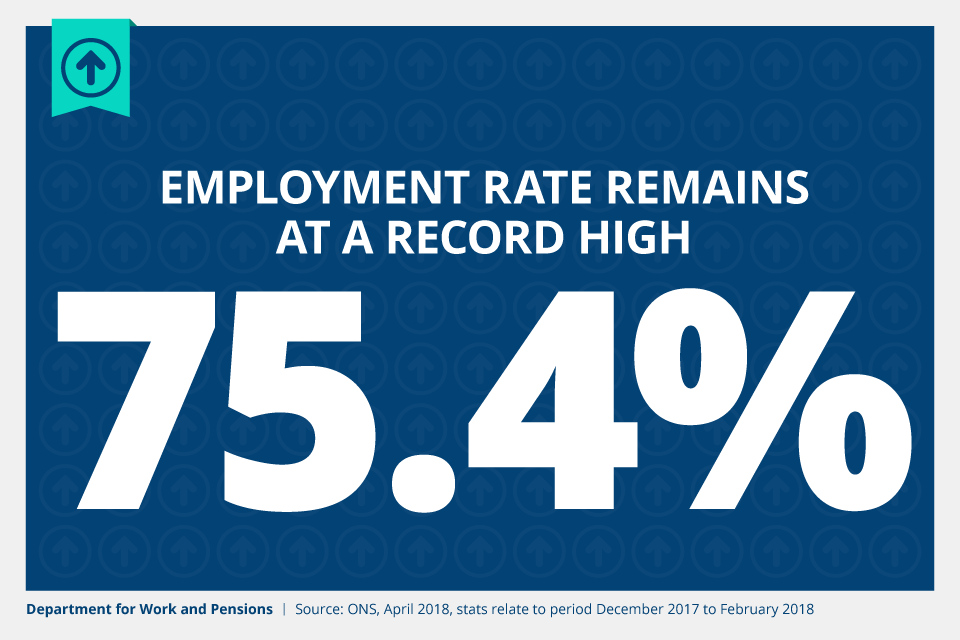
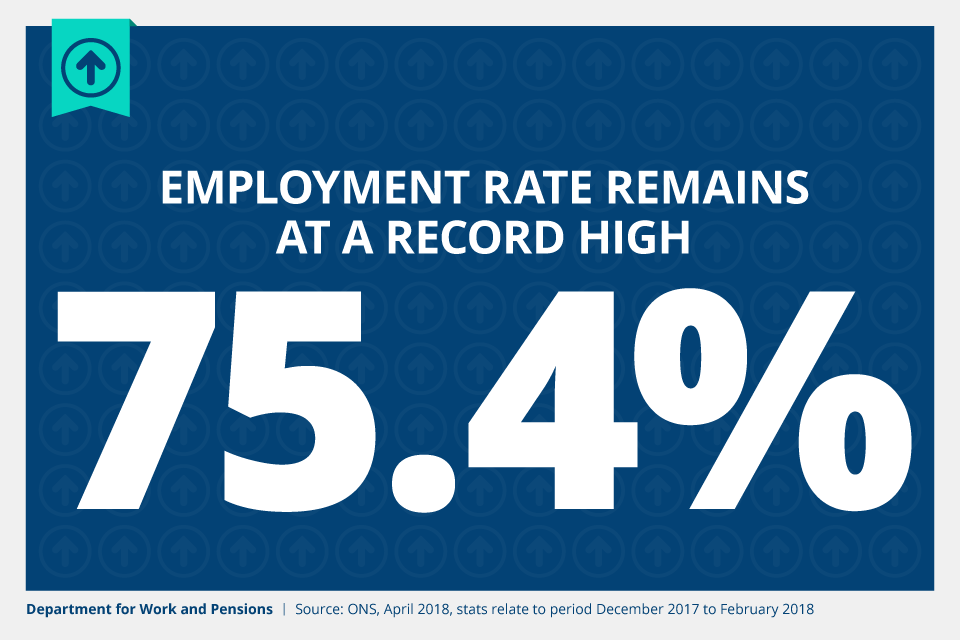
Figures released by the Office for National Statistics (ONS) show that 427,000 more people have moved into employment in the last year, with 32.26 million now in work. On average, 1,000 more people have entered employment every day since 2010.
The unemployment rate (4.2%) has not been lower since 1975, and the number of people out of work is down by 136,000 compared to a year ago.
In addition, as recognised by the ONS, wages are now outpacing inflation.
The Secretary of State for Work and Pensions, Esther McVey, said:
Another milestone for employment has been reached under this government as employment reaches a record high, up 3.2 million since 2010 – the 16th time the employment record has been broken in the same period.
That means on average, over 1,000 people have moved into work every day since 2010, and credit has to be given to the businesses who have created those jobs and the individuals who are taking those opportunities.
Day by day we are helping people turn their lives round by getting into employment. Jobs are key to transforming lives and work is the best route out of poverty.
And this month we have again increased the personal allowance and taken more people out of paying tax all together making sure people can keep more of what they earn.
This comes as we have reformed welfare to make work pay, backed businesses to take more people on, and built a stronger, fairer economy. But we want to help even more people benefit from a well-paid job. That’s why we are:
Today’s employment figures also show:
Read the Labour Market Statistics – April 2018 from the Office for National Statistics.
Caxton House
Tothill Street
London
SW1H 9NA
London Press Office (national media and London area enquiries only – not questions about personal claims)
020 3267 5144
Out-of-hours (journalists only)
07623 928 975
England and Wales (local media enquiries)
029 20 586 then 097 or 098 or 099
Scotland (local media enquiries)
0131 310 1122
Follow DWP on:
Link: Press release: Employment rate reaches another new record high
Source: Gov Press Releases
The government today (17 April 2018) launched an independent review of the Financial Reporting Council (FRC), the regulator for auditors, accountants and actuaries.
The review will be led by Sir John Kingman, who has extensive private and public sector experience. He will be supported by an advisory board which he will convene.
The root and branch review, due for completion by the end of 2018, will assess the FRC’s governance, impact and powers, to help ensure it is fit for the future.
The review aims to make the FRC the best in class for corporate governance and transparency, while helping it fulfil its role of safeguarding the UK’s leading business environment.
The review follows the announcement of Andrew Tyrie as the recommended new head of the Competition and Markets Authority, demonstrating the government’s determination that markets and the economy are working for consumers.
Business Secretary Greg Clark said:
The UK has a strong reputation as a dependable place to do business but this needs to be continuously updated and it’s important to ensure all of our regulators continue to drive high standards.
I am pleased to appoint Sir John who has a rigorous approach to bring to bear in leading this comprehensive review of the Financial Reporting Council. This review is part of the government’s Industrial Strategy aim of creating a business environment that ensures our regulators are fit for the future and our markets are working for consumers.
The review will include a consultation, asking for views on the FRC’s role in the British economy.
Link: Press release: Government launches review of audit regulator
Source: Gov Press Releases
International Development Secretary Penny Mordaunt will join President Kenyatta of Kenya to open trading at the London Stock Exchange today (17 April 2018) where she will praise the critical role financial markets play in supporting prosperity and growth across the Commonwealth – and welcome a new partnership between the London Stock Exchange and the Nairobi Securities Exchange.
Ms Mordaunt will unveil a partnership package between the Bank of England and central banks in Sierra Leone, Ghana and South Africa to share expertise, improve regulation and reduce the risk of bank failures. Expert Bank of England staff will help central banks develop sustainable financial systems that power local and regional growth, job creation and investment opportunities.
She will also announce UK funding to help developing countries raise investment from global capital markets in their own currencies, promoting investment and job creation.
International Development Secretary Penny Mordaunt said:
Healthy financial markets create opportunities for new investment, trade and jobs, playing a critical role in delivering the global prosperity that benefits us all.
What’s more, financial markets open the door to a future free from aid dependency. By building partnerships, sharing knowledge and opening up markets across the Commonwealth, we can defeat poverty, boost trade and investment, and deliver on the ambitions of countries that want to stand on their own two feet.
Dr Ernest Addison, Governor of the Bank of Ghana, said:
The Bank of Ghana is happy to be part of this technical cooperation programme with the Bank of England. We envisage benefitting from the Bank of England’s experience in dealing with financial stability and macroprudential regulation, to assess the full implications of macro issues on the financial system.
Joanna Place, Chief Operating Officer at the Bank of England said:
The Bank of England is excited to be embarking on this new partnership with the Bank of Ghana, the Bank of Sierra Leone and the South African Reserve Bank. In our increasingly interconnected global financial system, cooperation between central banks is critical to providing the financial stability on which all our citizens rely.
We look forward to supporting our counterparts in delivering their priorities in building this essential foundation for growth.
Ms Mordaunt will also welcome the launch of the Commonwealth Digital Finance Champions Group. By sharing expertise and knowledge, the Group will drive innovation to improve financial access for the most vulnerable and underbanked people in societies – for example, exploring ways to reduce the cost of sending remittances. The UK, Kenya, Ghana, Jamaica and Rwanda have all confirmed they will be founding members of the group.
Joe Mucheru, EGH, Cabinet Secretary for the Ministry of Information, Communications and Technology of Kenya said:
Kenya is hailed globally for its early and successful adoption of mobile money. The recent launch of mobile money interoperability in the country will contribute towards bridging the remaining margin to achieve total financial inclusion for all Kenyans.
I encourage the Commonwealth community to explore the potentials of applying cutting edge technologies such as blockchain for distributed ledgers and artificial intelligence as this can enhance public service delivery and boost economic growth, particularly for developing economies such as Kenya.
The event marks the second day of the Commonwealth Heads of Government Meetings – bringing together business, civic society and government leaders from across the 52 Commonwealth nations in London for a week of events, forums and discussions.
*The UK is partnering with Commonwealth countries with ambition around digital finance, to share knowledge and expertise on how to transition to a digital economy in an inclusive and sustainable way. The inaugural meeting of the Group will take place in Q3 of 2018, where the founding members – including the UK, Ghana, Kenya, Jamaica and Rwanda – will agree on priorities and identify where support is needed.
* Possible areas of collaboration and support include:
* Implementing initiatives to bring down the cost of remittances – at an average of 8.4%, the cost of sending remittances in Commonwealth corridors is higher than the Global Goal target of 3%;
* Reducing costs and cutting down on corruption by digitising government payment systems;
* Implementing the new Guidelines for Investing in Responsible Digital Finance, which have been developed by CDC, the IFC and Goodwill.
Email
mediateam@dfid.gov.uk
Telephone
020 7023 0600
Follow the DFID Media office on Twitter – @DFID_Press
]
Link: Press release: International Development Secretary: “Financial markets open the door to a future free from aid dependency”
Source: Gov Press Releases
International Development Secretary Penny Mordaunt will today highlight the important role that science, innovation and the City of London can play in helping developing countries build resilience against and recover after natural disasters.
At an event at Lloyd’s of London Ms Mordaunt will join Dame Inga Beale, CEO of Lloyd’s of London, to showcase how science and technology are powering the design of innovative financial products which are helping developing countries recover more quickly after extreme climates and disasters.
At the event – held on the first day of the Commonwealth Heads of Government Meetings this week – Ms Mordaunt will announce:
Ms Mordaunt will also reflect on the progress of Global Parametrics, a UK aid-backed social enterprise that is using cutting-edge climatic, seismic and financial risk modelling to build products that make a real difference when natural disasters hit. This includes a recently launched facility with its first client, VisionFund, which will help 4 million people access crucial finance to rebuild their lives and businesses in the wake of natural disasters.
Speaking ahead of the event International Development Secretary Penny Mordaunt said:
Last year Hurricanes Irma and Maria showed once again the destruction extreme weather events can cause – and the devastating effect this can have on the lives of families and communities.
When disaster does strike, it is crucial that finance is easily and quickly available to help people rebuild their homes and livelihoods. The use of science, real-time data and innovative finance can be game-changing – helping to cut response times and get countries back on their feet faster.
Dame Inga Beale, CEO of Lloyd’s of London said:
Insurance exists to provide critical support in times of disaster, enabling quick recovery and economic protection. Sadly, many of the world’s most vulnerable countries also have the biggest protection gap, meaning that recovery is slow and costs so high that rebuilding takes significantly longer.
Lloyd’s has worked in partnership with the Department for International Development to co-sponsor the Global Centre for Disaster Protection’s first Innovation Lab focussed on developing new financial instruments that combine incentives for resilience with risk transfer. This initiative is part of a collaborative effort to help mitigate the devastating and long-term economic and social impacts of disasters most keenly felt by developing nations around the world and across the Commonwealth.
The International Development Secretary will also announce a partnership with the Met Office and the World Bank to strengthen weather forecasting systems and deliver new technologies and innovative approaches to help vulnerable communities use climate warnings and forecasts to better prepare for shocks across Asia.
International Development Secretary, Penny Mordaunt said:
Changing global climates will impact all our lives, but can have deadly consequences for the world’s poorest people. By improving the use of forecasting information such as early-warning systems, and sharing the Met Office’s world-leading expertise, we can help governments and communities prepare for these shocks, so fewer lives are lost each year to extreme weather.
Professor Stephen Belcher, the Met Office Chief Scientist, said:
The Commonwealth brings together a rich heritage and shared cultural values. But these aren’t the only common bonds linking member states. Each is also inextricably connected by the shared impacts of weather and climate. Improving resilience and forecasting will provide a lifeline for vulnerable communities helping them to cope with weather and climate shocks through measures which improve food security and provide protection from extremes of weather.
There can surely be no better aspiration than sharing cutting edge climate science to improve the fortunes and prospects of people in their day-to-day lives.
The Commonwealth Heads of Government Meetings take place this week in London, bringing together representatives from business, civil society and government from across the Commonwealth.
The UK will provide up to £23.5 million through the Met Office (£12 million), World Bank (£10 million), and activities directly executed by DFID (£1.5 million) over four years. The programme will deliver:
Email
mediateam@dfid.gov.uk
Telephone
020 7023 0600
Follow the DFID Media office on Twitter – @DFID_Press
]
Link: Press release: International Development Secretary hails role of innovation and finance in helping developing countries to build back better after natural disasters
Source: Gov Press Releases