These Regulations provide for the enforcement of Regulation (EU) 2016/425 of the European Parliament and of the Council of 9 March 2016 on personal protective equipment (OJ No L81, 31.3.2016, p51) (“EU Regulation 2016/425”).
These Regulations provide for the enforcement of Regulation (EU) 2016/426 of the European Parliament and of the Council of 9 March 2016 on appliances burning gaseous fuels (OJ No L81, 31.3.2016, p99) (“EU Regulation 2016/426”).
HM Land Registry completed more than 1,632,960 applications to change or query the Land Register
the South East topped the table of regional applications with 376,385
The transaction data shows HM Land Registry completed 1,632,969 applications in February compared with 1,782,088 in January and 1,516,596 last February, of which:
376,546 were applications for register updates compared with 462,352 in January
796,961 were applications for an official copy of a register compared with 825,613 in January
186,329 were search and hold queries (official searches) compared with 211,393 in January
23910 were postal applications from non-account holders, compared with 26,002 in January
Transaction Data is published on the 15th working day of each month. The March Transaction Data will be published at 11am on Monday 23 April 2018 at HM Land Registry Monthly Property Transaction Data.
We are challenging ourselves to reassess our language to make our terms understandable to both our commercial and citizen customers. This is in line with our commitment set out in the Business Strategy 2017-2022 under the ‘simplicity’ element of our ambition.
The monthly Transaction Data shows how many applications for register create (new titles), leases, transfer of part, register updates (updating existing titles), official copies of the register and search and hold queries (official searches) were completed. It reflects the volume of applications lodged by customers using an HM Land Registry account number on their application form.
Completed applications in England and Wales shown by region and by local authority include postal applications as well as those sent electronically.
Transaction Data excludes pending applications, bankruptcy applications, bulk applications, and discharge applications (to remove a charge, for example, a mortgage, from the register).
Transactions for value are applications lodged involving a transfer of ownership for value. For an explanation of other terms used, see abbreviations used in the transaction data.
Most search and hold queries carried out by a solicitor or conveyancer are to protect the purchase and/or mortgage. For example, a search will give the buyer priority for an application to HM Land Registry to register the purchase of the property. This can give an indication of market activity.
Reasonable skill and care are used in the provision of the data. We strive to ensure that the data is as accurate as possible but cannot guarantee that it is free from error. We cannot guarantee our data is fit for your intended purpose or use.
Transaction Data is available free of charge for use and re-use under the Open Government Licence (OGL). The licence allows public bodies to make their data available for re-use.
HM Land Registry’s mission is to guarantee and protect property rights in England and Wales.
HM Land Registry is a government department created in 1862. It operates as an executive agency and a trading fund and its running costs are covered by the fees paid by the users of its services. Its ambition is to become the world’s leading land registry for speed, simplicity and an open approach to data.
HM Land Registry safeguards land and property ownership worth in excess of £4 trillion, including around £1 trillion of mortgages. The Land Register contains more than 25 million titles showing evidence of ownership for some 85% of the land mass of England and Wales.
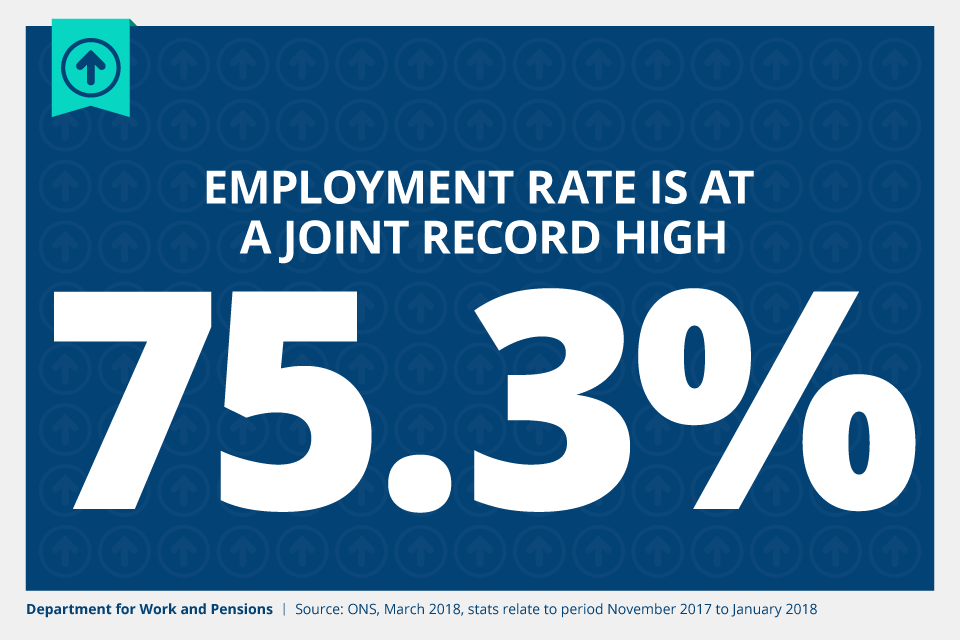
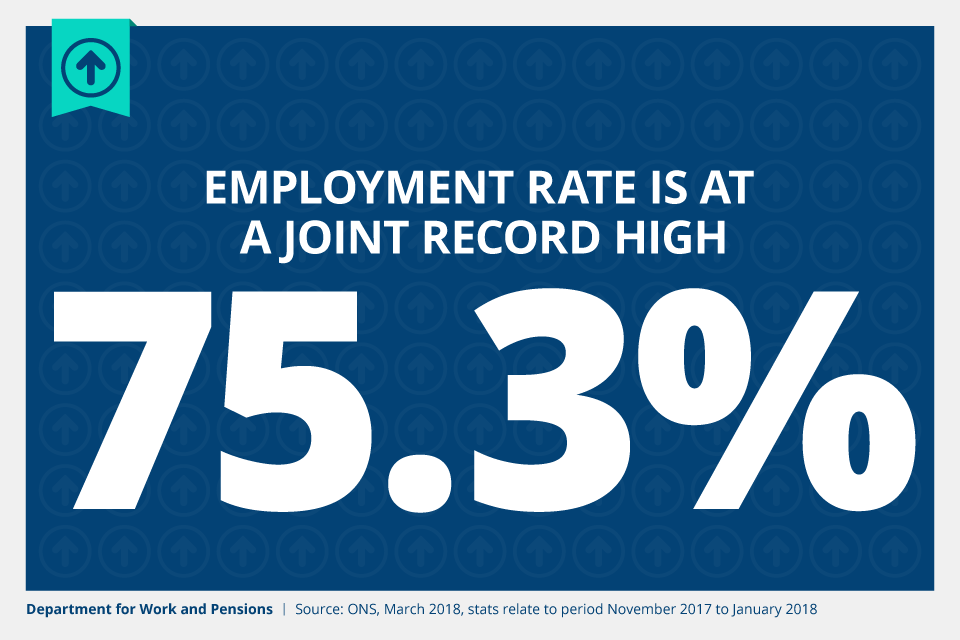
Figures released by the Office for National Statistics show that 402,000 more people have moved into employment in the last year.
The unemployment rate (4.3%) has not been lower since 1975, and the number of people out of work is down by 127,000 compared to a year ago.
The number of people not working and not looking for work fell by 158,000 on the year. The rate has not been lower since records began.
Since 2010, over 70% of employment growth has been in permanent roles, with around 70% in higher skilled work.
Secretary of State for Work and Pensions Esther McVey said:
Getting a job means securing an income for a family and the chance to build a better future. That’s why up and down the country we are doing all we can to help people into work.
And from next month, we’ll be taking thousands more people out of paying tax and also increasing the National Living Wage, benefiting those on the lowest pay and making sure they keep more of what they earn.
In fact by raising the National Living Wage we have ensured that the lowest earners have seen their wages grow by almost 7% above inflation since 2015.”
The amount of money people can earn before they start paying income tax will rise in April 2018 from £11,500 to £11,850. From 1 April 2018, the National Living Wage – the minimum paid to employees aged over 25 – will rise from £7.50 an hour to £7.83, equating to a £600 annual pay rise for full-time workers on basic pay.
This comes as we have reformed welfare to make work pay, backed businesses to take more people on, and built a stronger, fairer economy.
But we want to help even more people benefit from a well-paid job. That’s why we are:
mproving the welfare system with Universal Credit, which helps people move into work faster and to stay in work longer than under the old system
introducing a modern Industrial strategy to help businesses create better, higher-paying jobs in every part of the UK
helping people stay in work longer with our Fuller Working Lives strategy, which supports employers to recruit, retrain and retain older workers
tackling inequalities in employment highlighted by the Race Disparity Audit, through targeted support in 20 areas around the country and £90 million announced by the Prime Minister to help young people
Today’s figures also show:
since 2010, the number of people in employment has increased by around 3.2 million
83.4% of employment is in the private sector, with 16.6% in the public sector
the female employment rate is at a record high of 70.9%, with over 15 million women in work – a rise of 234,000 on the year
Separate figures out today showed that 770,000 people are now on Universal Credit as the rollout of the new benefit continues. Of these, 39% were in employment (300,000). Through Universal Credit, people are keeping more of their earnings as their Universal Credit payment gradually adjusts when their income climbs.