Press release: Back to school to inspire engineers of the future

Ongoing and planned engagement with schools and colleges in Wiltshire, Somerset and Cornwall is helping to highlight numerous engineering opportunities within the highways industry and inspire young people to consider engineering as a rewarding career.

Next week the company will be involved in a bridge-building exercise with pupils from a Somerset school.
The team behind the A303 Sparkford to Ilchester dualling scheme will visit Countess Gytha Primary School in Queen Camel on 23 November, helping Year 6 pupils to design and build K’Nex bridges as well as giving the youngsters an insight into the design of the route and what animals have been found during survey work.

Hannah Sanderson, Project Manager for the A303 Sparkford to Ilchester scheme, said:

Highways England is very focused on inspiring young people to consider engineering as a rewarding career.

It should be a fun experience for the youngsters, and we’re really looking forward to taking our branch of engineering into the classroom.

Responsible for improving, managing and maintaining England’s motorways and major A roads, the company is working with schools and colleges across the country as part of the Year of Engineering campaign.

By bringing young people face to face with engineering experiences and role models, the campaign aims to showcase the creativity and innovation of engineering careers and widen the pool of young people from all backgrounds who are willing to consider the profession.

As part of the STEM (Science, Technology, Engineering and Mathematics) Insights programme, Highways England also took part in a recent initiative with Wiltshire schools.

Maria Madeley, a primary teacher and science co-ordinator at Minety School, spent a week with the company earlier in the year, gaining an understanding of the engineering and geotechnical work around structures and roads across the strategic network.

This enabled Maria to build a curriculum around road building for her Year 5 and Year 6 pupils. And after Highways England spent a day teaching the children about smart motorways, bridge building and the geology of rocks, it culminated in a British Science Association-funded How Real Stuff Works event at Malmesbury School.

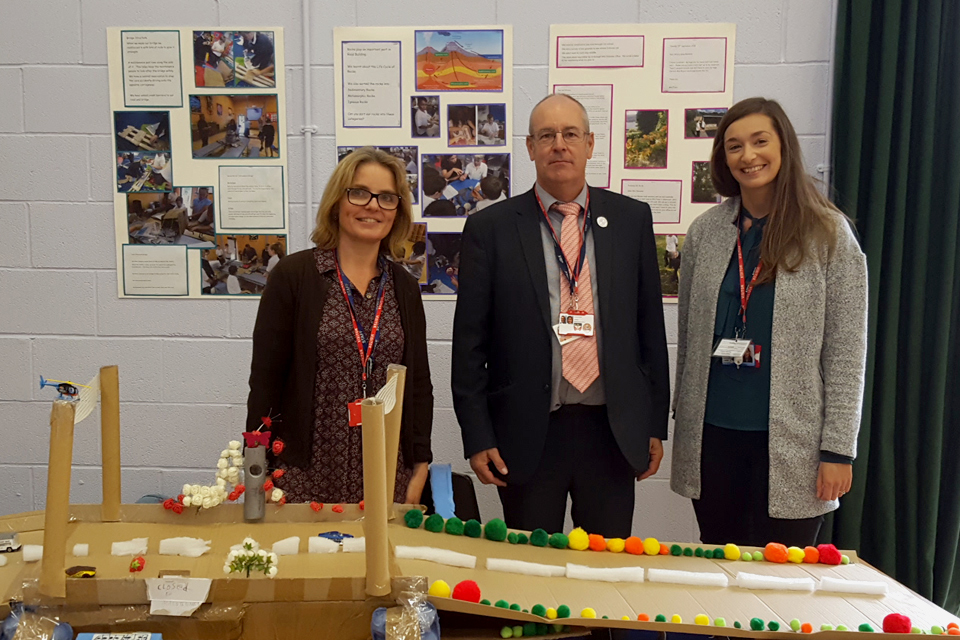
image showing Minety school teacher Maria Madeley with Garry Packer and Emma Grayson of Highways England
Minety School teacher Maria Madeley, left, with Garry Packer and Emma Grayson of Highways England and her pupils’ bridge design at the British Science Association’s How Real Stuff Works event at Malmesbury School

Elsewhere, the team behind the A417 Missing Link project engaged three Gloucestershire schools in chocolate-based STEM projects recently, while earlier this year the A303 Stonehenge project team met with Amesbury Primary School pupils, educating the children about the company’s environmental and archaeological work, as well as safety and engineering aspects of the proposed scheme.

Esther Gordon-Smith, the team’s legacy and benefits lead, also took part in Wiltshire Council’s Science and Engineering Fair last month, delivering a ‘STEM serves society’ presentation to teachers and school leaders.
The A30 Chiverton to Carland Cross team are also seeking to build relationships with schools and communities alongside the route in Cornwall, and have just launched a STEAM (Science, Technology, Engineering, Arts and Maths) initiative.

The schools’ outreach programme is designed to engage children from four to 18 in fun, hands-on activities.

Any schools interested in receiving a STEAM visit, can email: A30ChivertontoCarlandCross@highwaysengland.co.uk

For more information visit the Year of Engineering website.

General enquiries

Members of the public should contact the Highways England customer contact centre on 0300 123 5000.

Media enquiries

Journalists should contact the Highways England press office on 0844 693 1448 and use the menu to speak to the most appropriate press officer.


Link: Press release: Back to school to inspire engineers of the future
Source: Gov Press Releases

Press release: Safety warning following seven gritter crashes in North West

Motorway drivers are being urged to take extra care around gritters this winter following seven collisions in the North West.

Highways England has issued the warning after 36 of its vehicles were struck on motorways and major A roads across the country last winter.

Gritter driver Garry White was spreading salt on the M57 near junction 6 at Kirkby in March this year when his vehicle was struck from behind by a Ford Focus travelling at high speed. The car was written off and the back of the gritter also received extensive damage, requiring repairs.

Garry, 43 from Runcorn, suffered minor injuries and was off work for several days following the collision. He said:

The psychological impact was quite bad to be honest and I didn’t want to get back in a wagon for a few weeks after it happened. Experience prevails, and you push on and you get back in, but both me and the car driver were lucky not to have sustained much worse injuries.

I’d ask drivers to give us as wide a birth as possible this winter and to stay behind us until we’ve finished our treatment if they can as it’s much safer. Usually you’ll find a gritter will only be doing a few motorway junctions before pulling off anyway.

Gritters have flashing amber beacons, are 2.5 metres wide and are bright orange but causes of collisions have included drivers misjudging the amount of space needed to overtake them or driving too close to them when they are spreading salt.

The vehicles, which each weigh up to 26 tonnes, usually travel at 40mph in the middle lane to ensure the right amount of salt is spread to all lanes.

The back of a gritter is the most vulnerable area as it is where the salt spreading equipment is located. If it is struck then it can mean the gritter has to be taken off the road to be repaired, which is costly and could affect critical services in extreme weather conditions.

Andrew Olive, Highways England’s North West severe weather manager, said:

The vast majority of drivers support our gritter drivers by leaving a sensible distance and only passing when it’s safe to do so, but we do have occasions when people misjudge the situation and end up colliding with one of our vehicles.

The driver of the Ford Focus was lucky not to be more seriously injured in the incident on the M57 earlier this year, and gritter drivers like Garry should be able to do their job without having to worry about whether other vehicles might strike them.

Our gritter drivers perform a vital role to keep motorways and major A roads moving during the winter so I’d urge drivers to take extra care when travelling near them.

During severe winter weather drivers are urged to follow this advice:

  • In snow and ice: Drivers should stick to the main roads where they can and only travel if necessary. Drivers are also encouraged to make sure they have a winter kit in their vehicle, including an ice scraper and de-icer, warm clothes and blankets and sunglasses to cope with the low winter sun.
  • In high winds: Drivers should slow down and avoid using exposed sections of road if possible. Lorries, caravans and motorbikes are at particular risk.
  • In heavy rain: Drivers should keep well back from the vehicle in front, gradually ease off the accelerator if the steering becomes unresponsive, and slow down if the rain and spray from vehicles makes it difficult to see and be seen.
  • In fog: Drivers should switch on their fog lights and not use lights on full beam as the fog will reflect the light back. If drivers really cannot see, they should consider stopping until it is safe to continue.

General enquiries

Members of the public should contact the Highways England customer contact centre on 0300 123 5000.

Media enquiries

Journalists should contact the Highways England press office on 0844 693 1448 and use the menu to speak to the most appropriate press officer.

Link: Press release: Safety warning following seven gritter crashes in North West
Source: Gov Press Releases

Press release: Search to find Cyber Security experts of the future

An online programme designed to inspire teenagers to think about a career in cyber security will continue for a second year after a successful pilot across England.

Over 23,000 young people aged between 14 and 18 have already taken part in the Cyber Discovery programme which uses interactive games to teach teenagers about cyber security in an accessible and fun way. Those who perform at the highest levels, will also have the opportunity to attend a special summer camp to hone their skills and meet industry leaders.

The scheme sits within Cyber First, the government’s cyber security skills programme, which is part of the £1.9 billion investment through the National Cyber Security Strategy to transform the UK’s cyber security and ensure we build skills in the workforce of the future.

Minister for Digital Margot James said:

We need to inspire young people and show them a career in Cyber Security can be exciting and rewarding, not only to give them more opportunities but also help build a talented workforce for the future. The Cyber Discovery programme has been a great success so far. I hope more teenagers will take part and learn that those working in cyber security can come from any walk of life, and have studied any subject.

The £20 million Cyber Discovery programme teaches students about subjects including digital forensics, defending against web attacks and cryptography. It is being delivered by IT security training company the SANS Institute.

The programme is also a key part of the government’s modern Industrial Strategy – a long term plan to ensure that businesses have the skilled workers they need here in Britain.

Head of Research and Development for SANS Institute James Lyne said:

Based on the success of last year’s Cyber Discovery programme, it’s clear there’s both the appetite and the aptitude to learn about cyber security in the UK. Before taking part in Cyber Discovery 40.4% of female students and 35.5% of male students hadn’t even considered a career in cyber security. This dropped to 9.6% and 6.3% respectively after these students took part in the programme. And many of the club leaders who are also Computer Science teachers, told us they used Cyber Discovery last year to complement their lesson plans. We hope to extend this enthusiasm and passion for cyber security across the the UK in year two.

Any young person between the ages of 14 to 18 can take part. Registration and completion of the first assessment phase closes on 7 January 2019. Find out more on the Cyber Discovery website.

Further Information:

  1. The Government is committed to ensuring that the UK has a sustainable pipeline of cyber security talent supporting a workforce that meets current and future cyber security demands and supports the UK’s prosperity by keeping the economy and the country safe from cyber threats.

  2. The National Cyber Security Strategy commits to developing and implementing ‘a self-standing skills strategy that builds on existing work to integrate cyber security into the education system. This will continue to improve the state of computer science teaching overall and embed cybersecurity into the curriculum. Everyone studying computer science, technology or digital skills will learn the fundamentals of cyber security and will be able to bring those skills into the workforce. As part of this effort, we will address the gender imbalance in cyber-focused professions, and reach people from more diverse backgrounds, to make sure we are drawing from the widest available talent pool.

  3. SANS Institute was established in 1989 as a cooperative research and education
    organisation and is now the largest provider of cyber security training and certification to
    practitioners at governments and commercial institutions worldwide. The SANS curriculum
    spans more than 60 courses across multiple cyber security disciplines. SANS has
    successfully run programmes for school age students and is passionate about encouraging
    young people to pursue a career in cyber security.

Link: Press release: Search to find Cyber Security experts of the future
Source: Gov Press Releases

Press release: UK House Price Index for September 2018

The September data shows:

  • on average, house prices have not changed since August 2018
  • there has been an annual price rise of 3.5%, which makes the average property in the UK valued at £232,554

England

In England, the September data shows on average, house prices have not changed since August 2018. The annual price rise of 3.0% takes the average property value to £249,408.

The regional data for England indicates that:

  • the East Midlands and West Midlands experienced the greatest monthly price rise, up by 1.1%
  • the Yorkshire and the Humber saw the most significant monthly price fall, down by 1.1%
  • the West Midlands experienced the greatest annual price rise, up by 6.1
  • London saw the lowest annual price increase, down by 0.3%

Price change by region for England

Region Average price September 2018 Monthly change % since August 2018
East Midlands £194,803 1.1
East of England £294,027 -0.1
London £482,241 -0.4
North East £132,049 0.8
North West £162,915 -0.8
South East £328,059 -0.2
South West £260,142 0.3
West Midlands £199,763 1.1
Yorkshire and the Humber £162,009 -1.1

Repossession sales by volume for England

The lowest number of repossession sales in July 2018 was in the East of England.

The highest number of repossession sales in July 2018 was in the North West.

Repossession sales July 2018
East Midlands 43
East of England 10
London 38
North East 80
North West 127
South East 69
South West 31
West Midlands 50
Yorkshire and the Humber 64
England 512

Average price by property type for England

Property type September 2018 September 2017 Difference %
Detached £382,714 £365,228 4.8
Semi-detached £233,050 £223,502 4.3
Terraced £201,818 £195,140 3.4
Flat/maisonette £225,757 £228,595 -1.2
All £249,408 £242,041 3.0

Funding and buyer status for England

Transaction type Average price September 2018 Annual price change % since September 2017 Monthly price change % since August 2018
Cash £234,743 3.0 -0.1
Mortgage £256,801 3.1 0.0
First-time buyer £208,497 2.5 -0.4
Former owner occupier £284,022 3.6 0.3

Building status for England

Building status* Average price July 2018 Annual price change % since July 2017 Monthly price change % since June 2018
New build £308,859 5.2 2.5
Existing resold property £244,482 2.8 1.2

*Figures for the two most recent months are not being published because there are not enough new build transactions to give a meaningful result.

London

London shows, on average, house prices have fallen by 0.4% since August 2018. An annual price fall of 0.3% takes the average property value to £482,241.

Average price by property type for London

Property type September 2018 September 2017 Difference %
Detached £943,905 £913,220 3.4
Semi-detached £598,120 £578,519 3.4
Terraced £504,774 £496,318 1.7
Flat/maisonette £418,919 £428,892 -2.3
All £482,241 £483,833 -0.3

Funding and buyer status for London

Transaction type Average price September 2018 Annual price change % since September 2017 Monthly price change % since August 2018
Cash £507,955 0.0 -0.4
Mortgage £474,396 -0.4 -0.3
First-time buyer £419,925 -1.0 -0.7
Former owner occupier £547,515 0.5 0.1

Building status for London

Building status* Average price July 2018 Annual price change % since July 2017 Monthly price change % since June 2018
New build £503,215 1.4 1.8
Existing resold property £484,584 -0.7 1.1

*Figures for the 2 most recent months are not being published because there are not enough new build transactions to give a meaningful result.

Wales

Wales shows, on average, house prices have risen by 0.5% since August 2018. An annual price rise of 5.8% takes the average property value to £162,089.

There were 62 repossession sales for Wales in July 2018.

Average price by property type for Wales

Property type September 2018 September 2017 Difference %
Detached £247,289 £231,555 6.8
Semi-detached £156,185 £147,039 6.2
Terraced £125,360 £118,443 5.8
Flat/maisonette £111,678 £111,226 0.4
All £162,089 £153,227 5.8

Funding and buyer status for Wales

Transaction type Average price September 2018 Annual price change % since September 2017 Monthly price change % since August 2018
Cash £157,510 5.4 0.6
Mortgage £164,805 6.0 0.4
First-time buyer £139,661 5.5 0.2
Former owner occupier £188,343 6.0 0.8

Building status for Wales

Building status* Average price July 2018 Annual price change % since July 2017 Monthly price change % since June 2018
New build £212,902 9.4 2.5
Existing resold property £155,711 5.0 1.1

*Figures for the two most recent months are not being published because there are not enough new build transactions to give a meaningful result.

Access the full UK HPI

UK house prices rose by 3.5% in the year to September 2018, up from 3.1% in the year to August 2018.

The UK Property Transaction Statistics for September 2018 showed that on a seasonally adjusted basis, the number of transactions on residential properties with a value of £40,000 or greater was 98,400. This is 2.7% lower compared to a year ago. Between August and September 2018, transactions fell by 0.5%.

House prices grew fastest in the West Midlands region increasing by 6.1% in the year to September 2018, followed by the East Midlands region which increased by 6.0% over the year. House prices in London fell by 0.3% in the year to September 2018. London house price have been falling over the year since March 2018.

See the economic statement.

Notes to editors

  1. The UK House Price Index (HPI) is published on the second or third Wednesday of each month with Northern Ireland figures updated quarterly. The October 2018 UK HPI will be published at 9.30am on Wednesday 19 December 2018. See calendar of release dates.

  2. We have made some changes to improve the accuracy of the UK HPI. We are not publishing average price and percentage change for new builds and existing resold property as done previously because there are not currently enough new build transactions to provide a reliable result. This means that in this month’s UK HPI reports, new builds and existing resold property are reported in line with the sales volumes currently available.

  3. The UK HPI revision period has been extended to 13 months, following a review of the revision policy (see calculating the UK HPI section 4.4). This ensures the data used is more comprehensive.

  4. Sales volume data is also available by property status (new build and existing property) and funding status (cash and mortgage) in our downloadable data tables. Transactions involving the creation of a new register, such as new builds, are more complex and require more time to process. Read revisions to the UK HPI data.

  5. Revision tables have been introduced for England and Wales within the downloadable data. Tables will be available in csv format. See about the UK HPI for more information.

  6. Data for the UK HPI is provided by HM Land Registry, Registers of Scotland, Land & Property Services/Northern Ireland Statistics and Research Agency and the Valuation Office Agency.

  7. The UK HPI is calculated by the Office for National Statistics (ONS) andLand & Property Services/Northern Ireland Statistics and Research Agency. It applies a hedonic regression model that uses the various sources of data on property price, in particular HM Land Registry’s Price Paid Dataset, and attributes to produce estimates of the change in house prices each month. Find out more about the methodology used from the ONS and Northern Ireland Statistics & Research Agency.

  8. The UK Property Transaction statistics are taken from HM Revenue and Customs (HMRC) monthly estimates of the number of residential and non-residential property transactions in the UK and its constituent countries. The number of property transactions in the UK is highly seasonal, with more activity in the summer months and less in the winter. This regular annual pattern can sometimes mask the underlying movements and trends in the data series so HMRC also presents the UK aggregate transaction figures on a seasonally adjusted basis. Adjustments are made for both the time of year and the construction of the calendar, including corrections for the position of Easter and the number of trading days in a particular month.

  9. UK HPI seasonally adjusted series are calculated at regional and national levels only. See data tables.

  10. The first estimate for new build average price (April 2016 report) was based on a small sample which can cause volatility. A three-month moving average has been applied to the latest estimate to remove some of this volatility.

  11. Work has been taking place since 2014 to develop a single, official HPI that reflects the final transaction price for sales of residential property in the UK. Using the geometric mean, it covers purchases at market value for owner-occupation and buy-to-let, excluding those purchases not at market value (such as re-mortgages), where the ‘price’ represents a valuation.

  12. Information on residential property transactions for England and Wales, collected as part of the official registration process, is provided by HM Land Registry for properties that are sold for full market value.

  13. The HM Land Registry dataset contains the sale price of the property, the date when the sale was completed, full address details, the type of property (detached, semi-detached, terraced or flat), if it is a newly built property or an established residential building and a variable to indicate if the property has been purchased as a financed transaction (using a mortgage) or as a non-financed transaction (cash purchase).

  14. Repossession sales data is based on the number of transactions lodged with HM Land Registry by lenders exercising their power of sale.

  15. For England, this is shown as volumes of repossession sales recorded by Government Office Region. For Wales, there is a headline figure for the number of repossession sales recorded in Wales.

  16. The data can be downloaded as a .csv file. Repossession sales data prior to April 2016 is not available. Find out more information about repossession sales.

  17. Background tables of the raw and cleansed aggregated data, in Excel and CSV formats, are also published monthly although Northern Ireland is on a quarterly basis. They are available for free use and re-use under the Open Government Licence.

  18. HM Land Registry’s mission is to guarantee and protect property rights in England and Wales.

  19. HM Land Registry is a government department created in 1862. It operates as an executive agency and a trading fund and its running costs are covered by the fees paid by the users of its services. Its ambition is to become the world’s leading land registry for speed, simplicity and an open approach to data.

  20. HM Land Registry safeguards land and property ownership worth in excess of £4 trillion, including around £1 trillion of mortgages. The Land Register contains more than 25 million titles showing evidence of ownership for some 85% of the land mass of England and Wales.

  21. For further information about HM Land Registry visit www.gov.uk/land-registry

  22. Follow us on Twitter @HMLandRegistry, our blog, LinkedIn and Facebook

Contact

Press Office

Trafalgar House
1 Bedford Park
Croydon
CR0 2AQ

Link: Press release: UK House Price Index for September 2018
Source: Gov Press Releases

Press release: £950 fine for Leicester man fishing with unlicensed rod and line

A 28-year old man from Burton Overy, Leicester has been successfully prosecuted after being found guilty of fishing with an unlicensed rod and line in May 2018.

The case was brought to Wellingborough Magistrates Court by the Environment Agency on 12 November 2018 where Sam Kirk, of Scotland Lane, Burton Overy, was proved guilty in his absence and ordered to pay a total penalty of £957.

The penalty includes a fine of £220 plus costs of £737 after Kirk was found in possession of an unlicensed fishing instrument, namely rod and line, with the intention of using it for fishing on 5 May 2018 at Beedles Lake, East Goscote, Leicester, contrary to Section 27(1)(b) of the Salmon and Freshwater Fisheries Act 1975.

Following the verdict, Pete Haslock, Fisheries Enforcement Team Leader for the Environment Agency said:

We take all kinds of illegal fishing extremely seriously – whether it’s those fishing without a licence, or licensed anglers using illegal equipment. This case shows anglers how seriously the courts take these offences and we hope it will act as a deterrent to other anglers who flout the laws.

Illegal fishing is not fair on other anglers who fish within the law, and it also endangers the future of the sport by damaging the sustainability of fish stocks.

We regularly carry out enforcement operations to protect fish stocks and improve fisheries and urge anyone who has any information about any incidents of illegal fishing to report them to us so we can investigate.

Anyone who suspects anglers of illegal fishing are urged to contact the Environment Agency’s 24/7 hotline on 0800 807060, or Crimestoppers anonymously on 0800 555 111.

Link: Press release: £950 fine for Leicester man fishing with unlicensed rod and line
Source: Gov Press Releases

Press release: Government welcomes conference for Libya in Palermo

An Foreign Office spokesperson said:

We welcome the conference for Libya held in Palermo today (13 November), which reaffirmed wide international support for the next steps in implementing the UN Action Plan, as set out by SRSG Salamé in his 8 November briefing to the UN Security Council. This includes the convening of a National Conference in early 2019.

There is now momentum for progress in Libya which we should maintain in the run up to the National Conference.

We urge Libyans and the international community to seize this opportunity by engaging fully with the UN to promote a more inclusive process, with a view to creating the conditions for national elections in the course of next year.

The UK will continue to co-operate closely with our international partners in support of Special Representative of the Secretary General Salamé, working towards our shared objective of a stable Libya capable of tackling its migration, terrorism and other challenges.

Further information

Media enquiries

For journalists

Link: Press release: Government welcomes conference for Libya in Palermo
Source: Gov Press Releases

Press release: Young people join together for Year of Green Action

Over 50 young people from around the UK have today been announced as environment ambassadors as part of the run up to the government’s 2019 ‘Year of Green Action’.

The inspiring group, which includes two teenage sisters who founded Kids Against Plastic to cut the single-use packaging, will encourage more young people to get involved in green projects through their school, youth group or local community.

The #iwill4nature initiative, part of the #iwill campaign which aims to embed social action into the lives of 10-18 year olds, was formally launched at a celebratory event at Kew Gardens. It comes as the government prepares for its 2019 Year of Green Action, a year-long drive to see more people from all backgrounds involved in projects to improve the natural world.

Defra Minister Lord Gardiner, at Kew Gardens today to congratulate the new ambassadors, said:

Our children and young people have a huge role to play in ensuring the next generation is motivated and equipped to protect the precious natural world.

It was inspiring to meet this group of young ambassadors who are so passionate about environmental protection and I look forward to seeing all they achieve over the coming year.

Launched in 2013, His Royal Highness the Prince of Wales is patron of Step Up to Serve, which coordinates the #iwill campaign. The Department for Environment, Food and Rural Affairs (Defra) has worked closely with the campaign team to develop the 2019 focus on the environment, which was outlined in the government’s 25 Year Environment Plan.

Many of this year’s ambassadors have been selected because they are already involved in environmental projects.

Joining 15-year-old Amy Meek and her 13-year-old sister Ella, who together launched Kids Against Plastic to stem the global use of single use plastic, as an ambassador is Emily McDonald. The 18-year-old has been made an ambassador after she founded a Bio-Eco Society at her school, bringing together peers to take positive action against climate change.

Bradley Gwin-Barrett has also been selected as an ambassador after he helped create a community garden in Anfield and went on to become a Community Engagement Officer.

Link: Press release: Young people join together for Year of Green Action
Source: Gov Press Releases

Press release: UK marine scientists begin work to deliver marine litter action in South Pacific

Marine litter scientists from the UK kick-off work with partners in the South Pacific this week to tackle plastic pollution in the ocean.

Experts from the Centre for Environment, Fisheries and Aquaculture Science (Cefas), part of the UK government, are working alongside colleagues in Vanuatu and the Solomon Islands to identify country specific solutions to problems posed by marine litter, including reducing our reliance on single-use plastics, improvements in waste management, and developing more sustainable life cycles for plastics.

In recent years, the serious issue of marine litter and plastic pollution has been recognised by international governments and organisations, as well as local communities, as a growing threat to the marine environment and people’s livelihoods. It will form a key part of the UK and Vanuatu led Commonwealth Clean Oceans Alliance (CCOA) launched at the April Commonwealth Heads of Government Meeting (CHOGM) held in London. The alliance unites countries around the Commonwealth in their shared ambition to tackle plastics in the marine environment. To support this, the UK government are funding the Commonwealth Litter Programme (CLiP) to help share expertise and solutions.

The programme will bring together scientists, policy makers and communities around the world to identify actions which can be taken to stop plastic entering the marine environment, remove existing litter from the environment and raise awareness of what individuals and society can do to protect our marine habitats and wildlife.

Scientists from the UK are working with their colleagues across the Vanuatu and Solomon Islands governments, regional organisations, academia and community groups, to develop ideas and actions which support the existing efforts such as the ban on plastic bags, which will enable them to further achieve their ambitions on tackling plastic pollution. The programme will develop best practices and create a network of people, groups and communities across which these solutions and ideas can be shared.

UK Environment Minister Thérèse Coffey said:

It is fantastic to see world-leading UK scientists joining their Commonwealth counterparts and sharing expertise in the international fight to tackle the scourge of plastic in our oceans.

Plastic pollution is a global challenge, which requires global action. I’m proud to say the UK is at the forefront of this challenge and, through our Commonwealth Clean Oceans Alliance, we will use the collective power of the Commonwealth to protect our marine environment for future generations.

UK Foreign Office Minister of State for the Commonwealth Lord (Tariq) Ahmad of Wimbledon said:

Islands in the South Pacific know all too well the negative impacts of plastic pollution. By working together, particularly through the Commonwealth, we can make a difference, by better protecting our precious marine environments and the livelihoods they support. The Commonwealth brings together British and international experts to find solutions and I am pleased it is leading the way for the rest of the world with this marine litter programme.

Cefas’ principal marine litter scientist, Thomas Maes said,

Cefas is delighted to be collaborating with the government and other organisations in the South Pacific in finding solutions to the issues around marine litter. Cefas has international expertise and experience in marine litter science and policy which we are pleased to share with Vanuatu and the Solomon Islands, and further nations, to help address the problem.

The two Pacific island nations are the first to receive support through CLiP.

Hon. Ralph Regenvanu, the Vanuatu Minister of Foreign Affairs, said,

We are happy to support Cefas, through the Commonwealth Litter Programme, to work towards identifying national solutions to the issues of marine litter, so that we can protect Vanuatu’s precious natural resources now and for future generations.

Toney Tevi, Head of the Oceans Division under the Vanuatu Ministry of Foreign Affairs added,

We are pleased to work with the programme, which aligns with existing national policy to tackle plastic pollution, because it is focussed specifically on Vanuatu’s needs. I am personally thankful that this programme will also build capacity here for continued marine litter monitoring to take place, leaving a legacy ensuring that we continue to look after our natural environment.

Scientists will be in the region until the end of February, working with local colleagues and stakeholders to monitor litter, clean beaches and raise awareness of actions which can be taken.

A national policy workshop in January and a final conference in February for wider South Pacific stakeholders will summarise findings and share potential solutions for the region, also informing the roll out of the wider CLiP programme in other Commonwealth countries.

Beyond February, as the programme expands to other parts of the world, networks will be developed to ensure that any further ideas can be shared back to the South Pacific for consideration.

Link: Press release: UK marine scientists begin work to deliver marine litter action in South Pacific
Source: Gov Press Releases

Press release: Eighth month of UK wage growth with disabled employment at record high

As the UK celebrates its first ever ‘Purple Tuesday’ highlighting the huge potential of disabled consumers’ £249bn spending power, new figures show more than half of disabled people are now in work, outnumbering those who are workless.

In a further boost to the economy and consumer spending, wage growth outpaced inflation for an eighth month in a row, rising 0.9% in real terms (against CPIH inflation). Regular pay before inflation grew at its fastest in almost a decade, 3.2%.

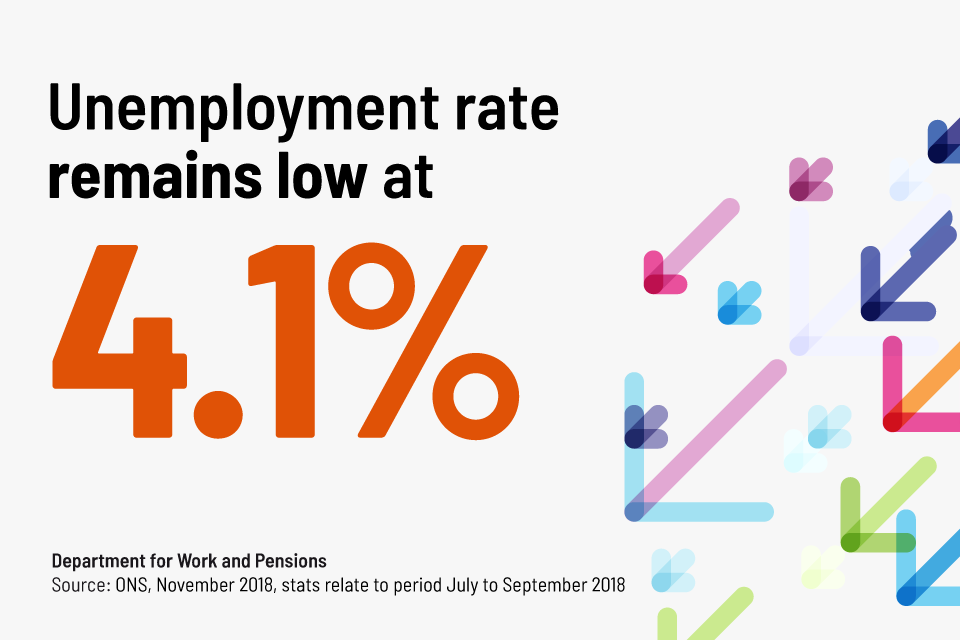
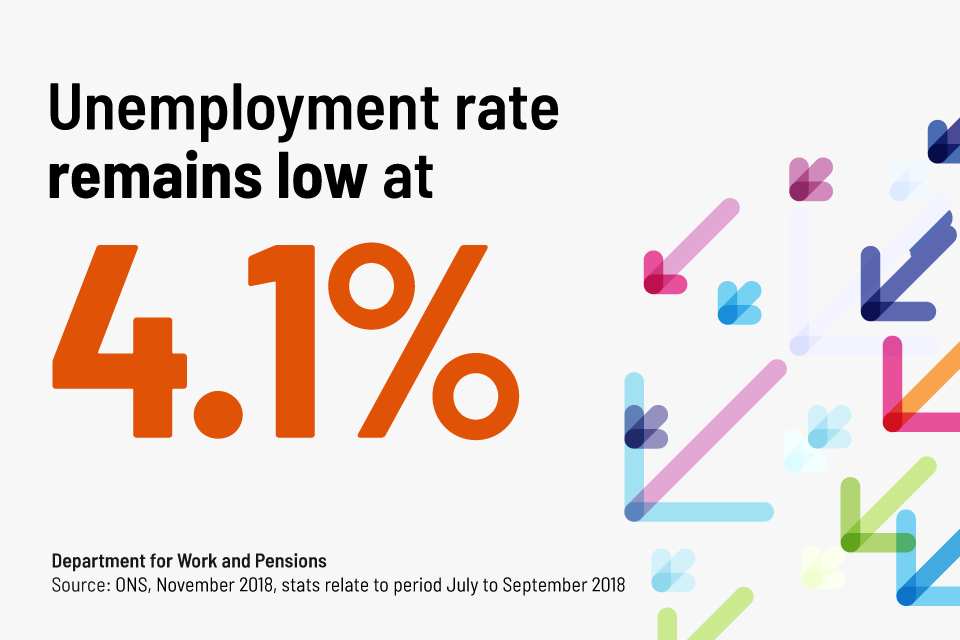
The UK’s unemployment rate has also nearly halved since 2010, now at 4.1%.

Unemployment rate remians low at 41%

The latest figures from the Office for National Statistics also revealed the employment rate remains high, at 75.5%, with a record number of people in employment – and over 3.3 million more people in work since 2010.

Work and Pensions Secretary Esther McVey said:

As we celebrate the anniversary of Disability Confident, we can see seismic shifts in opportunities for disabled people, with 973,000 more in work since 2013.

That’s empowering hundreds of thousands more disabled people with new career opportunities, and creating a brighter future.

Since 2010, employment has risen and unemployment has fallen in every single region of the UK. And with an average of 1,000 people moving into work each and every day, and three quarters of all new jobs in permanent, full time and high skilled roles, this shows our welfare reforms are working and delivering for people across the country.

Employment Minister Alok Sharma said:

Once again, the benefits of a strong jobs market are paying off, with the eighth month of real-terms wage growth for UK workers and the highest regular pay growth in almost a decade.

With more people now in work than ever before and unemployment almost halving since 2010, we are delivering an economy that gives people the opportunity of a better future.

And it’s worth noting that of the over 3.3 million jobs created in the British economy since 2010, three quarters are permanent, full time and in higher level occupations.

Figures also show three quarters of jobs created since 2010 are full time, permanent roles that are in higher skilled occupations, which typically bring higher earnings – all ambitions of the government’s Industrial Strategy which seeks to create better, well-paying jobs fit for the future.

This month also marked the anniversary of the anniversary of the Disability Confident scheme, which helps to transform business attitudes across the country and make our workplaces more inclusive. Over 9,000 businesses have signed up so far.

The government is helping even more people benefit from a well-paid job by:

  • backing businesses to create good jobs with our modern Industrial Strategy, while ensuring they play by the rules, so we are closing tax loopholes, strengthening workers’ rights, and tightening the rules big businesses must follow
  • investing in the infrastructure, training and apprenticeships we need for our future, with public investment at the highest sustained level in 40 years
  • introducing Universal Credit which is helping people move into work faster and stay in it longer, while recent Budget measures mean 2.4 million families will keep an extra £630 per year of what they earn
  • helping people stay in work longer with our Fuller Working Lives strategy, which supports employers to recruit, re-train and retain older workers
  • tackling inequalities in employment highlighted by the Race Disparity Audit, through targeted support in 20 areas around the country and £90 million announced by the Prime Minister to help young people
  • arranging work experience sessions for students through Jobcentre Plus, in over 1,400 schools

The work experience scheme is being rolled out across the country, to ensure young disadvantaged kids aged 12 to18 get opportunities including work experience to learn about the world of work and consider future career options. So far, the partnership between Jobcentre Plus and local schools has resulted in around 12,000 sessions for pupils, parents and teachers helping to prepare pupils for the world of work.

Read the latest labour marker statistics from the Office for National Statistics.

Contact Press Office

Media enquiries for this press release – 020 3267 5106

Press Office

Caxton House

Tothill Street
London
SW1H 9NA

Follow DWP on:


Link: Press release: Eighth month of UK wage growth with disabled employment at record high
Source: Gov Press Releases

Press release: The Future of ASEAN-UK Cooperation, Post-Brexit: Minister Field

Speaking to academics and think-tanks in attendance Minister Field said:

Good morning and thank you to Chatham House and the Singapore Institute of International Affairs for hosting this expert gathering. I know a great deal of time and effort has gone into arranging it, and it could not have been better timed.

The UK is making greater efforts than ever to broaden our international horizons and deepen our global partnerships, preparing the way for a new approach once we have left the EU.
Strengthening our relationship with the ASEAN community is a really important part of that, so I am delighted to have the chance to hear your thoughts on how we might go about it.

There is an excellent range of topics on your agenda today. Over the next 15 minutes or so I should like to touch on just some of them, to offer some food for thought.

UK-ASEAN

Since being appointed as Minister for Asia and the Pacific almost 18 months ago I have made it my personal mission to visit as many countries of the region as humanly possible, and to engage, face to face, with my ministerial counterparts.

Within the first or so I achieved my key ambition of visiting all ten members of ASEAN at least once.

This is already my second visit to Singapore, and over the course of two frantic weeks in August, I visited Indonesia, Philippines, Brunei, Thailand, Laos and Cambodia.

In Jakarta I set out our ‘All of Asia’ policy, through which we are engaging actively with all countries in the region, working with them to promote regional security, to build prosperity, and to strengthen the values which underpin the links between our people.
Today I hope that we can substantively build on this work – as I say, taking the opportunity to discuss and explore together the ways in which the UK can remain the strongest of partners to ASEAN – maintaining and strengthening our common areas of interest – after we leave the EU.

Our vision is of a genuine deep, comprehensive partnership – one that builds up our already excellent cooperation right across the board. I will say more about that in a moment.
It is really up to all of us – the UK and all the ASEAN community – to decide how we go about it.

I would like us to be really ambitious – to see where the UK-ASEAN relationship is now, to imagine how it might look in the future and to chart a course towards that goal.

Education

Let’s start with education – for the university academics among you, surely a subject close to your hearts.

I’m sure you don’t need me to tell you how open ASEAN as a whole is to education opportunities of all kinds.

I am pleased to say that UK institutions and qualifications seem particularly popular: more than 42,000 students from the region attended UK universities in 2016/17.

That includes some 8,000 Singaporeans and 17,000 Malaysians.

In fact Singapore, Malaysia and Thailand all rank in the top 10 countries from outside the EU for sending students to the UK.

However, more and more of your young people do not even need to leave home to get UK qualifications.
Approximately 130,000 young people are pursuing UK certified higher education courses right here in the region.

Respected British universities such as Nottingham, Newcastle, Herriot Watt and Coventry are all expanding their partnerships here.

I saw evidence of this first-hand in Vientiane earlier this year, when I had the pleasure of opening a new International Education Center at Panyathip School, hosting not one, but three UK institutions: Nottingham University, the Wimbledon School of English, and the Royal Academy of Dance.

It showed that our links are not just at tertiary level education – more and more schools across the ASEAN region are now teaching the British international school curriculum.

Education is a significant part of our relationship with ASEAN and I can see it really taking off over the coming years.

Research and Innovation

The same goes for research and innovation – where the ‘Fourth Industrial Revolution’ offers huge opportunities for collaboration.

Some of you may be familiar with the work that has flowed from our Newton Fund for science and innovation, which has been running since 2014.

The UK is investing £735 million in the Fund worldwide through to 2021, with matched funding from partner countries. In ASEAN we are partnering with Indonesia, Malaysia, the Philippines, Thailand and Vietnam, and these partnerships are delivering results.

They have already produced some outstanding research on sustainable rice production and food security, and we are working together to strengthen the resilience of vulnerable communities, improve forecasting of extreme weather, and tackle common diseases.

The range of our collaboration is truly out of this world. Through our Space Agency we are supporting research into the use of satellite technology to help our partners tackle problems ranging from illegal fishing in Indonesia to early warning of dengue outbreaks in Vietnam, and reducing illegal logging in Malaysia.

It may sound like science-fiction, but together with Singapore we are now firmly pushing the frontiers of ‘science fact’, with a £10 million joint initiative to build and fly a satellite quantum key distribution test-bed.

I won’t try to explain in detail what that is, I can’t claim to match Canadian Prime Minister Trudeau’s knowledge of quantum theory .

However I can say that it is a significant commitment to cyber technology and will open up a global market estimated to be worth more than £11 billion over the next ten years.

Research and innovation is already an integral part of the UK-ASEAN relationship and this latest project demonstrates just how far-reaching the opportunities could be in the future.

Trade and Investment

Trade is another area where I see huge scope for cooperation and two-way growth – and for using our departure from the EU as an opportunity for us all to redesign and strengthen our existing relationships.

It is something that our Prime Minister Theresa May was keen to emphasise at the recent Asia Europe Meeting in Brussels, which I also attended.
Take our investment in Singapore for instance.
Over 4,000 British companies have a presence here, employing over 50,000 people.

The UK is the second largest European investor in Singapore, and sixth largest overall.
There is a similarly positive picture across the ASEAN region.

In 2017, trade between the UK and the region was worth over £36.5 billion.

The UK remains ASEAN’s second largest source of investment, and we invest three times as much as Germany or France in wider Southeast Asia.

UK goods exports to ASEAN grew by 19.9% between 2016 and 2017. Our overall exports were more than double those to India.

More than ever, we are urging and supporting UK companies to take advantage of opportunities overseas, and we are attracting inward investment into the UK too – not least for UK Smart Cities projects and align ourselves with the ASEAN Smart Cities Network.

We are also helping countries of the region to make themselves more attractive to foreign investment – using our Prosperity Fund programmes to cut red-tape, tackle corruption and promote a fair business environment.
From within the EU we have been a cheerleader for its Free Trade Agreements with Singapore and Vietnam.

We are determined to ensure that these trade benefits are transitioned into bilateral arrangements immediately after we leave.

Alongside our bilateral agreements, we are also exploring accession to the CPTPP and ways to further develop trade and investment between us.
We are doing all this with one goal in mind, to strengthen our partnership economically, diplomatically and politically with ASEAN.

Challenges

Alongside all these areas of positive collaboration, we recognise that there are also challenges.

I make no bones about our concern over the direction some countries are taking on democratic values or human rights.
The ‘war on drugs’ in the Philippines and the recent flawed elections in Cambodia are two such causes of concern.

The despicable treatment of the Rohingya community by the Burmese military also remains high on the agenda of the UK and indeed many other nations the world over, not least here in South East Asia.

We do not hide our views on these subjects or row back from our firm commitment to uphold a rules-based international system, upon which prosperity, security and freedom for us all depends.

We continue to encourage others to remain equally committed, and
my colleagues and I continue to press for positive change. We will continue to do so after we leave the EU.

Security

Of course many of the challenges we face are shared, and they are challenges that we shall face together, because the UK is committed to the security of this region.

We demonstrate that commitment in a number of ways – including our permanent military presence in Brunei, our participation in the Five Power Defence Arrangements and the deployment of Royal Navy ships to the region – three this year alone.
All of them have participated in joint exercises – a key part of our support for the development and integration of the region’s defence capabilities and our commitment to help address future security challenges.

Even in the defence sphere, our education links shine through. In the last five years, just under one hundred officers from ASEAN member states have graduated from UK defence establishments.

Today, the active Service Chiefs in four ASEAN countries studied in Britain.

It is not all ships, planes and people in uniform though. Our security cooperation is much broader than this, and cyber is a key element of it.

As you may know, Singapore, as the Chair of ASEAN, is spearheading an initiative to strengthen the cyberspace capabilities of all ASEAN states.

I am delighted that they have invited us to take part – we will be the only non-Dialogue Partner involved.

Counter Terrorism is another important element of our security collaboration.

We have established a regional Counter-Terrorism Unit to enhance the links between agencies and governments.

We have done extensive work in this area with Indonesia. We were a critical part of the JCLEC process that led to hundreds of arrests – by Indonesian officers drawing on skills learned from the UK.

Conclusion

I hope that I have given you a good idea of the breadth and depth of the UK’s engagement in ASEAN.

Not only that – I hope you have also got a sense of our ambition for our future relationship.
I have seen first-hand what it is like now, and I know there is a huge appetite from both sides to maintain and strengthen this precious relationship after we leave the EU.

I believe we can afford to think ambitiously and I hope today’s discussions allow you to do that.

I wish you a productive day and I look forward to hearing how you have got on when I come back this evening!

Thank you.

Link: Press release: The Future of ASEAN-UK Cooperation, Post-Brexit: Minister Field
Source: Gov Press Releases