
Press release: Foreign Secretary statement on the OPCW report into Amesbury

The independent report produced by the Organisation for the Prohibition of Chemical Weapons (OPCW) has today confirmed the assessment of the United Kingdom in identifying the chemical agent responsible for the death of Dawn Sturgess in Amesbury on 8 July. This was a Novichok nerve agent, of the same kind used in the attempted assassinations of Sergei and Yulia Skripal earlier this year.

Analysis carried out by the Defence Science and Technology Laboratory (DSTL) at Porton Down had previously identified the nerve agent as Novichok.

Chemical weapons experts from the OPCW have twice visited the UK to collect samples for testing after this latest detection of chemical weapons use on the streets of the UK. All the samples returned equally conclusive results.

The Foreign Secretary said:

We are grateful to the OPCW for the independent, expert work in confirming the type of nerve agent used in Amesbury, and once again pay tribute to the high standards set by our world-leading scientists.

The recklessness of the Russian state in bringing a nerve agent in to the UK, and total disregard for the safety of the public, is appalling and irresponsible. Our thoughts are with the family of Dawn Sturgess, and with Charlie Rowley.

This is another reminder of the importance of the international community standing together to uphold the global ban on all use of chemical weapons, and ensure that the rules based international order is respected so we can all keep our citizens safe.

In the interests of transparency, the UK has requested that the OPCW publish the executive summary and share the full report with all state parties of the Chemical Weapons Convention.

The police continue their investigation into the poisonings in Amesbury and Salisbury and we await their further conclusions.

The OPCW Executive Summary can be found here

Further information

Media enquiries

For journalists

Link: Press release: Foreign Secretary statement on the OPCW report into Amesbury
Source: Gov Press Releases
Press release: New UK aid package to meet immediate needs of Palestinians though UN Relief and Works Agency

The UK will step up its support to the UN Relief and Works Agency (UNRWA) to help ensure vulnerable Palestinians are able to continue accessing vital healthcare and education services, Minister for the Middle East Alistair Burt has announced.

The UN agency, which is facing severe financial pressure at a time of unprecedented demand, is a lifeline for millions of Palestinian refugees across the Middle East.

Today’s announcement of additional UK aid support from the Department for International Development aims to help UNRWA keep schools open for over 500,000 children, and provide medical care for 3.5 million refugees.

Minister for the Middle East Alistair Burt said:

UK aid support though UNRWA provides an essential humanitarian and stabilising force in the Middle East, educating hundreds of thousands of children every year and providing healthcare to some of the most vulnerable Palestinian refugees. Today’s UK aid package reaffirms our unequivocal support to this UN agency and the important work it does.

We are deeply concerned about the devastating impact a shortage of funds for UNRWA could cause on those that rely on its services, as well as the consequences this could have for regional stability.

Whilst today’s UK aid announcement will help to meet immediate needs, we are clear that the UK cannot act alone. For the sake of millions of Palestinians, the international community and other donors must follow our lead and step up support to UNRWA to ensure its vital services are not interrupted.

In March the UK announced that it was providing financial assistance earlier than originally planned to ensure some of the poorest Palestinians continue to receive education and healthcare. In June the UK provided an additional £10 million to help address the unexpected shortfall in funding, and meet growing beneficiary needs, particularly in Gaza.

Notes to editors

  • Today’s £7 million announcement brings the total UK contribution to UNRWA’s Programme Budget to £45.5m.
  • In the financial year 2018/19, the UK has already provided £38.5m to UNRWA to ensure core programmes and services remain uninterrupted.
  • The £7 million is being provided by DFID in addition to its existing programme in the Occupied Palestinian Territories – this has been reallocated from other DFID programmes.

General media queries

Follow the DFID Media office on Twitter – @DFID_Press

Link: Press release: New UK aid package to meet immediate needs of Palestinians though UN Relief and Works Agency
Source: Gov Press Releases

Press release: Barclays launches major Midlands trade centre to boost UK exports

  • the centre follows the Barclays’ Midlands Growth Fund, a £370 million lending fund for SMEs across the Midlands to boost jobs and growth
  • new report reveals the characteristics of ‘superstar’ exporters – to further improve support for UK businesses

Minister of State for Trade and Export Promotion Baroness Fairhead opened Barclays’ new trade centre on Monday 3rd September, dedicated to helping over 1000 UK businesses to export more of their goods and services each year.

Staffed by 30 export and trade product specialists, the new centre will work to boost jobs and economic growth, enabling British businesses to start exporting sooner, or sell even more of their products in domestic and overseas markets.

The announcement is a great example of the private sector support that the Department for International Trade (DIT) is promoting as part of their new Export Strategy. This is part of a commitment to better signpost all support available to British companies.

The strategy also sets out the government’s ambition to raise exports as a percentage of GDP from 30% to 35%.

A raft of measures, including the roll out of thousands of Export Champions, increased awareness raising of the £50 billion of finance available from UK Export Finance and a boost to the number of export opportunities listed on GREAT.gov.uk were also announced as part of the strategy.

The Birmingham-based team has already started to help a number of British businesses with their export activity into markets such as India, Pakistan, Bangladesh, across Europe, the Middle East, Africa, as well as Far Eastern markets such as China, South Korea, Thailand, and Vietnam.

Minister of State for the Department for International Trade, Baroness Fairhead, said:

Time and again we have seen the boost that exporting gives to UK businesses. By selling their goods and services around the world, companies can increase profits, employ more workers and create businesses which endure longer.

That is why our new Export Strategy aims to increase the substance, availability and awareness of export support.

I am therefore delighted to be opening Barclays’ new trade centre today, and would encourage businesses up and down the country to make the most of the team’s expertise.

Jes Staley, Barclays Group CEO, said:

From manufacturing to agriculture, retail to digital, we are helping more UK businesses sell their goods and services to more people around the world. This trade centre is our latest initiative to make it easier for UK businesses to find their way in overseas markets, by providing the right finance, and all-important advice and guidance.

New research we have commissioned on this important subject, published today with the Policy Institute at King’s College London, shows that one important way to boost UK exports is to create more ‘superstar exporters’, or UK firms who export 10 or more products to 10 or more overseas markets. Helping these businesses to export more in turn helps smaller firms in their supply chain to grow, and to create jobs. Helping firms to become superstar exporters can deliver wider benefits to the UK economy and Barclays is determined to play its part.

The key findings from the report are:

  • superstar exporters support smaller firms to export through their supply chains
  • non-manufacturing production sectors are weakly represented in terms of access to trade support
  • export growth associated with DIT support appears to arise mainly from access to more overseas markets
  • overseas trade missions can increase the likelihood that firms start and continue exporting to a new market
  • firms receiving trade support are unevenly distributed across the country

DIT will consider the recommendations in the report as part of the department’s commitment to listen to voices from across the business community with regards to trade and export support.

Further information

Contact the DIT Media and Digital Team on 020 7008 3333

Contact Barclays on 07775 555626 and husbanj1@barclayscorp.com.

Link: Press release: Barclays launches major Midlands trade centre to boost UK exports
Source: Gov Press Releases

Press release: Traffic officers hit the road to help motorists in Cornwall

As part of a trial announced earlier this year, Highways England’s traffic officers have been patrolling a section of the A30 in Cornwall for the first time during the busy holiday periods, and have been on hand to deal with everything from live lane breakdowns, road traffic collisions and debris clearance.

During the summer holidays, Highways England crews have attended a total of 112 incidents during the 31 days of patrols. And on the last Sunday in July, the traffic officers’ ‘powers of recovery’ averted major disruption on the westbound A30 as they were able to assist police by towing a broken down horsebox and vehicle to Okehampton Services.

The current patrols will come to an end on 10 September.

Rob Penney, South West Service Delivery Manager for Highways England, said:

The aim of the initiative is to provide further assistance to motorists on our South West network, and we’re delighted to extend our service further south into Cornwall and to continue our close working partnership with Devon and Cornwall Police and Cornwall Council.

The patrols have provided real value, they’ve been well received, and there may be scope to increase the patrols in the future, dependent on a review of this trial period.

Earlier trial patrols took place over the Easter and May Bank Holidays. During five days over Easter the traffic officers dealt with and assisted 16 incidents on the A30 between Carland Cross and Lifton Down, and during the May Bank Holiday weekend, they attended 13 incidents over the three days, 11 of which saw them help broken down vehicles to safety.

Highways England already works in partnership with Devon and Cornwall Police, forming part of a multi-agency partnership in terms of safety and severe weather handling, and the trial is aimed at providing further support to Devon and Cornwall Police to help meet the demands of increased traffic volumes and related incidents on the A30 in Cornwall.

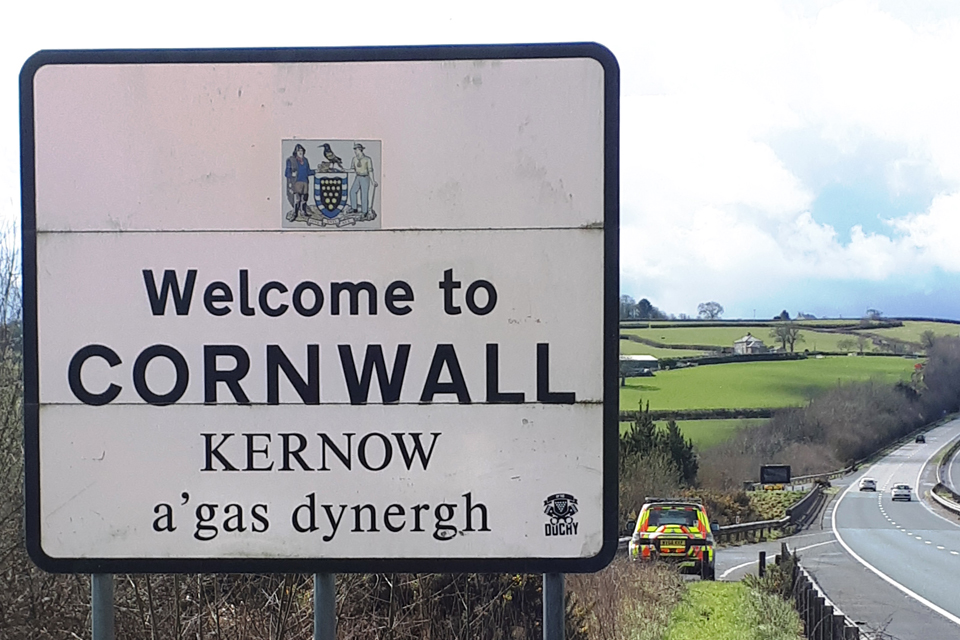
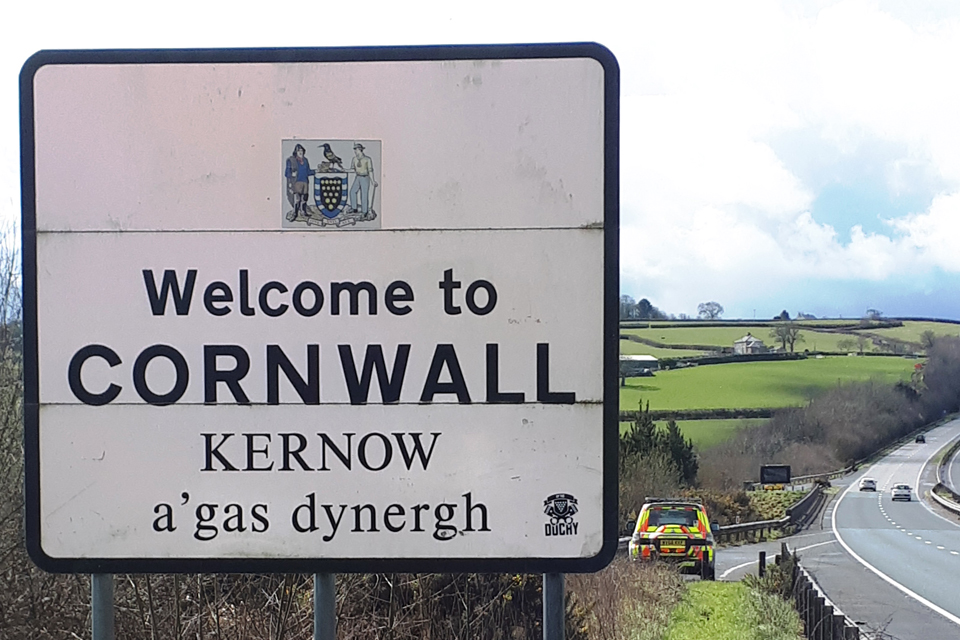
welcome to cornwall
Welcome to Cornwall sign on the A30 near Liftondown

Traffic officers currently assist drivers in any difficulty, co-ordinate the resources of the emergency services, manage traffic to reduce incident-related congestion and clear debris from the carriageways.

The traffic officers are currently patrolling the A30 between Carland Cross and Liftondown and, based at Bodmin police station and Cornwall Council’s Castle Canyke depot during the peak holiday months, they have been much closer at hand to provide assistance along both the A30 and A38.

Chief Inspector Adrian Leisk, head of roads policing for the Devon & Cornwall Police and Dorset Police alliance, said:

Devon and Cornwall Police is delighted to expand its partnership working with Highways England into Cornwall.

This builds on the considerable success of the operational activity on the M5, A38 and A30 in Devon, where Highways England Traffic Officers have supported police resources in dealing with road traffic collisions and other incidents which have the potential to cause disruption on our strategic road network

This ‘one team’ approach will undoubtedly help support communities and businesses who rely on a resilient and capable road network in Cornwall, particularly during the busiest periods of the year.

Highways England’s Traffic Officer service patrols England’s motorways and major A roads, helping to keep traffic flowing smoothly.

Traffic officers are not an enforcement agency, but they do have the power to stop and direct traffic, close lanes and carriageways and manage traffic, and road users must obey their directions.

As well as incident management, they also deal with broken down and abandoned vehicles on the strategic road network, recovering vehicles that are causing a blockage or hazard, and ensure that the scene of an incident is safe, for road users and working partners.

For more information on the roles and responsibilities of a Highways England traffic officer go to the traffic officer information page.

General enquiries

Members of the public should contact the Highways England customer contact centre on 0300 123 5000.

Media enquiries

Journalists should contact the Highways England press office on 0844 693 1448 and use the menu to speak to the most appropriate press officer.


Link: Press release: Traffic officers hit the road to help motorists in Cornwall
Source: Gov Press Releases

Press release: Consultation due to launch on major upgrade to the A38 in Derby

People interested in plans to upgrade the A38 in Derby are urged to have their say as Highways England prepares to launch a consultation this week on proposals to upgrade a busy bottleneck in the city.

The project, valued at around £225m, will make journeys between Birmingham and the M1 and through Derby quicker and simpler by separating long distance traffic from those making local journeys.

The Kingsway, Markeaton and Little Eaton roundabouts will be replaced with two underpasses and a flyover respectively, which will collectively help to reduce congestion on this busy route.

The consultation is the next step in making the scheme a reality and runs from Friday, 7 September until Thursday, 18 October 2018.

Highways England project manager, Paul Nagra, said:

This upgrade is an important development for the A38 and the tens of thousands of people that rely on the road every single day.

Once this work is complete it will provide smoother and more reliable journeys along this important route helping support future investment and economic growth opportunities in the area.

The design has now been developed in more detail and people attending the consultation can have their say on the proposals.

Anyone interested in the scheme can attend any of the public information events that are running between 7 September and 22 September at various locations throughout Derby.

For more information about the events and about the consultation, please visit the scheme website.

Alternatively email A38derbyjunctions@highwaysengland.co.uk.

General enquiries

Members of the public should contact the Highways England customer contact centre on 0300 123 5000.

Media enquiries

Journalists should contact the Highways England press office on 0844 693 1448 and use the menu to speak to the most appropriate press officer.

Link: Press release: Consultation due to launch on major upgrade to the A38 in Derby
Source: Gov Press Releases

Press release: Minister for Asia and the Pacific unveils plans to curb Pacific Ocean plastic pollution

Britain has pledged to champion Climate Risk and Resilience at next year’s UN Secretary-General’s Climate Summit, and has confirmed that its three missions in Samoa, Tonga, and Vanuatu will all be free of avoidable single-use plastics.

The uninhabited Henderson Island was recently established to have the worst levels of plastic rubbish on its shores of anywhere in the world, and marine plastic pollution elsewhere in the region is a growing problem. The UK’s three additional diplomatic missions in the region will be barred from using avoidable single-use plastics, and will help promote further joint work on climate change issues in the region.

Making the announcement at the Pacific Islands Forum, Minister for Asia and the Pacific Mark Field said:

Climate change poses a clear and present danger to the people of the Pacific islands like nowhere else in the world. The UK is already working with Vanuatu through the Commonwealth Clean Oceans Alliance to tackle the scourge of plastic pollution, and it is important our own representatives lead by example by cracking down on single-use plastics.

But addressing climate change needs massive transformational change and I am proud of Britain’s contribution through the Green Climate Fund. We will be building on this by working much more closely with all the Pacific islands through our missions in the region in the coming years.

The UK is among the largest contributors of international climate finance and in the four years to 2020 will be giving developing countries over £5.5 billion to help them mitigate and adapt to the impacts of climate change.

This will build on commitments made at the Commonwealth Head of Governments Meeting in London earlier this year which saw the creation of the Commonwealth Clean Oceans Alliance.

The government has today also announced that the Solomon Islands and Vanuatu are the first of six countries to receive support through Defra’s £6 million Commonwealth Litter Programme, partnering with countries in their efforts to reduce single-use plastics and other litter entering the oceans.

The Foreign & Commonwealth Office (FCO) will eliminate avoidable single-use plastics from its UK operations by the end of the year, and from its global operations by 2020. It is the first UK government department to announce such a ban and the commitment makes the FCO global a leader in the fight against plastic pollution.

Notes to editors

  1. Britain has in the past had missions in Tonga and Vanuatu and is now re-establishing High Commissions in each, along with a new High Commission in Samoa. They will collectively deliver significant bilateral and regional impact and help increase UK influence in multilateral fora.
  2. Initial estimates suggest that the FCO globally is consuming at least 3.45 million items of avoidable single-use plastics.

Media enquiries

For journalists

Link: Press release: Minister for Asia and the Pacific unveils plans to curb Pacific Ocean plastic pollution
Source: Gov Press Releases

Press release: Change of Her Majesty’s Ambassador to Zimbabwe in January 2019

CURRICULUM VITAE

Full name: Melanie Robinson

Married to: Lucas Robinson

Children: Two

2015 to present World Bank Group Washington, Executive Director for the UK
2012 to 2015 Department for International Development (DFID), Addis Ababa, Head of Office
2010 to 2012 DFID, Principal Private Secretary to Secretary of State
2009 to 2010 Department for Energy and Climate Change, Head of International Climate Policy
2007 to 2009 DFID, Team Leader, Climate Change Adaptation
2005 to 2007 DFID, Private Secretary to Secretary of State
2004 to 2005 DFID, Policy Analyst, lead on UK G8 and EU Presidencies
2002 to 2004 DFID, Senior Programme Officer, Mozambique
2001 to 2002 DFID, Policy Analyst, Performance and Effectiveness Department
2000 to 2001 DFID, EU Lead, Central and South Eastern Europe Department

Further information

Media enquiries

For journalists

Link: Press release: Change of Her Majesty’s Ambassador to Zimbabwe in January 2019
Source: Gov Press Releases

Press release: UK Hydrographic Office appoints new Director of Customer Division

The UK Hydrographic Office (UKHO) is pleased to announce the appointment of Cathrine Armour as the new Director of its Customer Division.

Cathrine brings experience in leading data, science and technology-centric organisations, and will be instrumental in developing the UKHO as a leading marine geospatial information agency and hydrographic office.

Cathrine joins the UKHO from Catapult’s South West Centre of Excellence in Satellite Applications, a partnership led by the University of Exeter to stimulate the data economy; helping UK businesses develop new products and solutions using satellite technology. Cathrine also led the development of the Ordnance Survey’s Geovation Hub and accelerator program. An award-winning initiative, Geovation has helped many UK start-ups find innovative uses for geospatial data.

Commenting on the timing of her appointment, Cathrine explained: “More people are starting to understand the importance of our marine environment and the need to use ocean resources in a sustainable way. Marine geospatial data is essential to help unlock the value of our oceans whilst ensuring their protection for years to come.

“In its position as a leading marine geospatial agency, the UKHO has a key role to play in how this data is applied and used across our oceans. This means thinking differently about data we hold, and ensuring that, as an organisation, we can package our data in ways that meet the needs of a wide range of users.”

“The potential for users, from commercial and government to philanthropic and aid, to use this data is limitless.”

Cathrine is also a leading commentator on the economic power of innovation, and is a guest lecturer at the University of Exeter’s Business School. In 2016, her work to facilitate international collaboration and cooperation in environmental data for sustainable development was recognised as a finalist for the WISE International Open Source Award sponsored by Bloomberg.

Cathrine explained how her belief in the power of innovation would benefit her in her new role at the UKHO: “Innovation is a powerful and compelling force for change. Be it economic, societal or environmental, data for decision-making is critical to shaping our shared future. I am looking forward to leading the UKHO’s development in this area as we further strengthen our position as the authoritative marine geospatial agency and hydrographic office.”

Link: Press release: UK Hydrographic Office appoints new Director of Customer Division
Source: Gov Press Releases

Press release: Charity Commission orders military charity to wind up

In a report published today the Commission sets out its findings, conclusions and regulatory action taken following its investigation into 1st Knight Military Charity. The charity, which had objects to assist members of the armed forces and their dependents or carers, was ordered to and has now been wound up.

The Commission’s inquiry was opened on 8 November 2016 after undercover reporting for a BBC Scotland programme exposed anti-Islamic comments made at the charity’s shop by a trustee and volunteer, as well as the sale of merchandise displaying anti-Islamic and derogatory comments and imagery.

“Wholly offensive and inappropriate” materials and comments

The inquiry concluded that there was misconduct in relation to offensive material available for sale at the charity’s premises and comments recorded as part of the programme. The Commission’s report highlights:

  • A second trustee present at the time of the undercover recording failed to intervene or challenge the comments made.
  • The offensive merchandise was ordered on more than one occasion, and the trustees did not seek to later return or dispose of the stock.
  • Further highly offensive and inappropriate t-shirts depicting Nazi symbolism was advertised for sale on the charity’s online store.
  • An unannounced visit to the charity’s premises later confirmed that the relevant materials had been removed from sale, however offensive and inappropriate merchandise was still displayed on the charity’s online store in February 2017.

Michelle Russell, Director of Investigations, Monitoring and Enforcement at the Charity Commission said:

The public rightly expect charities to demonstrate the highest standards of integrity and conduct. What we saw in this case fell short of that: not only was this charity mismanaged, we also saw evidence of behaviours and attitudes that have no place in charity. The organisation has now wound up, and I am pleased that we have ensured its assets are redistributed by another charity.

The inquiry also found wider concerns about the charity’s management and governance.

The Commission issued an order under section 84B of the Charities Act 2011 to direct the trustees to wind up and dissolve the charity, in the public interest and because it was unlikely that the charity could continue to operate beyond the end of the inquiry. The trustees complied with this order on 22 March 2018 and the charity was dissolved and removed from the Register of Charities on 23 March 2018.

The charity’s remaining funds were transferred to another charity, identified by the Commission, with similar objects to the charity. They will be used to provide support to wounded veterans and their loved ones.

The full report of the inquiry is available on GOV.UK.

Ends.

Notes to Editors

  1. Under new powers granted to it under section 84B of the Charities Act 2016, the Commission has the power to direct charity trustees to wind up and dissolve a charity. On 22 December 2017 the Commission published a public notice of its intention to issue the order under section 84B (2) of the Act. This was published on the Commission’s website for a period of 60 days. The Commission did not receive any representations following the issuing of public notice. After the period for representations expired the trustees were directed to take specified action to wind up and dissolve the Charity and have its remaining property transferred to a charity with the same or similar purposes.
  2. The programme ‘The Great Military Charity Scandal’ was broadcast on BBC One Scotland at 19:00, Tuesday 8 November 2016.
  3. The Charity Commission is the independent regulator of charities in England and Wales. To find out more about our work, see the about us page on GOV.UK.
  4. Search for charities on our online register.

Press office

Link: Press release: Charity Commission orders military charity to wind up
Source: Gov Press Releases

Press release: New HIV diagnoses across the UK fell by 17 per cent in 2017

Data published today by Public Health England (PHE) reveal that new HIV diagnoses in the UK have fallen for the second year in a row. New diagnoses decreased by 17% in 2017 – from 4,363 new diagnoses reported compared to 5,280 in 2016, which brought new cases down to their lowest level since 2000.

This decrease continues a downward trend that started in 2015, with an overall 28% reduction in new HIV diagnoses between 2015 and 2017. The reduction was largely driven by a decline in new HIV diagnoses among gay and bisexual men, which fell by 17% compared to 2016 and by 31% compared to 2015. This decrease was due to the high uptake of HIV testing in this group, particularly repeat HIV testing among higher risk men. Increased uptake of anti-retroviral therapy (ART) – drugs that keep the level of HIV in the body low and help prevent it being passed on – also significantly contributed to the decline in new diagnoses.

New HIV diagnoses in black African and Caribbean heterosexuals have been steadily decreasing over the past 10 years. For the first time, a UK-wide fall was also seen in new diagnoses in heterosexuals from other ethnicities, with a drop of 20% in 2017 when previously they had remained stable at around 1000 per year.

Professor Noel Gill, Head of the STI and HIV Department at Public Health England, said:

We are pleased to see that UK prevention efforts are having a significant impact on new HIV diagnoses, and this heralds the lowest number of HIV diagnoses in the UK since 2000. However, we know that anyone who has sex with a casual partner without a condom or shares needles may be at risk of infection.

The most common way of getting HIV in the UK is through having sex without a condom – so consistent and correct condom use with new and casual partners stops you getting or transmitting HIV and other STIs. If you think you have been exposed to HIV it is easy to get tested so, if positive, you can start treatment as soon as possible.

Steve Brine, Public Health Minister said:

HIV is a devastating and life-altering disease. Today’s figures mean we are well on our way to eradicating it once and for all but we have not an ounce of complacency.

Our commitment to prevention has led to more people getting tested and almost every person with a diagnosis is now in treatment – meaning they are unlikely to pass the virus on to someone else. I am committed to ensuring that we deliver on our promise to reduce the number of people contracting HIV even further.

There are very effective treatments for HIV that enable people diagnosed with the virus to live a long and healthy life, and minimise the risk of onward transmission. Early diagnosis through regular testing ensures people get the greatest benefit from these HIV treatments. HIV testing is freely available through GP surgeries, local hospitals and sexual health clinics, as well as through a self-sampling service or by using a home-testing kit.

Public Health England, alongside other government and third sector organisations, is working to control HIV by 2030 and these new figures are an encouraging sign that this is achievable.

Background

  1. Epidemiological data on new HIV diagnoses and people receiving HIV care can be found in the PHE health protection report and annual HIV data tables. Regional and Local Authority data on new HIV diagnosis rates, late diagnoses and diagnosed HIV prevalence data can be analysed on the PHE Sexual Health Profiles.
  2. The data shows that:
    • In 2017, 4,363 people were newly diagnosed with HIV in the UK, a reduction by 17% compared to the 5,280 diagnoses reported in 2016.
    • There were 2,330 new HIV diagnoses among gay and bisexual men reported in 2017, a 17% reduction from the 2,820 diagnoses in 2016 and 28% reduction from the 3,390 diagnoses in 2015.
    • There were 594 new HIV diagnoses among black African and Caribbean heterosexuals in 2017, a reduction of 23% compared to the 775 diagnoses in 2016.
    • Overall, 42% of people were diagnosed at a late stage of infection (CD4 count <350 cells/mm3 at diagnosis) in 2017. Late diagnosis is associated with a ten-fold increased risk of short term mortality (within a year of diagnosis).
    • In 2017, there were 230 people with an AIDS-defining illness reported at HIV diagnosis (5.3%) and 428 deaths among people with HIV.
    • In 2017, 93,385 people were receiving HIV-related care in the UK, with 98% (91,266/93,385) receiving anti-retroviral therapy to control the virus. Of those receiving anti-retroviral therapy in 2017, 97% (88,528/91,266) had untransmissable levels of virus.
  3. HIV is a virus which damages the cells in people’s immune system and weakens their ability to fight everyday infections and diseases. Without treatment, after an average of 10 to 15 years, the infection is fatal.
  4. PHE advises gay and bisexual men to have an HIV test at least once a year, or every 3 months if they’re having unprotected sex with new or casual partners. Black African men and women are advised to have a regular HIV and STI screen, if they’re having unprotected sex with new or casual partners.
  5. You can find out more information about how to prevent and get tested for HIV on NHS Choices. The HIV home sampling service offers an alternative to traditional testing offered by GPs and sexual health clinic. Visit www.FreeTesting.hiv to find out more about free HIV home-sampling test kits.
  6. It is too early to know the size of the expected additional effect on underlying HIV transmission and new HIV diagnoses of the scale-up of pre-exposure prophylaxis (PrEP). PHE is supporting NHS England in delivering the 3-year PrEP Impact Trial, which began in October 2017.

Public Health England press office

Link: Press release: New HIV diagnoses across the UK fell by 17 per cent in 2017
Source: Gov Press Releases