
Press release: Green light for ultra-fast electric car charging innovation

A new pioneering technology to ensure a next generation of safer, high-powered electric car batteries can be charged by drivers in ultra-fast time is just one of 12 innovation projects to receive the green light from the government’s Faraday Battery Challenge.

The PowerDrive Line project being led by Southampton-based company Ilika is focusing on sold state battery cell development, in particular how to manufacture at scale in the UK and how to build in ultra-fast charging technology of less than 25 minutes for a vehicle as is seen in some current battery systems.

In total £22 million grants are being rewarded to consortia across the UK as part of the latest round of funding through the Faraday Battery Challenge, part of the government’s Industrial Strategy Challenge Fund.

The funding is key to realising the government’s ambitions for innovative energy solutions as set out in our modern Industrial Strategy. The Faraday Battery Challenge brings together world-leading research and business to accelerate the research needed to develop battery technologies.

Other major R&D projects funded include:

  • a revolutionary approach to battery management led by Williams Advanced Engineering
  • a McLaren Automotive led consortium project that aims to accelerate the development of electrified powertrains
  • a revolutionary battery recycling project that will develop the first UK industrial scale capability to reclaim and reuse battery essential metals. This project is being led by Cheshire-based ICoNiChem and involves Jaguar Land Rover
  • an Aston Martin Lagonda project into the development of better performance battery packs.

Business and Energy Secretary Greg Clark said:

Innovative battery technology is changing the way we live, travel and work and the Government is committed to putting Britain at the heart of this energy revolution.

Today’s £22 million investment in world-leading R&D projects is an example of our modern Industrial Strategy in action and will help pioneering companies realise the economic benefits the global transition to a low carbon economy offers.

UK Research and Innovation chief executive Professor Sir Mark Walport said:

Effective, efficient and sustainable transport is key to addressing so many of today’s challenges from industrial growth to social inclusion. Through advanced battery technology, we will unlock a new generation of electric vehicles, further improving vehicle performance and uptake, opening doors to innovative new transport ideas and significantly reducing environmental impacts. Today’s investment shows we are catalysing collaboration between research teams and commercial partners across the UK to make this a reality.

Battery Challenge Director Tony Harper said:

This latest round of cutting-edge research and development projects illustrate the quality of innovations coming from our research and industrial base, and reinforce why the UK is a world-leader in battery technology development.

Link: Press release: Green light for ultra-fast electric car charging innovation
Source: Gov Press Releases
Press release: A14 Cambridge to Huntingdon: preview of plans for Huntingdon

The 43 year-old viaduct, which carries the existing A14 over the railway line and local roads currently dominates the skyline near the Huntingdon train station. Removing it, and creating link roads to and from the old A14, is an important part of the A14 Cambridge to Huntingdon scheme, which is upgrading 21 miles of the A14 to three lanes in each direction, including a brand new bypass south of Huntingdon.

The plans will enable a major redesign of the Huntingdon train station area. A new public transport hub will be created, with bus stops conveniently located for the railway station. Removing the viaduct will also reduce noise and air pollution and will facilitate further improvements in Huntingdon town centre.

Main construction work is expected to start in 2019.

Chris Bayliss, A14 project manager at Highways England, said:

Work to upgrade the A14 between Cambridge and Huntingdon is progressing well and we are on schedule to open the new road to traffic by the end of 2020.

The Huntingdon viaduct was built in 1975, and removing it will create new opportunities for Huntingdon. Once the new A14 is open to traffic, the old A14 will become a local road. The plans we are sharing today will make it even easier for people to travel around, as well as in and out of, Huntingdon.

We are holding six public events this June and encourage people to come see us for a chat and find out more about these exciting plans!

To find out more about the work in Huntingdon people are invited to come along to one of the events – details can be found on the scheme webpage.

The £1.5bn A14 upgrade will add additional capacity, boost the local and national economy and cut up to 20 minutes off journeys.

The main construction work at Huntingdon will include a new Mill Common link road, the removal of the A14 viaduct and work around the train station, and a new Views Common link road. Preparatory work, such as archaeology and utility diversion, will start ahead of main construction work.

Chance to volunteer on the A14 community archaeology dig this summer

The A14 Cambridge to Huntingdon archaeology team is calling for volunteers to take part in a free summer community dig programme between 24 July and 25 August 2018.

This is a once in a lifetime chance for people to take part in one of the largest archaeological excavation projects ever undertaken in Britain.

Volunteers will work alongside archaeology experts from the A14 archaeology team and its contractors MOLA Headland Infrastructure, exploring evidence of industrial activity relating to the abandoned medieval village of Houghton, near Huntingdon, as well as Iron Age and Roman remains.

Each volunteer must be able to commit to five (not necessarily consecutive) days of excavation from 9am to 4pm.

To apply, email msearle@molaheadland.com before 25 June 2018, stating your preferred days.

For the latest information about the A14 Cambridge to Huntingdon improvement scheme, including job and training opportunities, visit the scheme webpage follow @A14C2H on Twitter and like our Facebook page.

General enquiries

Members of the public should contact the Highways England customer contact centre on 0300 123 5000.

Media enquiries

Journalists should contact the Highways England press office on 0844 693 1448 and use the menu to speak to the most appropriate press officer.

Link: Press release: A14 Cambridge to Huntingdon: preview of plans for Huntingdon
Source: Gov Press Releases

Press release: Foreign Secretary statement on US-DPRK summit

Foreign Secretary Boris Johnson said:

We welcome that President Trump and Kim Jong Un have held a constructive summit. This is an important step towards the stability of a region vital to global economic growth and home to thousands of British Nationals and important UK interests.

The reaffirmation of North Korea’s commitment in the Panmunjom Declaration to work towards complete denuclearisation of the Korean Peninsula is a signal that Kim Jong Un may have finally heeded the message that only a change of course can bring a secure and prosperous future to the people of North Korea.

There is much work still to be done and we hope Kim continues to negotiate in good faith towards complete, verifiable and irreversible denuclearisation. The UK will continue to support the United States in its efforts to achieve denuclearisation of the Korean Peninsula.

Further information

Media enquiries

For journalists

Link: Press release: Foreign Secretary statement on US-DPRK summit
Source: Gov Press Releases

Press release: Employment rate remains at record high

The unemployment rate is now 4.2% – down 0.4% since last year – with the number of people out of work falling by 115,000.

The figures published by the Office for National Statistics (ONS) come as Black, Asian and minority ethnic employment (BAME) is at a record high. The BAME employment gap – the difference between the employment rates of the ethnic minority population and the overall population – is at an all-time low of 10.1% points.

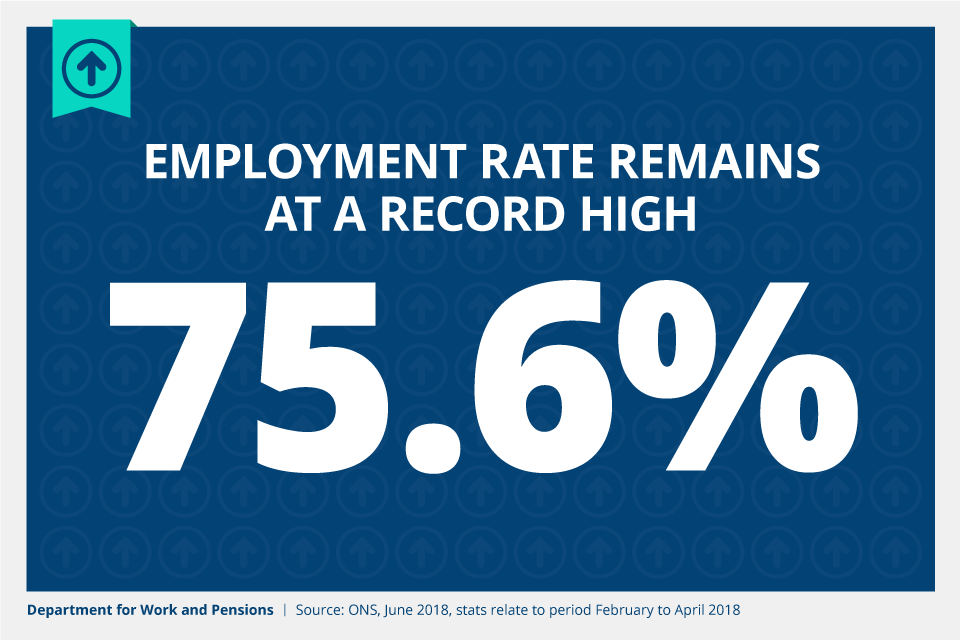
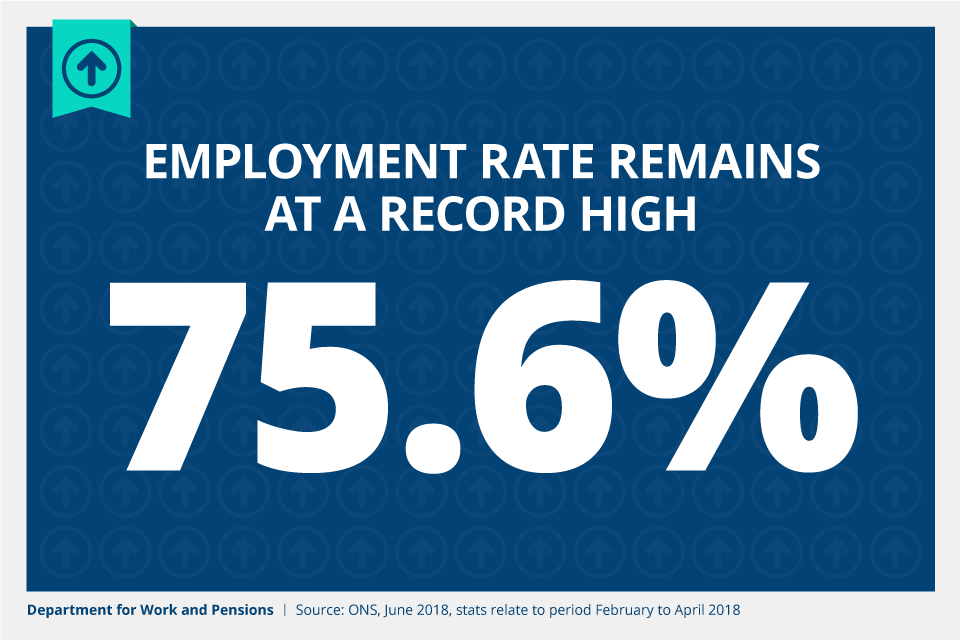
Employment rate remains at a record high of 75.6%.

Secretary of State for Work and Pensions, Esther McVey said:

The employment rate has never been higher – with over 3.3 million people moving into work since 2010.

It’s a great British success story with businesses from Exeter to Edinburgh creating jobs – helping, on average 1,000 people find a job each and every day since 2010.

And with the increase in the personal tax allowance, this government has ensured that people are keeping more of their money before they begin paying tax – meaning more take-home pay, that’s more money in your pocket for you and your family.

Minister for Employment, Alok Sharma said:

At 75.6%, the employment rate has never been higher, with more people in work than ever before. And with a continued fall in unemployment, we have a strong jobs market that’s set 17 new employment rate records since 2010.

It’s also very welcome news that the ONS has reported that regular pay has outpaced inflation for the third month in a row.

The increase in personal allowances means that the typical basic rate taxpayer is now paying £1,075 less in income tax than in 2010. Thanks to the National Living Wage full time minimum wage workers have had an annual boost of £2,000 since 2016.

Today’s figures also show:

  • private sector employment is now at 27.04 million, up by over 3.7 million since 2010
  • the number of women in work is at a record high of 15.26 million
  • youth unemployment has fallen by over 40% since 2010
  • the number of workers aged 50 plus has reached a record 10.18 million

Separate figures released today show that more than 920,000 people are now receiving Universal Credit, with 37% in employment. The rollout of Universal Credit remains on track and the business case summary published last week confirms an estimated £8 billion boost to the economy every year when it is fully rolled out, with an additional 200,000 people moving into work.

The government has reformed welfare to make work pay, backed businesses to take more people on, and built a stronger, fairer economy. But we want to help even more people benefit from a well-paid job. That’s why we are:

  • introducing a modern Industrial Strategy to help businesses create better, higher-paying jobs in every part of the UK
  • helping people stay in work longer with our Fuller Working Lives strategy, which supports employers to recruit, retrain and retain older workers
  • tackling inequalities in employment highlighted by the Race Disparity Audit, through targeted support in 20 areas around the country and £90 million announced by the Prime Minister to help young people

We are also arranging work experience sessions for students through Jobcentre Plus in over 1,400 schools. The scheme is being rolled out across the country, to ensure young disadvantaged kids aged 12 to 18 get opportunities including work experience to learn about the world of work and consider future career options. So far, the partnership between Jobcentre Plus and local schools has resulted in around 12,000 sessions for pupils, parents and teachers helping to prepare pupils for the world of work.

Read the Labour Market Statistics – June 2018 from the Office for National Statistics.

Contact Press Office

Press Office

Caxton House

Tothill Street
London
SW1H 9NA

Follow DWP on:


Link: Press release: Employment rate remains at record high
Source: Gov Press Releases

Press release: Government gears up for social impact investment drive

Departments across Whitehall will work with leaders in the financial services industry to help make it easier for people to invest their money in the issues they care about.

The government has today responded to the industry-led report Growing a Culture of Social Impact Investment in the UK which made a number of recommendations to better enable people to invest in line with their values. The report was compiled by senior representatives from across the investment industry and chaired by Elizabeth Corley, vice chair of Allianz Global Investors.

As part of the response, the government has committed to work with the investment and savings industry to support the launch of further social impact investment funds.

It has also outlined plans to encourage more investments to flow into disadvantaged areas and to create investment opportunities that address social challenges, while also creating financial return.

It highlighted the need to champion and promote the social and environmental responsibility of businesses across the country.

Tracey Crouch, Minister for Sport and Civil Society, said:

People increasingly want to see their savings and investments to have a positive impact on society, as well as bring financial returns. By utilising the wealth of experience within the financial services industry, we can expand social impact investing to help build a society that works for everyone.

Even if you have a small amount of savings, or a pension pot, you should be able to invest in the issues you care about. I want to thank Elizabeth Corley and the Advisory Group. I look forward to continuing to work with the wider industry to expand social impact investment.

John Glen, Economic Secretary to the Treasury, said:

Investing can and should be a force for good, and it’s vital that industry and government work together to make it easy for people to invest in the causes they care about.

Social impact investing is brimming with potential and we are encouraging firms to develop products to meet the rising demand, while championing the industry’s potential to make a real difference to people’s lives.

The government will continue to work alongside the financial services industry and regulators and will provide a progress update in winter 2018.

Read more about the Government’s response to the Growing a Culture of Social Impact Investment in the UK report

Notes to Editors

For further information call the DCMS press office on: 0207 211 2210.

Background information – Advisory Group

In 2016, government appointed Elizabeth Corley, Vice Chair of Allianz Global Investors, to chair an industry-led Advisory Group looking at how to grow a culture of social impact investment and savings in the UK. The group included senior representatives from across the investment and savings industry.

The Advisory Group published its report in November 2017, setting out the following five key areas of recommendations:

  1. Improve deal flow and the ability to invest at scale
  2. Strengthen competence and confidence within the financial services industry
  3. Develop better reporting of non-financial outcomes
  4. Make it easier for people to invest
  5. Maintain momentum and build cohesion across initiatives

In February 2018, Prime Minister Theresa May asked Elizabeth Corley to form an industry follow-up taskforce to lead on the implementation of the recommendations.

Link: Press release: Government gears up for social impact investment drive
Source: Gov Press Releases

Press release: Dr Fox on latest trade figures

According to the latest independent statistics, released by the ONS on Monday, 11 June, UK exports rose 7.4% (£43.3 billion) to £625.4 billion to the end of April 2018 compared to the same time last year.

Exports continue to grow faster than imports for the tenth month continuously with the overall trade deficit narrowing by £6.7 billion from £37.5 billion to £30.8 billion.

The country’s renowned service sector continues to thrive with exports up 7.5% to £282.6 billion, increasing the service surplus to £108.7 billion.

Goods exports also rose strongly by 7.4% to £342.8 billion.

International Trade Secretary Dr Liam Fox MP said:

Far from the gloom some people report, today’s trade figures show in the year to April 2018 the trade deficit narrowed by £6.7 billion as overall exports rose by 7%.

If we look on a stable longer term basis, the growth was driven by both the UK’s renowned service sector which saw exports rising by 7.5% to £283 billion and UK goods exports which grew by 7.4%.

For the first time as a dedicated trade department, we’re able to provide comprehensive support to British exporters – helping make sure they meet the global demand for our top-of-the-range high quality goods and services.

The figures follow separate analysis released by HMRC (7 June) which found the number of VAT-registered businesses exporting goods in England, Scotland, Wales and Northern Ireland is at 109,000 – a rise of 4.1% from the previous year.

The figures also reveal:

  • exports of goods from England increased by 6.5% to £244.6 billion
  • in Scotland, goods exports increased by 12.1% to £28.8 billion
  • in Wales, goods exports increased by 7.1% to £16.4 billion
  • in Northern Ireland, goods exports increased by 4.9% to £8.5 billion

In the first months of 2018, the average value of goods exported per exporter was £750,000.

Businesses were also taking advantage of global interest as the number exporting to non-EU countries rose to over 47,000. The most popular non-EU destinations include the USA, that 19.2% of exporters sold goods to, Australia (7.3%) and Switzerland (7.2%).

Further information:

Link: Press release: Dr Fox on latest trade figures
Source: Gov Press Releases

Press release: Minister for Women joins procession through London

On Sunday 10 June, the Minister for Women joined thousands of women and girls as they walked together through London as part of a mass participation artwork to mark the centenary year of women’s suffrage.

Processions took place in London, Belfast, Cardiff and Edinburgh, with participants wearing either green, white or violet – the colours of the suffrage movement – to give the appearance of a flowing river of colour through the cities’ streets.

Nearly £210,000 of UK Government funding went towards commissioning women artists to work with organisations and communities across England to create centenary banners for the London Procession as part of an extensive public programme of creative workshops.

Minister for Women Victoria Atkins said:

Yesterday’s processions have the potential to go down in history, just as the processions 100 years ago, and to serve as a legacy for us all to build on.

It is vital that we all play our part in celebrating our history, paying tribute to those who sacrificed so much to shape our country, and reigniting our determination to build on the great work of the great women who have gone before us.

Link: Press release: Minister for Women joins procession through London
Source: Gov Press Releases

Press release: UK aid gives emergency medical treatment to world’s poorest in deadly heatwave

The UK is providing emergency medical treatment to some of the world’s poorest people at risk from a deadly heatwave that has seen temperatures in Pakistan reach as high as 45°C, significantly hotter than the temperature in London today which is expected to reach 24°C.

UK aid is providing relief to up to 30,000 vulnerable people, including children and the elderly, in some of the poorest areas of Karachi, Pakistan, where up to 70 people have already died from heat-related symptoms since mid-May.

UK aid is supporting 30 heat stroke relief camps which are equipped with solar fans, cold drinking water and first aid kits. The camps are also providing spaces for people to keep cool, providing temporary shelters for those at high risk of death or falling critically ill from the extreme temperatures. Specialist medical staff are treating patients with symptoms such as heat exhaustion and heatstroke, which can damage the brain and cause organ failure.

Secretary of State for International Development Penny Mordaunt said:

Our thoughts are with the loved ones of those that have lost lives from these extraordinary temperatures.

UK aid is working hard to save the lives of the most vulnerable people in some of Pakistan’s poorest communities, including the elderly and new born babies born during this deadly heatwave.

With temperatures reaching as high as 45°C, our support is providing emergency medical assistance and helping to prevent people falling critically ill in the first place.

Pakistan is one of the UK’s top development priorities, with around 60 million people in Pakistan living in poverty meaning nearly 1 in 3 of the population are living on less than 80p a day. Camps have been set up in some of the region’s poorest areas, where many face challenges to their everyday lives including power outages and water shortages.

In 2015, where temperatures were similar to those in parts of Pakistan now, over 1,300 people died. Simple measures, such as providing clean water and keeping people cool, can be the difference between life and death.

The heatwaves come in the holy Muslim month of Ramadhan, increasing the risk of dehydration as Muslims fast during the hours of daylight.

UK aid is also supporting the ‘Beat the Heat’ campaign to educate up to 150,000 people about how to reduce the risks of falling critically ill to the high temperatures. The campaign will distribute brochures and posters with important advice in communities, and display banners at prominent locations including bus stops, schools, hospitals and main roads.

Notes to editors

The relief activities are a part of DFID’s Multi-Year Humanitarian Programme in Pakistan (MYHP). The programme supports responses to natural disasters and helps those displaced as a result of conflict.

The support is being provided through a local partner on the ground, the Health and Nutrition Development Society (HANDS). HANDS has established 30 relief camps in the most densely populated and poverty stricken areas in Lyari Town, Korangi Town, Surjani Town, Nazimabad, Gulshan e Iqbal, Gulstan e Jauher, and Saddar.

General media queries

Follow the DFID Media office on Twitter – @DFID_Press

Link: Press release: UK aid gives emergency medical treatment to world’s poorest in deadly heatwave
Source: Gov Press Releases

Press release: Operation Stack listening exercise starts today

The exercise is part of a completely fresh look at how traffic can be managed better when there is disruption to services across the English Channel, and builds on significant improvements already made by Highways England and its partners in Kent since the unprecedented deployment of Operation Stack in summer 2015.

The exercise starting today is inviting feedback on the development of a lorry holding area. The solution could be an on-or off holding area for lorries, at one site or a number of sites. No specific sites have been identified at this stage. Views are also welcomed on the possible provision of 24-hour lorry parking facilities for everyday use by lorry drivers, which could help with lorry parking problems in Kent.

Highways England project director John Kerner said:

The disruption that people in Kent experienced in the summer of 2015 underlined the need for improvements to how traffic is managed when services across the English Channel are interrupted. Around 11,500 lorries use the Kent corridor to access cross-Channel travel services every day. In 2016, the port of Dover and Eurotunnel handled a record number of lorries and this is expected to double over the next decade.

We now have an opportunity to take a completely fresh look at what a permanent solution to Operation Stack could be, and understanding people’s views will be vital in making sure we can identify the most appropriate outcome. I encourage anyone with an interest to get involved.

When disruption occurs, as a result of severe weather, industrial action or operational problems, lorries often queue on the roads leading to the port, leading to congestion of the strategic and local road network.

When extraordinary levels of disruption occur, Operation Stack is activated to queue lorries on the M20 until they can catch their ferry or train. In summer 2015, Operation Stack was in place for over 30 days. As a result, the Government asked Highways England to investigate options for management and handling of lorries caught up heading to Dover.

Without action, existing and likely future issues will continue to put pressure on the roads and motorways in Kent. With traffic levels due to increase, this would likely mean Operation Stack being activated more frequently.

The exercise starts today and runs until 22 July 2018.

Drop in sessions are being held across Kent, and information will be available at 30 locations countywide. For more information on the dates and venues, and to sign up to receive updates about the scheme, visit the project page on the Highways England website.

General enquiries

Members of the public should contact the Highways England customer contact centre on 0300 123 5000.

Media enquiries

Journalists should contact the Highways England press office on 0844 693 1448 and use the menu to speak to the most appropriate press officer.

Link: Press release: Operation Stack listening exercise starts today
Source: Gov Press Releases

Press release: New merger and takeover rules come into force

  • new rules apply to businesses developing military and dual-use technology, computing hardware and quantum technology
  • changes to help continue to keep the country safe and maintain UK’s global reputation as an open, trading nation
  • the measures follow a review of the government’s approach to foreign investment and national security

Today (Monday 11 June 2018) the government made changes to the UK’s merger regime to recognise the growing importance of small British businesses in developing cutting edge technology products with national security applications.

In order to address changes in the market, the government amended the threshold tests for businesses in the military, dual-use, computing hardware and quantum technology sectors that are most likely to have implications for our security.

Today’s changes allow ministers to intervene on certain grounds when the target business’s UK turnover is more than £1 million, down from £70 million under the previous rules. They also remove the requirement that a merger or takeover in these sectors lead to an increase in the parties’ combined share of supply of relevant goods or services before the government is able to intervene.

Business Minister Richard Harrington said:

These new rules ensure mergers and takeovers in key areas of the economy cannot risk our national security, while maintaining the openness to trade and investment that is underpinned by our modern Industrial Strategy.

The changes follow a consultation launched last year to amend the Enterprise Act to reform and strengthen the government’s powers. Today’s new rules are the first step, with broader changes to be announced in a white paper later this year.

The government is publishing guidance today for businesses to support them in adapting to today’s changes.

Notes to editors

  1. The National Security and Infrastructure Investment Review green paper, published on 17 October 2017, outlined the government’s plans to take a staged approach through short and long term measures to reform how it scrutinises national security implications of business transactions. Today’s measures are a response to this consultation on amending the Enterprise Act through secondary legislation. National security and infrastructure investment review with Part 1 government response and draft guidance.
  2. The consultation on longer term proposals closed on 9 January. The government will publish a response to this consultation in due course.
  3. Ministers can only intervene in mergers and takeovers (foreign or domestic) that give rise to specific public interest concerns of national security, financial stability or media plurality. However, for ministers to be able to intervene, the transaction had to meet certain thresholds. These were that the target company had a UK turnover of over £70 million, or that the merger took the merging parties’ combined share of supply to 25% or more (or increased an existing share of supply of 25% or more). There were limited exceptions to this related to some defence and media transactions.
  4. The affirmative statutory instrument that comes into force today amends the share of supply test to allow the scrutiny of more mergers in 3 areas: (a) the military and dual-use sector, (b) 2 parts of the advanced technology sector, encompassing computing hardware and quantum technologies. For these areas alone, the instrument amended the share of supply test so that it is met where a merger or takeover involves a target with 25% or more share of supply in the UK, as well as where the deal leads to an increase in the share of supply to, or above, this threshold, which is the previous requirement.
  5. The second, negative statutory instrument that comes into force today amends the turnover test to allow the scrutiny of more mergers in the same 3 areas of the economy. The second instrument lowers the level of UK turnover required of the target business from over £70 million to over £1 million. Both of these instruments have come into force at the same time.
  6. The changes, while made for national security-related reasons, also amend the thresholds that allow the independent Competition and Markets Authority (CMA) to scrutinise mergers for competition concerns. However, neither the government or the CMA expect that the changes will bring about a material change in the CMA’s approach to the assessment of mergers on competition grounds. The CMA have today also published their technical guidance in relation to these changes ‘Guidance on changes to the jurisdictional thresholds for UK merger control’.

Link: Press release: New merger and takeover rules come into force
Source: Gov Press Releases