Press release: Attacker jailed following Solicitor General’s referral

A man who attacked a woman in her own home has been sent to prison after the Solicitor General, Robert Buckland QC MP, referred his original sentence for being too low.

Steven Ridings, 55, attacked, forcibly restrained, and threatened to kill the victim with kitchen knives.

Ridings was originally sentenced to 12 months’ imprisonment suspended for 2 years at Manchester Minshull Street Crown Court. He was also required to fulfil rehabilitation and unpaid work requirements, and a restraining order was made.

Today, after the Solicitor General’s reference, the Court of Appeal increased his sentence to 21 months in prison.

Commenting on the sentence increase, the Solicitor General said:

I am pleased that the Court of Appeal has agreed with my referral and sentenced Mr Ridings’ to immediate custody. His victim went through a terrifying ordeal, and I hope that this decision will bring her some comfort.

Link: Press release: Attacker jailed following Solicitor General’s referral
Source: Gov Press Releases

Press release: Highways England attends event to promote motorcycle safety

As part of the Peninsular Road Safety Partnership, Highways England joined forces with Devon and Cornwall Police, Devon and Somerset Fire Service and Devon County Council to promote road safety awareness at the annual BMAD motorcycling festival in Paignton, which was attended by more than 10,000 people over the first May Bank Holiday weekend.

Following the launch of the Motorcycle Safety Campaign last year, Highways England is currently engaged in the Distressed campaign, which aims to promote behavioural change to help reduced the number of young motorcycle riders killed or seriously injured across the country.

The campaign aims to address the behaviours of young scooter, moped and low-powered motorcycle riders, focusing on three key areas:

  • not checking at roundabouts and junctions
  • not checking when filtering
  • not wearing appropriate personal protective clothing (PPE)
Distressed campaign poster displaying a damaged leather jacket

Beverley Hannah, Highways England’s regional safety co-ordinator for the South West, attended the popular fundraising event, displaying items of Distressed clothing as well as one of the 10 Ducati motorcycles provided by Highways England for the BikeSafe project.

She said:

Safety is at the heart of everything we do at Highways England and we are conscious that motorcyclists are one of the most vulnerable groups of road users – in 2016, 40 motorcyclists were killed or seriously injured in the South West alone.

The event provided an ideal platform for Highways England to promote responsible riding and road safety information in conjunction with our partners, and this was well received by the many people who visited the stands.

In terms of the campaign, the Distressed clothing items each have a price tag swapping monetary value for a range of possible injuries a young rider could suffer in a collision.

The mental and physical cost of not wearing the correct motorcycle clothing can be far greater than the financial cost, and it’s important that our young riders understand that they need to be prepared and always wear the appropriate clothing when riding.

The campaign forms part of Highways England’s Safe Systems strategy focused on safer vehicles, safer roads and safer people in an effort to reduce the number of people killed or seriously injured across the network by 40 per cent by 2020.

More information on motorcycle safety can be found on the Think! website.

General enquiries

Members of the public should contact the Highways England customer contact centre on 0300 123 5000.

Media enquiries

Journalists should contact the Highways England press office on 0844 693 1448 and use the menu to speak to the most appropriate press officer.


Link: Press release: Highways England attends event to promote motorcycle safety
Source: Gov Press Releases

Press release: UK aid helps vaccinate over 450,000 people to prevent the spread of deadly cholera in Yemen

The first ever phase of a cholera vaccination campaign will be completed in Yemen today (Tuesday 15 May), as International Development Secretary Penny Mordaunt demands full humanitarian access so that even more vulnerable people can receive the vaccinations they need as the rainy season begins.

The looming rains are expected to increase the risk of another life-threatening resurgence of the cholera in the coming weeks. Backed by UK aid and financed by Gavi, the vaccine alliance, doses of the vaccine administered over the last nine days have helped protect 455,000 people from the potentially fatal disease.

This phase aimed to vaccinate everyone over 12-months old in five districts around the city of Aden in the south of Yemen, following the world’s largest cholera outbreak last year, with more than one million suspected cases recorded in the conflict-ravaged country.

With vaccinations being blocked in the north of the country, the International Development Secretary today called for immediate and unfettered humanitarian access to be granted across the whole of Yemen.

International Development Secretary Penny Mordaunt said:

Tragically there were more than one million suspected cases of cholera in Yemen last year alone. With the rainy season now starting, there is a danger that the mass pain and suffering throughout the country could be made even worse by a widespread cholera outbreak.

The UK is at the forefront of the international response in Yemen with the first ever phase of a cholera vaccination campaign completed today, helping protect more than 450,000 men, women and children from this potentially fatal disease.

There are still millions of vulnerable people in Yemen whose lives are at risk because aid is being blocked. Vital medicine, fuel, water and sanitation cannot reach those in dire need. I urge all parties to the conflict to allow the next phase of the vaccination campaign to proceed and to enable full and unhindered access including in the north of the country.

UK aid is also helping to detect early signs of a cholera outbreak, increase awareness of how to prevent the spread of the diseases and improve access to sanitation and clean or chlorinated water.

Notes to editors

The first ever cholera vaccination campaign in Yemen has now taken place, with 455,000 doses of oral cholera vaccine taken from the Gavi-funded global stockpile being administered in the south of the country by the World Health Organisation, UNICEF and partners.

The UK is largest donor to Gavi, the vaccine alliance. We contributed 25% of the costs of this vaccination campaign, which has paid for 113,750 doses delivered in the last nine days.

The UK is the fourth largest donor to the humanitarian response in Yemen, providing at least £170 million in the financial year 2018/19.

As penholder for Yemen at the UN Security Council, the UK was responsible for the 15 March Presidential Statement on Yemen which included calls for all parties to the conflict to allow unhindered humanitarian and commercial access for food, fuel and medical supplies throughout the country and compliance with obligations under International Humanitarian Law to reduce the impact on civilians. We also called for the payment of public sector salaries to avoid the collapse of critical services.

General media queries

Follow the DFID Media office on Twitter – @DFID_Press

Link: Press release: UK aid helps vaccinate over 450,000 people to prevent the spread of deadly cholera in Yemen
Source: Gov Press Releases

Press release: Unemployment rate lowest in over 40 years

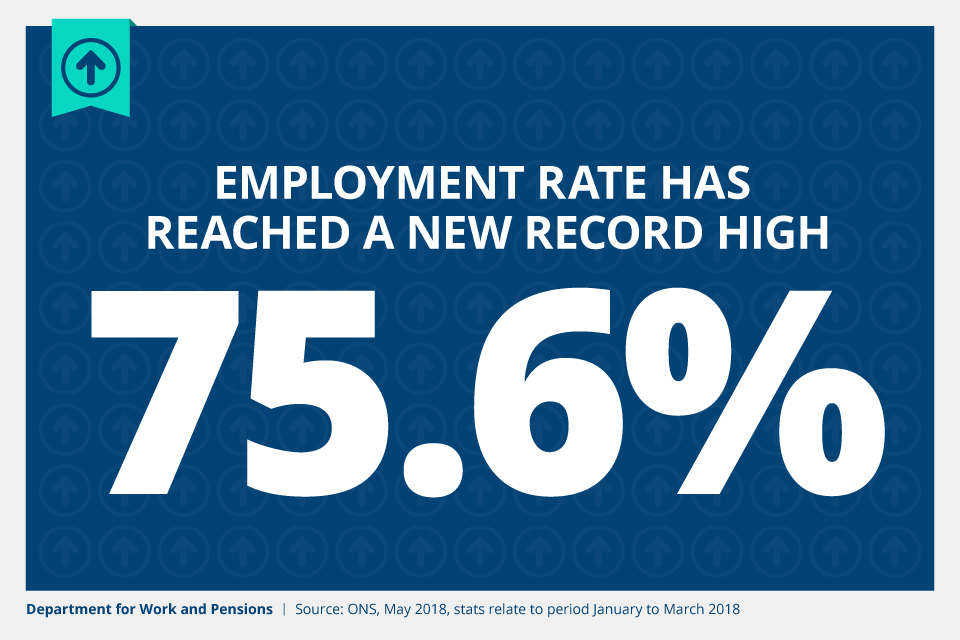
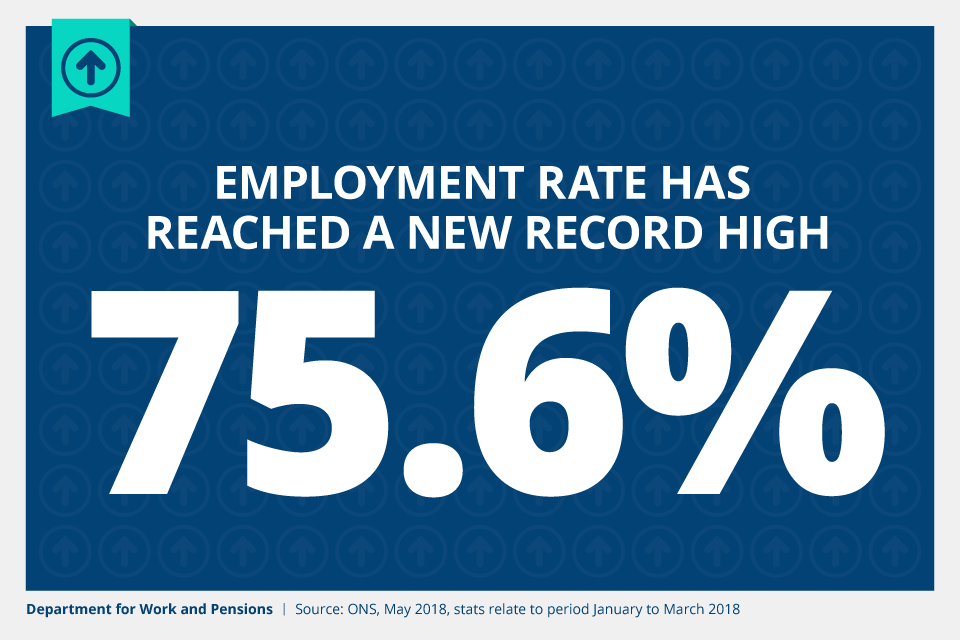
Today’s figures also show the employment rate has remained at a record 75.6%, with 197,000 more people in work compared to October to December 2017.

And with the number of black, Asian and minority ethnic (BAME) people in work up 475,000 since 2015, the government is making rapid progress on its commitment to increase BAME employment by 20% by 2020.

The employment rate has reached a new record high of 75.6%. Source: Office for National Statistics, May 2018, stats relate to period January to March 2018.

The Secretary of State for Work and Pensions, Esther McVey, said:

Since 2010 we have seen more than 3.2 million people move into work right across the UK. Youth unemployment has fallen by over 40% and the unemployment rate has not been lower since 1975.

Today’s figures once again cement that turnaround, with a new employment rate record of 75.6%, and on average over 1,000 people each and every day, since 2010, getting a job.

With wages growing faster than inflation and increases in the personal tax allowance, not only are more people bringing home a pay packet but they are keeping more of their hard earned money for themselves and their families.

Figures also show:

  • the BAME employment gap has closed to just 10.1 percentage points, a decrease of 1.3 percentage points since 2015 and the lowest the gap has been since the series began in 2001
  • the number of people in employment has increased by over 3.2 million since 2010
  • there are 806,000 vacancies in the economy at any one time
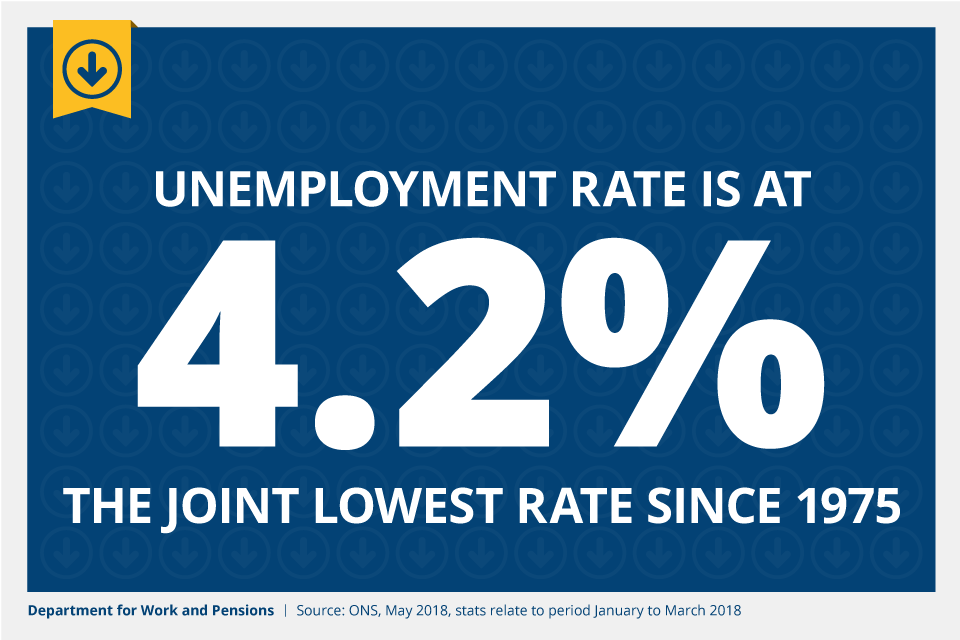
The unemployment rate is at 4.2% - the joint lowest rate since 1975. Source: Office for National Statistics, May 2018, stats relate to period January to March 2018.

This comes as we have reformed welfare to make work pay, backed businesses to take more people on, and built a stronger, fairer economy. But we want to help even more people benefit from a well-paid job. That’s why we are:

  • improving the welfare system with Universal Credit, which helps people move into work faster and to stay in work longer than under the old system
  • introducing a modern industrial strategy to help businesses create better, higher-paying jobs in every part of the UK
  • helping people stay in work longer with our Fuller Working Lives strategy, which supports employers to recruit, re-train and retain older workers
  • tackling inequalities in employment highlighted by the Race Disparity Audit, through targeted support in 20 areas around the country and £90 million announced by the Prime Minister to help young people

Also, the Department for Work and Pensions launched a new ‘Find a job’ service this week to support thousands of jobseekers into work. The site will continue to allow jobseekers to search for work 24 hours a day, 7 days a week, and will offer jobseekers and employers a simpler and more streamlined way to log in and access their information.

Separate figures out today showed that 870,000 people are now on Universal Credit as the rollout of the new benefit continues. Of these, 36% were in employment (320,000). Through Universal Credit, people are keeping more of their earnings as their Universal Credit payment gradually adjusts when their income climbs.

More information

Read the Labour Market Statistics – May 2017 from the Office for National Statistics.

Contact Press Office

Press Office

Caxton House

Tothill Street
London
SW1H 9NA

Follow DWP on:


Link: Press release: Unemployment rate lowest in over 40 years
Source: Gov Press Releases

Press release: Taunton boss handed suspended sentence after pocketing £100,000

Andrew Reed (53) was the director of APR Media, formerly known as APR Video, where he produced and duplicated recordable media since it was first incorporated in 1996.

However, when the company began to make a loss and after 16 years of trading, Andrew Reed instructed insolvency practitioners in October 2012 to place APR Media into creditors’ voluntary liquidation with a total deficiency of just over £800,000.

During the initial investigation into the company’s affairs, the insolvency practitioners could not account for around £125,000 which had been transferred out of APR Media’s accounts just a couple of months before it was placed into liquidation.

Further enquiries by the Insolvency Service found that Andrew Reed fraudulently transferred money out of APR Media in the full knowledge that the business was insolvent in order to avoid paying his creditors.

In August 2012, Andrew Reed paid himself a £100,000 dividend and in September 2012, he transferred £25,250 to M5 Audio & Events, a company where his wife was a director.

Andrew Reed pleaded guilty to two fraud charges and on 27 April 2018 he was sentenced to 15 months in prison, suspended for two years, while also being ordered to complete 120 hours of unpaid work and pay £7,500 in costs.

The sentence was handed down despite the fact that Andrew Reed had paid back over £200,000 to the estate once the wrongful payments had been identified by the insolvency practitioner.

Glenn Wicks, Deputy Chief Investigation Officer of the Insolvency Service, said:

Andrew Reed knew his company was failing and unscrupulously ripped off his creditors by transferring money to his other company. The court has shown anyone doing this stands a serious chance of going to prison.

Notes to editors

APR Video Limited (Company number: 03239812) was incorporated on 20 August 1996 before it changed its name to APR Media in 2006.

On 19 March 2018 Andrew Reed pleaded guilty to two charges contrary to section 207(1)(a) of the Insolvency Act 1986 of undertaking transactions in fraud of APR Audio Limited’s creditors at Taunton Crown Court.

Insolvency Service

The Insolvency Service, an executive agency sponsored by the Department for Business, Energy and Industrial Strategy (BEIS), administers the insolvency regime, and aims to deliver and promote a range of investigation and enforcement activities both civil and criminal in nature, to support fair and open markets. We do this by effectively enforcing the statutory company and insolvency regimes, maintaining public confidence in those regimes and reducing the harm caused to victims of fraudulent activity and to the business community, including dealing with the disqualification of directors in corporate failures.

BEIS’ mission is to build a dynamic and competitive UK economy that works for all, in particular by creating the conditions for business success and promoting an open global economy. The Criminal Investigations and Prosecutions team contributes to this aim by taking action to deter fraud and to regulate the market. They investigate and prosecute a range of offences, primarily relating to personal or company insolvencies.

The agency also authorises and regulates the insolvency profession, assesses and pays statutory entitlement to redundancy payments when an employer cannot or will not pay employees, provides banking and investment services for bankruptcy and liquidation estate funds and advises ministers and other government departments on insolvency law and practice.

Further information about the work of the Insolvency Service, and how to complain about financial misconduct, is available.

Contact Press Office

Media enquiries for this press release – 020 7637 6498 or 020 7596 6187

Press Office

The Insolvency Service


4 Abbey Orchard Street
London
SW1P 2HT

This service is for journalists only. For any other queries, please contact the Insolvency Enquiry line on 0300 678 0015.

For all media enquiries outside normal working hours, please contact the Department for Business, Energy and Industrial Strategy Press Office on 020 7215 1000.

You can also follow the Insolvency Service on:

Link: Press release: Taunton boss handed suspended sentence after pocketing £100,000
Source: Gov Press Releases

Press release: Bonus beaches leads to record number of swimming spots

As the bathing water season begins this week, visitors to the seaside will have 422 bathing spots to choose from after nine new beach locations have been designated as official bathing waters along the south coast.

The Environment Agency tests water quality at every official bathing water to ensure it is maintained and improved. Last year, water quality remained high with 98.3% of bathing waters in England meeting the tough standards. 92% of these locations achieved the top rating of Excellent or Good.

Beach-goers can check out the water quality at their nearest bathing water spot by visiting the Environment Agency’s online map at the Bathing Water Data Explorer website.

Helen Wakeham, Deputy Director of Water Quality at the Environment Agency, said:

It is wonderful news that more beaches have been given bathing status in time for the start of the 2018 season. Water quality has improved at English beaches giving locals and tourists a better experience as well as benefiting the environment.

Water quality tests are published online, me and my family will certainly be searching the online map before heading off to enjoy time at the beach this summer.

The Environment Agency will continue to work with water companies, councils and local communities to keep our beaches clean, reduce pollution and protect our environment. We are working to achieve the goal in Defra’s 25 Year Plan to minimise the harmful bacteria in our bathing waters by 2030.

During the bathing water season environment officers will take up to 20 samples at each location, from now until the end of September. Samples will be tested in Environment Agency labs for cleanliness. This year, in addition to sampling water quality, Environment Agency teams will also carry out surveys of plastic pollution on beaches. This data will help target our work and support community action.

Dramatic improvements have already been made over the last two decades to prevent pollution ending up in the sea, but there is always more to do.

Pollution from sewage and from agriculture are generally recognised as the two most significant sources but there are some local variations. Surveys have shown that around a third of bathing water pollution is caused by agriculture. This year the Environment Agency is rolling out new rules for farmers to ensure best practice is followed and pollution from farms is reduced.

Water companies have done a lot over the last two decades to improve infrastructure investing over £2.5 billion on projects that have improved water at swimming beaches.

To go further the Environment Agency are advising water companies on the investment they should be making to protect the environment, these include measures to protect water quality as well as being more resilient to flooding and potential water shortages. Environment Agency proposals include that water companies should improve 24 bathing waters between 2020-2025.

All members of the public can help keep water clean by taking all rubbish with them after visits to the beach, not leaving dog mess on the beach and at home never flushing wet wipes or pouring fats down drains.

Heavy rain is likely to reduce water quality in the short term, even at Excellent beaches. Information on the Bathing Water Data Explorer website may advise against swimming and there could be temporary signs at beaches.

The nine new beaches have become official bathing waters following suggestions from councils, feedback from public consultations and a decision by the Department for Environment, Food and Rural Affairs.

All the new bathing waters will have signage to show they are official swimming spots and the Environment Agency will test water quality regularly.

One of the new beaches is in Bournemouth, Manor Steps beach. Eight of the new locations are in Cornwall: South Fistral beach in Newquay, Booby’s Bay near Trevose Head, Mexico Towan, Upton Towan and Godrevy, all situated on a long stretch of dunes in St Ives Bay, Northcott Mouth beach to the north of Bude, Gwynver Beach which forms part Whitesand Bay and Tregonhawke in Whitesand Bay.

Link: Press release: Bonus beaches leads to record number of swimming spots
Source: Gov Press Releases

Press release: Independent investigation finds no further action required on fridge freezer model

The investigation into the fridge freezer Hotpoint FF175B model identified by the Metropolitan Police as being involved in the Grenfell Tower fire has confirmed there is no need for a product recall or any other corrective action, and that consumers can continue using the product as normal.

As part of the government’s response to the Grenfell Tower fire, Business Secretary Greg Clark ordered an immediate examination of the unit by independent technical experts.

This included a thorough product safety investigation which examined the Grenfell Tower appliance, further independent examinations and testing of other FF175B appliances, undertaking analysis of data and documents, and commissioning independent experts to assess the risk of the FF175B model.

Based on the findings of the investigation, the experts have concluded that the product met legal safety requirements and that the risk associated with the model is assessed as low.

This conclusion has been verified by the Chief Scientific Adviser who chaired a panel that considered the methodology and conclusions of the technical investigation.

John Loughhead, BEIS Chief Scientific Adviser said:

Having considered the robust technical investigation, I support its conclusion that no product recall or other corrective action is required, and that people who own this particular model can continue to use it as normal.

The results of the investigation have been shared with the Metropolitan Police, the Grenfell Inquiry, and, with the Grenfell residents through appropriate channels.

The government continues to place huge importance on consumer safety. This is why, on 21 January 2018, we accepted all the recommendations made by the Working Group on Product Recalls and Safety to upgrade the UK system of product safety, and we established the Office for Product Safety and Standards.

As the manufacturer of this product, Whirlpool has co-operated with the investigation and has undertaken their own investigation in line with their legal obligations.

Whirlpool will continue to provide advice and support to its customers directly through Whirlpool Corporation’s Freephone hotline on 0800 316 3826 and its website www.hotpointservice.co.uk/fridgefreezer.

Consumers are encouraged to:

  • visit the ‘Product Recall – Acting on Product Safety’ page for up-to-date information on current recalls
  • register their household appliances so manufacturers can get in touch quickly if a problem is identified – visit Register my appliance for more information
  • re-familiarise themselves with the manufacturer’s instructions to check they are using their household appliances safely
  • follow standard safety advice, not overload plugs, ensure sockets are not damaged and check cables and leads are in good condition

People with concerns about product safety can call the Citizens Advice consumer service line on 03454 04 05 06. The government website on product recalls can be found at www.gov.uk/productrecall.

Note to editors

  1. On 14 June 2017 the Prime Minister announced a Public Inquiry into the Grenfell Tower fire. Chaired by Sir Martin Moore-Bick, a highly experienced former judge of the Court of Appeal, the Inquiry will report directly to the Prime Minister and will examine the circumstances surrounding the fire, including the immediate cause or causes of the fire and the means by which it spread to the whole of the building.
  2. The Working Group on Product Recalls and Safety consisting of product and fire safety experts was brought together to explore and build on the recommendations made by Lynn Faulds Wood in her independent review into consumer product recalls. The Working Group is chaired by Neil Gibbins, former Deputy Chief Fire Officer for Devon and Somerset, and consists of fire safety, trading standards, consumer and industry experts. The Working Group report was published on 19 July 2017.
  3. The government responded to the Working Group’s report and launched a new Office for Product Safety and Standards in January to further enhance the UK’s world-leading product safety system and give consumers the highest ever levels of protection.

Link: Press release: Independent investigation finds no further action required on fridge freezer model
Source: Gov Press Releases

Press release: Grants for Peatlands Restoration

A new injection of £10m of government money will help restore more than 10,000 football pitches-worth of England’s iconic peatlands.

Peat bogs and fens are important habitats that provide food and shelter for wildlife, help with flood management, improve water quality and play a part in climate regulation. The new funding will help deliver commitments in the Government’s flagship 25 Year Environment Plan to create a new ambitious framework for peat restoration in England.

The total area of 6,580 hectares of upland and lowland peatlands that these grants will support work on is equivalent to 10,613 football pitches. The work will be delivered through four local partnership projects and will reduce greenhouse gas emissions making their way into the atmosphere by creating a natural store for carbon.

This vital work will abate and store an estimated 23,000 tonnes of carbon per year contributing to the UK’s climate change goals.

A panel of experts and Defra officials assessed the projects and awarded the funding based on the potential for carbon abatement.

Environment Minister Thérèse Coffey said:

Peatlands are an iconic aspect of the English landscape which are not only a haven for wildlife but also provide us with clean water and help reduce greenhouse gas emissions.
The 25 Year Environment Plan sets out the Government’s commitment to improve peatlands and grant schemes such as this one will enable us to leave our environment better than we inherited it.

Defra has allocated a total of £10 million between the four projects.

The North of England Peat Partnership led by the Yorkshire Wildlife Trust will restore 394 ha of lowland raised bog and 1679 ha of blanket bog across 21 peatland sites in the north of England.

Dr Tim Thom, Peat Programme Manager at Yorkshire Wildlife Trust, which co-ordinated the bid, said:

It’s fantastic to see peatlands on the Government’s agenda and getting the recognition they deserve – both in terms of the benefits they bring and the parlous condition we have let so many of them reach. I’m thrilled that our bid has been successful and I know I speak for all of our partners when I say I cannot wait to get started.

This funding will enable us to restore some of the most important and beautiful sites across the north of England – from England’s largest lowland raised bog in South Yorkshire all the way up to Northumberland’s highest point near the Scottish border – over 2,000 hectares of peatland will be repaired, locking up carbon, filtering our drinking water, managing flooding and providing habitat for some fascinating species.

The South West Peatlands Bid led by South West Water will be delivered through local partnerships.

The focus is on 1,680 ha of upland peat across Bodmin Moor, Dartmoor and Exmoor. To date very little of the peatland on Dartmoor and Bodmin Moor has been restored. Exmoor has had over 1,900 ha of restoration to date.

Morag Angus, Exmoor Mires Partnership Manager said:

This peatland grant from Defra presents a real opportunity to make a significant difference to deliver peatland restoration across Bodmin Moor, Dartmoor and Exmoor.

The peatlands of south-west England are very important for water quality, carbon storage, biodiversity, cultural history, recreation and farming but they are the most vulnerable in the UK to the impacts of climate change, due to their southerly position. Working with our partners in these three moors enables these nationally and internationally important habitats to be restored for the benefit of all and future generations.

Meres & Mosses Carbon Capture Project led by Shropshire Wildlife Trust aims to restore a mix of nine lowland and upland peatland sites covering 98 ha across the Meres & Mosses Natural Area.

John Hughes, Development Manager, Shropshire Wildlife Trust said:

The Mosses of Shropshire, Cheshire and Staffordshire are one of the least known, but most ecologically important, suites of peatbogs. Our partnership is delighted that this Defra funding will allow us to carry out even more work in our mission to restore them to favourable condition.

Moor Carbon, led by the Peak District National Park Authority, will be working in the Peak District National Park, West Pennine Moors SSSI, and Rossendale Gap to restore over 2,000 hectares of blanket bog.

Chief Executive, Sarah Fowler, said:

We are delighted to have been awarded this funding from Defra; helping to achieve an early win for Defra’s 25 Year Environment Plan. The project will deliver vital conservation work on more than 2,100 hectares of blanket bog in the UK’s original National Park. The work will help to reduce over 4,500 tonnes of carbon dioxide loss into the atmosphere every year. We are proud to play a role in helping to achieve the Government’s aspiring climate change targets.

As well as carbon storage, this innovative partnership project will provide a wealth of benefits to both people and animals. Work will help to improve the quality of the water that we consume; and enhance the precious home of rare birds and mammals. Bare peat re-vegetation and blocking eroded gullies on the moors will help to slow the flow of water when it rains; reducing the threat of flooding in local at-risk communities. The Partnership has a proven track-record of undertaking moorland conservation projects on such a large scale. We work together to help care for these stunning wild spaces that mean so much to so many people; and to ensure that they are protected for generations to come.

Photos of peatlands are on Defra’s Flickr account.

Link: Press release: Grants for Peatlands Restoration
Source: Gov Press Releases

Press release: PM bilateral meeting with President Varela: 14 May 2018

A Downing Street spokesperson said:

The Prime Minister held a bilateral meeting with the President of Panama, Juan Carlos Varela, at Downing Street earlier today.

They discussed the importance of the international community continuing to come together to uphold the global prohibition on the use of chemical weapons, particularly in the wake of the attack in Douma, Syria, and the attempted murder of the Skripals in Salisbury.

They discussed regional security cooperation, agreeing on the importance of our joint work to address cross-border threats including the trafficking of narcotics, people, contraband and counterfeit goods, and illicit finance.

They discussed joint anti-corruption efforts, and the Prime Minister noted the importance of seeing further progress in introducing anti-corruption legislation and criminalising tax evasion in Panama.

They also discussed education, noting the strong teacher training links between our two countries and the centrality of education to development.

Finally, they discussed trade, agreeing trade links between the UK and Panama would continue to go from strength to strength as the UK leaves the EU. In particular, they welcomed the approach agreed at the March European Council to provide continuity during the implementation period for international agreements, which could be swiftly transitioned into new bilateral agreements once the implementation period ends.

Link: Press release: PM bilateral meeting with President Varela: 14 May 2018
Source: Gov Press Releases