Press release: New chairman of HMCTS board appointed

Tim Parker will take up his new position as Chairman of the Board of HM Courts & Tribunals Service (HMCTS) on 27th April.

The Board is responsible for overseeing the leadership and direction of HMCTS and ensuring that it effectively delivers the aims and objectives set by the Lord Chancellor, the Lord Chief Justice and the Senior President of Tribunals. The Chair provides leadership, vision and direction – ensuring HMCTS is driving forward the Government’s £1 billion reform of courts and tribunals.

Tim will bring a wealth of knowledge and experience in business transformation and is currently chairman of the Post Office, Samsonite and the National Trust. He previously spent time as an economist in the Treasury and was chief executive of Clarks, Kwik-Fit and the AA.

His appointment has been made by the Lord Chancellor, Lord Chief Justice and Senior President of Tribunals.

He will formally take up the post at the end of April, following the retirement of Robert Ayling, who has served as Board Chairman since HMCTS was established in 2011. Robert has overseen the design and implementation of the transformation programme for the courts and tribunals service, which will streamline working practices, update and replace currently outdated technology and provide much improved services for users.

Tim Parker, incoming chairman of the Board of HMCTS, said:

I am delighted to be joining HMCTS and look forward to spearheading its programme of reform – bringing courts and tribunals into the digital age and ensuring they are providing the best service possible for the public.

Lord Chancellor David Gauke said:

Tim’s expertise will be vital as we deliver our reform and modernisation of the courts and tribunals system – making it more convenient, easier to use, and providing better value for the taxpayer. I would like to place on record my sincere thanks to Robert for his outstanding service to HMCTS and the wider justice system through his chairmanship over the past seven years.

The Lord Chief Justice of England and Wales, Lord Burnett of Maldon, and the Senior President of Tribunals, Sir Ernest Ryder, said:

We congratulate Tim Parker on his appointment, and pay tribute to his predecessor, Robert Ayling who chaired the Board and led the organisation with dedication, integrity and skill for the last seven years. Tim takes up the reins at a critical time and we look forward to working closely with him.

Link: Press release: New chairman of HMCTS board appointed
Source: Gov Press Releases
Press release: The UK announces further support in the fight against malaria

As the second largest international donor, the UK has been at the forefront of efforts to reduce the number of cases for many years by investing in treatment, prevention and research, including the fight against the threat of drug resistance.

Today the International Development Secretary Penny Mordaunt announced a £100 million fund to be matched pound for pound by the private sector, which will be used to support priority countries with mosquito nets, indoor sprays and the strengthening of health systems.

International Development Secretary Penny Mordaunt said:

We know malaria still causes one out of ten child deaths in Africa and costs economies billions every year. We also know progress on reducing malaria cases has stalled, which is why it is so important it is one of the focuses of the Commonwealth Heads of Government Meeting.

The UK government is a leader in the fight against malaria and has been for many years. We are the second largest international funder in the world and invest in treatment, prevention and research, including fighting against the threat of drug resistance.

Our new commitment will save countless more lives and build a safer, healthier and more prosperous world for us all which is firmly in the UK’s national interest.

Malaria is a major health issue for the Commonwealth, with 90% of Commonwealth citizens living in affected countries.

The UK’s new commitment will distribute 26 million nets and ensure more than five million households in target areas are reached with indoor spraying. This money will save more lives and help build a safer, healthier and more prosperous world for us all, which is firmly in the UK’s national interest.

Heads of government will be urged to make a commitment to halve malaria across the Commonwealth by 2023 at a Malaria Summit tomorrow in London co-hosted by the governments of Rwanda, Swaziland and the UK.

Today the Prime Minister supported the pledge to halve malaria in the next five years and re-affirmed the government’s commitment in 2016 to spend £500 million a year on malaria for five years.
UK aid has helped Nigeria cut the estimated number of people who die from malaria in Nigeria every year by more than half – from 210,000 to 100,000 between 2000 and 2016. This year the Department for International Development will launch a new £50 million programme to push for further malaria control in the country.

The UK is also committing £9.2 million of research funding to develop two new safe and effective malaria treatments. The programme will be led by the Mahidol-Oxford Tropical Medicine Research Unit (MORU) which is a collaboration of the University of Oxford, Wellcome Trust and Mahidol University, Thailand.

This comes on top of the UK’s leading work in the fight against malaria:

  • Since 2011, DFID has distributed 49.7 million long-lasting, insecticide-treated bed nets – saving up to 808,000 lives.
  • In September 2016 DFID announced the UK pledge of £1.1 billion to the Global Fund to Fight AIDS, TB and Malaria over the next three years. In 2016 UK support helped the Global Fund to save 2.2 million lives and avert 50 million new infections from malaria, TB and HIV.
  • UK funded research that supported the development of child-friendly malaria drugs has now been used for more than 350 million treatments in malaria-endemic countries.
  • The UK also remains committed to its five-year pledge, made in 2016, to spend £500m a year tackling malaria until March 2021.

Notes to editors:

As part of our £500m a year commitment on malaria, today we are announcing a £100 million investment in malaria. This is a match fund which leverages support from the private sector, giving an additional boost to the fight against the disease.

This money will support the Global Fund’s work in priority countries. The Global Fund works in 38 of the 53 Commonwealth countries including Nigeria, Kenya, Malawi and Tanzania.

Tackling malaria not only has a positive impact on improving health services, it also increases economic growth and productivity of affected countries.

Malaria affects economic growth, with the growth rate of the gross domestic product per capita in malaria-endemic countries as much as 1.3 percentage points lower than in countries without malaria.

It can cost as little as £3.25 to avert a case of malaria – with an astonishing return on investment as malaria control brings £36 in social and economic benefits for every pound spent.

DFID supports research on infectious diseases, such as malaria, through the Ross Fund Portfolio. This follows a pledge in 2016 for the department to invest 3% of its budget in high quality, high impact research across all of its policy areas.

General media queries

Follow the DFID Media office on Twitter – @DFID_Press

Link: Press release: The UK announces further support in the fight against malaria
Source: Gov Press Releases

Press release: G7 foreign ministers’ statement on the Salisbury attack

We, the G7 foreign ministers, of Canada, France, Germany, Italy, Japan, the United Kingdom and the United States of America and the High Representative of the European Union, are united in condemning, in the strongest possible terms, the attack that took place against Sergei and Yulia Skripal, using a nerve agent in Salisbury, United Kingdom, on March 4, 2018. A British police officer and numerous civilians were exposed in the attack and required hospital treatment, and the lives of many more innocent British civilians have been threatened. We express our deepest sympathies to them all and our admiration and support for the UK emergency services for their courageous response.

The United Kingdom has thoroughly briefed G7 partners. We share, and agree with, the UK’s assessment that it is highly likely that the Russian Federation was responsible for the attack and that there is no plausible alternative explanation. We condemn Russia’s continued failure to address legitimate requests from the UK government, which further underlines its responsibility. We call on Russia to urgently address all questions related to the incident in Salisbury. The Organisation for the Prohibition of Chemical Weapons (OPCW) has now independently confirmed the findings of the United Kingdom relating to the identity of the toxic chemical that was used in Salisbury. Russia should provide full and complete disclosure of its previously undeclared Novichok program to the OPCW in line with its international obligations.

This use of a military-grade nerve agent, of a type developed by Russia, constitutes the first offensive use of a nerve agent in Europe since the Second World War and is a grave challenge not only to the security of the United Kingdom but to our shared security. It is an assault on UK sovereignty. Any use of chemical weapons by a state party, under any circumstances, is a clear breach of international law and a violation of the Chemical Weapons Convention. It is a threat to us all. Their use is abhorrent, completely unacceptable and must be systematically and rigorously condemned. We, participating states of the International Partnership Against Impunity for the Use of Chemical Weapons, stand together against impunity for those who develop or use these weapons, anywhere, any time, under any circumstances.

The G7 is committed to protecting and promoting the rules-based international system. We stand in unqualified solidarity with the United Kingdom. Our concerns are also heightened against the background of a pattern of earlier irresponsible and destabilizing Russian behaviour, including interference in countries’ democratic systems. We call on Russia to live up to its Chemical Weapons Convention obligations, as well as its responsibilities as a permanent member of the UN Security Council, to uphold international peace and security. In order to bring Russia back into the rules-based international system, we will continue to engage with Russia, as appropriate, on addressing regional crises and global challenges.

The G7 will continue to bolster its capabilities to address hybrid threats, including in the areas of cybersecurity, strategic communication and counter-intelligence. We welcome national action taken to constrain Russian hostile-intelligence activity and to enhance our collective security. The G7 will remain closely focused on this issue and its implications.

Link: Press release: G7 foreign ministers’ statement on the Salisbury attack
Source: Gov Press Releases

Press release: Employment rate reaches another new record high

Figures released by the Office for National Statistics (ONS) show that 427,000 more people have moved into employment in the last year, with 32.26 million now in work. On average, 1,000 more people have entered employment every day since 2010.

The unemployment rate (4.2%) has not been lower since 1975, and the number of people out of work is down by 136,000 compared to a year ago.

In addition, as recognised by the ONS, wages are now outpacing inflation.

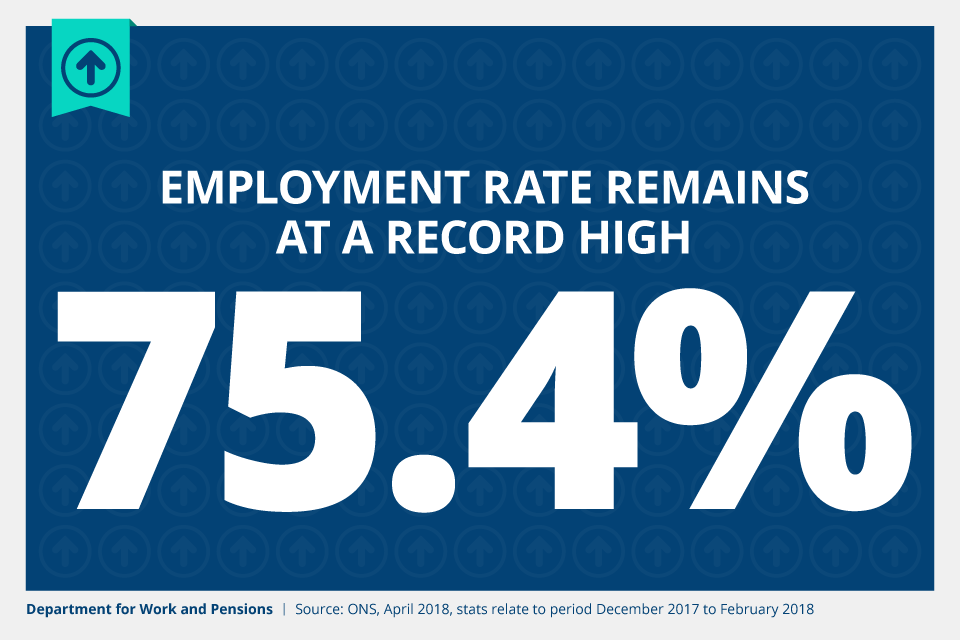
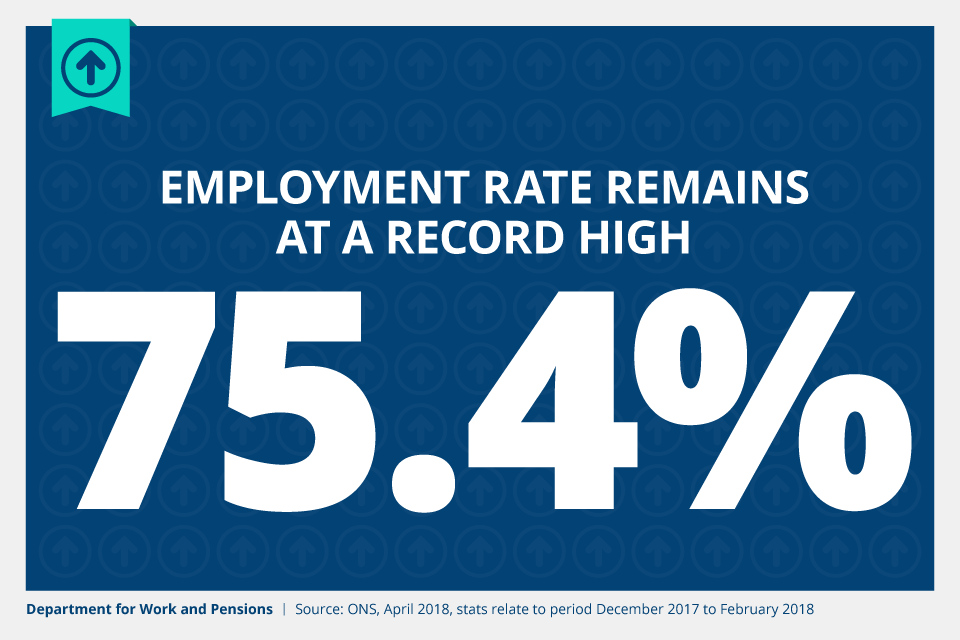
Employment rate remains at record high of 75.4%

The Secretary of State for Work and Pensions, Esther McVey, said:

Another milestone for employment has been reached under this government as employment reaches a record high, up 3.2 million since 2010 – the 16th time the employment record has been broken in the same period.

That means on average, over 1,000 people have moved into work every day since 2010, and credit has to be given to the businesses who have created those jobs and the individuals who are taking those opportunities.

Day by day we are helping people turn their lives round by getting into employment. Jobs are key to transforming lives and work is the best route out of poverty.

And this month we have again increased the personal allowance and taken more people out of paying tax all together making sure people can keep more of what they earn.

This comes as we have reformed welfare to make work pay, backed businesses to take more people on, and built a stronger, fairer economy. But we want to help even more people benefit from a well-paid job. That’s why we are:

  • improving the welfare system with Universal Credit, which helps people move into work faster and to stay in work longer than under the old system
  • introducing a modern industrial strategy to help businesses create better, higher-paying jobs in every part of the UK
  • helping people stay in work longer with our Fuller Working Lives strategy, which supports employers to recruit, re-train and retain older workers
  • tackling inequalities in employment highlighted by the Race Disparity Audit, through targeted support in 20 areas around the country and £90 million announced by the Prime Minister to help young people

Today’s employment figures also show:

  • there are 815,000 vacancies in the economy at any one time
  • the number of people in employment has increased by over 3.2 million since 2010
  • the UK has the third highest employment rate in the G7
  • the number of workers aged 50 or over has reached a record 10.1 million
  • youth unemployment level has fallen by over 40% since 2010
  • the proportion of young people who are unemployed and not in full time education is 5.1%, a fall of 3.9 percentage points since 2010
  • more than 820,000 people are now receiving Universal Credit, with 38% in employment

More information

Read the Labour Market Statistics – April 2018 from the Office for National Statistics.

Contact Press Office

Press Office

Caxton House

Tothill Street
London
SW1H 9NA

Follow DWP on:


Link: Press release: Employment rate reaches another new record high
Source: Gov Press Releases

Press release: PM meeting with Prime Minister of Jamaica: 17 April 2018

A Downing Street spokesperson said,

The Prime Minister had a bilateral meeting with the Jamaican Prime Minister Andrew Holness earlier today.

The Prime Minister said Jamaica was a key Commonwealth partner, with over 800,000 members of the Jamaican diaspora residing in the UK and over 200,000 Britons visiting Jamaica each year.

The Prime Minister said she deeply valued the contribution made by the Windrush generation and all Commonwealth citizens who have made a life in the UK, and that the UK Government would ensure the correct support was in place to give people certainty about their existing right to reside here. They looked forward to the meeting later this morning with heads of delegation from Commonwealth Caribbean countries where the matter will be discussed and the Prime Minister will have further opportunity to listen to concerns.

They discussed climate change and migration and agreed that the UK and Jamaica would continue to cooperate closely on disaster preparation ahead of hurricane season, on tackling serious and organised crime, and on healthcare training and education.

They agreed the bilateral trade and investment relationship would continue to grow, with the Prime Minister noting that as we leave the European Union, we are encouraging British businesses to look more widely around the world to identify opportunities to expand and diversify trade. They agreed that economic development and the provision of opportunities for the many young people in the region was key to Caribbean security.

Link: Press release: PM meeting with Prime Minister of Jamaica: 17 April 2018
Source: Gov Press Releases

Press release: G7 leaders: statement on chemical weapons use in Syria

We, the G7 Leaders of Canada, France, Germany, Italy, Japan, the United Kingdom, the United States of America and the European Union, are united in condemning, in the strongest possible terms, the use of chemical weapons in the April 7 attack in Eastern Ghouta, Syria.

We fully support all efforts made by the United States, the United Kingdom and France to degrade the Assad regime’s ability to use chemical weapons and to deter any future use, demonstrated by their action taken on April 13. This response was limited, proportionate and necessary – and taken only after exhausting every possible diplomatic option to uphold the international norm against the use of chemical weapons.

Use of chemical weapons is a breach of the Chemical Weapons Convention and constitutes a threat to international peace and security. The repeated and morally reprehensible use of chemical weapons by the Assad regime in the past has been confirmed by independent international investigators. We condemn this deliberate strategy of terrorizing local populations and forcing them into submission. Syria’s possession of chemical weapons and their means of delivery are illegal under UN Security Council Resolution 2118 and the Chemical Weapons Convention. We stand together against impunity for those who develop or use these weapons, anywhere, anytime, under any circumstances.

We remain committed to a diplomatic solution to the conflict in Syria. We commend and support UN Special Envoy de Mistura’s efforts towards an inclusive and credible political transition in accordance with UN Security Council Resolution 2254 and the Geneva Communiqué.

Link: Press release: G7 leaders: statement on chemical weapons use in Syria
Source: Gov Press Releases

Press release: Devolved Brexit legislation referred to the Supreme Court

The UK Government’s senior Law Officers, the Attorney General and the Advocate General for Scotland, are referring EU exit legislation passed in the Scottish Parliament and the National Assembly for Wales to the Supreme Court.

They are asking for a ruling on whether this legislation is constitutional, and properly within devolved legislative powers. The legal power to refer devolved legislation to the Supreme Court for a ruling on its constitutionality – as set out in the Devolution Acts – is exercisable by the Law Officers in the public interest.

Announcing the decision, the Attorney General, Jeremy Wright QC MP said:

This legislation risks creating serious legal uncertainty for individuals and businesses as we leave the EU. This reference is a protective measure which we are taking in the public interest. The Government very much hopes this issue will be resolved without the need to continue with this litigation

The two Bills – the UK Withdrawal from the European Union (Legal Continuity) (Scotland) Bill, and the Law Derived from the European Union (Wales) Bill – passed through the Scottish Parliament and Welsh Assembly on 21 March this year.

The reference is made to the UK Supreme Court under powers conferred by the Scotland Act 1998 and the Government of Wales Act 2006, which provide the Law Officers with discretion to ask the Supreme Court to consider whether legislation passed by the devolved legislatures is within their respective legislative competence. These powers allow the Law Officers to fulfil their unique constitutional duties to uphold the rule of law and the boundaries of the devolution settlements.

The European Union (Wales) Bill and the UK Withdrawal from the European Union (Legal Continuity) (Scotland) Bill cover very similar ground to the EU(Withdrawal)Bill currently before Parliament but with significant differences in terms of the EU law that is retained and the processes by which it can be amended. To leave these pieces of legislation on the statute book would create very significant legal uncertainty as to how the law would operate.

Link: Press release: Devolved Brexit legislation referred to the Supreme Court
Source: Gov Press Releases

Press release: UK is making sure one million girls across the Commonwealth get a quality education

Almost one million vulnerable and marginalised girls in developing countries across the Commonwealth will receive the life-changing education they need to become the thinkers and leaders of the future, the Prime Minister announced today (Tuesday 17th April).

130 million girls around the world are missing out on school, and in Sub-Saharan Africa fewer than 1 in 20 poor, rural girls are on track to complete secondary school.

DFID’s Girls Education Challenge will make sure 920,000 girls continue their education through primary, secondary school and training, so they can fulfil their potential to play a transformational role in their communities, economies and political institutions.

Today’s announcement will also give a further 53,000 adolescent girls in developing countries across the Commonwealth, who have never attended or dropped out of school due to poverty, motherhood, disability or conflict, a second chance to learn through catch-up classes and vital skills training.

DFID is also launching a new research partnership with the Malala Fund and the UN Girls’ Education Initiative (UNGEI) to help governments better harness their own resources to break down barriers to education for the most marginalised girls.

International Development Secretary Penny Mordaunt said:

Girls across the Commonwealth have huge potential to be the world’s next generation of problem-solvers, innovators and leaders.

But too many girls are still missing out on school. That’s why the UK is working with our Commonwealth partners to make sure that every girl receives the life-changing quality education they need to achieve their full potential.

Getting girls into school, and then into good employment, allows them to play a transformational role lifting their communities out of poverty, growing their economies and shaping the future of their countries.

The Girls Education Challenge is making it easier and safer for girls to get to school, training and equipping good quality teaching staff, and working with communities and families to raise awareness of the vital importance of educating girls.

Through its new Policy Lab, the UK is also sharing its world-class education expertise, to support the Commonwealth to work together to deliver for girls.

Notes to editors

DFID is committing £212 million to provide almost one million vulnerable and marginalised girls in developing countries across the Commonwealth with 12 years of quality education so that they can fulfil their potential. The second phase of DFID’s Girls Education Challenge (£212 million) will:

  • Ensure 920,000 girls in Commonwealth countries transition through primary and secondary school and training so that they can get good jobs, support themselves and their families, and play a role in the growth of their countries.
  • Give 53,000 highly marginalised adolescent girls in Commonwealth countries, who have never attended or dropped out of school as a result of poverty, early marriage and pregnancy, disability or conflict, a second chance to learn literacy, numeracy and other vital life skills.
  • Launch a new Policy Lab to bring the UK’s world-class expertise to work in partnership with other countries and help Commonwealth countries deliver for girls – supporting developing countries to ultimately become self-sufficient and provide quality education. This will begin with a pilot of five countries.

DFID is also launching a new research partnership with the Malala Fund and the UN Girls’ Education Initiative (UNGEI) to help governments better harness their own resources to break down barriers to education for the most marginalised girls so they can progress through primary and secondary education.

Through the first phase of the Girls’ Education Challenge (GEC I) UK aid:

  • Supported over a million marginalised girls to get a quality education. Through the second phase of the GEC we will support the vast majority of these girls to continue with their learning through secondary school and training to give them the opportunity to complete a full 12 years of education.
  • Benefitted many more girls and communities through 37 different projects in 18 countries across Africa and Asia, many operating in conflict and crisis settings

This is just one part of DFID’s education work. In 2015-2017 DFID supported 7.1 million children to gain a decent education. This included at least 3.3 million girls.

General media queries

Follow the DFID Media office on Twitter – @DFID_Press

Link: Press release: UK is making sure one million girls across the Commonwealth get a quality education
Source: Gov Press Releases

Press release: Government launches review of audit regulator

  • new comprehensive review to examine the role and powers of audit regulator, the FRC
  • Independent review to be led by Sir John Kingman
  • Findings will help assessment of the FRC’s governance, impact and powers

The government today (17 April 2018) launched an independent review of the Financial Reporting Council (FRC), the regulator for auditors, accountants and actuaries.

The review will be led by Sir John Kingman, who has extensive private and public sector experience. He will be supported by an advisory board which he will convene.

The root and branch review, due for completion by the end of 2018, will assess the FRC’s governance, impact and powers, to help ensure it is fit for the future.

The review aims to make the FRC the best in class for corporate governance and transparency, while helping it fulfil its role of safeguarding the UK’s leading business environment.

The review follows the announcement of Andrew Tyrie as the recommended new head of the Competition and Markets Authority, demonstrating the government’s determination that markets and the economy are working for consumers.

Business Secretary Greg Clark said:

The UK has a strong reputation as a dependable place to do business but this needs to be continuously updated and it’s important to ensure all of our regulators continue to drive high standards.

I am pleased to appoint Sir John who has a rigorous approach to bring to bear in leading this comprehensive review of the Financial Reporting Council. This review is part of the government’s Industrial Strategy aim of creating a business environment that ensures our regulators are fit for the future and our markets are working for consumers.

The review will include a consultation, asking for views on the FRC’s role in the British economy.

Read the Terms of Reference.

Link: Press release: Government launches review of audit regulator
Source: Gov Press Releases

Press release: International Development Secretary: “Financial markets open the door to a future free from aid dependency”

International Development Secretary Penny Mordaunt will join President Kenyatta of Kenya to open trading at the London Stock Exchange today (17 April 2018) where she will praise the critical role financial markets play in supporting prosperity and growth across the Commonwealth – and welcome a new partnership between the London Stock Exchange and the Nairobi Securities Exchange.

Ms Mordaunt will unveil a partnership package between the Bank of England and central banks in Sierra Leone, Ghana and South Africa to share expertise, improve regulation and reduce the risk of bank failures. Expert Bank of England staff will help central banks develop sustainable financial systems that power local and regional growth, job creation and investment opportunities.

She will also announce UK funding to help developing countries raise investment from global capital markets in their own currencies, promoting investment and job creation.

International Development Secretary Penny Mordaunt said:

Healthy financial markets create opportunities for new investment, trade and jobs, playing a critical role in delivering the global prosperity that benefits us all.

What’s more, financial markets open the door to a future free from aid dependency. By building partnerships, sharing knowledge and opening up markets across the Commonwealth, we can defeat poverty, boost trade and investment, and deliver on the ambitions of countries that want to stand on their own two feet.

Dr Ernest Addison, Governor of the Bank of Ghana, said:

The Bank of Ghana is happy to be part of this technical cooperation programme with the Bank of England. We envisage benefitting from the Bank of England’s experience in dealing with financial stability and macroprudential regulation, to assess the full implications of macro issues on the financial system.

Joanna Place, Chief Operating Officer at the Bank of England said:

The Bank of England is excited to be embarking on this new partnership with the Bank of Ghana, the Bank of Sierra Leone and the South African Reserve Bank. In our increasingly interconnected global financial system, cooperation between central banks is critical to providing the financial stability on which all our citizens rely.

We look forward to supporting our counterparts in delivering their priorities in building this essential foundation for growth.

Ms Mordaunt will also welcome the launch of the Commonwealth Digital Finance Champions Group. By sharing expertise and knowledge, the Group will drive innovation to improve financial access for the most vulnerable and underbanked people in societies – for example, exploring ways to reduce the cost of sending remittances. The UK, Kenya, Ghana, Jamaica and Rwanda have all confirmed they will be founding members of the group.

Joe Mucheru, EGH, Cabinet Secretary for the Ministry of Information, Communications and Technology of Kenya said:

Kenya is hailed globally for its early and successful adoption of mobile money. The recent launch of mobile money interoperability in the country will contribute towards bridging the remaining margin to achieve total financial inclusion for all Kenyans.

I encourage the Commonwealth community to explore the potentials of applying cutting edge technologies such as blockchain for distributed ledgers and artificial intelligence as this can enhance public service delivery and boost economic growth, particularly for developing economies such as Kenya.

The event marks the second day of the Commonwealth Heads of Government Meetings – bringing together business, civic society and government leaders from across the 52 Commonwealth nations in London for a week of events, forums and discussions.

Notes to Editors

Central Bank Partnership announcement

  • The Bank of England will establish technical assistance partnerships with central banks – initially in in three Commonwealth countries at different stages of development: Sierra Leone, Ghana, and South Africa.
  • The UK will provide up to £2 million for tailored technical assistance, provided by expert Bank of England staff, across a range of central bank functions. In South Africa, focus will be given to the important financial hub role played by the country across southern Africa.
  • These partnerships will share expertise across the Commonwealth, improving the regulation and supervision of financial sectors and mitigating the risk and severity of economic recessions due to bank failures and crises.

Local Currency Bonds announcement

  • Access to finance is fundamental to driving growth in developing countries, but when companies seek finance abroad it is most often in foreign currencies – meaning companies take on the risks associated with potential negative currency movements. This leads to underinvestment, hampers job creation, and can lead to volatile prices for consumers.
  • Today’s £5 million announcement to support and work with developing countries will help them raise local currency finance through the London market. This will include technical assistance to help address regulatory barriers to issuing local currency bonds in London and other global financial centres.
  • The demand-driven support package will help countries such as Nigeria, Pakistan and Ghana to benefit from increased access to international finance, by:
  • Identifying key regulatory and political barriers to accessing local currency bonds;
  • Identifying and building commitment of key public authorities;
  • And providing advice on regulatory reform.

Digital Finance Champions Group announcement

*The UK is partnering with Commonwealth countries with ambition around digital finance, to share knowledge and expertise on how to transition to a digital economy in an inclusive and sustainable way. The inaugural meeting of the Group will take place in Q3 of 2018, where the founding members – including the UK, Ghana, Kenya, Jamaica and Rwanda – will agree on priorities and identify where support is needed.
* Possible areas of collaboration and support include:
* Implementing initiatives to bring down the cost of remittances – at an average of 8.4%, the cost of sending remittances in Commonwealth corridors is higher than the Global Goal target of 3%;
* Reducing costs and cutting down on corruption by digitising government payment systems;
* Implementing the new Guidelines for Investing in Responsible Digital Finance, which have been developed by CDC, the IFC and Goodwill.

Partnership between London Stock Exchange and Nairobi Securities Exchange

  • Today the London and Nairobi Exchanges have signed a Letter of Understanding with FSD Africa, a DFID-funded NGO based in Nairobi focused on financial sector development in Africa.
  • With support from FSD Africa, the two exchanges aim to bring the ‘Elite’ SME development programme, to East Africa.
  • More info on FSD Africa is available at: www.fsdafrica.org, and on the Elite programme at: www.lseg.com/elite.

General media queries

Follow the DFID Media office on Twitter – @DFID_Press

]

Link: Press release: International Development Secretary: “Financial markets open the door to a future free from aid dependency”
Source: Gov Press Releases