Sir Alan joined the MCA in July 2010 after a 33-year career with the Royal Navy, where he left as Second Sea Lord.
During his eight-year tenure, Sir Alan has successfully steered the MCA through changes to modernise Her Majesty’s Coastguard, new arrangements for the UK’s search and rescue helicopter capability, a transformed survey and inspection capability and a more commercially-responsive approach to how the UK Ship Register operates. Sir Alan will continue his role until late 2018, to allow the appointment process for a successor to take place.
Bernadette Kelly, Permanent Secretary of the Department of Transport said: “I want to thank Sir Alan for his leadership of the MCA and his tireless commitment to improving safety at sea for all and supporting the UK’s maritime interests. I know that he will continue to make an exemplary contribution to the MCA and its ambitious plans until he leaves his post later this year.”
Sir Alan said: “It has been an immense privilege to work for the MCA and serve the public. I am extremely proud of what we have achieved. Whilst this has been a difficult decision for me to make, I feel that now is the right time for a new Chief Executive to bring a fresh perspective, new ideas and initiatives to the Agency. I’m confident that the MCA will continue to successfully deliver its objectives under new leadership. I will continue to lead the MCA with my full commitment and energy until my successor is found and is ready to take over towards the end of this year.”
The Department of Transport will launch a competition to recruit a new Chief Executive on Monday 19 March.
sugar makes up 13.5% of 4- to 10-year-olds, and 14.1% of teenagers’ (11- to 18-year-olds) daily calorie intake respectively; the official recommendation is to limit sugar to no more than 5%
4- to 10-year-olds consume two thirds of the amount of sugary drinks they did 8 years ago – down from 130g per day in 2008 to 2010 to 83g in 2014 to 2016
for teenagers, sugary drink intake is more than double that of younger children (191g) even though consumption has decreased by 30%; sugary drinks remain the main source of sugar (22%) in their diets
The survey confirms the UK population continues to consume too much saturated fat and not enough fruit, vegetables, and fibre:
average saturated fat intake for adults (19 to 64 year olds) is 12.5% of daily calorie intake, above the 11% recommended maximum
adults consume on average 4.2 portions of fruit and vegetables per day, 65- to 74-year-olds consume 4.3 portions and teenagers consume just 2.7 portions per day
only 31% of adults, 32% of 65- to 74-year-olds and 8% of teenagers meet the 5 A Day recommendation for fruit and vegetables
average fibre intake in adults is 19g per day, well below the recommended 30g per day
Dr Alison Tedstone, chief nutritionist at PHE, said:
Poor diets are all too common in this country and, along with obesity, are now one of the leading causes of disease such as cancer, heart disease and type 2 diabetes. It’s clear from these data that the nation’s diet needs an overhaul.
A healthy balanced diet is the foundation to good health. Eating 5 A Day and reducing our intake of calories, sugar, and saturated fat is what many of us need to do to reduce the risk of long term health problems.
The data underscores PHE’s call for the population to follow a healthy balanced diet, based on the Eatwell Guide, which includes eating at least 5 portions of a variety of fruit and vegetables per day, increasing consumption of oily fish and fibre and limiting the amount food high in saturated fat, sugar and salt.
Following a healthy, balanced diet and reducing calories will help reduce obesity and the economic and social burden of its consequences.
The NDNS rolling programme is a continuous cross-sectional survey, designed to assess the diet, nutrient intake and nutritional status of a representative sample of around 1,000 people per year (500 adults and 500 children) from the general population aged 18 months upwards living in private households in the UK. The NDNS comprises an interview, a 4-day diet diary and collection and analysis of blood and urine samples. Results are used by government to monitor the diet and nutritional status of the population, to provide the evidence base for policy development and to track progress towards public health nutrition objectives such as reducing sugar, saturated fat and salt intakes. This report covers data collected over a 2-year period – from year 2014 to 2015 to year 2015 to 2016.
Work to deliver years 7 and 8 of the NDNS rolling programme was carried out by NatCen Social Research and the Medical Research Council Elsie Widdowson Laboratory (formerly known as MRC Human Nutrition Research).
The last NDNS report covering years 5 and 6, (2012 to 2013; 2013 to 2014) was published in 2016.
Reference to poor diets being one of the leading causes of disease: Newton JN et al (2014) – Changes in health in England, with analysis by English regions and areas of deprivation, 1990 to 2013: a systematic analysis for the Global Burden of Disease Study 2013. Lancet 386(10010):2257-74.
The Scientific Advisory Committee on Nutrition (SACN) advice is to limit free sugars to no more than 5% of daily calorie intake:
adults should have no more than 30g of free sugars a day, (roughly equivalent to seven sugar cubes)
children aged 7 to 10 should have no more than 24g of free sugars a day (six sugar cubes)
children aged 4 to 6 should have no more than 19g of free sugars a day (five sugar cubes)
there is no guideline limit for children under the age of 4, but it’s recommended they avoid sugar-sweetened drinks and food with sugar added to it
Public Health England exists to protect and improve the nation’s health and wellbeing, and reduce health inequalities. We do this through world-leading science, knowledge and intelligence, advocacy, partnerships and providing specialist public health services. We are an executive agency of the Department of Health and Social Care, and a distinct organisation with operational autonomy. We provide government, local government, the NHS, Parliament, industry and the public with evidence-based professional, scientific expertise and support. Follow us on Twitter: @PHE_uk and Facebook: www.facebook.com/PublicHealthEngland.
As the £1.5bn project enters its second year of construction at full speed, the team this week found out that they have been shortlisted the 2018 Construction News Awards 2018 in the Supply Chain Excellence category.
This nomination to a top industry award comes after the recent news that the team won the BIM Show Live 2018 Award in the Information Management category (on 27 February 2018). Earlier last year, the team also won the Highways Award 2017 for Team of the Year – Procurement & Supply Chain, and the Judges overall winner award.
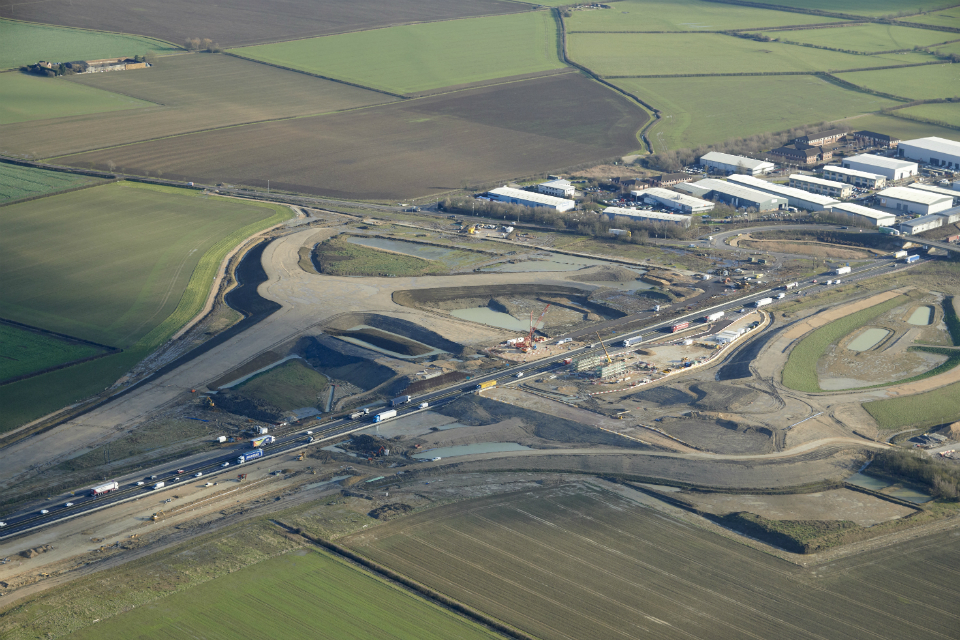
The project, which will see 21 miles of A14 in Cambridgeshire upgraded to three lanes in each direction (four between Bar Hill and Girton), is continuing to progress to its challenging schedule to open to traffic by the end of 2020 despite the recent severe weather. It is doing so while being recognised as leading the way in the construction industry.
David Bray, A14 project director at Highways England, says:
Since it was given the go ahead by the Secretary of State for Transport in May 2016, the A14 Cambridge to Huntingdon improvement scheme has been leading the way in the road construction sector in many ways.
The way the project delivery team is set up in itself is unique – one big team delivering all the construction packages as one. We’re matching each project milestone with the best team to deliver it, drawing from specialist areas across all contractors working on the scheme.
This means we’re making the most of the expertise at our disposal and it has already been paying off across the board.
Industry leading delivery
The project’s environmental team, which is continuing its work to create 18 wildlife habitats as part of the scheme covering a total of 271 hectares of new habitat by the time the scheme is completed, has received a lot of attention from the public over the past few months.
The A14 upgrade aims to leave a positive footprint on the local environment when it is complete by the end of 2020.
David explains:
Thanks to the publication of the team’s high-standard work via the media earlier this year, the team was nominated by the public for this year’s BBC Countryfile Award in the Conservation Success of the Year category. Even though we didn’t win the award, being one of five finalists nationwide is still an amazing achievement!
Another aspect in which the A14 upgrade is a trailblazer for the construction industry is via the Considerate Constructors Scheme (CCS). For the past 18 months, the project has been one of 12 pilot ‘Ultra Sites’ – the first major road infrastructure project to be recognised as such. This has meant that we’ve helped CCS develop and refine the initiative, which has been an invaluable opportunity for the team.
The Ultra Sites initiative, which was launched on 14 February 2018, demonstrates and promotes the highest standards of considerate construction. Ultra Sites actively seek to become beacons of best practice in the construction industry and a catalyst for exceptional leadership, collaboration and innovation. To find out more, visit the Considerate Constructors Scheme website.
We’ve also taken community engagement very seriously right from the start
using as many ways as possible to communicate with people living along the A14 in South Cambridgeshire and beyond. We’ve been using a mobile visitor centre, social media, newsletters, and more to give people a chance to find out more, get involved or even gain skills, get a job or secure funding for community projects. And we’re also planning to open our doors to the public soon!
On Saturday 24 March, the project team will participate in the nationwide ‘Open Doors – Get in to Construction’ initiative, welcoming people to visit one of the project’s three compounds. There will be opportunities to talk to the team to find out more about what it takes to build such a huge road project, as well as come out on a guided tour of the project’s construction site. Places are limited and can be booked via the Open Doors website.
The A14 Community Fund has also been very successful in helping the local community forge meaningful links with the road upgrade. The A14 Writer in Residence project led by the University of Cambridge Institute of Continuing Education, which secured funding from the Community Fund last year, has now concluded. A collection of writing inspired by the road called A14 Voices was published on 11 March 2018. The 120-page book contains poems, letters, fiction and short stories from people who live locally.
Recent milestones achieved
David Bray continues:
A lot has happened since the construction phase of the project reached its first anniversary at the end of November last year.
Nearly 40 percent of the project’s main construction work has been successfully completed and work is currently focusing on the scheme’s 34 bridges and structures while winter continues, marking a pause in the earth works side of the project.
Giant steel beams have been delivered steadily to site since the end of December and many have now taken up their permanent positions on a number of bridges near Huntingdon, including the bridge over the East Coast Main Line train line and a bridge near Brampton Hunt junction which will carry the future A14 over the A1. The 750m long River Great Ouse viaduct, with its 17 spans of piling, has also seen seven of its spans fitted with steel beams, with the rest to come between now and this summer.
And a second bridge was opened to traffic in February: the Brampton Road bridge over the A1, linking Brampton and Grafham. The old bridge it replaces was demolished that same week in just under 19 hours.
Demolition of the old Brampton Road bridge over the A1 on 17 February 2018
Coming up next
We will start the new earth works season as soon as the weather turns milder and drier.
By the time the project is completed at the end of 2020, we will have moved ten million cubic metres of earth across site, equivalent to 4,000 Olympic swimming pools, to build the foundations for the new road. Last year, we moved a quarter of that amount.
This second year of construction will see yet more project milestones reached as well as work starting on new sections of the scheme’s 21 miles of road upgrade. A crucial but challenging part of the project will be the redesign of the Bar Hill junction, on which we will start work after Easter.
We need to build a completely new junction which will span eight lanes of A14 traffic as well as link with the future local access road – at the exact location of the old bridge, which is still being used by traffic every day. This will mean some disruption to local residents at times, though we are planning the work to minimise impact as much as possible and will make sure people are kept informed so they can plan ahead.
More information about work at the Bar Hill junction will be available in the coming weeks.
Other work planned for the coming months includes the installation of beams across the A14 at Swavesey as part of the redesign of the Swavesey junction, where the current path of the A14 veers off to the south marking the start of the future Huntingdon southern bypass.
The Swavesey interchange taking shape – picture taken in January 2018
Work to widen the A1 from two to three lanes in each direction near Alconbury has also been progressing well and a section of the new southbound carriageway is planned to open to traffic by Easter.
David concludes:
Once again, I’d like to take this opportunity to thank all the roads users and local residents who use or live near the A14 for their patience.
We’re continuing to make great progress and the support we are getting from people locally means a lot to us.
The improvements we are delivering between Cambridge and Huntingdon are vital for the local area and for the country’s economy and we’re doing our best to make sure they are delivered to the highest standard, leading the way and showcasing best practice for future road investment projects as well as building a positive legacy for when the project is completed.
For the latest information about the A14 Cambridge to Huntingdon improvement scheme, including job and training opportunities, visit the scheme web page follow @A14C2H on Twitter and like our Facebook page at www.facebook.com/A14C2H/.
General enquiries
Members of the public should contact the Highways England customer contact centre on 0300 123 5000.
Media enquiries
Journalists should contact the Highways England press office on 0844 693 1448 and use the menu to speak to the most appropriate press officer.
The company is using its presence at the Big Bang Fair 2018 to encourage young people to take up three challenges to test their engineering skills.
One is a gaming challenge asking 11-14 year olds how they would connect two separated communities.
A second invites young Fair visitors to try their hand at being a Traffic Officer, and the third tests their maths skills to work out the right speed limits to use on motorways to keep traffic moving smoothly.
Highways England’s Early Talent Specialist Charlotte Potter said:
Engineering is an exciting career and we are encouraging more children to become the engineers of the future. Our three challenges on our stand at the Big Bang Fair show the variety of work we do, from major projects to connect communities to the daily job of keeping our roads flowing. We hope young people will be inspired by the variety of roles we offer and look to Highways England as an employer.
A Big Bang Fair visitor tries one of the challenges at the Highways England stand
The Big Bang UK Young Scientists & Engineers Fair, taking place until 17 March at the NEC, Birmingham, is a celebration of science, technology, engineering and maths (STEM) for young people in the UK, attracting thousands of visitors each year.
Highways England needs a continuing pipeline of young engineers to help deliver the massive investment planned for the country’s motorways and major A-roads, benefitting the economy and improving people’s lives. Over the next few months the company will be taking on 75 apprentices and 35 graduates.
Simulator
A Big Bang Fair visitor experiences the Highways England simulator
The Highways England driver simulator will test participants’ awareness skills as they use this technology and real-life scenarios to experience life on the road. Could they make it as a Traffic Officer to access the incident safely and quickly?
Connecting Communities
Highways England has developed a gaming challenge for children to try and solve. The task is a classic engineering problem; connecting two separated communities with either a bridge or tunnel. But how will they do it?
Variable Speed Limits
Highways England has devised a maths-based activity around traffic flow data to demonstrate how variable speed limits are needed on motorways to smooth the flow of traffic.
To find out more about the roles, apprenticeships or graduate placements within Highways England, and sign up for e-mail alerts visit Highways England’s careers homepage.
General enquiries
Members of the public should contact the Highways England customer contact centre on 0300 123 5000.
Media enquiries
Journalists should contact the Highways England press office on 0844 693 1448 and use the menu to speak to the most appropriate press officer.
Dstl, part of the Ministry of Defence, has teamed up with UK Naval Engineering Science and Technology (UKNEST) and the Women’s Engineering Society (WES) to pilot the STEM Returners programme. The programme is aimed at giving experienced science, technology, engineering and maths (STEM) professionals the confidence to step back into their careers after time taking off or the opportunity to transfer into another field.
Natalie Desty from the STEM Returners programme, said:
The science and engineering industry has a shortage of skilled workers, but many highly qualified and experienced people are struggling to get back into work. We want to change employers’ perceptions of CV gaps, remove barriers to returning to work and ensure the widest possible pool of talent is being considered for jobs.
For example, female professionals returning from career breaks are often underemployed, with three in five likely to move into lower-skilled or lower-paid roles.
The Dstl pilot is open to any gender and offers individuals a paid 12-week placement, where they will work on challenging projects that make a real difference to the UK’s defence and security. Successful applicants could work in areas such as platform systems, cyber and information systems, or defence and security analysis. Placements are also available with the Defence and Security Accelerator, which manages the £800 million Defence Innovation Initiative.
As well as contributing to exciting and rewarding projects, the programme offers
1-to-1 mentoring, networking opportunities and further career support.
Helen Christie, Dstl Resourcing Specialist said:
We’re thrilled to be involved in the STEM Returners programme and help break down barriers people face when coming back to work. Dstl has long been committed to a flexible and supportive workplace so that talented people of all backgrounds and circumstances can thrive here and contribute to our country’s national security.
While we can’t guarantee a permanent position with Dstl at the end of the placement, it’s equally important that the wider science and engineering community is full of skilled and experienced people. About half of Dstl’s work is delivered externally through industry, universities, and small-and-medium-sized enterprises, so we rely on being able to collaborate with STEM workers all over the UK. We hope by participating in the programme, we can help grow the STEM workforce.
Dstl is also part of the STEM Futures consortium, which is proud to embrace the STEM Returners programme as part of its overall intent to develop talent while actively championing diversity and inclusion.
The Prime Minister spoke to the Prime Minister of Australia, Malcolm Turnbull, this morning about the attack on Sergei Skripal and his daughter and the reckless endangerment of the British public through the use of a military grade nerve agent developed by Russia.
Prime Minister Turnbull said he joined the Prime Minister in her condemnation of the appalling act and expressed his complete solidarity with the UK and its response to the attack.
The Prime Minister explained how she had visited the site at Salisbury yesterday and reiterated how the act represented an unlawful use of force by the Russian state against the UK.
On the UK’s response, she explained how it will expel 23 Russian diplomats who have been identified as undeclared Russian intelligence officers, develop new legislative powers to harden our defences against such hostile activity and suspend all planned high-level contacts between the UK and the Russian Federation.
She thanked Prime Minister Turnbull for his strong support and they agreed on the importance of the international community coming together to take a stand against this despicable act.
Steps to transform education for children with additional needs and ambitious plans to improve the experiences of children in alternative provision have been announced today by Education Secretary Damian Hinds.
Evidence shows children educated in alternative provision, school settings for children who face challenges in mainstream school, are less likely to achieve good GCSE grades and are less likely to be in education, employment or training post-16. Previous analysis also shows that children excluded from school are more likely to end up in the criminal justice system.
The plans announced today (16 March) aim to tackle those inequalities and ensure Britain is a country that truly works for everyone by looking at the experience and outcomes for children who face the most challenges in mainstream school – including those at greatest risk of exclusion – such as those with special educational needs (SEN), children with autism or children in need of help and protection, including those in care.
They include an externally led review of school exclusions, originally announced by the Prime Minister in response to the Race Disparity Audit, which will look at why some children are more likely to be excluded than others. Plans also include a new £4million fund to develop new ways to help children with additional needs move from alternative provision in to mainstream education or special schools and measures to drive up standards in alternative provision education settings.
Education Secretary Damian Hinds said:
It’s a mark of a strong society how we treat children who are most in need of our support. Every child, whatever their background and no matter what challenges they face, should have access to a world-class education that prepares them for life in the modern world.
Thanks to our reforms and the hard work of teachers, standards are rising and we are already encouraging schools to focus on the achievements of all pupils, not just the highest achievers.
Children only get one chance at their education and they deserve the best. But for too many children – and often those who are most vulnerable – there are inconsistencies when it comes to their experiences of school and too many parents are left worried and concerned.
That’s not good enough which is why we are going to improve our understanding of these important issues and tackle them head on.
The proposals outlined today include:
The launch of an externally led review of exclusions, led by former Children’s Minister Edward Timpson to look at how the use and levels of exclusions vary from school to school focusing on those children who are more likely to be excluded.
A ‘roadmap’ setting out how the government will transform alternative provision to make sure these education settings provide high-quality teaching and an education that meets the individual needs of young people in their care.
A £4 million Alternative Provision Innovation Fund to test and develop projects that support children back into mainstream or special schools, as well as encouraging parental and carer involvement in the education of their child. The investment will also fund schemes that support young people as they move from alternative provision in to training or further education at post-16, so all young people can succeed in the next stage of their lives.
A call for evidence on how to improve educational outcomes for Children in Need – children that need additional help or protection, including children in care. The call for evidence will gather best practice from school leaders, social workers and other professionals, fulfilling a manifesto commitment to find out what works in improving the educational outcomes for these children.
New analysis published today reveals how far Children in Need fall behind their peers from the early years, making less progress throughout school. Children in Need are three times more likely to have special educational needs than other children, and this compounds poor educational outcomes.
Today’s plans will sharpen the focus on the core essentials of education and improve educational outcomes for these children, widening the options available to them so that they can succeed later in life.
Leader of the external review into exclusions and former Children’s Minister, Edward Timpson said:
I’m delighted to have been asked by the Secretary of State to lead this important piece of work. As someone who grew up in a family who fostered, I’m all too familiar with the disproportionately higher levels of exclusion of some children, including those in care.
This review provides a real opportunity to fully understand what drives the different rates of exclusion in our schools system and the impact it has on the outcomes of children involved.
I intend to draw from the best possible expertise, knowledge and evidence of what works in the field to ensure the review can help address the clear disparities and variability that still exists in the practice, impact and experience around exclusions, starting with an open ‘Call for Evidence’ I am launching today.
Building on the Race Disparity Audit, the review of exclusions will look to tackle some of the inconsistencies highlighted including exploring why Black Caribbean boys are more than three times as likely to be excluded from school.
Sir Kevan Collins, Chief Executive of the Education Endowment Foundation:
Outcomes for these pupils across education, health and employment are poor. The government’s new plans provide a welcome opportunity to refocus our efforts and transform life chances for this important group of learners.
It is good to see a focus on evidence for improving outcomes too. Making the best of what we already know about ‘what works’ and sharing that knowledge across the system is key to getting it right.
Dame Christine Lenehan, Director for the Council for Disabled Children said:
We welcome these important announcements on behalf of children with special educational needs and their families for too long the education system has disproportionately excluded these children and failed to celebrate their achievements. This affects, not just their childhood but their whole lives.
We will want to work alongside the review and ensure that it makes a real difference.
A raft of initiatives to boost economic growth in North Wales will be on the agenda today (16 March) as UK Government Minister Stuart Andrew visits the region to champion government support for the area’s economy.
Mr Andrew will address business leaders at the CBI North Wales Committee meeting at Ruthin Castle where he will update on progress with the North Wales Growth Deal and challenge local companies to capitalise on the opportunities presented by the UK Government’s Industrial Strategy.
The UK Government has already delivered the £1.2 billion Cardiff Capital Region City Deal and, last year, the Prime Minister signed the Swansea Bay City Region Deal.
It is now turning its attentions to delivering a growth deal for North Wales, working with local partners and the Welsh Government to identify the best way to strengthen the region’s economy and make the most of its connections to the Northern Powerhouse.
The Growth Deal sets out a vision for the region with the aims of creating 5,300 jobs and attracting private sector investment to the value of £1bn in the region over the next 15 years.
UK Government Minister Stuart Andrew said:
From the engineering and manufacturing capabilities of businesses large and small to the research expertise of our colleges and universities, North Wales has long been an engine of the UK’s economic prosperity.
The UK Government is doing all it can to support the region; whether that’s by backing local leaders to create jobs and growth through the North Wales Growth Deal, rolling out superfast broadband to homes and businesses, or creating Industrial Strategy sector deals that capitalise on the area’s strengths.
By taking clear and decisive action and giving direct support to companies and regions they can realise their growth potential and compete in the global economy.
The Minister will also use the meeting to update members on the Chancellor’s Spring Statement and address the crucial aspect of cross border working and the benefits North Wales can draw from it to bring prosperity to the region.
He added:
The Northern Powerhouse, coupled with a growth deal represents our best chance to bring transformational change to North Wales – and cross border connectivity is crucial to achieving that aim.
The region is perfectly positioned to benefit from a lucrative export base and a reputation for big energy projects – making it a perfect partner for closer collaboration to expand the economy of the North.
The Minister’s visit to North Wales will also see him visit two companies leading the way in groundbreaking design and engineering.
He will visit award winning engineering contractor, Jones Bros Civil Engineering UK in Ruthin. The family owned company was established as a small start-up in the 1950s and now employs almost 350 across the UK. It currently works on contracts in sectors including the construction of highways, flood and marine defence and energy projects around the UK. It has most recently won the contract to build the Brenig wind farm in Denbighshire.
He will then visit a company making a significant contribution to the UK’s defence capability in St Asaph. Kent Periscopes is an international supplier of unity vision periscopes, vehicle sights and related equipment for armoured fighting vehicles.
The UK Government will push forward the agenda for a growth deal for Mid Wales today when Wales Office Minister Lord Bourne hosts a meeting of project team members in Aberystwyth today (FRIDAY 16 March 2018).
Lord Bourne will meet with business leaders and representatives from the agriculture sector and further education establishments to discuss their vision for a Mid Wales Growth Deal and to underline the UK Government’s support for the area’s economy.
During last year’s Autumn Budget, the UK Government announced it would welcome proposals for a Mid Wales growth deal.
At Friday’s meeting, members of the Growing Mid Wales Partnership will set out what work has already been undertaken to progress the deal and how the proposed projects fit together.
UK Government Minister Lord Bourne said:
Giving local areas powers and freedoms to help support economic growth, create jobs and drive investment is a key part of achieving a Britain that works for everybody.
This is Mid Wales’ opportunity to benefit from this growing City and Growth Deal movement. I want to see what progress is being made on developing the vision for the region’s economic future.
It is for the partners involved to come up with proposals, and to work with the UK and Welsh Governments to achieve the best deal for Mid Wales. I have no doubt about the ambition of leaders in Mid Wales to get this right as we work together to agree a new deal that will drive growth across the region.
The UK Government has already delivered the £1.2 billion Cardiff Capital Region City Deal and last year, the Prime Minister signed the Swansea Bay City Region Deal. It is also working towards delivering a growth deal for North Wales, working with local partners and the Welsh Government to identify the best way to strengthen the region’s economy and make the most of its connections to the Northern Powerhouse.
A successful proposal for Mid Wales would see every part of Wales benefitting from a UK Government growth deal.
“This afternoon the Prime Minister hosted a further meeting of her Business Advisory Council at Downing Street.
“The Prime Minister opened the roundtable with a summary of key moments in the past few weeks, including progress in the Brexit negotiations, the Chancellor’s Spring Statement and the Industrial Strategy.
“On the UK’s withdrawal from the EU, the Prime Minister spoke about the need to reach agreement with the EU on the terms of the implementation period ahead of the March European Council next week, which the attendees agreed would be vital in providing certainty to businesses and people across the UK.
“She then reiterated the themes from her Mansion House Speech which set out an ambitious partnership with the EU, one driven by principled practicality rather than ideology. The business leaders welcomed the detail provided in the speech and gave their support.
“The Prime Minister and business leaders also discussed the government’s Industrial Strategy, agreeing on the importance for government and business to work together on all aspects of the plan, particularly investing in the infrastructure and skills needed to support UK productivity growth and the ambition of the government’s “Grand Challenges”.
“The meeting was also attended by the Chancellor of the Exchequer who provided an update on the Spring Statement, the Business Secretary, Greg Clark, who discussed the Industrial Strategy and Brexit Minister, Suella Fernandes, who spoke about Ministerial engagement with European Member States.”
Attendees
Ivan Menezes, CEO, Diageo
Constantin Cotzias, Director of Bloomberg Europe, Bloomberg
António Horta-Osório, CEO, Lloyds Banking Group
Jan du Plessis, Chairman, BT
Moya Greene, CEO, Royal Mail
Sir Charlie Mayfield, CEO, John Lewis Partnership
Ian Davis, Chairman, Rolls Royce
Mike Cherry OBE, National Chairman, FSB
Dr Adam Marshall, DG, BCC
Stephen Phipson CBE, DG, EEF
Carolyn Fairbairn, DG, CBI
Jayne-Anne Gadhia CBE, CEO, Virgin Money plc
Dame Helena, Head of Personal Investing, Legal & General Group plc
Oliver Benzecry, Chairman and Senior Managing Director, Accenture, UK and Ireland