
Press release: Middle East Minister condemns violence against innocent Syrians as new report reveals 9 in 10 live in daily fear

The scale of fear and suffering in Syria, as well as the extreme measures people are taking to survive the relentless conflict, has been confirmed by a new report from global aid organisation Mercy Corps, backed by the Department for International Development, which has been released today (22 February 2018).

Speaking at the launch of the report, Middle East Minister Alistair Burt called out the “callous” Asad regime for using food as a weapon of war and announced an emergency UK aid package to provide safe water to 575,000 people in Idlib, where violence against innocent Syrians has intensified in recent weeks.

As the crisis enters its eighth year, the new report reveals that 9 in 10 people live in daily fear for their own safety and the safety of their families.

It finds that military attacks continue to affect millions of innocent men, women and children still living in Syria. They typically experience serious violence – which would result in death, injury or destruction of property – twice a week.

Desperate parents are taking extreme measures, such as selling their homes and sending children to work in order to raise money, while a few have even joined armed groups and forced young daughters into marriage.

Speaking at the launch of the report, Middle East Minister Alistair Burt said:

As the brutal conflict enters its eighth year, this important report lays bare the horrific reality of daily life in Syria. With food still being used as a weapon of war by the callous Asad regime, families are driven to desperate measures to survive and their bravery and resilience are clear.

Millions of innocent Syrian men, women and children rely on UK aid and they need our help now more than ever. That’s why we’re providing an emergency clean water to hundreds of thousands of people that have fled the violence in Idlib, to help keep them alive and stop the spread of deadly and preventable diseases.

But aid alone is not enough. All parties must stop the bloody violence, protect civilians, respect international international law and allow immediate and unhindered access for much needed aid convoys to get to those in need. Whilst the international community works towards a political solution to the conflict, which is in all our interests, emergency aid is the only way to alleviate the crisis inside Syria.

The research shows how civilians have learned to adapt. Although, more than two-thirds of those surveyed have lost their jobs, at least a third of those have been able to find new sources of income.

However, two in three households still don’t know where their next meal is coming from, underlining the importance of getting immediate and unfettered aid access to stop people starving.

One family told Mercy Corps that they suffered from poisoning after eating animal fodder because it was the only way they could feed themselves.

Arnaud Quemin, Country Director for Mercy Corps in Syria said:

This study backs up with evidence what we have seen in our daily work in Syria. The resourcefulness of people in the midst of extreme violence is remarkable and a testament to the immense adaptive power of humanity. These are dire events, and yet there are still glimmers of hope.

With the vital support of UK aid, Mercy Corps has been helping Syrians since the war began almost seven years ago, and has saved many lives. We believe that the findings from this report offer us new ways to adapt that support to help Syrians in the best way possible.

Since the conflict began in 2011, 11 million people have fled their homes and 6 million of those are still sheltering inside Syria.

Britain has been at the forefront of the response to the Syria crisis and we have delivered 21 million food rations, 8.8 million relief packages, 3.3 million vaccines against deadly diseases and 8.1 million medical consultations for those in need in Syria.

UK aid continues to provide vital food, water and shelter to those most in need – including in Eastern Ghouta, where 400,000 people are under siege by the Asad regime, and in Idlib, where more than 300,000 people have fled their homes in the last two months.

The package of support announced today will provide fuel and oil to open 49 pumping stations to get clean drinking water to 575,000 people in over 122 villages in Idlib. This will give a vital lifeline to hundreds of thousands that have fled their homes in recent weeks and face death, disease or serious illness without a clean water supply.

It will also send water trucks, hygiene kits and emergency supplies to the most vulnerable people if the fighting intensifies to the point that they cannot get access to the water that they so desperately need.

Notes to editors

  1. ‘The Wages of War’ report published today (Thursday 22 February) was produced by Mercy Corps and is backed by the Department for International Development. It is the result of surveys with 1600 people in more than 120 communities across Syria, including areas under siege. The report can be viewed here: http://bit.ly/2EEypBJ

  2. The UK aid package announced today will provide up to £15 million for an NGO to deliver clean water to people in the region of Idlib. It is a new allocation from the UK’s response to the Syria crisis. For safety and security reasons, DFID does not name a number of our partners operating in Syria.

  3. The UK is a leading donor in the humanitarian response. To date we have committed over £2.46 billion in humanitarian funding to the region. We have already delivered 20.9 million food rations, 8.8 million relief packages, 3.3 million vaccines against deadly diseases and 8.1 million medical consultations for those in need in Syria.

  4. As well as delivering vital aid, we have helped renew United Nations Security Council resolution 2165, which allows aid to be delivered cross-border into Syria without the consent of the regime. Since the UK sponsored the resolution in 2014, it has allowed desperately needed aid to reach over 3 million people.

  5. For more information on the UK’s humanitarian response to the Syria crisis, visit: https://www.gov.uk/government/publications/factsheet-the-uks-humanitarian-aid-response-to-the-syria-crisis

  6. Mercy Corps is an independent, neutral and impartial humanitarian organisation with a mandate to deliver urgent aid to civilians in need, irrespective of race, ethnicity, religion or political affiliation. For more, visit: http://www.mercycorps.org.uk

ENDS

General media queries

Follow the DFID Media office on Twitter – @DFID_Press

Link: Press release: Middle East Minister condemns violence against innocent Syrians as new report reveals 9 in 10 live in daily fear
Source: Gov Press Releases
Press release: PM meetings with the leaders of the DUP and Sinn Fein: 21 February 2018

A No 10 spokesperson said:

This afternoon, the Prime Minister had meetings with the leaders of the DUP and Sinn Fein on restoring devolved government to Northern Ireland.

In both meetings, she said it was important for everyone to reflect on the circumstances which have led to this and their positions, so a way forward could be found to restore an Executive.

She made clear how the UK government remains steadfast in its commitment to the Belfast Agreement and its successors and reiterated that devolved government is in the best interests of the people in Northern Ireland.

On next steps, she set out how the Northern Ireland Secretary would continue to work intensively with the parties on the basis for an agreement.

The Prime Minister also made clear how challenging decisions lay ahead as the UK government has a responsibility to ensure the continued delivery of public services in Northern Ireland.

On the weeks ahead, she said she will be working closely with the Northern Ireland Secretary and will continue to engage with the parties and the Irish Government.

Link: Press release: PM meetings with the leaders of the DUP and Sinn Fein: 21 February 2018
Source: Gov Press Releases

Press release: PM meeting with the PM of the Netherlands: 21 February 2018

A Downing Street spokesperson said:

The Prime Minister Theresa May hosted Prime Minister Mark Rutte of the Netherlands for a working lunch at Downing Street this afternoon.

Mrs May began by welcoming the new Eurostar route between the UK and the Netherlands, noting that this will bring the two countries who already share close ties, even closer.

She then gave an update on Brexit negotiations with both leaders agreeing on the importance of concluding the terms of the implementation period in March and the terms of the future partnership as soon as possible.

The Prime Minister set out her vision for a bold future economic partnership with the Netherlands and the whole of the EU after the UK leaves, stressing that we should all be optimistic and flexible to achieve a trading relationship which is as frictionless as possible, which Prime Minister Rutte welcomed.

Finally, both leaders discussed the importance of the role that the UK and Dutch forces were both playing in the Baltics and expressed their wish to continue to work closely together on their shared security issues.

Link: Press release: PM meeting with the PM of the Netherlands: 21 February 2018
Source: Gov Press Releases

Press release: Minister for the Middle East statement on the sentencing of Nabeel Rajab in Bahrain

Minister for the Middle East Alistair Burt said:

I am concerned about the five year sentence handed down by the Higher Criminal Court of Bahrain today to Mr Nabeel Rajab, in addition to a two year sentence given in July 2017. I understand that Mr Rajab now has the right of appeal against this latest sentence. The UK urges Bahrain to protect freedom of expression for all of its citizens, in line with its international obligations.

Further information

Media enquiries

For journalists

Link: Press release: Minister for the Middle East statement on the sentencing of Nabeel Rajab in Bahrain
Source: Gov Press Releases

Press release: Homes England supports first Custom Build project in Shropshire

Czero Developments will build 9 serviced plots for custom build homes – the first ever custom build homes in Shropshire.

The scheme, which already has 6 of its 9 plots reserved, will be delivered at Lavender Bank in Bishops Castle, Shropshire.

Using its development facility from the Home Building Fund, Czero will provide the necessary infrastructure such as roads, drainage and utilities to deliver serviced plots for purchasers. Plot purchasers will be able to customise their homes under a design code agreed alongside the Planning Permission, before either commissioning Czero to build the home or employing their own contractor.

The local authority, Shropshire Council, is one of only 11 local authorities to have been granted Custom Build ‘Vanguard’ status by the Ministry of Housing, Communities and Local Government. This project will be the first custom build scheme in the county.

Simon Linford, Director of Czero, summed up the advantage of the Home Building Fund:

Homes England uniquely understands the custom build model and the role it can play in housing delivery, particularly on smaller sites like Lavender Bank. The Home Building Fund has met a real need with this form of lending.

Chris Raybould, Senior Manager at Homes England, said:

The Home Building Fund is specifically designed to support small builders and custom builders as well as larger builders and developers. Given that custom build schemes remain scarce in number, Czero Developments had found traditional development finance difficult to obtain so we are pleased to have been able to work with them to help make this project a reality.

Homes England’s Home Building Fund helps unlock or accelerate the delivery of residential and mixed-use housing developments. For more information on how the Home Building Fund can help to grow your business or accelerate the delivery of schemes in your development pipeline visit our website.

Contact Homes England

For media enquiries contact the press office.

Link: Press release: Homes England supports first Custom Build project in Shropshire
Source: Gov Press Releases

Press release: Fourteen men fined for fishing without a licence

The Environment Agency is reminding anglers of the importance of having a rod licence after successfully prosecuting fourteen men last month.

The anglers were caught committing the offences in 14 separate incidents across the North East in July, August and September last year, including three in Hexham, and one each in Bellingham, Harlow Hill and Wylam. They received combined fines of £3,749, including £1,784 in costs and £300 victim surcharge. All pleaded guilty with the exception of two who were found guilty in their absence.

Rachael Caldwell, Enforcement Team Leader at the Environment Agency, said:

We’ve started the year as we mean to go on – taking strong action against illegal fishing.

The majority of anglers fish legally and purchase a rod licence. Those that don’t are cheating their fellow anglers and endangering the future of the sport. In addition rod licence cheats risk a criminal conviction, a significant fine and could lose their fishing equipment.

The Environment Agency carries out enforcement work all year round. Fisheries enforcement work is intelligence-led, targeting known hot-spots and where illegal fishing is reported.

All income from rod licence sales is used to fund Environment Agency work to protect and improve fish stocks and fisheries, including improving habitats for fish and facilities for anglers, tackling illegal fishing and working with partners to encourage people to give fishing a go.

Buying a rod licence is quick and easy – you can buy them online at Gov.uk.

Anyone witnessing illegal fishing incidents in progress can report it directly to the Environment Agency hotline on 0800 80 70 60. Information on illegal fishing and environmental crime can also be reported anonymously to Crime stoppers on 0800 555 111.

Link: Press release: Fourteen men fined for fishing without a licence
Source: Gov Press Releases

Press release: Business Secretary calls for new tech revolution in agriculture

  • new £90 million investment to bring together AI, robotics and earth observation to improve supply chain resilience in the agri-food sector
  • UK agri-tech sector contributes £14.3 billion to UK economy, employing 500,000 people, with companies and researchers developing pioneering technologies from farming drones to 3D printing
  • helping to fuel rural growth, create high-skilled jobs and open up new export opportunities as part of the Industrial Strategy

The Ordnance Survey’s use of cutting edge satellite imagery and digital data collection to map over 200,000 miles of England’s farmland and the CROPROTECT app which helps farmers protect crops from pests, weeds and diseases are among the technological innovations improving farming and food production that were hailed today (21 February 2018) in a speech by Business Secretary Greg Clark as he set out his ambition for a revolution in agri-farming, as part of the government’s Industrial Strategy.

In a keynote speech to the National Farmers’ Union conference, the Business Secretary highlighted how new technology is boosting farmers’ earning power and making agri-businesses more productive and profitable than ever before.

To make it easier for farmers and agricultural supply-chain businesses to embrace technology and innovation, Mr Clark today announced £90 million of new funding to bring together the UK’s world-class agri-food sector with expertise in robotics, AI and data science.

The funding, delivered as part of the new the Industrial Strategy Challenge Fund, will make it easier for food and agri-business to embrace technology and innovation that will be critical to meeting the increasing food demands of a growing population, fuel rural growth and create high-skilled jobs.

Business Secretary Greg Clark said:

As someone who has known all my life that farming is foundational not just to our economy, but to our country. Providing the food and drink we live on and stewarding the countryside that is so much part of our national and local identity means there is no more essential industry.

The agricultural sector is the biggest industrial sector in the UK, Employing almost 4 million people and larger than the automotive and aerospace sectors combined.

For your unique role in stewardship and in feeding the nation like big industry, you need to be profitable and we need to help make the conditions right for investment in the future.

With the technological revolution that is happening, the skills of the farming workforce need to keep pace. New technologies require new abilities and today’s modern British farmer is a Swiss-Army-Knife of skills. An engineer, an environmentalist, a data scientist a biochemist, an energy producer, a tourism entrepreneur, and an investor too.

As part of the Industrial Strategy, we announced a Transforming Food Production Challenge and I’m delighted to announce the government will invest £90 million to make this challenge a reality.

This will include the creation of ‘Translation Hubs’ bringing together farmers and growers businesses, scientists and Centres for Agricultural Innovation to apply the latest research to farming practice.

Today’s investment forms part of the government’s Industrial Strategy which sets out a long term plan to boost the productivity and earning power of people throughout the UK. Through this strategy government is working with industry to help businesses create better, higher-paying jobs as well as setting a path for Britain to lead in the high-tech, highly-skilled industries of the future.

The announcement follows the government committing, through the Industrial Strategy, to raise public and private investment in UK research and development to 2.4% of GDP by 2027. This will be the UK’s biggest ever increase in research and development investment and help to make Britain’s economy the most innovative in the world.

Commitments

Government investment will help build on the strengths of the UK’s booming agri-food sector, which employs around 4 million people across the UK, and support it by:

  • bringing together businesses, farmers and academics to take forward priority research projects through new Challenge Platforms
  • supporting Innovation Accelerators which will be responsible for exploring the commercial potential of new tech ideas at pace
  • demonstrating innovative agri-tech projects and how they will work in practice
  • launching a new bilateral research programme that will identify and accelerate shared international priorities and help build export opportunities for pioneering agricultural-technologies and innovations overseas

UK companies leading the way

UK farmers, agri-tech companies and research centres are already leading the way in this area, using technology like data, robotics and AI to help create new technologies and herald innovative new approaches, including:

  • the Agricultural Engineering and Precision Innovation (Agri-EPI) Centre is bringing together leading organisations in the food supply chain to become a world-leading centre for excellence in engineering and precision agriculture
  • the mobile app and website CROPROTECT, developed by Rothamsted Research, is helping farmers to protect their crops with farmers and agronomists using it to exchange best practice and tips on smart management of pest, weed and diseases
  • Ordnance Survey have used their satellites to accurately map 232,342 miles of England’s farmland hedges to create a new digital dataset and use planes with fixed state-of-the-art digital cameras to record thousands of individual photos that can map out farms and entire green landscapes

The funding forms 1 of 8 key areas that the government, together with business and academia, has identified through the Industrial Strategy Challenge Fund (ISCF), as being priority areas where research and innovation can help unlock markets and industries of the future in which the UK can become world-leading.

In the Industrial Strategy white paper, the government announced £725 million of investment through the fund in cutting-edge technologies to create jobs and raise living standards.

Other areas set to receive government support through the ISCF in 2018 to 2019 includes early diagnosis and precision medicine to help detect life-changing diseases earlier, new products and services that support older people in the UK to remain active and independent, and new smart energy systems that deliver cleaner, cheaper energy for consumers and their communities.

UK Research and Innovation (UKRI) will shortly open a new expressions of interest call for more industry-led challenges that will form part of the next wave of the ISCF.

This third wave of programmes will invest in further ground-breaking ideas to tackle our major industrial and societal challenges, boost our productivity and delivery economic growth.

Professor Sir Mark Walport, Chief Executive of UKRI, which is responsible for the ISCF said:

Developing and effectively utilising the latest technologies and research methods will revolutionise the way we produce our food. Right across the agricultural sector, we can make the process more efficient, more productive and more sustainable to deliver benefits for growers, producers and consumers. This is precisely why the ISCF was created.

We are now launching the process for businesses and researchers alike to come together to identify both pressing problems in food production and farming and opportunities that could benefit from the next wave of ISCF funding. I want to strongly encourage everyone in the sector to respond to our call for expressions of interest.

Link: Press release: Business Secretary calls for new tech revolution in agriculture
Source: Gov Press Releases

Press release: Employment remains at near-record high

Today’s figures also show that groups across society are accessing new job opportunities:

  • nearly 500,000 more people from a black and minority ethnic background (BAME) have started working since 2015
  • the gender employment rate gap is at a near-record low, just 8.9%
  • every region across the UK has seen employment increase since 2010
  • youth unemployment has fallen by over 40% since 2010
  • there are a record breaking number of workers aged 50 plus in work, reaching 10 million
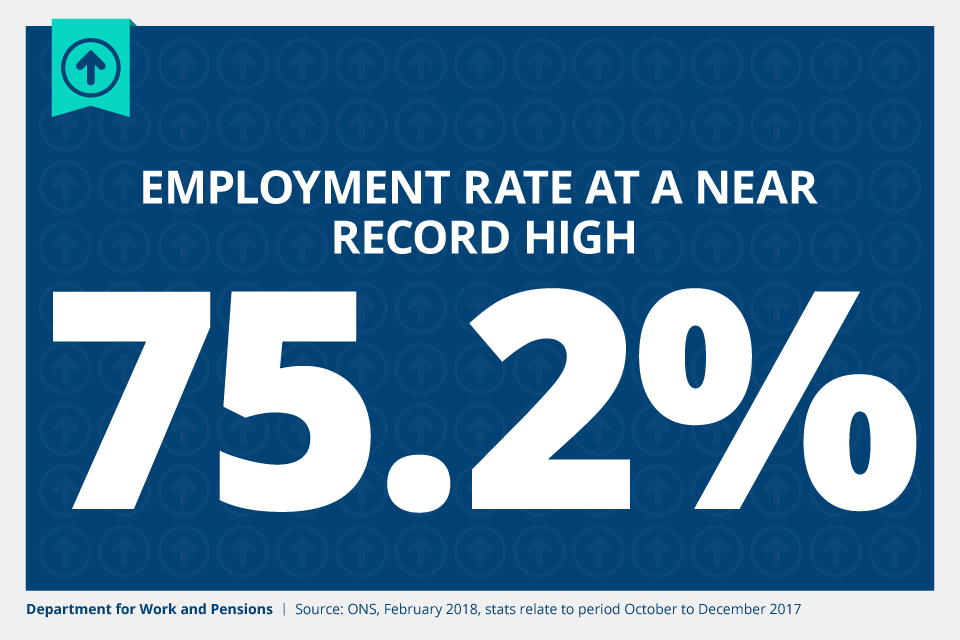
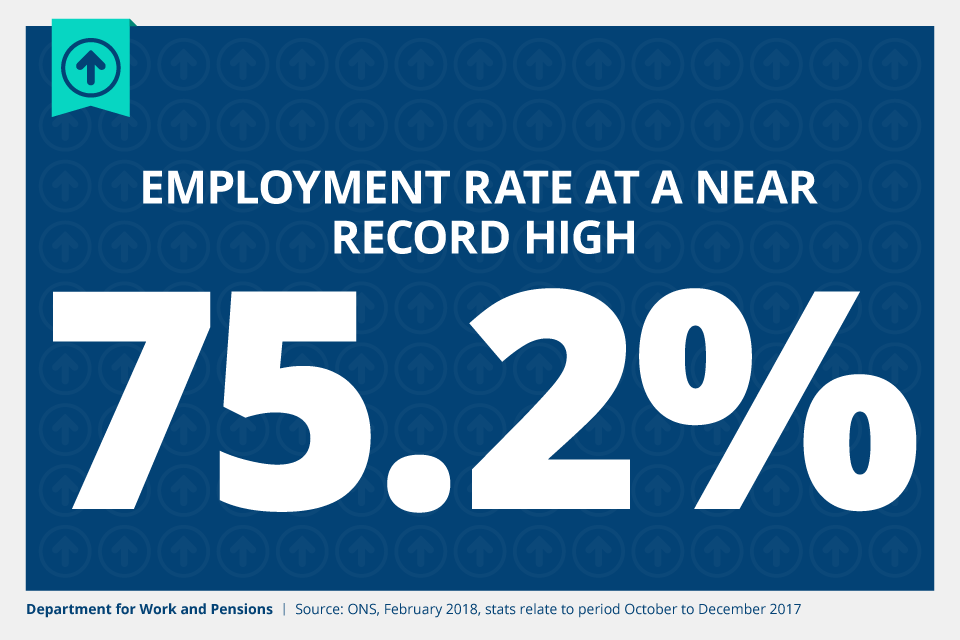
The employment rate is at a near record high of 75.2% (February 2018).

Minister for Employment Alok Sharma said:

High employment rates are a reliable feature of today’s economy – and this is an incredible achievement. It is equally important that across society everyone has the opportunity to get a good job and get on in life.

Today’s figures show that this government is building a fairer economy that supports people from all backgrounds to get into work. We are closing the BAME and gender employment gaps, and people across the country are accessing new opportunities.

Separate figures out today showed that 730,000 people are now on Universal Credit. Of these, 40% were in employment (290,000).

More information

Read the Labour Market Statistics – February 2017 from the Office for National Statistics.

Contact Press Office

Press Office

Caxton House

Tothill Street
London
SW1H 9NA

Follow DWP on:


Link: Press release: Employment remains at near-record high
Source: Gov Press Releases

Press release: January 2018 Transaction Data

In January:

  • HM Land Registry completed more than 1,782,080 applications to change or query the Land Register
  • the South East topped the table of regional applications with 403,526

The transaction data shows HM Land Registry completed 1,782,088 applications in January compared with 1,266,641 in December and 1,563,358 last January, of which:

  • 462,352 were applications to update existing titles compared with 319,721 in December
  • 825,613 were applications to obtain an official copy of a register compared with 551,427 in December
  • 211,393 were official searches compared with 197,327 in December
  • 26,002 were postal applications from non-account holders, compared with 26,377 in December

Applications by region and country

Region and country November applications December applications January applications
South East 408,756 287,649 403,526
Greater London 339,086 250,636 339,286
North West 200,475 139,168 222,150
South West 173,351 124,681 173,058
West Midlands 152,816 107,079 150,292
Yorkshire and the Humber 135,373 98,017 139,207
East Midlands 125,846 90,239 122,812
Wales 82,646 58,854 80,315
North 81,197 56,648 77,912
East Anglia 74,499 53,549 73,345
Isles of Scilly 92 79 110
England and Wales (not assigned) 86 42 75
Total 1,774,223 1,266,641 1,782,088

Top 5 local authority areas

Top 5 local authority areas November applications Top 5 local authority areas December applications Top 5 local authority areas January applications
Birmingham 27,715 Birmingham 19,714 Birmingham 27,561
City of Westminster 23,565 City of Westminster 17,977 City of Westminster 25,488
Leeds 20,137 Leeds 14,262 Leeds 20,256
Cornwall 18,823 Manchester 13,384 Manchester 19,350
Manchester 18,542 Cornwall 13,332 Cornwall 18,367

Top 5 customers

Top 5 customers November applications Top 5 customers December applications Top 5 customers January applications
Enact 49,360 Enact 36,313 Enact 50,327
Optima Legal Services 25,532 Optima Legal Services 19,826 Nationwide Building Society 31,589
O’Neill Patient 24,260 O’Neill Patient 19,764 Optima Legal Services 27,284
TM Group (UK) Ltd 19,701 HBOS PLC 16,649 O’Neill Patient 26,073
HBOS PLC 19,315 TM Group (UK) Ltd 16,444 My Home Move Limited 19,103

Access the full dataset on data.gov.uk.

Notes to editors

  1. Transaction Data is published on the 15th working day of each month. The February Transaction Data will be published at 11 am on Wednesday 21 March 2018 at HM Land Registry Monthly Property Transaction Data.
  2. The monthly Transaction Data showing how many applications for new titles, leases, splitting titles, updating existing titles, official copies of the register and searches were received, reflects the volume of applications lodged by customers using an HM Land Registry account number on their application form.
  3. Completed applications in England and Wales, shown by region and by local authority include postal applications as well as those sent electronically.
  4. Transaction Data excludes pending applications, bankruptcy applications, bulk applications and discharge applications (to remove a charge, for example, a mortgage, from the register).
  5. Transactions for value are applications lodged involving a transfer of ownership for value. For an explanation of other terms used, see abbreviations used in the transaction data.
  6. Most searches carried out by a solicitor or conveyancer are to protect the purchase and/or mortgage. For example, a search will give the buyer priority for an application to HM Land Registry to register the purchase of the property. This can give an indication of market activity.
  7. Reasonable skill and care are used in the provision of the data. We strive to ensure that the data is as accurate as possible but cannot guarantee that it is free from error. We cannot guarantee our data is fit for your intended purpose or use.
  8. Transaction Data is available free of charge for use and re-use under the Open Government Licence (OGL). The licence allows public bodies to make their data available for re-use.
  9. If you use or publish the Transaction Data, you must add the following attribution statement:
    Contains HM Land Registry data © Crown copyright and database right 2017. This data is licensed under the Open Government Licence v3.0.
  10. HM Land Registry’s mission is to guarantee and protect property rights in England and Wales.
  11. HM Land Registry is a government department created in 1862. It operates as an executive agency and a trading fund and its running costs are covered by the fees paid by the users of its services. Its ambition is to become the world’s leading land registry for speed, simplicity and an open approach to data.
  12. HM Land Registry safeguards land and property ownership worth in excess of £4 trillion, including around £1 trillion of mortgages. The Land Register contains more than 25 million titles showing evidence of ownership for some 85% of the land mass of England and Wales.
  13. For further information about HM Land Registry visit www.gov.uk/land-registry.
  14. Follow us on: Twitter @HMLandRegistry, our blog, LinkedIn and Facebook.

Contact

Senior Press Officer

Marion Shelley
Head Office

Trafalgar House
1 Bedford Park
Croydon
CR0 2AQ

Press Officer

Paula Dorman
Head Office

Trafalgar House

1 Bedford Park
Croydon
CR0 2AQ

Link: Press release: January 2018 Transaction Data
Source: Gov Press Releases

Press release: Country stores merger could reduce competition

Mole Valley and Countrywide Farmers each run country stores, operating a total of 99 premises primarily located across the South and West of England. These typically each have a bulk agricultural products supply business – through which they sell large-scale supplies of agricultural products, such as fertiliser or fencing – and a retail business, through which they sell a wide range of products including animal feed, clothing, pet food and gardening tools.

The Competition and Markets Authority (CMA) is investigating Mole Valley’s proposed purchase of 48 Countrywide Farmers’ outlets, and has identified competition concerns in a total of 45 local areas. This involves both their bulk agricultural and retail businesses.

The companies are two of the largest suppliers of agricultural products in bulk, and there are no or few other suppliers physically located in these 45 areas. The CMA’s investigation found that, while the businesses face competition from other suppliers that operate without local premises, many customers prefer to be able to buy products directly from a supplier’s store.

Therefore, these alternative suppliers may not provide enough competition to stop customers from losing out after the merger. The CMA’s investigation found that competition concerns in the supply of agricultural products in bulk arise in 45 local areas in total.

The CMA also found that the companies’ retail businesses compete closely, resulting in reduced competition for customers in 25 of the 45 local areas after the merger. Its investigation found that there would be either no or very few competing country stores in these local areas as, while the companies’ retail businesses face competition for some products from suppliers specialising in one type of product (such as DIY stores, garden centres or pet food suppliers), many customers value being able to buy a range of items in one place. Therefore, these specialist suppliers may not provide enough competition to stop customers from losing out after the merger.

Mole Valley now has the opportunity to offer ways to address these competition concerns. If Mole Valley does not make such an offer, or if any undertakings do not sufficiently address the CMA’s concerns, the merger will be referred for in-depth investigation through a ‘phase 2’ inquiry.

Rachel Merelie, Acting Executive Director of Mergers and Markets and the decision maker in this case, said:

It’s our job to make sure that people continue to have enough choice, get fair prices and good quality products after companies merge. Mole Valley and Countrywide Farmers are two of the biggest operators of country stores, and so it’s important that their customers can find good deals when they need to buy these kinds of products.

Notes to editors

  1. The CMA is the UK’s primary competition and consumer authority. It is an independent non-ministerial government department with responsibility for carrying out investigations into mergers, markets and the regulated industries and enforcing competition and consumer law. For CMA updates, follow us on Twitter @CMAgovuk, LinkedIn, Facebook, Youtube and Flickr.
  2. Enquiries should be directed to the CMA press team at press@cma.gsi.gov.uk or 020 3738 6460.

Link: Press release: Country stores merger could reduce competition
Source: Gov Press Releases