Science Minister Sam Gyimah attended the Research Day of the Competitiveness Council to exchange views on research and innovation developments
The UK is a world leader in research and innovation, and sharing this knowledge and expertise internationally is vital to address global challenges
The importance of international collaboration was reinforced on Friday 2 February by Science Minister Sam Gyimah at the Research Day of the EU Competitiveness Council in Bulgaria, where he outlined his desire to see the principles of excellence, competitiveness and openness to the world to remain the guiding principles of European science and innovation, and for the UK to play a leading role in shaping these principles, both now and in the future.
He further stressed these messages in bilateral meetings with his counterparts from other member states while discussing the concerns of British and European researchers. The Minister reiterated the government’s desire for an ambitious science and innovation agreement with the EU, and the UK’s commitment to guarantee competitive EU funds bid for while the UK is a member of the EU.
The informal Council provides a forum for European Research Ministers to discuss EU policy on research and innovation, and this time around the Council had a particular focus on boosting innovation and investing in people. During the meeting, the Minister highlighted how the UK’s ambitious Industrial Strategy has science and research at its heart, as well as outlining the contribution that British knowledge and expertise is making to the UK helping tackle global challenges and the UK’s commitment to developing the technologies of the future.
Following the Council, Science Minister Sam Gyimah said:
The Competitiveness Council provided a fantastic opportunity to discuss the importance of working together for the advancement of research and innovation, ensuring UK researchers can continue collaborating on European programmes.
The UK has world-leading academic institutions and an internationally recognised science and innovation base, with some of the best minds from across world coming to research here.
Through the government’s ambitious vision for an Industrial Strategy we are committed to ensuring the UK remains a ‘go to’ destination for research and innovation for years to come.
That’s why it’s in all our interests to pursue a deep and special partnership with the EU recognising our shared interest in maintaining and strengthening research collaboration and driving innovation.
This afternoon the Prime Minister spoke with President Erdogan of Turkey. The leaders discussed the ongoing Turkish operation in Afrin in Syria, with the Prime Minister recognising the right of Turkey to secure its border. The Prime Minister and President Erdogan agreed on the need to protect civilians and avoid a deterioration in the humanitarian situation. The Prime Minister also underlined that the UK would continue to work with Turkey to tackle the threat posed by the PKK more broadly.
The Prime Minister recognised the important role that Turkey is playing in Syria, both in the Counter-Daesh Coalition and in hosting more than 3 million refugees from the conflict. She reiterated her strong belief that the long-term stability of Syria can only be secured through a political settlement and restated the importance of the primacy of the UN-led talks in Geneva to achieve this.
The Prime Minister and President Erdogan welcomed the continuing industrial collaboration between the UK and Turkey, including through the recent Turkish Airlines deal with Airbus. They agreed to continue to discuss ways to enhance the UK’s trade relationship with Turkey as we leave the EU.
The Prime Minister also reaffirmed her strong desire for a resolution to the case against Amnesty International staff.
The Charity Commission, the independent regulator of charities in England and Wales, has opened a new statutory inquiry into the Cymmer Workmens Hall and Institute (810098). The investigation was opened on 7 September 2017.
The charity, based in Wales, operates a social club and funds educational activities. Its property is used by local community groups.
The Commission has previously provided advice and guidance to the trustees regarding substantial levels of non-primary purpose trading that the charity has undertaken and the charity’s failure to submit Statement of Recommended Practice compliant accounts.
The Commission is also concerned that there appears to be only one active trustee of the charity.
The charity was included and subsequently removed from the Commission’s class inquiry in 2014 after submitting the outstanding accounts, but fell into default and became part of the class inquiry again in February 2017. After further reminders from the Commission the charity submitted late accounts for 2014 and 2015 but these were not compliant with the Statement of Recommended Practice.
The investigation is examining:
the administration, governance and management of the charity by the trustees, with specific regard to:
ensuring any trading carried out by the charity is compliant with current legislation
the charity’s control systems
how the charity complies with its governing document
risks to the charity, its property and reputation
the extent to which any failings or weaknesses identified in the management and administration of the charity, during the conduct of the inquiry, were a result of misconduct and/or mismanagement by the trustees
the extent to which the charity is able to operate on a proper footing and whether steps need to be undertaken to modify the operating structure and governing document framework of the charity and social activities associated with the charity’s property
The purpose of an inquiry is to examine issues in detail, investigate and establish the facts so that the regulator can decide what action needs to be taken to resolve the serious concerns, if necessary using its investigative, protective and remedial powers to do so.
A meeting with the one active trustee has already taken place and an order under S84 Charities Act 2011 has been issued to the charity requesting the submission of all outstanding documents by 6 March 2018. To date, the trustee has co-operated fully with the inquiry.
It is the Commission’s policy, after it has concluded an inquiry, to publish a report detailing what issues the inquiry looked at, what actions were undertaken as part of the inquiry and what the outcomes were. Reports of previous inquiries by the Commission are available on GOV.UK.
The Charity Commission is the independent regulator of charities in England and Wales. To find out more about our work, see the about us page on GOV.UK.
Section 46 of the Charities Act 2011 gives the commission the power to institute inquiries. The opening of an inquiry gives the commission access to a range of investigative, protective and remedial legal powers.
The Charity Commission says safeguarding should be a priority for all charities, not just those working with groups traditionally considered at risk.
It comes as the charity regulator publishes a report showing safeguarding concerns are an increasing feature in its regulatory compliance case work with charities.
Tackling abuse and mismanagement, the regulator’s annual report of its compliance case work, reveals that safeguarding concerns featured in 302 regulatory compliance cases opened in 2016-17, up from 163 in the previous year. Disclosures with other agencies that have safeguarding responsibilities have increased by 30%, at 244 (up from 187 in 2015-16). Six statutory inquiries, the regulator’s most serious type of engagement with charities, featured safeguarding concerns.
Over half of serious incidents reported by the charities to their regulator related to safeguarding concerns (1,203 of 2,182).
The Commission recently updated its strategy on safeguarding in charities, which reminded trustees that they should proactively safeguard and promote the welfare of their charity’s beneficiaries and take reasonable steps to ensure that their beneficiaries or others who come into contact with their charity do not, as a result, come to harm.
Michelle Russell, Director of Investigations, Monitoring and Enforcement, said:
We know that it is vital that trustees set a culture within their charity that prioritises safeguarding, so that the risk of safeguarding incidents is minimised, and so that it is safe for those affected to come forward and report incidents and concerns with the assurance they will be handled sensitively and properly. As our safeguarding strategy makes clear, everybody has the right to be safe, no matter who they are or what their circumstances are, and the public rightly expects charities to be safe and trusted places.
Our wider compliance case work shows that problems in charities often result from basic failures by trustees to understand and fulfil their legal duties. In the area of safeguarding, this can include failing to recognise that your beneficiaries may be at risk or vulnerable in certain situations, or not taking proper steps to protect others who come into contact with your charity, such as staff members and volunteers.
I hope this report serves as a tool that enables trustees in managing their charities effectively.
Last month, the Commission issued an alert to charities reminding them of the importance of safeguarding, following a number of reports of serious incidents, and growing public interest in and concerns about accusations of harassment in the work place, including media reporting about some safeguarding incidents which have affected charities.
Tackling abuse and mismanagement also shows that in 2016-17 the Commission opened:
1,664 new regulatory compliance cases (2015-16: 1,804)
503 new monitoring cases (2015-16: 424)
187 new statutory inquiries* (2015-16: 53)
2,182 serious incidents (2015-16: 2,117)
*the increase in statutory inquiries relates in part to a class inquiry involving 74 connected charities which opened during the year; in addition, more charities became part of the double defaulters class inquiry.
The regulator also used its powers on 1,099 occasions; 13 of these were powers granted through the 2016 Charities Act. By the end of December 2017, the Commission had used these new powers on 80 occasions.
The Commission has today also published an updated regulatory and risk framework; the updated document explains the Commission’s approach to risk-led regulation and sets out how it prioritises both reactive and its proactive engagement with charities, including the development of policy and guidance aimed at enabling charity trustees to run their charity effectively.
The framework is designed as a guide for the Commission’s staff and as a reference tool and guide for those involved in charities, notably trustees, staff and professional advisers.
The Commission is not responsible for dealing with incidents of actual abuse and does not administer safeguarding legislation. It cannot prosecute or bring criminal proceedings, but it can and does refer any concerns we have to the police, local authorities, the Disclosure and Barring Service (‘DBS’), and other agencies each of which has a particular statutory function.
The work is taking place at 21 sites in Devon and Cornwall and involves the planting of 10,000 native trees and shrubs to fill or reduce gaps in hedgerow and woodland along the roadside.
In total the planting will provide around three extra miles of vegetation and connect over 105 miles of habitat on the verge and land adjacent to the A30 and A38.
The scheme is being delivered under Highways England’s national Biodiversity Plan which is being supported by a £30 million national investment programme over the next five years.
The plan recognises road verges and associated land can be managed to provide areas of habitat, relatively free from human access, that may be scarce in the surrounding landscape.
These road verges can also be used to connect fragmented habitats in the wider landscape, enabling plant and animal populations to move and interact, and so become stronger and more resilient.
Ecologist Leonardo Gubert said:
Highways England is committed to protecting the environment through its biodiversity plan and improving the connectivity of habitats along our roads is one of our top nature conservation priorities.
The main aim of this improvement scheme is to reconnect wildlife habitat and ecosystems on a significant scale across our road network in the South West allowing species to move between core areas.
The work is expected to have a huge benefit for a wide variety of species of animals including insects, birds, and mammals, such as butterflies, bees, flies and dormice, suitable places to forage, shelter and breed.
Tree and shrub species being planted include oak, maple, holly, willow, honeysuckle and rose at locations between Pocombe Bridge and Pulsack on the A30 and Wrangaton and Bellamarsh on the A38.
The programme runs from Monday 5 February until Friday 16 March 2018.
The majority of planting will not require any traffic management but a few schemes may require lane closures at times and no delays are anticipated.
Highways England has also been undertaking a lowland heathland conservation scheme in Devon and Cornwall and has plans to expand its species rich wildflower meadows in the South West as part of a future improvement programme.
The lowland heathland is a priority for nature conservation because it is a rare and threatened habitat which supports a variety of scare birds, animals and plants.
There are several areas on the Highways England network in Devon and Cornwall where road verges are either suitable for heathland species or are located adjacent to sites where heathland is present or has been historically recorded.
Work has included the planting and management of new heathland areas and aftercare at eight locations covering over 26,000 square metres across the Highways England network. Location sites are along the A30 and A38 including Dartmoor, Bodmin Moor and Goss Moor, and Haldon Hill.
General enquiries
Members of the public should contact the Highways England customer contact centre on 0300 123 5000.
Media enquiries
Journalists should contact the Highways England press office on 0844 693 1448 and use the menu to speak to the most appropriate press officer.
This evening the Prime Minister spoke with Prime Minister Malcolm Turnbull of Australia.
They discussed the upcoming Commonwealth Summit, with the Prime Minister setting out her plans for an ambitious CHOGM which aims to reinvigorate the Commonwealth. They discussed policy priorities for the Summit, including environmental issues, which Mr Turnbull offered his support towards achieving.
On trade between the two countries, the Prime Ministers recognised the strength of the bilateral relationship between the UK and Australia, and expressed their wish for this to continue to develop after the UK’s exit from the EU.
They discussed Mrs May’s recent trip to China, including the importance of China supporting the rules based international system.
They also covered their shared interest in stability in the region, and recent developments on the Korean Peninsula.
Before the call ended, Mrs May welcomed Australia’s recent decision to legalise same sex marriage and wished Australia luck for their hosting of the upcoming Commonwealth Games.
A key poll taken at first UK Government Severn Growth Summit has revealed that 97% of delegates felt that the removal of the Severn tolls would be of benefit to Wales.
During the live poll carried out by Cardiff based award-winning company, Doopoll, it was also revealed that 90% (139 out of 155 respondents) of the guests feel that their business will be boosted by the abolition of the Severn Tolls.
Over 300 guests from either side of the Severn estuary attended the inaugural event at the Celtic Manor Resort, held to explore how links between the South Wales and South West England economies can be strengthened following the abolition of the Severn Tolls.
Companies on both sides of the border are already benefitting from the removal of VAT from the crossing tolls earlier in January. Later this year, the tolls will be consigned to history when they are abolished altogether by the UK Government.
The poll also revealed:
80% of delegates felt that removal of the tolls will give them access to a wider market (168 out of 203 respondents)
Almost 60% of respondents felt that road links were a challenge of cross border working (119 out of 200 respondents)
86% of respondents cited faster rail links between Bristol and South Wales as important to them (out of 151 responses)
Secretary of State for Wales Alun Cairns said:
The Severn Growth Summit has sparked the biggest commercial conversation for the west of the UK in a generation. It is clear from these findings that we have a golden opportunity to capitalise on the ambitions of industries from both sides of the Severn Crossings.
From Bath, all the way across to Swansea, we can create a critical mass that can raise prosperity, create closer collaboration and competition and improve social and cultural opportunities for people who live in the region.
I am delighted to see almost universal recognition from this live poll that scrapping the tolls will benefit Wales – this will be the biggest economic stimulus in decades and it fits my approach of making politics fit the economy rather than the economy fit politics. Exporting goods to the rest of the UK from Wales is of vital importance, with 8 out of 10 lorries destined for the UK market – scrapping the tolls will help our economy go from strength to strength.
Housing Secretary Sajid Javid today (4 February 2018) confirmed government backing to create a new generation of town houses in cities like London and Manchester to ease pressure on valuable open spaces and help growing families.
Under the changes it will be easier to build upwards on existing blocks of flats and houses as well as shops and offices.
For example, an additional 2 levels could be added to a property – provided it was in keeping with the roofline of other buildings in the area.
It will ensure councils can protect valuable open space in inner city areas, maintain the character of residential areas, safeguard people’s privacy and stop unwanted garden grabbing. These developments must remain in keeping with the character of the local area, including the preservation of listed buildings and conservation areas.
Housing Secretary Sajid Javid said:
The answer to building new homes isn’t always an empty plot, or developing on a derelict site.
We need to be more creative and make more effective use of the space we already have available.
That’s why we are looking to strengthen planning rules to encourage developers to be more innovative and look at opportunities to build upwards where possible when delivering the homes the country needs.
Delivering development in built up areas is an important part of the government’s housing white paper proposals.
This policy will be included in the revised draft National Planning Policy Framework, which is due for consultation in early 2018.
Further information
The government consulted on a proposal to amend national planning policy to give greater emphasis to this matter as part of the housing white paper published on 7 February 2017.
In February 2016, the government consulted, jointly with the Mayor of London, on proposals to support building upwards in London to deliver new homes through development plan policies, a permitted development right or Local Development Orders.
Responses offered support for a policy approach to the principle of building upwards.
The government response to the consultation, published alongside the housing white paper in February 2017, set out the intention to “take forward the policy option through the National Planning Policy Framework to support the delivery of additional homes by building up”, as part of a package of measures to support building at higher densities and using land more efficiently.
The consultation draft of the revised National Planning Policy Framework will be published in early 2018, and will include building up policy alongside others to make efficient use of land and buildings, and building at higher densities.
This policy will be incorporated into the updated National Planning Policy Framework.
British Business Bank to support up to £100 million of lending to small businesses through its delivery partners
UK Finance confirms an additional multi-million pound package for SMEs and extra help for customers concerned about their mortgage or credit card payments
industry and government continue to work together to ensure businesses and workers are supported following Carillion’s liquidation
A further package of support for the businesses and workers affected by Carillion’s liquidation was welcomed today (Saturday 3 February) by Business Secretary Greg Clark.
Through delivery partners that include all the major high street lenders, the British Business Bank will provide support to make available up to £100 million of lending to small businesses who may not have the security otherwise needed for conventional bank lending using its Enterprise Finance Guarantee programme.
This will be of benefit to small businesses, including the chain of subcontractors to Carillion, who may not have sufficient assets as security to access conventional loans. These guarantees can be used to support overdraft borrowing and refinancing of existing debt.
The UK’s leading banks have also furthered their commitment to provide support to those affected with UK Finance confirming additional support for personal banking customers concerned about overdraft, mortgage or credit card repayments, as well as further financial support for small businesses to provide short-term relief to help keep them afloat.
Business Secretary Greg Clark said:
We want to signal very clearly to small and medium sized businesses who were owed money by Carillion that they will be supported to continue trading.
The banks have responded to my request by agreeing to support businesses and individuals affected. This further guarantee will help those businesses who may not be able to provide the usual security for a loan.
I will continue to work closely with business organisations, trade unions and banks to actively support those affected by Carillion’s insolvency.
British Business Bank CEO Keith Morgan said:
The Enterprise Finance Guarantee (EFG) is an important option for smaller businesses who need access to finance, but may not be able to meet a provider’s normal security requirements. To help in these exceptional circumstances, we have designed additional flexibility into EFG that could be particularly suitable for firms in the Carillion supply chain. We would encourage lenders to work with their customers to use these new flexibilities to meet their needs.
UK Finance Managing Director, Commercial Finance Stephen Pegge said:
UK banks are working with government to support customers and businesses who have been impacted by the Carillion liquidation. The enhancement of the Enterprise Finance Guarantee by the British Business Bank will help those facing temporary cash flow issues to access the finance they need to support their businesses through this period.
This package is in addition to the more than £200 million already announced by Lloyds Banking Group, HSBC and RBS.
Notes to editors
More than 40 accredited lenders provide finance to their SME customers under the British Business Bank’s Enterprise Finance Guarantee (EFG) scheme. The Business Secretary has written to all accredited Enterprise Finance Guarantee (EFG) lenders to draw their attention to this additional support, and expects them to ensure that they are actively engaging with SME businesses in Carillion’s supply chain so they can give them the support they need. Accredited EFG lenders are listed on the British Business Bank website.
The Business Secretary has written to all accredited Enterprise Finance Guarantee (EFG) lenders to draw their attention to this additional support, and expects them to ensure that they are actively engaging with SME businesses in Carillion’s supply chain so they can give them the support they need. Accredited EFG lenders are listed on the British Business Bank website.
Information on how the Enterprise Finance Guarantee scheme operates and supports businesses can be found on the British Business Bank website.
The British Business Bank is the UK’s national economic development bank. Established in November 2014, its mission is to make finance markets for smaller businesses work more effectively, enabling those businesses to prosper, grow and build UK economic activity. Its remit is to design, deliver and efficiently manage UK-wide smaller business access to finance programmes for the UK government.
On Thursday 18 January the Business Secretary chaired the first meeting of a taskforce set up to monitor and advise on mitigating the impacts of Carillion’s liquidation on construction firms, particularly SMEs and those working in the sector. This meeting builds on a series held by the Business Secretary last week with trade associations, unions and banks.
The UK Emergency Medical Team (EMT), deployed to the camps of Cox’s Bazar in Bangladesh following a deadly outbreak of diphtheria, is heading home after bringing the disease under control.
Medical professionals, including doctors, nurses and paramedics, will return this weekend having spent up to six weeks triaging more than 3000 Rohingya people.
Almost 500 people were treated for diphtheria and were it not for British help, many could have died.
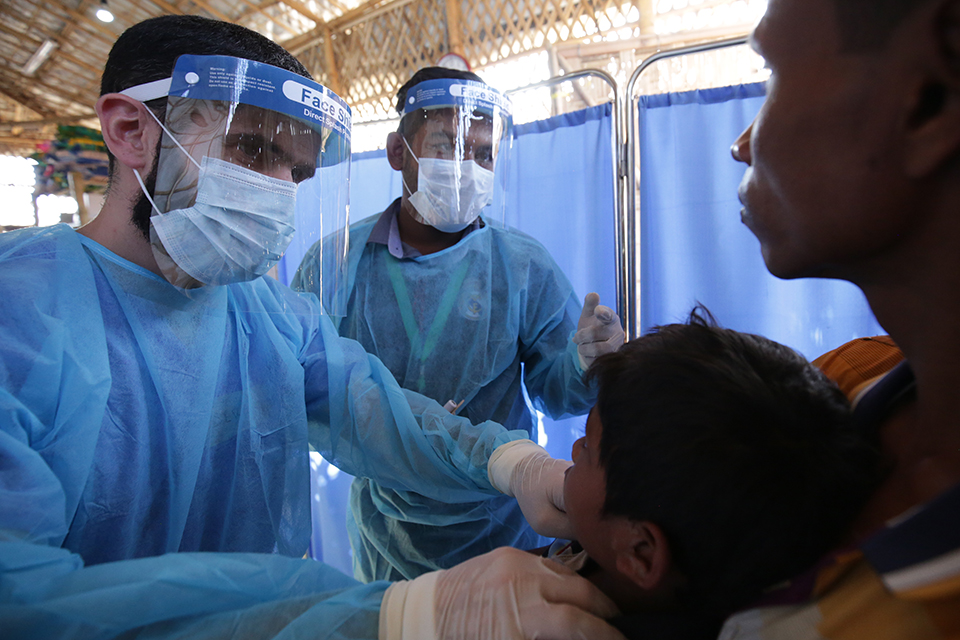
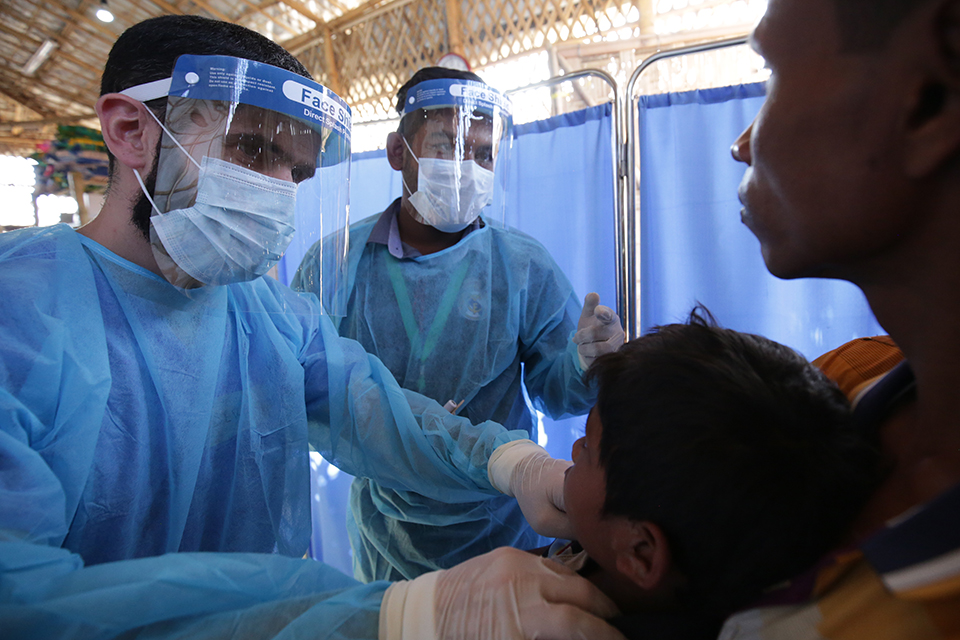
Dr Derek Sloan, a consultant in infectious diseases from Fife, Scotland, examines a young boy for symptoms of diphtheria in Kutupalong, Bangladesh
Stationed across three diphtheria treatment centres, the 40-strong UK aid-funded EMT prescribed precautionary antibiotics to the displaced men, women and children suspected to have the disease. Those displaying clear symptoms were immediately given live-saving diphtheria anti-toxin.
With the outbreak now under control, local Bangladeshi health professionals working for the International Organisation for Migration (IOM) have taken over from the UK clinicians and will work to completely stamp out this disease from the camps.
Ummul Jesmin, one of the Bangladeshi nurses who worked alongside the UK EMT, has also learned vital infection prevention and control skills. These will be essential should another infectious disease outbreak like cholera occur. Pleased with the opportunity to work alongside the EMT, Ummul had nothing but praise for her British colleagues.
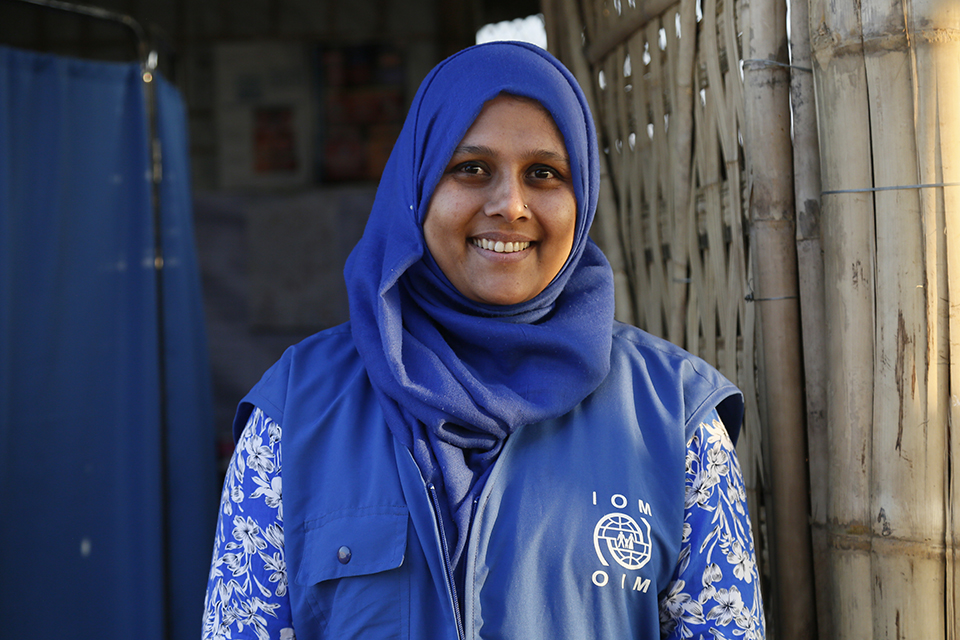
Ummul Jesmin, one of the Bangladeshi medics who worked alongside the UK EMT and who will continue to tackle the outbreak now that the British team is leaving.
Diphtheria, entirely preventable through vaccination, surfaced within the camps in late 2017. To date, there have been over 5,000 suspected diphtheria cases and at least 37 deaths.
The overcrowded camps, home to over 655,000 Rohingya refugees who have fled persecution in neighbouring Burma, are a breeding ground for diphtheria.
The contagious disease can cause extreme breathing difficulties and inflammation of the heart. This can lead to heart failure, damage to the nervous system and fatal paralysis.
It is especially dangerous to children; more than half the deaths recorded relate to those under the age of five. The expertise of the British clinicians has saved countless lives including that of four-year-old Settara.
Settara was brought to a treatment centre by her mother Moriam in mid-January with a fever, sore throat and in pain.
One of the nurses instantly identified that Settara was displaying symptoms of diphtheria. Doctors admitted Settara immediately and gave her diphtheria anti-toxin along with a course of antibiotics.
Whilst Settara underwent treatment, the team established that Moriam had seven other children who had all been exposed to the disease. The entire family was provided with precautionary antibiotics and Settara went on to make a full recovery.
Six-year-old Sumaiya, sitting up in bed and already recovering after receiving diphtheria antitoxin treatment.
Six-year-old Samaiya was also brought to the treatment centre in mid-January with clear symptoms of diphtheria. Just a few hours after being given diphtheria anti-toxin, she started to look and feel much better and was seen happily sitting in bed drawing pictures. Samaiya was discharged shortly after to complete her course of antibiotics at home.
The UK, having led the way in providing medical expertise to the crisis, has also helped fund a UNICEF vaccination programme which protects vulnerable Rohingya children from diphtheria.
The first round of the vaccination campaign is now complete and has ensured more than 350,000 children aged between six-weeks and 15-years-old are protected. Children are now receiving their second dose of the vaccine; 110,513 have been vaccinated in the last week alone.
International Development Secretary Penny Mordaunt said:
I have nothing but admiration and thanks for the UK medics who travelled to Cox’s Bazar over the New Year to help victims of diphtheria, who, without UK support, would have died.
These medics embody everything that the UK stands for. We are a nation which does not shy away from our responsibility. When the desperate and the displaced are in need of our help we step in. We should be incredibly proud of this.
Our team has now handed their knowledge over to medics in Bangladesh so they can carry on the fight against diphtheria. Diseases have no respect for borders and this vital work is ultimately making the world a safer place.
Notes to Editors:
The UK’s Emergency Medical Team (EMT) is a collaboration between DFID, the NHS, Public Health England, UK Med – a register of NHS volunteers ready to deploy to emergencies, Handicap International and the UK Fire and Rescue Service. This is the first deployment of the EMT since it was verified by the World Health Organisation (WHO) in December 2016. UK medical personnel have previously been deployed to respond to Typhoon Haiyan in the Philippines in 2013 and the Nepal earthquake in 2015.
The deployment has been funded from DFID’s Bangladesh humanitarian budget – up to £650,000 has been earmarked for the EMT.
The EMT deployed to Cox’s Bazar on 28 December 2017 and some staff were rotated out of Cox’s Bazaar after three weeks. Replacement clinicians were deployed in mid-January. All staff were given a diphtheria booster injection before deployment.
Following the request for international assistance by the World Health Organisation on 15 December, a UK EMT team travelled to Bangladesh to conduct an emergency assessment, and recommended the deployment of the EMT.
In response to the diphtheria outbreak in Cox’s Bazaar, existing clinical facilitates have been converted and scaled up. This was led by Médecins Sans Frontières MSF and the International Organisation for Migration (IOM). However IOM and other international NGOs are unable to manage the complex care needs of these patients, which is why they required the support of UK staff.
IOM has provided the medical facilities for the deployment. The World Health Organisation (WHO) has provided drugs. The UK EMT provided a specialised clinical team, clinical oversight, some key medical equipment not available in country, and accommodation and transport for staff.
Diphtheria is a bacterial infection. It most often causes infection of the upper respiratory tract. Diphtheria is most commonly spread from person to person through respiratory droplets (coughs and sneezes), or by direct contact with either respiratory secretions or infected skin lesions. Respiratory diphtheria usually occurs after an incubation period of 2-5 days. It causes life-threatening airway obstruction if untreated.
The first suspected case of diphtheria was reported on 10 November at an MSF clinic in Cox’s Bazar. The outbreak was confirmed through laboratory testing on 04 December 2017. As of 30/1, 5,120 suspected cases of diphtheria and 37 deaths have been reported.
DFID is working in partnership with the government of Bangladesh to ensure that children living in the camps and host communities are vaccinated against this deadly disease.
DFID is funding £2 million of the $4.6 million cost (£3.4 million) required to vaccinate 351,458 children aged six-weeks to 15-years-old as part of the vaccination campaign.
The wider UNICEF vaccination campaign will also vaccinate 130,000 school children living in host communities near to the camps in Cox’s Bazar.
Funding for this vaccination campaign has been provided from the response budget announced on 23rd October and 27th November 2017.
Medics have worked tirelessly to ensure the swift vaccination of those most at risk.
The UK has currently contributed £59 million to the crisis since 25 August 2017.