Press release: Foreign Secretary discussions on Iran nuclear deal with Iranian and European counterparts

Foreign Secretary Boris Johnson travelled to Brussels today (11th January) for high-level meetings focused on the Iran nuclear deal. He was joined in his discussions by Iranian Foreign Minister Mohammed Zarif, French Foreign Minister Jean-Yves Le Drian, German Foreign Minister Sigmar Gabriel and EU High Representative for Foreign Affairs Federica Mogherini.

Speaking ahead of the meetings, Foreign Secretary Boris Johnson said:

The UK has always been clear: the Iran nuclear deal is a crucial agreement that makes the world safer. It is vital that we continue to work with our European partners to preserve the Iran deal, and with it the security and prosperity it is bringing to the people of Iran and the world. It is those shared interests which will drive our discussions in Brussels.

Of course there are areas where we disagree with Iran, not least on its destabilising regional activity and its ballistic missile programme. This will be an important part of our conversation.

I will be making it clear to Foreign Minister Zarif, on the subject of the recent protests in Iran, that the right to peaceful demonstration within the law is central to any truly thriving society. I will also raise all of our Iranian dual-national consular cases.

Further information

Media enquiries

For journalists

Link: Press release: Foreign Secretary discussions on Iran nuclear deal with Iranian and European counterparts
Source: Gov Press Releases

Press release: Government’s vision for a greener future launched

A pledge to eliminate avoidable waste, introduce new safeguards for wildlife and connect more children with nature are among the ambitious plans for a greener future outlined by Prime Minister Theresa May and Environment Secretary Michael Gove today.

In a major speech today, the Prime Minister has launched the government’s landmark 25 Year Environment Plan, setting out how we will improve the environment over a generation by creating richer habitats for wildlife, improving air and water quality and curbing the scourge of plastic in the world’s oceans.

“A Green Future: Our 25 Year Plan to Improve the Environment” sets out how over the next quarter of a century the government will:

  • Crackdown on plastics by eliminating all avoidable plastic waste through extending the 5p plastic bag charge to small retailers, removing consumer single use plastics from the government estate, supporting the water industry to significantly increase water fountains and working with retailers on introducing plastic-free supermarket aisles.
  • Help wildlife thrive by creating 500,000 hectares of new habitat for endangered species, supporting farmers to turn fields into meadows and other habitats, replenishing depleted soils and providing £5.7 million to kick-start a [new Northern Forest] (https://www.gov.uk/government/news/new-northern-forest-gets-government-backing).
  • Be a world leader in environmental protection by investigating the feasibility of an anti-poaching taskforce to tackle the illegal wildlife trade, committing overseas aid to help developing nations combat plastic waste, and extending the UK’s network of marine protected areas
  • Deliver a Green Brexit by consulting on a new environmental watchdog to hold government to account for environmental standards, and setting out a new approach to agriculture and fisheries management
  • Seek to embed a ‘net environmental gain’ principle so development delivers environmental improvements locally and nationally, enabling housing development without increasing overall burdens on developers
  • Connect people with nature by creating ‘nature friendly schools’ and reviewing National Parks to see how they can improve and whether the network should be extended.

Environment Secretary Michael Gove said:

Respecting nature’s intrinsic value and making sure we are wise stewards of our natural world is critical if we are to leave the environment in a better state than we inherited it.

Our Environment Plan sets out how over the next 25 years we will radically reduce the waste that is choking oceans and rivers, cleanse our air of toxic pollutants and create new habitats for our most precious wildlife to thrive.

Through this plan we will build on our reputation as a global leader in environmental protection, creating an environment everyone can enjoy and helping the next generation flourish.

In a world-first, the 25 Year Environment Plan also sets out how we will use a natural capital approach to help us see the additional benefits – whether that is improved health and wellbeing, or national prosperity – in every part our environment, helping improve and direct decision making, and guiding new development.

The Plan sits alongside existing work. A Call for Evidence on reward and return schemes for drinks containers, including plastic bottles, has closed. Its findings are now being assessed by the Working Group, who will make recommendations to ministers this Spring.

As announced in the Budget, the Government will also launch a further Call for Evidence shortly on how changes to the tax system or charges on single-use plastics can play a role in reducing waste.

The plan sits alongside the Government’s Clean Growth Strategy, which sets out how the UK is leading the world in cutting carbon emissions to combat climate change and driving economic growth.

Link: Press release: Government’s vision for a greener future launched
Source: Gov Press Releases

Press release: New charity investigation: Hope House School Limited

The Charity Commission, the independent regulator of charities in England and Wales, has opened a new statutory inquiry into Hope House School Limited, registered charity number 1121132. The investigation was opened on 9 October 2017.

The charity’s objects are to advance the education of children who suffer from neurological and psychological conditions such as Smith-Lemli-Opitz syndrome, autistic spectrum disorders, Asperger’s syndrome and Dyspraxia.

The Commission conducted a books and records inspection following an anonymous complaint which raised concerns about the charity’s governance and administration.

The visit raised a number of regulatory concerns and the Commission has therefore opened a statutory inquiry to examine the governance, management and administration of the charity. The inquiry will focus particularly on whether:

  • the trustees have exercised sufficient oversight and control of the charity
  • the financial controls of the charity are adequate and its funds have been properly expended solely in furtherance of its charitable objects
  • potential conflicts of interest and connected party transactions have been properly managed
  • there has been any unauthorised trustee benefit

The Commission has also exercised temporary and protective powers to restrict the transactions that the charity can enter into to ensure that any funds expended are only in furtherance of the charity’s objects and closely monitored.

The Commission stresses that opening an inquiry is not in itself a finding of wrongdoing. The purpose of an inquiry is to examine issues in detail and investigate and establish the facts so that the regulator can ascertain whether there has been misconduct or mismanagement; establish the extent of the risk to the charity’s property, beneficiaries or work; and decide what action needs to be taken to resolve the serious concerns, if necessary using its investigative, protective and remedial powers to do so.

It is the Commission’s usual policy, after it has concluded an inquiry, to publish a report detailing what issues the inquiry looked at, what actions were undertaken as part of the inquiry and what the outcomes were. Reports of previous inquiries by the Commission are available on GOV.UK.

The charity’s details can be viewed on the Commission’s online charity search tool.

Ends.

Notes to Editors

Press office

  1. The Charity Commission is the independent regulator of charities in England and Wales. To find out more about our work, see our annual report.
  2. Search for charities on our check charity tool.
  3. Section 46 of the Charities Act 2011 gives the commission the power to institute inquiries. The opening of an inquiry gives the commission access to a range of investigative, protective and remedial legal powers.
  4. The Commission’s decision to announce the opening of a statutory inquiry is based on whether it is in the public interest to do so and with consideration of our objective to increase public trust and confidence in charities.

Link: Press release: New charity investigation: Hope House School Limited
Source: Gov Press Releases

Press release: Report 01/2018: Runaway of a maintenance train near Markinch

180111_R012018_Markinch

This file may not be suitable for users of assistive technology.
Request an accessible format.

If you use assistive technology (such as a screen reader) and need a
version of this document in a more accessible format, please email enquiries@raib.gov.uk.
Please tell us what format you need. It will help us if you say what assistive technology you use.

Summary

At about 04:25 hrs on Tuesday 17 October 2017, a maintenance train that was clearing leaf debris from the track, hit a tree just north of Markinch station, Fife. The debris from the tree disabled the train’s braking system. The train came to a stop before running away backwards for a distance of about 4.7 miles (7.5 km). The train crew on board made an emergency call to the signaller before jumping off the train, suffering minor injuries.

The train eventually came to a stop at Thornton North junction after running backwards and forwards between two adjacent gradients a total of nine times.

The brakes were fully released when debris from the tree operated the release mechanisms on the brake system distributors underneath both of the vehicles in the train.

The driver was unable to reapply the brakes because the debris from the tree had also separated all three of the brake pipes between the two vehicles in the train.

Recommendations

The RAIB has made two recommendations to Network Rail. The first addresses the risk of a runaway being initiated by debris on the track causing multiple disruptions to the braking system on this type of train. The second recommendation addresses the possibility that similar risks might be present for other short formation trains that operate on its infrastructure.

Notes to editors

  1. The sole purpose of RAIB investigations is to prevent future accidents and incidents and improve railway safety. RAIB does not establish blame, liability or carry out prosecutions.
  2. RAIB operates, as far as possible, in an open and transparent manner. While our investigations are completely independent of the railway industry, we do maintain close liaison with railway companies and if we discover matters that may affect the safety of the railway, we make sure that information about them is circulated to the right people as soon as possible, and certainly long before publication of our final report.
  3. For media enquiries, please call 01932 440015.

Newsdate: 11 January 2018


Link: Press release: Report 01/2018: Runaway of a maintenance train near Markinch
Source: Gov Press Releases

Press release: New housing agency to boost housebuilding

A new national housing agency – Homes England – has today (11 January 2018) been launched by Housing Secretary Sajid Javid as one of the key steps towards delivering the homes the country needs.

As the successor to the Homes and Communities Agency, Homes England will drive forward change, as set out in the government’s housing white paper.

By bringing together their existing planning expertise and new land buying powers, the new agency will play a major role in securing land in areas where people want to live, support smaller and more innovative house builders into the market and resource brownfield sites from across the country to deliver homes for families.

Homes England will play a major role in fixing the housing market by helping to deliver an average of 300,000 homes a year by the mid-2020s.

Visiting Alconbury in Cambridgeshire, a former airfield which will bring 5,000 new homes, the Housing Secretary toured the 1,420 acre site which is just one of the many locations across the country receiving government funding to build more homes.

Housing Secretary Sajid Javid said:

This government is determined to build the homes our country needs and help more people get on the housing ladder. Homes England will be at the heart of leading this effort.

The development at Alconbury is a prime example of how the agency has worked to deliver thousands of new homes, as well as improve roads and create space for local businesses.

The new agency will be key in replicating this approach right across the country and will help us build a Britain fit for the future.

Nick Walkley, Chief Executive of Homes England, said:

As Homes England, we will use our land, finance and expertise to expand the delivery of affordable new homes and connect ambitious partners to remove barriers to house building.

Sir Ed Lister, Chairman of Homes England, added:

We will take the lead in delivering better quality homes and great places that set the bar high for others. We will also stimulate demand for Modern Methods of Construction and ultimately disrupt the housing market.

The launch of Homes England is just one of the steps this government is taking to fix the broken housing market. Since 2010, government has delivered more than 1.1 million homes and Help to Buy has supported over 255,000 people to buy a property.

Around 310 local authorities have now published a brownfield register, revealing over 26,000 hectares of developable land on over 16,000 sites. More registers expected to be published over the next few weeks. By prioritising both the areas where people want to live and developers can build, Homes England will use the registers to progress brownfield development across the country.

The agency has already been supporting developments across the country including 10,000 new homes on a brownfield site northwest of Cambridge and a 3,200 new homes site in South Yorkshire.

Homes England will develop a new commercial approach to acquiring, preparing, managing and developing land in areas of high demand and strategic importance. By focusing on using both the land and money to support builders of all sizes to increase supply will continue to support accelerated construction on a selection of sites.

Meeting housing demand is also about supporting the SME sector and over £750 million of the £1 billion short term fund has been committed to SMEs, custom builders and developers using modern methods of construction which will result in over 25,500 homes being built. Homes England will support this initiative and SME builders to grow their businesses and build more homes.

Further information

The Homes and Communities Agency was established in 2008 as the government’s housing, land and regeneration agency, and the regulator of social housing providers in England.

The Chancellor announced that the Homes and Communities Agency will be launched as Homes England during the Autumn Budget in 2017.

Homes England is lending £45.07 million to Urban&Civic through the Home Building Fund to ramp up the delivery of 4,507 homes by funding enabling works and infrastructure. The loan will be repaid over 11 years as serviced land is sold to house builders.

Approximately 310 local authorities have published a brownfield register, which reveal over 26,000 hectares of developable land.

The £1 billion short term fund is part of the Home Building Fund which also consists of a £2 billion long term fund for infrastructure. A further £1.5 billion was announced in the Autumn Budget for the short term fund.

Government has previously announced that the Regulator of Social Housing will be separated from the Agency and established as a standalone organisation. Homes England will be a commercially-focused land and investment agency.

See further details about the new Ministry of Housing, Communities and Local Government.

Office address and general enquiries

2 Marsham Street

London
SW1P 4DF

Media enquiries

Link: Press release: New housing agency to boost housebuilding
Source: Gov Press Releases

Press release: Parole Boars statement for Antoni Imiela

A spokesperson for the Parole Board said:

“We can confirm that the Ministry of Justice has referred the case of Antoni Imiela for an parole review. The review is following the standard 6 month process for all indeterminate sentence prisoners and will be reviewed on the papers in the first instance. The review may be concluded on the papers or alternatively it may be directed to an oral hearing.”

Link: Press release: Parole Boars statement for Antoni Imiela
Source: Gov Press Releases

Press release: New principles put people at the heart of road design

Highways England today renewed its focus on design with the launch of a set of design principles which will inform future road schemes – to ensure its roads better serve the people who use them and the environments through which they pass.

The company, responsible for delivering the Government’s £15bn Road Investment Strategy, says that as well as connecting people and places, there should be renewed focus on improvements which are long lasting, sensitive to their surroundings, and enhance the quality of life.

The design principles released today put people at the heart of its work.

Responsible for England’s motorways and main A roads, Highways England also announced the launch of a new body, comprised of experts across the industry, to provide support to designers on major projects. Early reviews include the Lower Thames Crossing and the A303 Stonehenge improvements.

Highways England’s Chief Highways Engineer Mike Wilson said:

We are delivering the biggest level of investment in England’s strategic road network for a generation.

We need to make sure that Highways England and the industry think in the right way when it comes to good design. The ten principles of good road design are to help us achieve that and will underpin our major improvements going forward.

We want roads that not only connect the country and communities, but which achieve a higher quality of life; that are designed in a way that is sensitive to the surroundings; provide greater economic vitality and use resources in a more efficient and innovative way.

The ten principles of good road design were published today following the recommendations of the Highways England Strategic Design Panel. They are that good road design:

  • makes roads safe and useful
  • is inclusive
  • makes roads understandable
  • fits in context
  • is restrained
  • is environmentally sustainable
  • is thorough
  • is innovative
  • is collaborative
  • is long-lasting

The panel was set up to support the development of a culture where good design is at the heart of everything within Highways England and the wider road sector. This coincides with Highways England delivering the biggest programme of Government investment in a generation. The panel’s focus is on strategic input rather than scheme specific details, targeting where its expertise, insight and guidance will have most positive impact and wider benefit such as standards, procurement and evaluation.

At the start of the Year of Engineering, acknowledging that good engineering changes people’s lives, Highways England has set out a design vision that:

We aim to put people at the heart of our work by designing an inclusive, resilient and sustainable road network; appreciated for its usefulness but also its elegance, reflecting in its design the beauty of the natural, built and historic environment through which it passes, and enhancing it where possible.

The new principles and vision have been launched at the start of the Year of Engineering, a government campaign to get many thousands more young people to consider engineering as a career. Highways England will work with suppliers to bring young people face to face with their work, offering them the opportunity to see first-hand the range of jobs on offer and the difference infrastructure projects make to people’s lives.

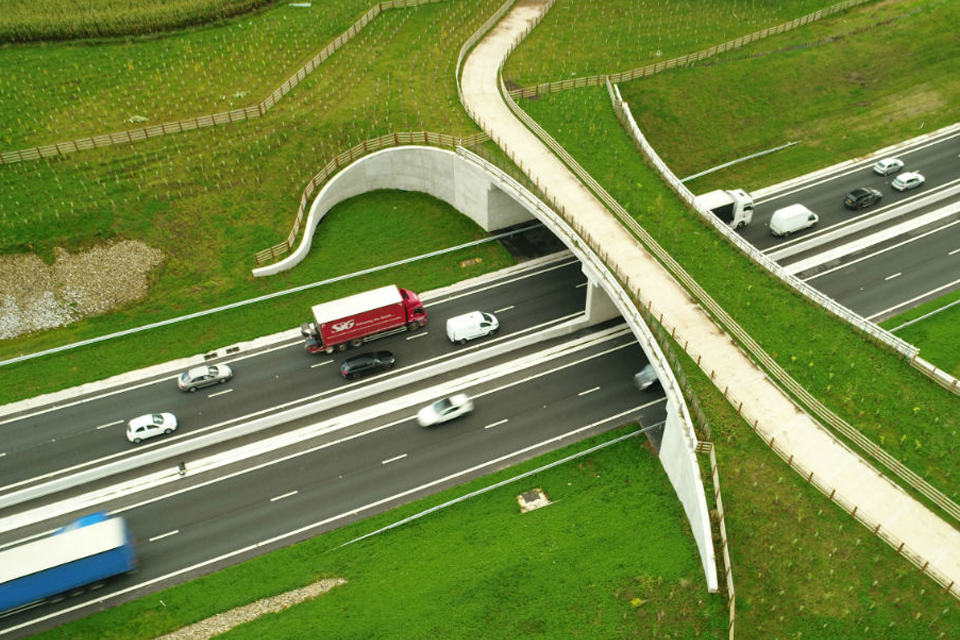
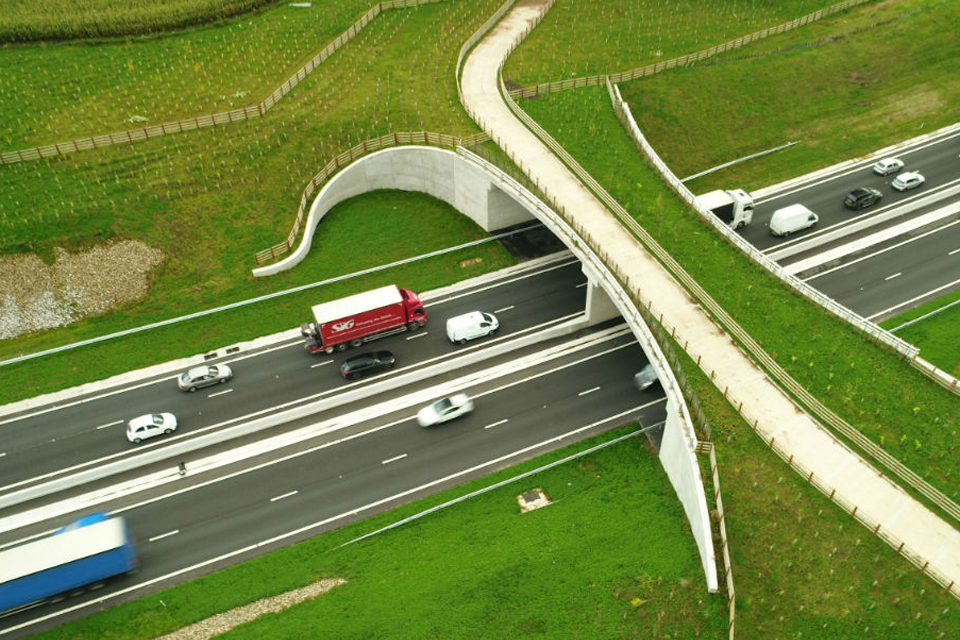
Examples of previous good design include the use of traditional dry stone to reinforce the A590’s connection to the Cumbrian landscape. Other examples of good design include the A3 Hindhead tunnel bypass and the decommissioning of the old road and the inclusion of a ‘green bridge’ on the A556 in Cheshire.

Image of green bridge over the A556 in Cheshire
The green bridge over the A556 in Cheshire is seamlessly integrated with the context and allows for wildlife to cross

Earlier today Highways England released images of a new green bridge on the A556 Knutsford to Bowdon scheme opened last year. The A556 project’s green measures earned it a prestigious Green Apple Award for Environmental Best Practice last year.

As recommended by the Strategic Design Panel, Highways England recently established an independent design review panel. This new design review panel provides expert and independent design advice to the Strategic Design Panel, Highways England and their design teams to ensure that the design vision and principles of good road design are applied to individual schemes.

The ten new principles of good road design and vision will underpin the updated Design Manual for Roads and Bridges. The Design Manual for Roads and Bridges was first published in 1992 and is the standard for the design, maintenance and operation of the strategic road network and is widely used for other roads in the UK and across the globe. The new manual will be rolled out in phases and is expected to be complete by March 2020.

General enquiries

Members of the public should contact the Highways England customer contact centre on 0300 123 5000.

Media enquiries

Journalists should contact the Highways England press office on 0844 693 1448 and use the menu to speak to the most appropriate press officer.


Link: Press release: New principles put people at the heart of road design
Source: Gov Press Releases

Press release: Welsh Secretary kicks off 2018 with EU exit talks

Secretary of State for Wales Alun Cairns will hit the ground running in 2018 when he hosts the next meeting of his EU Exit Expert Panel in Cardiff today (Thursday 11 January 2018).

The panel forms part of the UK Government’s nationwide engagement with those with key interests in our exit from the EU.

Mr Cairns will gather representatives from Welsh businesses, universities and the voluntary, farming, food and health sectors at Caspian Point to discuss their priorities for Brexit and to update them on negotiations and the progress of the Withdrawal Bill.

Secretary of State for Wales Alun Cairns said.

As we move closer towards our exit from the European Union, the job of listening to, and understanding the needs of, those who live, work and do business in Wales becomes ever more important.

The UK Government’s overriding goal is to make sure that the voices of sectors from all parts of the UK are listened to as we navigate an exit that works for everyone.

That is why I am working with experts from across all sectors in Wales to examine the challenges posed by Brexit and to explore the great opportunities for growth in business and employment.

The EU (Withdrawal) Bill is a key piece of legislation in the national interest which will convert EU law to UK law on exit day, ensuring certainty and continuity as we leave the EU.

The Secretary of State for Wales established the Expert Panel to work with him to deliver a smooth and orderly exit from the EU in Wales. The fifth meeting today builds on the constructive conversations they have already had on how powers returning from the EU should be exercised after exit day.

Link: Press release: Welsh Secretary kicks off 2018 with EU exit talks
Source: Gov Press Releases

Press release: New Shared Services Strategy to deliver millions of pounds of savings to the taxpayer

By improving civil servants’ interactions with government back office services, the strategy will support a Civil Service, where civil servants can seamlessly move between departments and roles, allowing the Civil Service to deploy what we need to meet the challenges of the day.

The strategy primarily focuses on driving value and efficiency for the taxpayer by moving to the latest cloud technology, promoting simpler back office processes across departments supported by automation, and meeting the needs of end users across the Civil Service, police, and the armed forces. Doing these things will enable a smarter and more flexible back office for the Civil Service.

Once it has been implemented successfully, the new strategy will promote competition between shared services providers in the market, driving both performance for users, and value for the taxpayer by making service providers constantly improve their technology. By making the most of the latest automation, and robotics, we can make sure that civil servants are supported while they deliver public services.

This strategy will be delivered by the newly formed Government Shared Services unit, from within the Cabinet Office, in collaboration with all government departments.

Matthew Coats, Interim Head of Government Shared Services, and Chief Operating Officer of the Ministry of Justice said:

The shared services strategy for government sets clear direction, and I am pleased to have been part of its development. This will be step change in shared services across the government, directly supporting civil servants in their roles, while also contributing significant savings to the public purse.

By allowing civil servants to spend less time doing administration, they can spend more time delivering vital services to the public.

Link: Press release: New Shared Services Strategy to deliver millions of pounds of savings to the taxpayer
Source: Gov Press Releases

Press release: Government agrees landmark Sector Deal to establish UK as world leader in future of mobility

  • Business Secretary confirms first Automotive Sector Deal, growing the partnership between government and industry, boosting investment in emerging technology and establishing the UK’s leadership in meeting the Future of Mobility and Clean Growth Grand Challenges
  • Sector Deal includes up to £32 million of new joint funding for an industry-led supply chain competitiveness programme to help grow the UK supply chain and make it internationally competitive
  • government also confirms latest £26.4 million investment, match-funded by industry, in 3 cutting-edge low carbon vehicle projects involving Ford, GKN and Jaguar Land Rover

A landmark Sector Deal between government and the automotive industry has today (Wednesday 10 January) been announced by the Business and Energy Secretary Greg Clark.

The deal aims to build on the unique strengths of the UK automotive sector and further develop the strong collaborative partnership established between government and industry.

The Sector Deal sets out a joint strategic vision for how both sides can continue to work together and is the first step towards establishing the UK’s leadership in meeting the Future of Mobility and Clean Growth Grand Challenges.

The deal secures joint investment and long-term commitments between government and industry in areas including the design and development of connected and autonomous vehicles (CAV), the research and development of battery technology and accelerating the manufacture of ultra-low and zero emission vehicles.

As part of this, the government has announced £26.4 million of investment, match-funded by industry to total £52.8 million, to help develop the next generation of driverless and low-carbon vehicles, with flagship projects led by Ford, GKN and Jaguar Land Rover.

Announcing the deal, Business and Energy Secretary Greg Clark said:

For decades, the UK’s automotive industry has powered our economy forward. Today, automotive firms from around the world choose to set up shop here, citing our history of excellence, skilled workforce and world-leading supply chains.

In the next 10 years, the sector will see more change than in the previous hundred. From the engines that power our cars, to the way we control them and our attitudes to owning them, technology is changing what the industry looks like and where money can be made.

The automotive sector will shape our response to the Grand Challenges articulated in our Industrial Strategy, such as Clean Growth and the Future of Mobility – transformations which will forever change how people live, work and travel.

As ever, partnership will be pivotal. As a result of the Sector Deal, both government and industry will invest about a quarter of a billion pounds to develop and manufacture electric vehicles, create a world-leading testing environment for connected and autonomous vehicles and invest in a new industry-led programme to raise the competiveness of UK suppliers to match the best in Europe.

As we open the automotive sector’s next chapter, we will continue to work with industry to make sure the technologies of tomorrow are developed, tested and manufactured right here in the UK.

Commitments

The Sector Deal brings together a number of long-term joint commitments between government and industry that will help build and establish the UK’s leadership in meeting the Future of Mobility and Clean Growth Grand Challenges, including:

Low-carbon automotive technologies

  • through the Advanced Propulsion Centre government is investing £500 million over 10 years to 2023 to research, develop and industrialise new low-carbon automotive technologies in the UK, with industry providing £500 million match funding for collaborative R&D projects

Automotive research and development

  • government is investing up to £225 million from 2023 to 2026 to support R&D in the sector, with industry providing equivalent match funding

Transitioning to ultra-low and zero emission vehicles

  • through the Faraday Battery Challenge, government is investing £246 million to make the UK a world leader in the design, development and manufacture of batteries for the electrification of vehicles

Connected autonomous vehicle (CAV) technology

  • £250 million of government investment to position the UK as a global leader in Connected and Autonomous Vehicles (CAVs) development and deployment. This includes:
    • £150 million for collaborative R&D projects from which, to date, £100 million has been committed to 51 projects, with industry contributing a further £56 million
    • £100 million for CAV testing infrastructure, £51 million of which has so far been committed to 4 infrastructure projects; 2 ‘controlled’ testing facilities and 2 ‘live’ public testing facilities
  • government will be launching a £15 million simulation and modelling R&D competition on the 16 January to accelerate the development of connected and autonomous vehicles

Supply chain competitiveness and productivity programme

  • £16 million of government funding, subject to business case, for an industry-led match-funded national supplier competitiveness and productivity improvement programme to support a sustainable and internationally competitive UK supply chain for future volume vehicle production

Europe

  • The deal acknowledges that the UK automotive industry has benefitted from the European market and as the UK leaves the EU, the industry welcomes the government’s ambition to achieve a new relationship that is free from tariffs and without friction to trade – factors that are fundamental to the competitiveness of the UK automotive sector
  • through the deal, government and the auto sector will work together to seize opportunities to do far more to engage with the wider world beyond Europe where there is untapped emerging innovation and opportunity

Further proposals are being shaped for the next phase of the Automotive Sector Deal, with a focus on capitalising on the UK’s capabilities including in the digital design and testing space which will substantially reduce the time and cost of developing the next generation of vehicles.

Nigel Stein, industry chairman of the Automotive Council said:

The long-term partnership developed between government and industry has played a key role in the automotive sector’s success. It has helped ensure that emerging technologies are developed in the UK and given companies the confidence to invest.

The government’s Industrial Strategy is a welcome renewed commitment to this partnership, helping to support the sector as we move into the third decade of this century and beyond.

Mike Hawes, SMMT Chief Executive:

We welcome today’s automotive sector deal which will help this vital UK industry meet some of the many global challenges it faces. The deal strengthens our long-standing partnership with government, with a boost to supply chain competitiveness and investment, matched by industry, to keep the UK at the forefront of electric, connected and autonomous vehicles.

In its implementation, the deal must help the industry build on our success and seize the opportunities presented by such technological innovations. Given current uncertainties, it must also be complemented by ongoing efforts to maintain the right conditions for growth.

Advanced Propulsion Centre (APC)

Three innovative projects involving Ford, GKN and Jaguar Land Rover will share grants from the latest round of funding from the Advanced Propulsion Centre (APC), APC8, the joint industry-government programme to put the UK at the forefront of low carbon vehicle technology.

The APC8 winning projects are:

  • E-Prime – a project led by Ford’s UK based Global Manufacturing Engineering team working with machine tool supply chain partners to develop process and equipment for production of ultra-high volume next generation electrified powertrain systems
  • ACe-Drive – development of GKN’s future generation e-Drive system platforms, utilising high speed electric machines and advanced high speed power electronics; in conjunction with universities and businesses, this project aims to further grow UK capability in the design and manufacture of eMachines and power electronics
  • VERBIUS – development of future state of the art electric hybrid vehicle systems for Jaguar Land Rover, in conjunction with universities and businesses across the UK; the project aims to significantly improve the vehicle system efficiency through utilisation of innovative electronic systems and componentry

Full details of the Sector Deal agreement between industry and government have been published today on GOV.UK.

Link: Press release: Government agrees landmark Sector Deal to establish UK as world leader in future of mobility
Source: Gov Press Releases