Press release: We’re urging ex-forces personnel to join our ranks

We’ve been given a prestigious award by the Ministry of Defence for our continued commitment to inspiring and supporting both veterans and reservists. The award is given to employers who support defence and inspire others to do the same.

It was presented to company representatives Royal Naval Reservist Lieutenant Commander Robert Jaffier, now an asset and resource manager, and Ron Calderwood-Duncan, Head of Engagement and Culture Change.

Robert, who nominated the company, said:

I am delighted that the hard work carried out by Highways England to recognise the achievements and skills of ex-military personnel has been recognised.

In practical terms, Highways England appeared a good fit for me to be able to continue my civilian career while pursuing my personal development as a reservist.

The main challenge was settling back down to civilian life from my time out on operations and become reacquainted with the culture of the business that had evolved while I was away. So, it’s great that my workplace offers successful applicants a buddy who is someone who has experienced making the transition from military life to working for Highways England. I am delighted to offer my support as a buddy for new recruits, and I urge anyone from the forces looking for a career change to consider Highways England.

The Ministry of Defence makes awards under its Defence Employer Recognition Scheme. Employers have to show their values are aligned with the Armed Forces Covenant.

Since signing the Armed Forces Covenant in June 2017, we’ve actively been supporting leavers from the Armed Forces reintegrate into civilian careers, and to help operate, maintain and improve motorways and major A roads in England.

We launched an ex-military recruitment programme earlier this year which incorporated an insight day for service leavers to find out more about how it works, and the roles it can offer. It employs and supports both reservists and veterans, with up to 10 days paid special leave for reservists to attend military-related training.

There are many career routes available, from working on major projects or support functions such as HR finance and IT through to hands-on operational roles running the everyday traffic operations.

You can search and apply for jobs at Highways England via our careers webpage.

You can also read the Armed Forces Covenant promise in full.

General enquiries

Members of the public should contact the Highways England customer contact centre on 0300 123 5000.

Media enquiries

Journalists should contact the Highways England press office on 0844 693 1448 and use the menu to speak to the most appropriate press officer.

Link: Press release: We’re urging ex-forces personnel to join our ranks
Source: Gov Press Releases

The Air Navigation (Amendment) (No. 2) Order 2018

This Order amends articles 99, 100 and 168 of the Air Navigation Order 2016 (“the 2016 Order”) and creates offences in respect of Annex III (Organisation Requirements for Air Operations, Part-ORO) and Annex V (Specific Approvals), Subpart K (Approval of helicopter offshore operations), of Commission Regulation (EU) No. 965/2012 laying down technical requirements and administrative procedures related to air operations pursuant to Regulation (EC) No. 216/2008 (“the Air Operations Regulation”).

Link: The Air Navigation (Amendment) (No. 2) Order 2018
Source: Legislation .gov.uk

The Merchant Shipping (Confirmation of Legislation) (Falkland Islands) Order 2018

This Order confirms the Maritime Ordinance 2017 (No. 20 of 2017) (“the Ordinance”) enacted by the Legislature of the Falkland Islands, in so far as the Ordinance repeals provisions of the Merchant Shipping Act 1894 (c. 60) (other than provisions in Part 3 relating to emigrant ships), the Merchant Shipping Act 1906 (c. 48), the Merchant Shipping Act 1921 (c. 28), the Merchant Shipping Act 1965 (c. 47), the Merchant Shipping Act 1970 (c. 36) and the Merchant Shipping Act 1981 (c. 10) relating to ships registered in the Falkland Islands and which continue to apply to the Falkland Islands. The Ordinance replaces the repealed extended legislation with local legislation.

Link: The Merchant Shipping (Confirmation of Legislation) (Falkland Islands) Order 2018
Source: Legislation .gov.uk

Gypsy and Traveller Communities (Housing, Planning and Education)

A Bill to make provision about periodical local authority reviews of the housing needs of Gypsy and Traveller communities; to make provision for the conversion of caravan sites into settled accommodation; to require local authorities to provide temporary caravan stopping sites where there is a demonstrated need; to create a criminal offence of unauthorised encampment; to make provision about the education of Gypsy and Traveller children; to require schools to have regard to Gypsy and Traveller culture and heritage in teaching; and for connected purposes.

Link: Gypsy and Traveller Communities (Housing, Planning and Education)
Source: Public Bills

Press release: Criminal exploitation and ‘county lines’: learn from past mistakes, report finds

Summary:

  • lessons must be learned from past sexual exploitation cases
  • all children, not just the most vulnerable, are at risk of criminal exploitation
  • agencies should not underestimate the risk of criminal exploitation in their areas
  • children should be seen as victims, not perpetrators
  • awareness-raising is crucial in preventing criminal exploitation

Local agencies must learn lessons from past sexual exploitation cases if they are to effectively respond to ‘county lines’ drug running and other forms of child criminal exploitation, a new report finds.

The thematic report, from inspectorates Ofsted, HMI Constabulary and Fire & Rescue Services (HMICFRS), the Care Quality Commission (CQC) and HMI Probation, also calls on agencies not to underestimate the risk of child criminal exploitation in their areas.

Read ‘Protecting children from criminal exploitation, human trafficking and modern slavery’ – this is an addendum to the 2016 report ‘Time to listen’.

The in-depth inspections scrutinised practice in children’s social care, education, health services, the police, youth offending services and probation services across 3 local authority areas.

Today’s report illustrates the nationwide scale of criminal exploitation, with all areas – urban, rural, affluent as well as deprived – affected. Child victims come from a wide range of backgrounds. And while the most vulnerable are obvious targets for gangs, there are examples of private school children being groomed too.

Much has been done by many local partnerships across the country to deal with child sexual exploitation in their areas, the report recognises. But this success must be built upon and shared so that other forms of exploitation, like county lines drug running, can be dealt with effectively.

Inspectors found that some partners do not have a grip on the scale of criminal exploitation in their area. Poor intelligence-sharing sometimes hampers wider recognition and understanding of criminal exploitation, and, in turn, the ability to effectively respond to children. This includes missing the risks to some children, or identifying them too late.

The report calls on all agencies to get the basics right. Making sure that there are clear systems in place at the ‘front door’ of services that first come into contact with children is essential, so that children at risk are identified and receive a prompt and appropriate response.

Ofsted’s Chief Inspector, Amanda Spielman, will also raise her concerns about the scale of criminal exploitation at the National Children and Adults Services conference in Manchester today.

Ms Spielman is expected to say:

Local partners must be quick to learn and quick to act. But not all agencies fully understand the scale of the problem in their area. And regional and national networks of exploitation of children are even less well understood.

It is also a concern that some agencies are still not looking past the behaviour of grooming victims to the root cause. If we have learnt anything from past exploitation cases, it should be to ‘see the child, not the problem’.

The inspectorates call for a ‘culture shift’, so that front line staff both recognise the signs of criminal exploitation, and see children as victims despite their apparent offending behaviour.

Better training for all agencies, but especially the police, is vital, the report argues. In the areas inspected, police had made some progress in recognising the context of criminal exploitation when dealing with children in possession of drugs. However, all police forces admitted that it was still possible that children could be prosecuted, despite clear evidence that they were being exploited.

The report calls for a whole system approach to address the perpetrators, to protect and support victims, as well as preventing exploitation by raising awareness in the community and disrupting criminal activity. In one of the areas visited, inspectors saw examples of innovative work to disrupt criminal exploitation from some agencies.

Agencies and professionals must work together with parents and children to alert them to the signs of grooming, exploitation and county lines. The report shows that children are often being groomed or tricked into working before they recognise the dangers, and often before parents or professionals realise what is happening. Inspectors saw clear efforts to raise awareness in the local community in the areas visited.

Schools and colleges are also essential partners in the whole-system approach. Some schools are working hard to understand, reduce and prevent the risks of county lines. However, this awareness needs to be developed and supported across the country.

Yvette Stanley, Ofsted’s National Director for Social Care said:

Tackling child criminal exploitation, including county lines, is a big challenge for agencies and professionals nationally and locally. It can be done, but agencies must make sure that they have the building blocks in place to work quickly and effectively.

Children who are being exploited cannot wait for agencies that are lagging behind or failing to recognise this issue. In responding to this dangerous situation, we must not repeat the mistakes of the past, where some partners were too slow to recognise the risk of child sexual exploitation in their areas, or somehow felt that it ‘doesn’t happen here’.

Wendy Williams, Her Majesty’s Inspector of Constabulary, said:

Criminally exploited children can only get the help they need when they’ve been recognised as a victim. We’ve found that when frontline officers handle cases involving children suspected of a criminal offence, they can be too quick to accept what they see at face value. Instead of seeing a vulnerable child in desperate need, they can see a criminal in the making. When officers ask the right questions – is this child being exploited? Are they at risk? – they can take the right steps to keep children safe and bring the real perpetrators to justice.

Professor Ursula Gallagher, Deputy Chief Inspector at the Care Quality Commission and lead for children’s health and safeguarding, said:

Healthcare professionals and anyone working with children have a responsibility to look for the signs of exploitation, to use their curiosity and compassion, and not judge a child for their behaviour or the situation they are in.

This is why we work with other regulators to test how well individual parts of a system are working together to protect children and young people and to make clear what we expect of a high-performing area.

But it doesn’t stop there. Services and systems as a whole need to consider how they share what they know with people working beyond their own locality, because people exploiting children do not limit their activity by geographical boundaries, and important safeguarding information must be able to follow children in order to protect them.

Dame Glenys Stacey, HM Chief Inspector of Probation, said:

We welcome this important report. The inspection shows that children of all backgrounds can be forced into criminal and sexual exploitation. What is also clear is that agencies and professionals need to do more to recognise the extent of the problem and intervene early. Youth offending teams are well placed to spot the signs of exploitation and we were pleased to see some good work recognised in this report. However it is clear that more needs to be done to make sure that all agencies are working together to protect children.

The inspectorates’ findings are published today [14 November 2018] as an addendum to the 2016 report: ‘Time to listen – a joined up response to child sexual exploitation and missing children’.

Link: Press release: Criminal exploitation and ‘county lines’: learn from past mistakes, report finds
Source: Gov Press Releases

Press release: New era at Sellafield as Thorp reprocessing ends

Opened in 1994, Thorp is one of only two commercial nuclear fuel reprocessing plants in the world.

It has reprocessed more than 9,000 tonnes of fuel from 30 customers in nine countries around the world. It generated an estimated £9bn in revenue.

The last batch of fuel to be reprocessed began its journey through the plant at 11.32am on Friday 9 November.

There will be no redundancies as a result of the switch-off. All employees in roles no longer required have been offered alternative jobs in the business.

Thorp will continue to serve the UK until the 2070s as a storage facility for spent fuel.

Meanwhile, Sellafield is being reinvented as a centre of expertise for nuclear clean-up.

This will unlock 100 years’ worth of opportunity for the site’s workforce, supply chain, and community.

Paul Foster, Sellafield Ltd’s Chief Executive Officer, said:

As we look forward to an exciting future, we want to celebrate the best of our past.

The end of reprocessing at Thorp is one of the most important events in Sellafield’s history.

Thorp has been a West Cumbrian success story. It has delivered jobs, skills, pride, and prestige.

Our community came together in the fight to get it built, through the ‘Trust Us’ campaign.

Together we completed one of the largest and most complex construction projects ever undertaken in Europe.

And during 24 years of operations, we safely reprocessed 9,331 tonnes of fuel from 30 customers in nine countries.

We helped to keep the lights on in the UK and around the world and generated £9bn in revenue for the UK.

I’m immensely proud of Thorp’s contribution and I’d like to thank the workforce for their unwavering dedication and professionalism throughout a period of unprecedented change.

Thorp (or the Thermal Oxide Reprocessing Plant) is one third of a mile long.

It dominates a huge central strip of the Sellafield site and is the largest structure on the site.

Costing £1.8bn to build, it was paid for by its future customers.

The decision to cease reprocessing was taken in 2012 in response to a significant downturn in demand.

The international market for reprocessing has shifted significantly since Thorp’s construction, with the majority of customers now opting to store rather than reprocess their fuel.

Link: Press release: New era at Sellafield as Thorp reprocessing ends
Source: Gov Press Releases

Press release: Back to school to inspire engineers of the future

Ongoing and planned engagement with schools and colleges in Wiltshire, Somerset and Cornwall is helping to highlight numerous engineering opportunities within the highways industry and inspire young people to consider engineering as a rewarding career.

Next week the company will be involved in a bridge-building exercise with pupils from a Somerset school.
The team behind the A303 Sparkford to Ilchester dualling scheme will visit Countess Gytha Primary School in Queen Camel on 23 November, helping Year 6 pupils to design and build K’Nex bridges as well as giving the youngsters an insight into the design of the route and what animals have been found during survey work.

Hannah Sanderson, Project Manager for the A303 Sparkford to Ilchester scheme, said:

Highways England is very focused on inspiring young people to consider engineering as a rewarding career.

It should be a fun experience for the youngsters, and we’re really looking forward to taking our branch of engineering into the classroom.

Responsible for improving, managing and maintaining England’s motorways and major A roads, the company is working with schools and colleges across the country as part of the Year of Engineering campaign.

By bringing young people face to face with engineering experiences and role models, the campaign aims to showcase the creativity and innovation of engineering careers and widen the pool of young people from all backgrounds who are willing to consider the profession.

As part of the STEM (Science, Technology, Engineering and Mathematics) Insights programme, Highways England also took part in a recent initiative with Wiltshire schools.

Maria Madeley, a primary teacher and science co-ordinator at Minety School, spent a week with the company earlier in the year, gaining an understanding of the engineering and geotechnical work around structures and roads across the strategic network.

This enabled Maria to build a curriculum around road building for her Year 5 and Year 6 pupils. And after Highways England spent a day teaching the children about smart motorways, bridge building and the geology of rocks, it culminated in a British Science Association-funded How Real Stuff Works event at Malmesbury School.

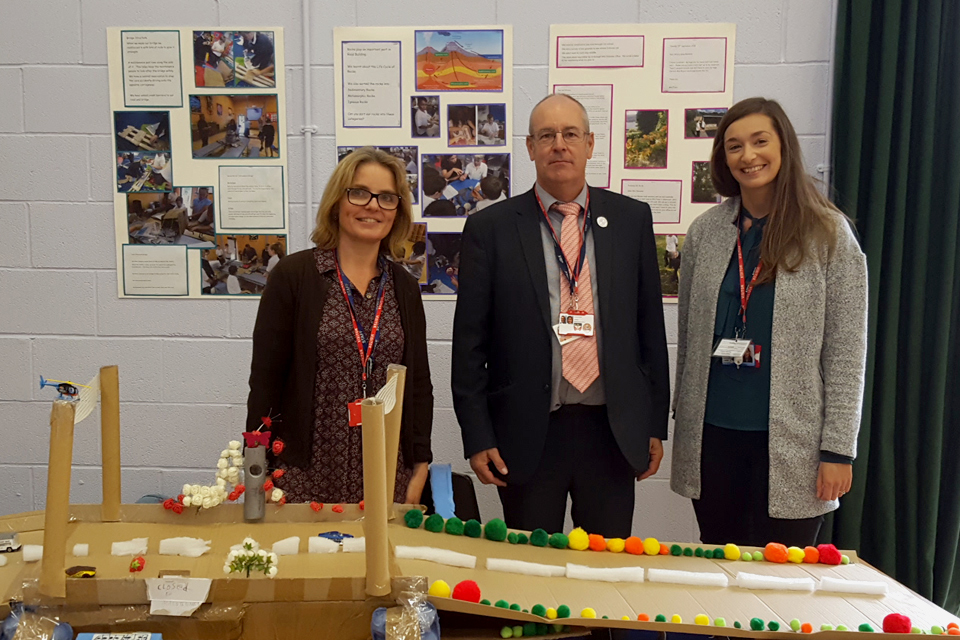
image showing Minety school teacher Maria Madeley with Garry Packer and Emma Grayson of Highways England
Minety School teacher Maria Madeley, left, with Garry Packer and Emma Grayson of Highways England and her pupils’ bridge design at the British Science Association’s How Real Stuff Works event at Malmesbury School

Elsewhere, the team behind the A417 Missing Link project engaged three Gloucestershire schools in chocolate-based STEM projects recently, while earlier this year the A303 Stonehenge project team met with Amesbury Primary School pupils, educating the children about the company’s environmental and archaeological work, as well as safety and engineering aspects of the proposed scheme.

Esther Gordon-Smith, the team’s legacy and benefits lead, also took part in Wiltshire Council’s Science and Engineering Fair last month, delivering a ‘STEM serves society’ presentation to teachers and school leaders.
The A30 Chiverton to Carland Cross team are also seeking to build relationships with schools and communities alongside the route in Cornwall, and have just launched a STEAM (Science, Technology, Engineering, Arts and Maths) initiative.

The schools’ outreach programme is designed to engage children from four to 18 in fun, hands-on activities.

Any schools interested in receiving a STEAM visit, can email: A30ChivertontoCarlandCross@highwaysengland.co.uk

For more information visit the Year of Engineering website.

General enquiries

Members of the public should contact the Highways England customer contact centre on 0300 123 5000.

Media enquiries

Journalists should contact the Highways England press office on 0844 693 1448 and use the menu to speak to the most appropriate press officer.


Link: Press release: Back to school to inspire engineers of the future
Source: Gov Press Releases

Press release: Safety warning following seven gritter crashes in North West

Motorway drivers are being urged to take extra care around gritters this winter following seven collisions in the North West.

Highways England has issued the warning after 36 of its vehicles were struck on motorways and major A roads across the country last winter.

Gritter driver Garry White was spreading salt on the M57 near junction 6 at Kirkby in March this year when his vehicle was struck from behind by a Ford Focus travelling at high speed. The car was written off and the back of the gritter also received extensive damage, requiring repairs.

Garry, 43 from Runcorn, suffered minor injuries and was off work for several days following the collision. He said:

The psychological impact was quite bad to be honest and I didn’t want to get back in a wagon for a few weeks after it happened. Experience prevails, and you push on and you get back in, but both me and the car driver were lucky not to have sustained much worse injuries.

I’d ask drivers to give us as wide a birth as possible this winter and to stay behind us until we’ve finished our treatment if they can as it’s much safer. Usually you’ll find a gritter will only be doing a few motorway junctions before pulling off anyway.

Gritters have flashing amber beacons, are 2.5 metres wide and are bright orange but causes of collisions have included drivers misjudging the amount of space needed to overtake them or driving too close to them when they are spreading salt.

The vehicles, which each weigh up to 26 tonnes, usually travel at 40mph in the middle lane to ensure the right amount of salt is spread to all lanes.

The back of a gritter is the most vulnerable area as it is where the salt spreading equipment is located. If it is struck then it can mean the gritter has to be taken off the road to be repaired, which is costly and could affect critical services in extreme weather conditions.

Andrew Olive, Highways England’s North West severe weather manager, said:

The vast majority of drivers support our gritter drivers by leaving a sensible distance and only passing when it’s safe to do so, but we do have occasions when people misjudge the situation and end up colliding with one of our vehicles.

The driver of the Ford Focus was lucky not to be more seriously injured in the incident on the M57 earlier this year, and gritter drivers like Garry should be able to do their job without having to worry about whether other vehicles might strike them.

Our gritter drivers perform a vital role to keep motorways and major A roads moving during the winter so I’d urge drivers to take extra care when travelling near them.

During severe winter weather drivers are urged to follow this advice:

  • In snow and ice: Drivers should stick to the main roads where they can and only travel if necessary. Drivers are also encouraged to make sure they have a winter kit in their vehicle, including an ice scraper and de-icer, warm clothes and blankets and sunglasses to cope with the low winter sun.
  • In high winds: Drivers should slow down and avoid using exposed sections of road if possible. Lorries, caravans and motorbikes are at particular risk.
  • In heavy rain: Drivers should keep well back from the vehicle in front, gradually ease off the accelerator if the steering becomes unresponsive, and slow down if the rain and spray from vehicles makes it difficult to see and be seen.
  • In fog: Drivers should switch on their fog lights and not use lights on full beam as the fog will reflect the light back. If drivers really cannot see, they should consider stopping until it is safe to continue.

General enquiries

Members of the public should contact the Highways England customer contact centre on 0300 123 5000.

Media enquiries

Journalists should contact the Highways England press office on 0844 693 1448 and use the menu to speak to the most appropriate press officer.

Link: Press release: Safety warning following seven gritter crashes in North West
Source: Gov Press Releases

Press release: Search to find Cyber Security experts of the future

An online programme designed to inspire teenagers to think about a career in cyber security will continue for a second year after a successful pilot across England.

Over 23,000 young people aged between 14 and 18 have already taken part in the Cyber Discovery programme which uses interactive games to teach teenagers about cyber security in an accessible and fun way. Those who perform at the highest levels, will also have the opportunity to attend a special summer camp to hone their skills and meet industry leaders.

The scheme sits within Cyber First, the government’s cyber security skills programme, which is part of the £1.9 billion investment through the National Cyber Security Strategy to transform the UK’s cyber security and ensure we build skills in the workforce of the future.

Minister for Digital Margot James said:

We need to inspire young people and show them a career in Cyber Security can be exciting and rewarding, not only to give them more opportunities but also help build a talented workforce for the future. The Cyber Discovery programme has been a great success so far. I hope more teenagers will take part and learn that those working in cyber security can come from any walk of life, and have studied any subject.

The £20 million Cyber Discovery programme teaches students about subjects including digital forensics, defending against web attacks and cryptography. It is being delivered by IT security training company the SANS Institute.

The programme is also a key part of the government’s modern Industrial Strategy – a long term plan to ensure that businesses have the skilled workers they need here in Britain.

Head of Research and Development for SANS Institute James Lyne said:

Based on the success of last year’s Cyber Discovery programme, it’s clear there’s both the appetite and the aptitude to learn about cyber security in the UK. Before taking part in Cyber Discovery 40.4% of female students and 35.5% of male students hadn’t even considered a career in cyber security. This dropped to 9.6% and 6.3% respectively after these students took part in the programme. And many of the club leaders who are also Computer Science teachers, told us they used Cyber Discovery last year to complement their lesson plans. We hope to extend this enthusiasm and passion for cyber security across the the UK in year two.

Any young person between the ages of 14 to 18 can take part. Registration and completion of the first assessment phase closes on 7 January 2019. Find out more on the Cyber Discovery website.

Further Information:

  1. The Government is committed to ensuring that the UK has a sustainable pipeline of cyber security talent supporting a workforce that meets current and future cyber security demands and supports the UK’s prosperity by keeping the economy and the country safe from cyber threats.

  2. The National Cyber Security Strategy commits to developing and implementing ‘a self-standing skills strategy that builds on existing work to integrate cyber security into the education system. This will continue to improve the state of computer science teaching overall and embed cybersecurity into the curriculum. Everyone studying computer science, technology or digital skills will learn the fundamentals of cyber security and will be able to bring those skills into the workforce. As part of this effort, we will address the gender imbalance in cyber-focused professions, and reach people from more diverse backgrounds, to make sure we are drawing from the widest available talent pool.

  3. SANS Institute was established in 1989 as a cooperative research and education
    organisation and is now the largest provider of cyber security training and certification to
    practitioners at governments and commercial institutions worldwide. The SANS curriculum
    spans more than 60 courses across multiple cyber security disciplines. SANS has
    successfully run programmes for school age students and is passionate about encouraging
    young people to pursue a career in cyber security.

Link: Press release: Search to find Cyber Security experts of the future
Source: Gov Press Releases