Press release: ‘Critical asset’ for predicting flooding in York being built

Anyone who frequently travels on the A59 between York and Harrogate is likely to have noticed a construction site at Skipbridge, Green Hammerton.

Taking place under the bridge, the Environment Agency is building a new channel to enable river flow meter readings to be taken.

Project manager Oliver Wilson said:

This is one of the Environment Agency’s critical assets for our flood warning service and for managing water resource available for abstraction.

Having an early warning that the Ouse could overtop in York means we can act early to prevent flooding by closing flood gates in the city.

The project involves building a concrete lined channel under the width of the River Nidd.

But building structures in a river channel is no easy feat, so a cofferdam has been built.

One half of the river is dammed off to create a dry working area to enable construction on that side, before the other side is dammed and the new channel structure can be completed.

The construction under the river enables an ultrasonic device attached under the bridge to measure the exact flow of water coming down the Nidd, which joins the Ouse about a mile downstream at Nun Monkton.

There was an existing concrete channel built a number of years ago but due to the design and flow dynamics it created in the river the bed got silted up, causing incorrect flow readings and it not working as an effective gauge station.

The new channel is designed to make sure sediment passes through it and flow readings are accurate.

Mr Wilson added:

Lower river levels have enabled us to make really good progress and we expect the gauge station to be fully functioning this winter.

North Yorkshire County Council’s Highways Department has carried out work on the bridge and road earlier this year and Northern Powergrid also recently installed an electricity line across the bridge.

Link: Press release: ‘Critical asset’ for predicting flooding in York being built
Source: Environment Agency

Press release: Government leads energy charge across public sector, saving up to £340 million

At a speech celebrating the Northern Powerhouse in Newcastle today (Thursday 5 July), the Business and Energy Secretary Greg Clark announced a range of measures to place the UK at the forefront of the global shift towards clean growth as part of our Industrial Strategy.

Following a speech by the Prime Minister last month, Greg Clark outlined how the government will deliver the Clean Growth Grand Challenge’s first ‘mission’ to halve the energy use of new buildings by 2030, saving families money.

Building on the momentum of ambitious energy efficiency measures within the public sector, the Secretary of State announced that central government will work towards a more stretching target with a reduction of 43% greenhouse gas emissions by 2019 to 2020 compared to 2009 to 2010 levels, potentially delivering £340 million in savings. We will also be publishing guidance on targets for the wider public and higher education sectors.

Business and Energy Secretary Greg Clark said:

Our new, ambitious target for reducing emission across our central estate shows how this government is continuing to lead the world and rise to the challenge of tackling climate change. We have made significant progress so far, meeting our previous target 3 years early and saving just over £100 million last financial year as a result.

The potential savings from this can make a big difference across the wider public sector, with the NHS saving £2 billion over the last decade; money that can be put straight back into frontline services where it’s needed most.

Industry energy efficiency

We need to revolutionise the way we heat our homes and businesses, to support this, the Business Secretary announced that government will be launching the £18 million Industrial Heat Recovery Support programme with applications invited in the autumn. This is intended to encourage industry to invest in heat recovery technologies, harnessing the power of heat which would otherwise go to waste to help improve the efficiency of industry and reduce costs.

Speaking today, Greg Clark said:

Of the more than £11 trillion investment expected in global power in the next three decades, 86% – is expected to be in low carbon. And by 2040, electric vehicles could make up over half of global car sales, compared to 1% today.

We will be working with businesses to highlight these opportunities during the first ever annual Green GB Week starting on the 15 October.

The Business Secretary also launched the Construction Sector Deal will bring together the construction, manufacturing, energy and digital sectors to deliver innovative approaches that improve productivity in construction and accelerate a shift to building safer, healthier and more affordable places to live and learn that use less energy.

Notes to editors

  1. The Greening Government Commitments require central government departments to adopt sustainable practices, including greenhouse gas emissions.
  2. We have announced a new target to reduce emissions by 43% by 2020, compared with 2009 to 2010 levels. This has the potential to deliver savings of £340 million in 2020 compared to a 2009 to 2010 baseline.
  3. The previous target for government, as a whole, was to reduce emissions by 32% by 2019 to 2020, compared with 2009 to 2010 levels. This was exceeded 3 years early with a 33% reduction by the end of 2016 to 2017, resulting in a saving of £104 million in 2016 to 2017 compared to the 2009 to 2010 baseline.
  4. We are also publishing guidance for wider public and higher education sectors to report against a voluntary target of more than 30% reduction in emissions by 2020 to 2021: Emissions Reduction Pledge 2020: emissions reporting in public and higher education sectors
  5. The Industrial Heat Recovery Programme will open for applications in Autumn 2018.
  6. The successful applicants from the 2 £10 million innovation competitions include northern companies such as Free Running Buildings in Leeds who are pioneering low energy ventilation technology, and Hull University who will develop a high efficiency, low carbon heating system for public buildings in Yorkshire.

Link: Press release: Government leads energy charge across public sector, saving up to £340 million
Source: Gov Press Releases

Press release: New appointments to the Board of the Royal Botanic Gardens, Kew

Defra Ministers have appointed Krishnan Guru-Murthy to the Board of Trustees of the Royal Botanic Gardens. They have also reappointed Catherine Dugmore and Nick Baird for second terms.
RBG Kew is an Executive Non-Departmental Public Body created under the National Heritage Act 1983, is sponsored by Defra. The Board of Trustees comprises a Chairman and eleven members.

Trustees provide non executive leadership and support to the executive through regular Board meetings, committees and groups.

Krishnan Guru-Murthy’s appointment is for 3 years and will run from 1 July 2018 to 30 June 2021. Catherine Dugmore’s and Nick Baird’s reappointments are for 3 years and will run from 1 June 2018 to 31 May 2021 and from 1 November 2018 to 31 October 2021, respectively.

The appointments have been made in accordance with the Ministerial Governance Code on Public Appointments. All appointments are made on merit and political activity plays no part in the selection process.

There is a requirement for appointees’ political activity (if significant) to be made public. The appointees have not declared any significant political activity in the past five years.

Trustees do not receive any direct remuneration for their services, although reasonable travel and subsistence expenses can be reimbursed.

Biographical details of Trustees

Krishnan Guru-Murthy

Krishnan Guru-Murthy is a presenter and reporter on Channel 4 News and on Channel 4’s Unreported World. He was previously a presenter and reporter for the BBC. He is a member of the executive committee of the Edinburgh Television Festival and a patron of Duchenne Children’s Trust.

Catherine Dugmore

Catherine Dugmore is a qualified Chartered Accountant. From 1988 to 2002 Catherine worked at PricewaterhouseCoopers, latterly as an audit partner based in Johannesburg. In addition to her role as a Trustee of the Royal Botanic Gardens, Kew, Catherine is a Board Member of Natural England and a Trustee of WWF-UK. She has worked in the NHS since 2012 and currently holds a non-executive role at Hertfordshire Partnership Foundation Trust. She was formerly Vice-Chair and Trustee of Action for Children and Chair of Victim Support.

Nick Baird

Nick Baird is currently Group Corporate Affairs Director of Centrica plc. He previously had a long and varied career in Government, his roles including CEO of UK Trade and Investment, Director General in the Foreign and Commonwealth Office leading its work on Europe, the global economy and consular issues, and British Ambassador to Turkey from 2006 to 2009.

Link: Press release: New appointments to the Board of the Royal Botanic Gardens, Kew
Source: Gov Press Releases

Press release: M4 smart motorway plans to go on show this weekend

32 miles of the M4 will have an extra lane created in both directions, with upgraded signs, signals and technology to inform drivers about conditions ahead.

Plans about the upgrade are going on show this weekend, Saturday 7 July, with the first of six public events ahead of main construction starting later this year.

Drivers, business owners and local residents are invited to find out more about the plans, which will add an extra lane in each direction to the M4 between junction 3, near Hayes, and junction 12 at Theale, to upgrade it to an all-lane-running smart motorway. New technology will help to manage traffic to reduce delays and give drivers up to date information about conditions on the road ahead.

Work is due to start this autumn on the stretch between junctions 8/9 and 10, between Maidenhead and Wokingham. Six public information events are being held in the area, starting in Maidenhead this weekend, and visiting Wokingham, Theale and Reading over the next two weeks.

The M4 smart motorway scheme has already been through a comprehensive consultation as part of the complex planning process, and people interested in finding out more about the plans are encouraged to attend an event and put any questions directly to the project team. Further events will take place early next year between junctions 8/9 and junction 3 (Hayes).

Highways England delivery director Mike Grant said:

Upgrading the M4 to a smart motorway between junctions 3 and 12 is a massive job and will provide huge benefits not only to the 130,000 drivers using it each day by tackling congestion and improving journey times, but also for business travellers and holiday makers using the corridor to get to and from the airports in the south, as well as residents and businesses based in the area.

Smart motorways add vital capacity to our motorway network and are central to our ambitious plans for modernising the motorway network, adding 120 miles of new lanes to motorways in the South East by 2020. Drivers will also see better information about conditions through new smart motorway technology which helps us to manage incidents, smooth traffic flow, make journeys more reliable and improve journey times, while maintaining high levels of safety.

The public exhibitions starting this weekend are an ideal place for anyone interested in the upgrade of the M4 to a smart motorway to meet the project team and find out more.

The M4 is the main strategic route between London, the west of England and Wales.

Under the plans, the hard shoulder will be permanently converted into a live running lane between junctions 3 and 12 in both directions. New signs and signals will be used to vary the speed limit to reduce congestion at busy times, and to control traffic if there is an obstruction on the road ahead.

Work is scheduled to start in September this year, and will be carried out in phases, with the smart motorway being fully operational in spring 2022.

Public information events are starting this weekend (Saturday 7 July, Holyport War Memorial Hall, near Maidenhead) with a further five events running until Thursday 19 July in Reading. People are encouraged to attend to find out more about the plans and put any questions directly to the project team. Further events will be held over the next few months along the route of the scheme.

Anyone interested in the scheme can visit the project page on the Highways England website.

General enquiries

Members of the public should contact the Highways England customer contact centre on 0300 123 5000.

Media enquiries

Journalists should contact the Highways England press office on 0844 693 1448 and use the menu to speak to the most appropriate press officer.

Link: Press release: M4 smart motorway plans to go on show this weekend
Source: Gov Press Releases

Press release: Man fined after pleading guilty to fishing offences

Christopher Myers, 27, of Surrey Place, Willington, Crook, appeared before Newton Aycliffe Magistrates Court on Wednesday 4 July where he pleaded guilty to fishing using illegal equipment, killing and being in possession of trout about to spawn.

He was ordered to pay a total of £1,180, which includes a fine of £800, costs of £300 and a victim surcharge of £80.

The offence happened at 2100 on 21 November last year when Environment Agency Fisheries Enforcement Officers were carrying out patrols at Waskerley Beck, Wolsingham.

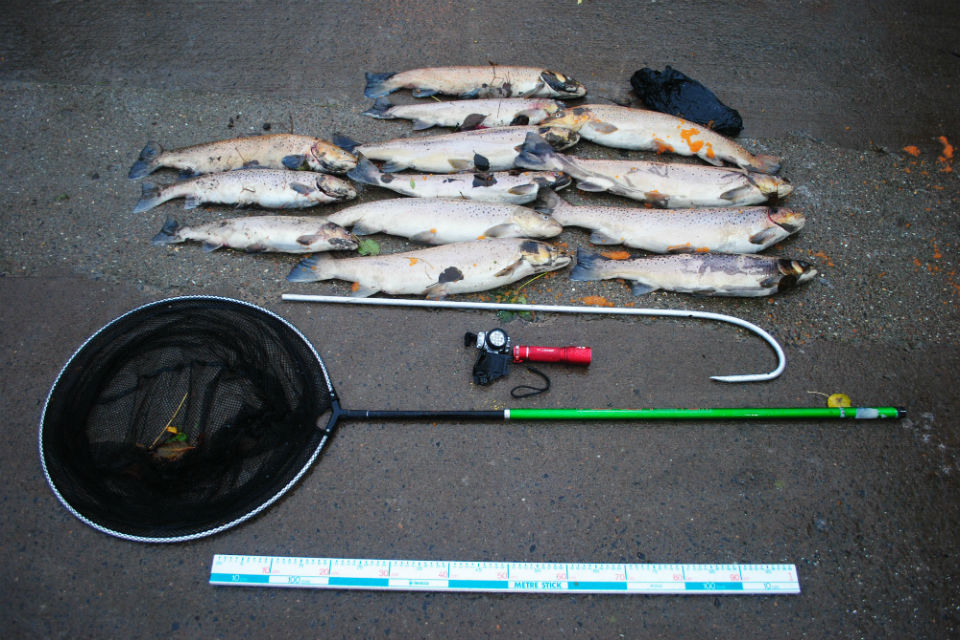
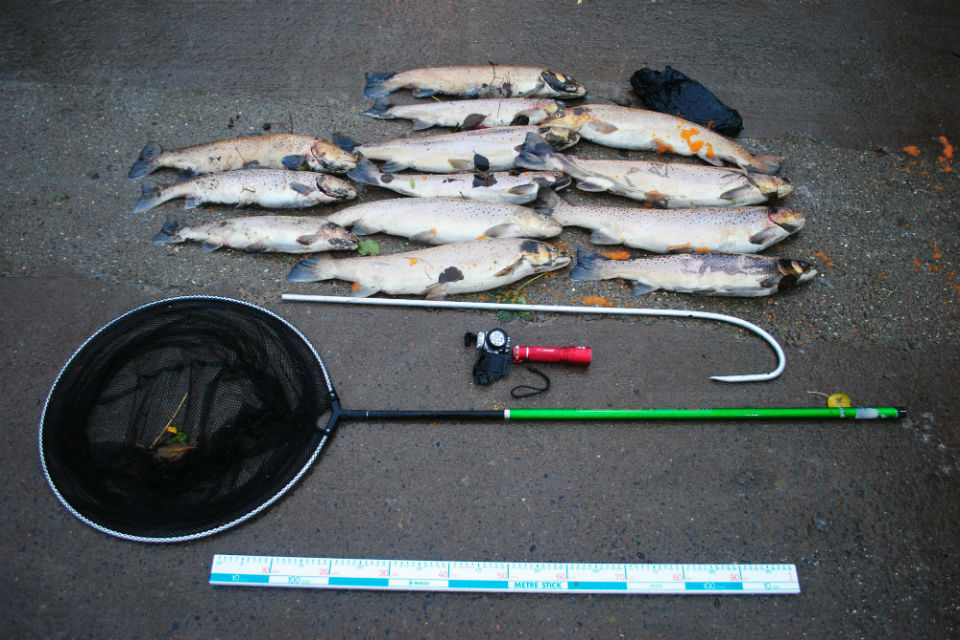
They observed three men on the beck. Myers was at the water’s edge shining a torch into the water and carrying a large gaff – a one meter long metal hook – with a number of fish impaled upon it. A second man was wearing a headlamp torch and the other was carrying a landing net that contained a number of fish.

After officers made themselves known to the poachers, all three ran, dropping the fish and equipment. Myers was caught and arrested while his accomplices escaped. Four dead trout were found in Myers nearby vehicle.

Seized equipment and eggs web

During a voluntary interview at the scene, Myers denied taking any fish, stating that he didn’t know who the other men were, that he did not know how the fish got into his pick up and that he was not the driver that night.

Officers found a total of 13 dead sea trout, 11 of which were females ready to spawn. Between them, they were carrying around 35,000 eggs. Their loss could have a major impact on future sea trout stocks in the River Wear.

In mitigation, Myers stated he didn’t know how serious these offences were and said he was very sorry.

The Environment Agency’s Kevin Summerson said: “This level of illegal activity could have a serious impact on the sustainability of future stocks of sea trout in the River Wear. That’s why we take reports of suspected poaching seriously and work closely with the police to take action where appropriate. We’re pleased the court has also recognised seriousness of the crime in sentencing.

“At this time of year salmon and sea trout are returning to rivers to spawn and protecting returning fish is vital to maintaining a healthy fish population.

“We’ll continue to target all aspects of illegal fishing activity, particularly where serious illegal and potentially damaging methods are used.”

The court also ordered the forfeiture of all seized items: gaff, net, torches and fish.

Under the Salmon & Freshwater Fisheries Act 1975, lights are prohibited, as are gaffs, and landing nets if used without an authorised rod and line. It is also illegal to fish during the close season for migratory fish.

Anyone discovered committing offences could face a substantial fine and imprisonment. The Environment Agency urges anyone to report illegal fishing by calling 0800 80 70 60.

You can buy a licence at https://www.gov.uk/fishing-licences and don’t forget that all fishing licence income is used to fund work to protect, improve and develop fisheries, fish habitats and angling. If you want to fish a new river this season, why not visit the fishinginfo website to find details of different venues, river levels and angling clubs.


Link: Press release: Man fined after pleading guilty to fishing offences
Source: Environment Agency

Press release: Government leads energy charge across public sector, saving up to £320 million

At a speech celebrating the Northern Powerhouse in Newcastle today (Thursday 5 July), the Business and Energy Secretary Greg Clark announced a range of measures to place the UK at the forefront of the global shift towards clean growth as part of our Industrial Strategy.

Following a speech by the Prime Minister last month, Greg Clark outlined how the government will deliver the Clean Growth Grand Challenge’s first ‘mission’ to halve the energy use of new buildings by 2030, saving families money.

Building on the momentum of ambitious energy efficiency measures within the public sector, the Secretary of State announced that central government will work towards a more stretching target with a reduction of 43% greenhouse gas emissions by 2019 to 2020 compared to 2009 to 2010 levels, potentially delivering £340 million in savings. We will also be publishing guidance on targets for the wider public and higher education sectors.

Business and Energy Secretary Greg Clark said:

Our new, ambitious target for reducing emission across our central estate shows how this government is continuing to lead the world and rise to the challenge of tackling climate change. We have made significant progress so far, meeting our previous target 3 years early and saving just over £100 million last financial year as a result.

The potential savings from this can make a big difference across the wider public sector, with the NHS saving £2 billion over the last decade; money that can be put straight back into frontline services where it’s needed most.

Industry energy efficiency

We need to revolutionise the way we heat our homes and businesses, to support this, the Business Secretary announced that government will be launching the £18 million Industrial Heat Recovery Support programme with applications invited in the autumn. This is intended to encourage industry to invest in heat recovery technologies, harnessing the power of heat which would otherwise go to waste to help improve the efficiency of industry and reduce costs.

Speaking today, Greg Clark said:

Of the more than £11 trillion investment expected in global power in the next three decades, 86% – is expected to be in low carbon. And by 2040, electric vehicles could make up over half of global car sales, compared to 1% today.

We will be working with businesses to highlight these opportunities during the first ever annual Green GB Week starting on the 15 October.

The Business Secretary also launched the Construction Sector Deal will bring together the construction, manufacturing, energy and digital sectors to deliver innovative approaches that improve productivity in construction and accelerate a shift to building safer, healthier and more affordable places to live and learn that use less energy.

Notes to editors

  1. The Greening Government Commitments require central government departments to adopt sustainable practices, including greenhouse gas emissions.
  2. We have announced a new target to reduce emissions by 43% by 2020, compared with 2009/2010 levels. This has the potential to deliver savings of £340 million in 2020 compared to a 2009/2010 baseline.
  3. The previous target for government, as a whole, was to reduce emissions by 32% by 2019/2020, compared with 2009/2010 levels. This was exceeded 3 years early with a 33% reduction by the end of 2016/2017, resulting in a saving of £104 million in 2016/2017 compared to the 2009/2010 baseline.
  4. We are also publishing guidance for wider public and higher education sectors to report against a voluntary target of more than 30% reduction in emissions by 2020/2021: Emissions Reduction Pledge 2020: emissions reporting in public and higher education sectors
  5. The Industrial Heat Recovery Programme will open for applications in Autumn 2018.
  6. The successful applicants from the two £10 million innovation competitions include northern companies such as Free Running Buildings in Leeds who are pioneering low energy ventilation technology, and Hull University who will develop a high efficiency, low carbon heating system for public buildings in Yorkshire.

Link: Press release: Government leads energy charge across public sector, saving up to £320 million
Source: Gov Press Releases

Press release: Attacker who attempted to burn Milton Keynes mum to death is jailed for life

A man who set a young mother alight and watched her burn has today been jailed for life after the Solicitor General, Robert Buckland QC MP, personally argued at the Court of Appeal that his original sentence was too low.

The victim Kirsten Ashby, 27, had known the offender Raymond Bowen, 24, for about a week through her friendship with Mr Bowen’s girlfriend. On the night of the offence, Ms Ashby had wanted to check on her friend, who she was concerned was having a diabetic fit.

When Ms Ashby suggested calling an ambulance, Mr Bowen attacked her, pouring petrol over her before throwing a lighter at her. He then stood back and watched as she tried to put out the fire.

Ms Ashby sustained such severe burns to her face, arms, and torso that doctors were unsure she would survive the night. She faces many years of surgery and permanent disfigurement, as well as suffering serious psychological trauma.

Mr Bowen was originally sentenced at Luton Crown Court in April, where he was given a sentence of 19 years’ imprisonment with a licence extension of 5 years. Today, after the Solicitor General argued at the Court of Appeal, he was given a life sentence with a minimum term of 12 years.

Commenting on the sentence increase, the Solicitor General said:

This was an appalling, unprovoked attack which nearly led to the death of a young woman. The victim will live with the physical and psychological impact of Bowen’s actions for years to come. I am pleased that the Court of Appeal has today decided to increase Bowen’s sentence, and hope it goes some way to righting this atrocious wrong.

Link: Press release: Attacker who attempted to burn Milton Keynes mum to death is jailed for life
Source: Gov Press Releases

Press release: Natural flood management scheme for Yorkshire Dales communities

Running through the dale from just south of Kidstones to its confluence with the River Ure just down from Aysgarth Falls, Bishopdale Beck can quickly overtop and cause flooding in heavy rain.

The main road through the dale, the B6160, can become impassable and result in local residents in villages, such as Kidstones and Newbiggin, being unable to access vital infrastructure including schools, doctors’ surgeries and shops.

But now a natural flood management (NFM) scheme aims to better protect the community in Bishopdale, which was chosen as one of three schemes in Yorkshire to benefit from an equal share of £501,000 of Government funding NFM initiatives.

Measures will be selected from a range of NFM interventions, including run-off management, using earth bunds and leaky wooden dams, peatland restoration, woodland creation, riparian buffer strips and management of floodplain grazing.

Simon Stokes, of the Environment Agency, said the scheme has been made possible by partner organisations coming together.

He said:

We look forward to working with the Yorkshire Dales Rivers Trust, the Yorkshire Dales National Park Authority and the local community in delivering this project.

We hope that this project will really showcase partnership working and deliver a noticeable increase in resilience to flooding for the communities in the Bishopdale Beck catchment as well as improving the environment for both people and wildlife.

The Yorkshire Dales Rivers Trust has been working with landowners to create individual farm plans, something which the partner organisations say they are keen to do more of in the Dales.

Tarja Wilson, of Yorkshire Dales National Park Authority (YDNPA), said:

The idea is simple: farmers in the hills can take measures to slow down flood waters, both benefitting their businesses and lowering the risk of homes being flooded downstream.

In Bishopdale farmers are working collaboratively through the Wensleydale Facilitation Fund to consider how they can carry out natural flood management on their holdings.

Natural flood management isn’t a silver bullet which will solve flooding downstream, but it has multiple benefits for farmers, such as improving water quality and reducing flood risk. It can be a genuine win-win, for farmers and the wider community.

The scheme will be developed in close consultation with communities and landowners to ensure interventions complement existing agricultural businesses.

Local famer and landowner Robert Brown said:

It’s great to see investment in the uplands for natural flood management. Previous projects have been very successful and it’s good to see lots of local farmers and landowners getting involved.

Dan Turner, of the Yorkshire Dales Rivers Trust, said:

The Yorkshire Dales Rivers Trust is really looking forward to working in partnership with the YDNPA and EA on the Bishopdale natural flood management project.

We believe that this could be a real flagship project, delivering natural flood management on a catchment scale while also providing other benefits, such as wildlife, and reducing diffuse pollution.

We have been working closely with farmers in the catchment for many years, so it’s great to once again, work together to creating a more resilient catchment, that’s both profitable, sustainable and working with the natural environment.

The scheme will complement peatland restoration work delivered through Pennine PeatLIFE, an EU LIFE project co-funded by the Environment Agency and water companies.

The project delivery partners, the Yorkshire Peat Partnership, have been working with land owners in Bishopdale to restore upland blanket bog habitat in the area.

These habitats are vital for water storage, with healthy bogs storingg and holding more water and sediment.

The two other areas to get a share of the £501,000 Government funding announced in the 2016 autumn budget for natural flood management schemes in Yorkshire are Brompton Beck, near Northallerton, and Backstones Beck in Ilkley.

The funding was part of a national £15million NFM programme which, in addition to delivering flood risk reduction and environmental enhancements, aims to contribute to the growing evidence base for NFM.

Link: Press release: Natural flood management scheme for Yorkshire Dales communities
Source: Gov Press Releases