
Press release: Glebe Quarry Ltd AKA 1st Call Skips fined for supplying contaminated waste

A Cornish waste disposal company has been ordered to pay £26,500 in fines and costs for illegally handling and disposing of hazardous waste.

Glebe Quarry Limited was also ordered to pay £17,000 compensation to a local farmer after waste contaminated with asbestos was dumped on his land. The case was brought by the Environment Agency.

The company, which trades as 1st Call Skips, operates a permitted waste transfer station at Glebe Quarry near Roche, St Austell. On 6 December 2017, the company pleaded guilty to 5 separate offences at Truro Crown Court.

The offences occurred at 3 sites in Cornwall, including the company’s own waste transfer station, a nearby farm and a site operated by the china clay company, Imerys.

The Environment Agency had earlier advised the company to improve Glebe Quarry after the drainage and concreting at the site was checked and found to be ‘inadequate’. No action was taken so the Environment Agency issued an enforcement notice requesting that improvements works be carried out.

Glebe Quarry Limited appealed, but the appeal was dismissed by the Planning Inspectorate; forcing the company to carry out the improvements that were finally completed in November 2016.

Further checks by the Environment Agency revealed the company had unlawfully dumped more than 2,400 tonnes of waste, some of which was contaminated with asbestos, on land which wasn’t authorised by their site permit. Glebe Quarry Limited continued illegally dumping waste at the site despite being warned they would be committing an offence if they carried on.

In 2015, the defendant also sent waste to Imerys Minerals Ltd with waste that should have been suitable for land improvements for restoring an area of china clay spoil heaps. However, it was later found to be contaminated with asbestos.

The asbestos was discovered before the waste was spread and the loads were returned to Glebe Quarry. Nearly 50 tonnes of hazardous material was removed by Glebe Quarry Limited but was never traced as no paperwork was kept.

Glebe Quarry Limited also supplied waste to local farms for use in low-risk activities such as the construction of farm tracks. This was done under an exemption which is an agreement that doesn’t require a permit. The waste supplied to one farm was heavily contaminated with asbestos and cost nearly £120,000 to clean-up.
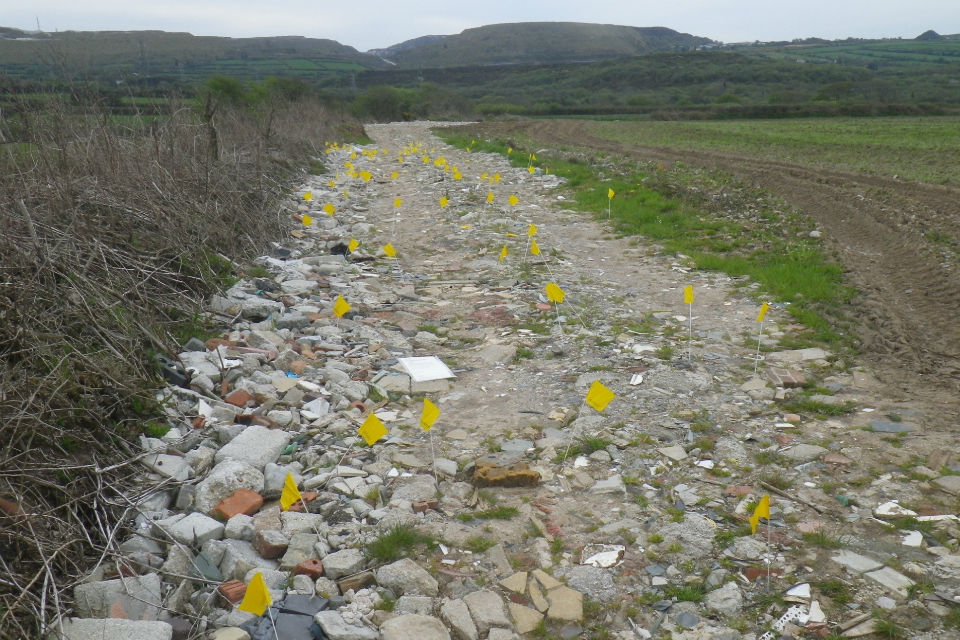
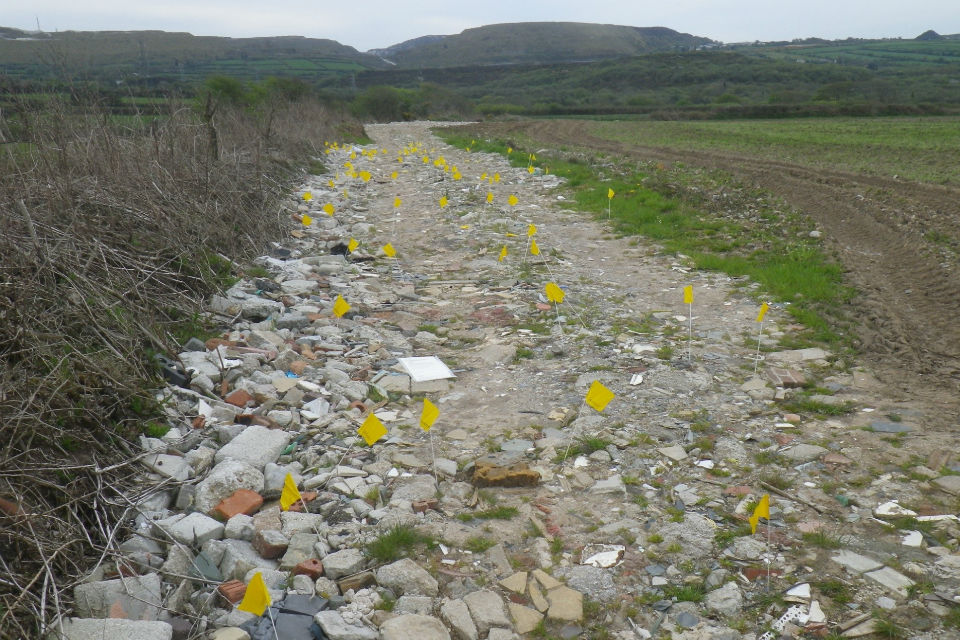
A farm track made of rubble and littered with little yellow flags
Each yellow flag in this farm track, made from waste supplied by Glebe Quarry Ltd, marks where asbestos was found

Matthew Lee of the Environment Agency said:

This case sends a clear message to those who put profit ahead of the environment and human health.

As a minimum, we expect waste companies who hold environmental permits to act legally and should set an example to others, but the behaviour in this case has fallen far short of exemplary.

Appearing before Truro Crown Court on 22 June 2018, Glebe Quarry Limited was fined £12,500 for offences under the Environmental Permitting (England and Wales) Regulations 2010, the Hazardous Waste (England and Wales) Regulations 2005, and the Environmental Protection Act 1990.

In addition to the financial penalty, the court ordered that Glebe Quarry Limited must proactively inform the Environment Agency which sites they are sending their waste to and they must also remedy the sites they have polluted.

If you see waste crime taking place report it by calling our incident hotline on 0800 80 70 60 or anonymously to Crimestoppers.

Link: Press release: Glebe Quarry Ltd AKA 1st Call Skips fined for supplying contaminated waste
Source: Environment Agency

Press release: Welsh language scheme to widen access to justice

  • staff and judicial vacancy adverts in Wales will be bilingual
  • programme covers prison, probation, legal and courts services

The Ministry of Justice (MOJ) has today improved the way services will be delivered in the Welsh language.

Approved by the Welsh Language Commissioner the scheme will cover each of the MOJ’s delivery bodies – Her Majesty’s Courts and Tribunals Service, Her Majesty’s Prison and Probation Service, the Legal Aid Agency, the Office of the Public Guardian, and the Criminal Injuries Compensation Authority. Each body will adopt their own version of the programme.

The Department will also now advertise vacancies for staff judges and magistrates in Wales bilingually and place adverts in Welsh language publications.

Ministry of Justice Permanent Secretary Richard Heaton said:

This change supports one of our most fundamental aims – making access to justice easier for everyone.

We listened carefully to the feedback from our public consultation and these improvements will allow us to deliver a service that works better for Welsh speakers.

Delivering our services in Welsh

We will deliver Welsh language services to the same quality and consistency as those provided in English, including by:

  • responding in Welsh to correspondence received in Welsh within the same timescale as correspondence in English
  • ensuring events in Wales are publicised in Welsh and that participants can contribute in Welsh
  • publishing Welsh language content on MOJ website

The scheme was developed following a public consultation with feedback from members of the public, businesses and legal professionals.

For more information on the Welsh Language Scheme visit GOV.UK.

Link: Press release: Welsh language scheme to widen access to justice
Source: Gov Press Releases

Press release: May 2018 Price Paid Data

This month’s Price Paid Data includes details of more than 83,400 sales of land and property in England and Wales that HM Land Registry received for registration in May 2018.

In the dataset you can find the date of sale for each property, its full address and sale price, its category (residential or commercial) and type (detached, semi-detached, terraced, flat or maisonette and other), whether it is new build or not and whether it is freehold or leasehold.

The number of sales received for registration by property type and month

Property type May 2018 April 2018 March 2018
Detached 18,060 16,728 20,144
Semi-detached 20,897 19,362 22,040
Terraced 22,363 20,714 23,036
Flat/maisonette 15,846 15,457 18,253
Other 6,263 6,147 6,811
Total 83,429 78,408 90,284

Of the 83,429 sales received for registration in May 2018:

  • 62,086 were freehold, a 2.4% fall on May 2017
  • 11,286 were newly built, a 12.9 % increase on May 2017

There is a time difference between the sale of a property and its registration at HM Land Registry.

Of the 83,429 sales received for registration, 21,349 took place in May 2018 of which:

  • 375 were of residential properties in England and Wales for £1 million and over
  • 215 were of residential properties in Greater London for £1 million and over
  • one was a residential property in Birmingham for more than £1 million
  • one was a residential property in Greater Manchester for more than £1 million

The most expensive residential sale taking place in May 2018 was of a detached property in the Royal Borough of Kensington and Chelsea, London for £15,750,000. The cheapest residential sales in May 2018 were of two properties in Rushden, East Northamptonshire for £9,500.

The most expensive commercial sale taking place in May 2018 was in the City of Westminster, London for £92,500,000. The cheapest commercial sale in May 2018 was in Stockport, Greater Manchester for £555.

Access the full dataset.

Notes to editors

  1. Price Paid Data is published at 11 am on the 20th working day of each month. The next dataset will be published on Friday 27 July 2018.
  2. Price Paid Data is property price data for all residential and commercial property sales in England and Wales that are lodged with HM Land Registry for registration in that month, subject to exclusions.
  3. The amount of time between the sale of a property and the registration of this information with HM Land Registry varies. It typically ranges between two weeks and two months. Data for the two most recent months is therefore incomplete and does not give an indication of final monthly volumes. Occasionally the interval between sale and registration is longer than two months. The small number of sales affected cannot be updated for publication until the sales are lodged for registration.
  4. Price Paid Data categories are either Category A (Standard entries) which includes single residential properties sold for full market value or Category B (Additional entries) for example sales to a company, buy-to-lets where they can be identified by a mortgage and repossessions.
  5. HM Land Registry has been collecting information on Category A sales from January 1995 and on Category B sales from October 2013.
  6. Price Paid Data can be downloaded in text, CSV format and in a machine-readable format as linked data and is released under Open Government Licence (OGL). Under the OGL, HM Land Registry permits the use of Price Paid Data for commercial or non-commercial purposes. However, the OGL does not cover the use of third party rights, which HM Land Registry is not authorised to license.
  7. The Price Paid Data report builder allows users to build bespoke reports using the data. Reports can be based on location, estate type, price paid or property type over a defined period of time.
  8. HM Land Registry’s mission is to guarantee and protect property rights in England and Wales.
  9. HM Land Registry is a government department created in 1862. It operates as an executive agency and a trading fund and its running costs are covered by the fees paid by the users of its services. Its ambition is to become the world’s leading land registry for speed, simplicity and an open approach to data.
  10. HM Land Registry safeguards land and property ownership worth in excess of £4 trillion, including around £1 trillion of mortgages. The Land Register contains more than 25 million titles showing evidence of ownership for some 85% of the land mass of England and Wales.
  11. For further information about HM Land Registry visit www.gov.uk/land-registry.
  12. Follow us: Twitter @HMLandRegistry our blog, LinkedIn and Facebook.

Contact

Press Office

Trafalgar House
1 Bedford Park
Croydon
CR0 2AQ

Link: Press release: May 2018 Price Paid Data
Source: Gov Press Releases

Press release: Six year ban for failing to keep company records

David Simpson Duffy was the sole director of Annick Structures Ltd (ASL), which traded as a construction and civil engineering company.

ASL was incorporated in 2012 and was ordered into compulsory liquidation in February 2016, following a petition by HMRC.

At liquidation, the company had an estimated deficiency to its creditors of over £900,000.

The investigation by the Insolvency Service, following the conclusion of the liquidation, found that from March 2014 to February 2016, Mr Duffy failed in his duty as a director to preserve or deliver up to the liquidator adequate accounting records for ASL, as he was required to do by law.

The result of which was that it was not possible to verify the true level of income and expenditure to and from the company bank account and specifically:

  • whether outstanding loans totalling £308,725 were collected for the benefit of the company or remained outstanding at liquidation
  • whether debtor sums totalling almost £35,000 and stock/Work in Progress sums totalling over £582,000 were collected for the benefit of the company
  • what the purposes were of transfers totalling £1.8 million and payments totalling £2.5 million related to

This was aggravated further by Mr Duffy’s failure to ensure that ASL prepared and filed annual accounts with Companies House, for the period to 28 February 2015.

Following the Insolvency Service investigation, Mr Duffy signed a six year undertaking, which was accepted on 11 May 2018.

The disqualification commenced on 1 June 2018 and is effective until 1 June 2024 and prevents Mr Duffy from directly or indirectly becoming involved, without the permission of the court, in the promotion, formation or management of a company or limited liability partnership for the duration of his ban.

Robert Clarke, Head of Company Investigation at the Insolvency Service said:

Directors have a duty to ensure that their companies maintain proper accounting records, and, following insolvency, deliver them to the office-holder in the interests of fairness and transparency.

Without a full account of transactions it is impossible to determine whether a director has discharged his duties properly, or is using a lack of documentation as a cloak for impropriety.

Notes to editors

Mr Duffy’s date of birth is June 1974. He was appointed as sole director of ASL on 13 June 2012 and remained in office until the date of liquidation.

Mr Duffy signed a 6 year Undertaking, which was accepted on 11 May 2018. The disqualification commences on 1 June 2018 and is effective until 1 June 2024.

A disqualification order has the effect that without specific permission of a court, a person with a disqualification cannot:

  • act as a director of a company
  • take part, directly or indirectly, in the promotion, formation or management of a company or limited liability partnership
  • be a receiver of a company’s property

Disqualification undertakings are the administrative equivalent of a disqualification order but do not involve court proceedings.

Persons subject to a disqualification order are bound by a range of other restrictions.

The Insolvency Service administers the insolvency regime, investigating all compulsory liquidations and individual insolvencies (bankruptcies) through the Official Receiver to establish why they became insolvent. It may also use powers under the Companies Act 1985 to conduct confidential fact-finding investigations into the activities of live limited companies in the UK. In addition, the agency deals with disqualification of directors in corporate failures, assesses and pays statutory entitlement to redundancy payments when an employer cannot or will not pay employees, provides banking and investment services for bankruptcy and liquidation estate funds and advises ministers and other government departments on insolvency law and practice.

Further information about the work of the Insolvency Service, and how to complain about financial misconduct, is available.

Contact Press Office

Media enquiries for this press release – 020 7674 6910 or 020 7596 6187

Press Office

The Insolvency Service


4 Abbey Orchard Street
London
SW1P 2HT

This service is for journalists only. For any other queries, please contact the Insolvency Enquiry line on 0300 678 0015.

For all media enquiries outside normal working hours, please contact the Department for Business, Energy and Industrial Strategy Press Office on 020 7215 1000.

You can also follow the Insolvency Service on:

Link: Press release: Six year ban for failing to keep company records
Source: Gov Press Releases