
Press release: Government acts to make ‘upskirting’ a specific offence

  • Government moves to make ‘upskirting’ a specific criminal offence
  • Worst perpetrators set to face two years in prison
  • Ministers demand the most serious offenders are placed on the sex offenders register

‘Upskirting’ is set to become a specific criminal offence, with perpetrators facing up to two years behind bars, under a new law backed by Government.

The highly intrusive practice – colloquially known as ‘upskirting’ – typically involves offenders taking a picture under a person’s clothing without them knowing, with the intention of viewing their genitals or buttocks.

Currently, this behaviour is being successfully prosecuted under the offence of Outraging Public Decency. However, ministers have decided to act after concerns were raised that potentially not all instances of ‘upskirting’ are covered by existing criminal law.

In April, the Justice Secretary David Gauke committed to ensuring the law was fit for purpose. Today, ministers have confirmed that the Government will support legislation to close any potential loopholes, in order to better protect victims and increase convictions.

Justice Minister Lucy Frazer said:

This behaviour is a hideous invasion of privacy which leaves victims feeling degraded and distressed.

By making ‘upskirting’ a specific offence, we are sending a clear message that this behaviour will not be tolerated, and that perpetrators will be properly punished.

I’d like to thank Wera Hobhouse, Gina Martin, and all other campaigners for their tireless work, and look forward to seeing the Bill progress through Parliament.

The measures were introduced in a Private Member’s Bill (PMB) by Wera Hobhouse MP. The Bill will receive its 2nd reading in the House of Commons today (15th June).

In recent years the Government has made tackling sexual abuse and sexual violence a priority, and keeps laws in this area under constant review. After listening carefully to the concerns of victims, stakeholders, and MPs from across the House, Ministers have decided a change in the law is necessary.

Wera Hobhouse MP said:

I got involved in politics to change things that my constituents and I care about. I am incredibly grateful to Gina Martin for starting this campaign, and for giving me the opportunity – in my first year in parliament – to do exactly that.

The fact that the government have listened to our calls is testament to the widespread consensus that there was a gap in the law that needed to be addressed. By working with Gina and Ministers on the detail of my bill, we have demonstrated when we work together successfully we can make a difference on issues that really matter to people.

We all made the case for common sense. Now if someone is to fall victim to upskirting, the law will recognise them as the victim, and the police will be able to act immediately and bring the perpetrators to justice.

Gina Martin said:

Almost a year ago, I started my campaign to make upskirting a sexual offence after I was targeted. I’ve been on an extraordinary journey since then. The inner workings of politics was a mystery to me, so I brought in my lawyer Ryan Whelan to help me create an argument that was legally sound and politically astute.

And now, the result of all that hard work is that women and girls who needed this law changed are now being heard by those in power. This has been a colossal undertaking for me personally and professionally, and I absolutely couldn’t have done it without Ryan and the incredible public behind me.

The new law would bring the punishment for ‘upskirting’ in line with other existing voyeurism offences, and the changes will see offenders face a maximum of two years in prison. The Government will now work with Wera Hobhouse and others to bring these measures through, with Ministers planning to ensure crucial amendments are made to the Bill. The most notable of these amendments includes placing the most serious offenders on the sex offenders register.

Katie Ghose, Chief Executive of Women’s Aid, said:

We welcome the government taking decisive action to make upskirting a criminal offence. This form of abuse is painful and humiliating for victims and often has a devastating impact on all aspects of their lives.

We hope that this new criminal offence will be another step forward in challenging the prevailing sexist attitudes and behaviours in our society that underpin violence against women and girls. Domestic abuse does not happen in a cultural vacuum.

By condemning this form of abuse, we can send out the powerful message that upskirting is unacceptable and perpetrators of this crime will be held to account.

Lisa Hallgarten, Head of Policy & Public Affairs for Brook, says:

Brook welcomes the Government’s recognition of the seriousness of upskirting as a move towards tackling the widespread incidence of sexual harassment of women and girls.

However, we know that the law alone is not enough and schools have a critical role in challenging harmful behaviours and practices by dealing with any issues promptly and in line with robust PSHE and safeguarding policies.

In order to keep children and young people safe from harm we must teach them at the earliest opportunity to respect each others’ privacy, to know their rights, and to understand issues around consent, coercion, and unwanted/unsafe touch.

Notes to editors

  • Currently, ‘upskirting’ does not go unpunished in England and Wales, and there have been successful prosecutions under the Outraging Public Decency (OPD) offence. Recent examples of successful prosecutions for ‘upskirting’ under OPD include someone who was convicted in January for taking photos up women’s skirts on trains, on a beach and at work, and a student who was convicted in March for taking photos up women’s skirts in Oxford.
  • However, existing criminal law does not necessarily cover every instance of ‘upskirting.’ Creating a specific ‘upskirting’ offence would strengthen the law in this area, as it doesn’t have the same limitations as existing offences. It would also allow this intrusive behaviour to be treated as a sexual offence and, with Government amendments, ensure that the most serious offenders are made subject to notification requirements (commonly referred to as the ‘sex offenders register’).
  • The PMB would insert a new offence under Section 67 of the Sexual Offences Act 2003. The changes will cover England and Wales; ‘upskirting’ is already a specific offence in Scotland.
  • It would capture instances where the purpose is to obtain sexual gratification or cause humiliation, distress or alarm.
  • A summary conviction would carry a sentence of up to one year in prison and/or a fine. And a more serious offence, tried in the Crown Court, would carry a sentence of up to two years in prison.
  • The Bill returns to Parliament for its 2nd reading on 15 June where the Government will formally give its support.

Link: Press release: Government acts to make ‘upskirting’ a specific offence
Source: Gov Press Releases
Press release: Government announces support for Finn’s Law campaign in Parliament

Courageous service animals such as police dogs and horses will be offered greater protection under a new law being backed by Government.

The Animal Welfare (Service Animals) Bill has been published in Parliament by Sir Oliver Heald MP and is scheduled for its second reading today (Friday 15 June).

It relates to the prominent Finn’s Law campaign, named after the police dog which was stabbed whilst pursuing a suspect with his handler PC David Wardell.

The proposed legislation will remove a section of the current law of self-defence, often used by those who harm a service animal.

This change, coupled with the government’s plans to increase maximum sentences for animal cruelty offences to five years in prison, will make sure those who harm service animals are punished accordingly.

Environment Secretary Michael Gove said:

This Bill will offer stronger protection for the many brave service animals that help to protect us. I pay tribute to PC David Wardell, Sir Oliver and all those who have campaigned for Finn’s Law.

This Government is continuing to raise the bar on animal welfare, whether it be for our beloved pets, brave service animals or on farms.

PC Dave Wardell, Finn’s Police Dog handler, said:

My boy Finn, now retired, was one of several thousand service animals that work to protect the whole of society 24 hours a day, everyday. When Finn was seriously injured it didn’t seem right to me or the public that he was seen as an inanimate object/property, in law.

This campaign and Bill is my way of saying thank you to Finn for saving my life and to the many others for the truly outstanding and brave work they do everyday.

With the amazing support of my MP, Sir Oliver Heald QC, a great working relationship with DEFRA was formed. Sir Oliver, along with Sarah Dixon and Nicola Skelley, have worked so incredibly hard to get us to the point we are at today. I would like to take this opportunity to thank them and DEFRA from my heart and from the thousands of supporters that our service animals have.

What you have done today will help protect our amazing service animals, animals we should be very proud of. It’s time for Finn’s Law

The Bill proposes amending the Animal Welfare Act 2006 to address concerns on an existing section where a defendant accused of causing unnecessary suffering to an animal can claim they were protecting themselves and justified in using physical force against a service animal.

Sir Oliver Heald MP, who presented the Bill, said:

I am delighted that the campaign for Finn’s Law has gained the support of the Government.

I’ve had productive meetings with Defra ministers on this Bill and am looking forward to its passage through Parliament. This is a good day for all of our brave service animals.

Nicola Skelley and Sarah Dixon, of the Finn’s Law Campaign, said:

We are absolutely delighted to receive and welcome the backing from DEFRA to Sir Oliver Heald’s amended Bill.

Throughout the Finn’s Law campaign we have been grateful to Lord Gardiner, in particular, for the respectful discussions he has held with Sir Oliver.

For too long have the Courts struggled with securing prosecutions for injuries intentionally inflicted on Police and Prison dogs and horses in particular.

We are looking forward to the 2nd reading of Sir Oliver’s Bill and we feel optimistic for a positive outcome. We will continue to work tirelessly towards securing protection for these animals.

Link: Press release: Government announces support for Finn’s Law campaign in Parliament
Source: Gov Press Releases

BS ISO 81346-12:2018 Industrial systems, installations and equipment and industrial products. Structuring principles and reference designations Construction works and building services

Technical documents
Identification methods
Documents
Graphic representation
Data processing
Designations
Graphical methods
Data management
Engineering drawings
Equipment safety
Codes
Graphic symbols
Function charts

Link: BS ISO 81346-12:2018 Industrial systems, installations and equipment and industrial products. Structuring principles and reference designations Construction works and building services
Source: BSI Standards

BS EN 62841-3-14:2017 Electric motor-operated hand-held tools, transportable tools and lawn and garden machinery. Safety Particular requirements for transportable drain cleaners

Cleaning equipment
Equipment safety
Electrically-operated devices
Transportable
Portable machine tools
Safety devices
Electrical safety

Link: BS EN 62841-3-14:2017 Electric motor-operated hand-held tools, transportable tools and lawn and garden machinery. Safety Particular requirements for transportable drain cleaners
Source: BSI Standards

BS EN ISO 18640-2:2018 Protective clothing for firefighters. Physiological impact Determination of physiological heat load caused by protective clothing worn by firefighters

Firefighting
Dimensional changes
Fire safety
Thermal resistance
Permeability
Heat transfer
Firefighting personnel
Design
Tear strength
Surface spread of flame
Wettability
Heat protection
Flameproof materials
Tensile strength
Marking
Protective clothing

Link: BS EN ISO 18640-2:2018 Protective clothing for firefighters. Physiological impact Determination of physiological heat load caused by protective clothing worn by firefighters
Source: BSI Standards

Press release: Rapist has sentence increased after Solicitor General’s referral

A man who attacked and raped a woman has today had his sentence increased after the Solicitor General, Robert Buckland QC MP, referred his sentence for being too low.

Samuel Simms, 45, attacked his victim before forcing her to the floor and raping her. Afterwards, in a conversation partially recorded by the victim, Simms threatened to kill both himself and the victim while gesticulating with a knife.

Simms was originally sentenced at Woolwich Crown Court in April, where he was given a sentence of 5 years’ imprisonment. Today, after the Solicitor General’s referral, the Court of Appeal increased his sentence to 8 years.

Commenting on the sentence increase, the Solicitor General said:

Simms subjected his victim to a callous attack which resulted in serious emotional trauma. The results of his actions will be long-lasting, and I hope that the increased sentence handed down today will more accurately reflect this.

Link: Press release: Rapist has sentence increased after Solicitor General’s referral
Source: Gov Press Releases

Press release: Welsh Secretary visits West Wales business success stories

From global denim brands favoured by Royalty to a gas terminal helping to boost the UK’s energy security, Secretary of State for Wales Alun Cairns has visited the west Wales coast today to meet members of the region’s workforce helping to drive the nation’s rural economy forward. (14 June).

The Secretary of State visited premium denim brand Hiut Denim Co – a label recently propelled into the global spotlight when the Duchess of Sussex wore one of their designs during a visit to Cardiff in January.

The Cardigan based family owned firm has since been flooded with worldwide attention and orders, sparking an imminent move to larger premises in the Ceredigion town later this year and a global order waiting list of three months.

The Secretary of State – who supported Hiut when they co-exhibited at London Craft Week with Danish furniture designers Carl Hansen & Son, was welcomed to the company’s HQ by David Hieatt. David founded the brand with his wife, Clare in 2011. Fiercely proud of their Welsh roots, the couple moved from London back to Cardigan and set about breathing life back into the town’s denim manufacturing history when it was home to clothing manufacturer, Dewhirst.

Mr Hieatt introduced Mr Cairns to the team of Grandmasters, so called due to their decades of denim experience at Dewhirst. Each are living examples of the company’s motto of “do one thing well” by singlehandedly crafting each pair of jeans for customers all over the world.

Secretary of State for Wales Alun Cairns said:

Hiut is a company that prides itself on doing one thing well – setting itself apart from the highly mechanised industry giants and helping to propel the ‘Made in Wales’ stamp around the world.

With its expansion plans and continued investment in the local economy, Hiut Denim Co is a shining example of a company looking to capitalise on the global demand for their goods – and showing how a little Welsh endeavour can go a long way.

The UK Government is ready to support any Welsh business looking to follow in their footsteps and take advantage of every opportunity available to them to grow and expand into new markets.

David Hieatt, co-founder of ‘Hiut Denim Co said:

Over the last six months, we have gone through the biggest growth period in the company’s life. We are already over 60% up on 2017. This is mostly thanks to the media coverage we received in December 2017 and, of course, since Meghan Markle was seen wearing our jeans in January.

Since then we have hired four new apprentices in the factory. We have also outgrown our current factory and will be moving to a larger factory in the next few weeks. We will be hiring more Grandmasters to work in the factory once we have the new factory up and running.

Hiut Denim Co. is a global denim company making jeans for the creative man and woman of the world. It’s quest is the same as was on day one: To get 400 people their jobs back.

We are fighting for the right to make. This is a maker town. We are passing those skills on to the next generation.

The Secretary of State also highlighted the region’s energy rich landscape with a visit to South Hook LNG Terminal in Milford Haven. The Terminal has been importing liquefied natural gas (LNG) from Qatar since it was fully commissioned in 2010. With capacity to process around 20% of the UK’s current natural gas needs, it is one of the largest terminals in Europe.

Alun Cairns added:

South Hook plays a crucial role in the fabric of Wales’ energy sector and the facility at Milford Haven is a key element in ensuring UK energy security. Employing just over 200 people in Milford Haven, with the vast majority coming from Pembrokeshire and Carmarthenshire, it is a key employer in the West Wales region.

Qatari investment in London, including the recent introduction of the daily Qatar Airways flight from Doha to Cardiff, shows that the UK is highly attractive to investors abroad, creating jobs and growth at home.

Rob Else, General Manager South Hook LNG Terminal said,

We were delighted to welcome the Secretary of State for Wales to our Terminal, where operational reliability is underpinned by the highest of safety standards.

Mr Cairns rounded off his day with a visit to the studios of Mumph Cartoons near Cardigan. While Wales’ reputation as a hotbed of creative and animation talent has been growing worldwide over recent years, Mal Humphreys has plied his trade as a full-time cartoonist since 1991 with his work gracing the pages of the broadsheets and S4C television screens.

Link: Press release: Welsh Secretary visits West Wales business success stories
Source: Gov Press Releases

Press release: Sea change for migrating smolts

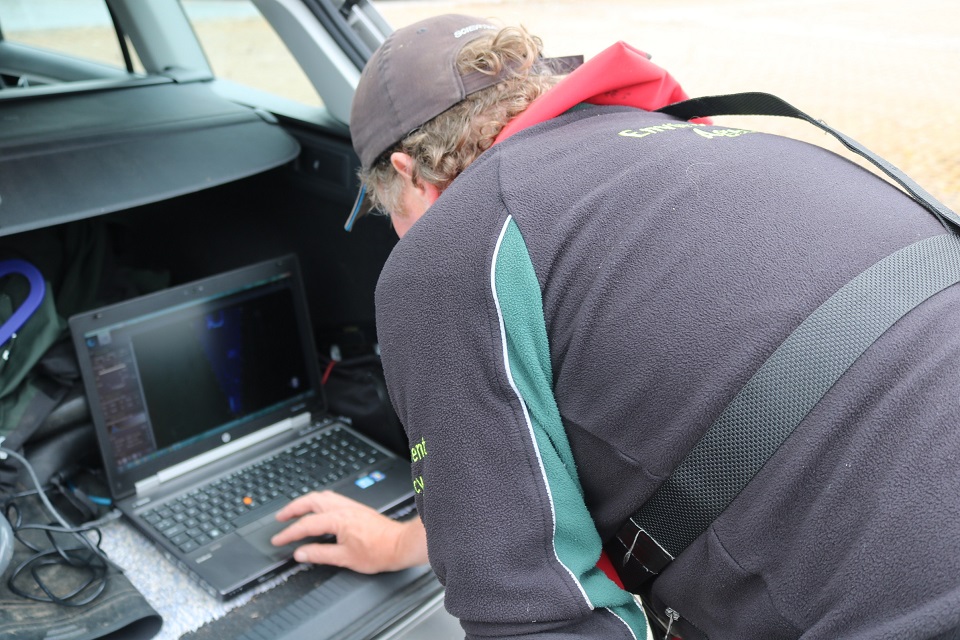
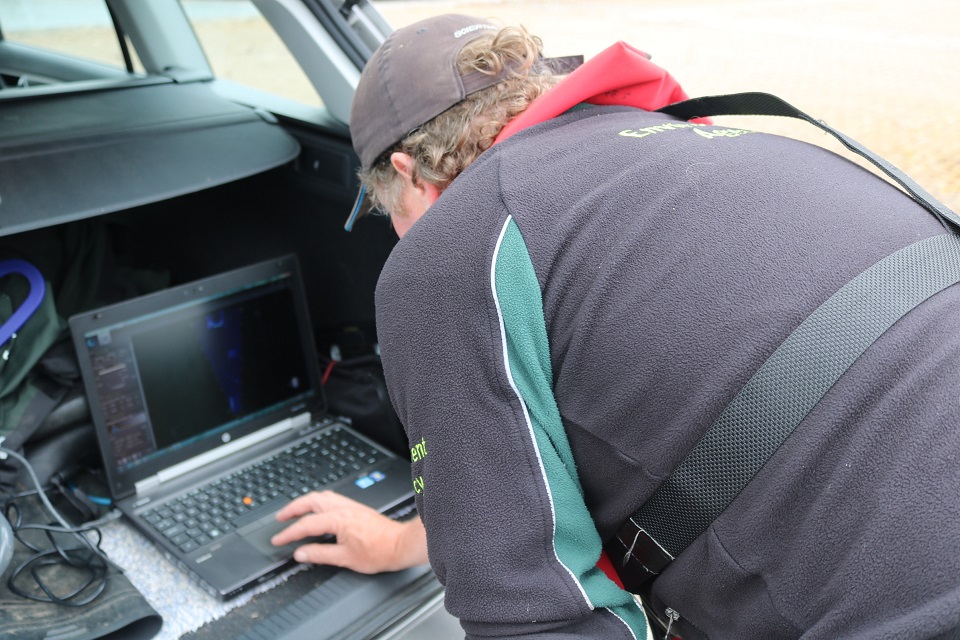
The Environment Agency has carried out underwater sonar surveys to check for young salmon using a new route across the Tees Barrage gates.

And the results show the juveniles – known as smolts – successfully making their journey from spawning grounds upstream out to sea.

It follows changes to the operation of the Tees Barrage in 2015, which means on every tidal cycle the gates are lowered to allow fish to pass both upstream and downstream.

Surveys have shown the barrage gates are the main route for salmon migrating upstream and the automation of the gates has resulted in an extra 1,500 hours per year of fish passage for returning adult salmon to reach their upstream spawning grounds.

It’s in addition to the other routes that salmon use including the Barrage’s navigation lock, the Denil fish pass, the fish pass in the white water rafting centre, and the main canoe slalom.

Image of Phil Rippon checking the sonar footage

Downstream migration improved

Phil Rippon, Fisheries Technical Specialist at the Environment Agency, said:

As well as improving the routes for returning adult fish we are also looking to improve the downstream migration of these precious fish and maximise the number of smolts reaching the North Sea.

By lowering the main barrage gates at set times, it means that as well as providing an additional upstream route for adult salmon we are providing a much easier route for the young salmon moving downstream as well. It is known that the sooner the smolts reach the sea the better their survival chances are, resulting in more returning adult fish.

Our recent work using an underwater sonar has shown large numbers of smolts using the gates to pass successfully downstream. It’s really positive to see yet more evidence that salmon are spawning upstream and these youngsters have been living in the river for up to 3 years before they move out to the sea.

Every year smolts, which are between 1 and 3 years old, leave the river to start their feeding migrations to the sea – travelling as far as Greenland – where they will spend up to three more years as an adult salmon before returning to the river to spawn.

Smolts are vulnerable throughout their migration and only around 5% of those that leave the river will return to spawn the next generation of salmon.

Underwater sonar footage of River Tees smolts crossing the Tees Barrage

Steering group

The Tees Barrage Fish Pass and Operation Steering Group, made up of Tees Barrage owners the Canal & River Trust, the Environment Agency, Angling Trust, Salmon & Trout Conservation Trust, Tees Rivers Trust, Industries Nature Conservation Association and Tees Barrage International White Water Centre, oversees the monitoring and research of fish and seal populations and carried out action to improve fish passage.

Research to understand the preferred routes through the barrage for fish and how to make it easier for them while reducing seal predation has been the focus of recent surveys.

Last year also saw the use of an acoustic deterrent device (ADD) to deter seals from entering the navigation lock, which showed promising results. Phil added:

We’re working really hard together with our partners to understand how fish naturally try to pass through the barrage and then to make it as easy as possible for them. We’ve changed the way the main gates and navigation lock operate to allow more fish passage, and we’ll be using an acoustic deterrent device again this summer.

We want as many fish as possible to make it upstream to their spawning grounds to ensure the River Tees continues to improve.


Link: Press release: Sea change for migrating smolts
Source: Environment Agency