Press release: Employment rate reaches another new record high

Figures released by the Office for National Statistics (ONS) show that 427,000 more people have moved into employment in the last year, with 32.26 million now in work. On average, 1,000 more people have entered employment every day since 2010.

The unemployment rate (4.2%) has not been lower since 1975, and the number of people out of work is down by 136,000 compared to a year ago.

In addition, as recognised by the ONS, wages are now outpacing inflation.
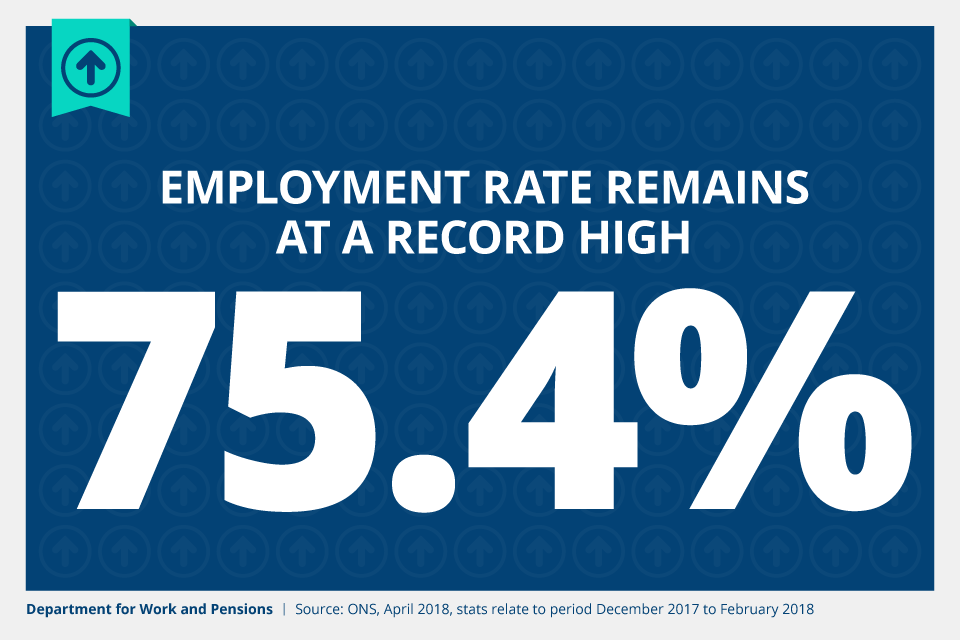
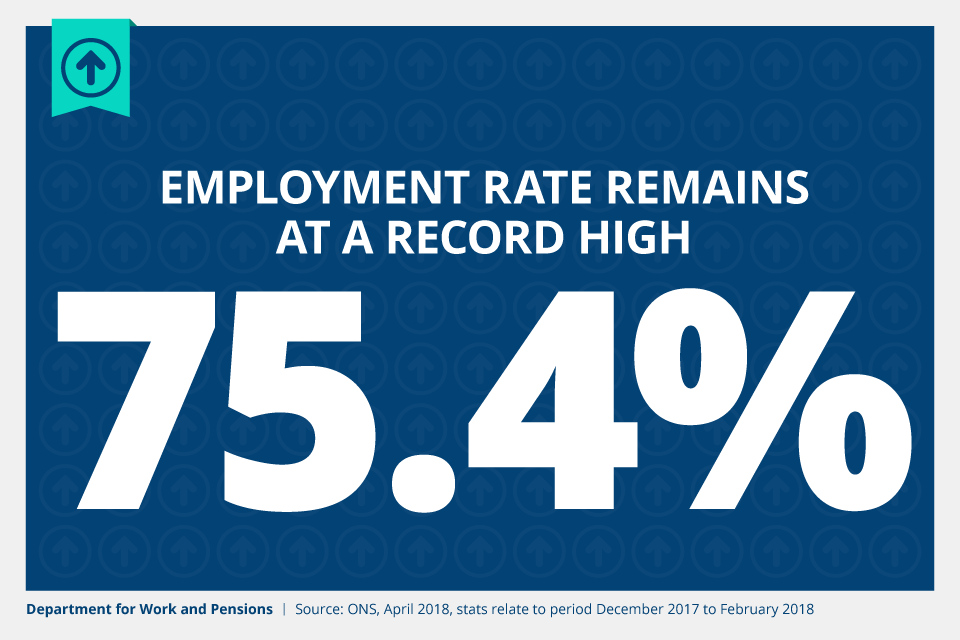
Employment rate remains at record high of 75.4%

The Secretary of State for Work and Pensions, Esther McVey, said:

Another milestone for employment has been reached under this government as employment reaches a record high, up 3.2 million since 2010 – the 16th time the employment record has been broken in the same period.

That means on average, over 1,000 people have moved into work every day since 2010, and credit has to be given to the businesses who have created those jobs and the individuals who are taking those opportunities.

Day by day we are helping people turn their lives round by getting into employment. Jobs are key to transforming lives and work is the best route out of poverty.

And this month we have again increased the personal allowance and taken more people out of paying tax all together making sure people can keep more of what they earn.

This comes as we have reformed welfare to make work pay, backed businesses to take more people on, and built a stronger, fairer economy. But we want to help even more people benefit from a well-paid job. That’s why we are:

  • improving the welfare system with Universal Credit, which helps people move into work faster and to stay in work longer than under the old system
  • introducing a modern industrial strategy to help businesses create better, higher-paying jobs in every part of the UK
  • helping people stay in work longer with our Fuller Working Lives strategy, which supports employers to recruit, re-train and retain older workers
  • tackling inequalities in employment highlighted by the Race Disparity Audit, through targeted support in 20 areas around the country and £90 million announced by the Prime Minister to help young people

Today’s employment figures also show:

  • there are 815,000 vacancies in the economy at any one time
  • the number of people in employment has increased by over 3.2 million since 2010
  • the UK has the third highest employment rate in the G7
  • the number of workers aged 50 or over has reached a record 10.1 million
  • youth unemployment level has fallen by over 40% since 2010
  • the proportion of young people who are unemployed and not in full time education is 5.1%, a fall of 3.9 percentage points since 2010
  • more than 820,000 people are now receiving Universal Credit, with 38% in employment

More information

Read the Labour Market Statistics – April 2018 from the Office for National Statistics.

Contact Press Office

Press Office

Caxton House

Tothill Street
London
SW1H 9NA

Follow DWP on:


Link: Press release: Employment rate reaches another new record high
Source: Gov Press Releases

Press release: PM meeting with Prime Minister of Jamaica: 17 April 2018

A Downing Street spokesperson said,

The Prime Minister had a bilateral meeting with the Jamaican Prime Minister Andrew Holness earlier today.

The Prime Minister said Jamaica was a key Commonwealth partner, with over 800,000 members of the Jamaican diaspora residing in the UK and over 200,000 Britons visiting Jamaica each year.

The Prime Minister said she deeply valued the contribution made by the Windrush generation and all Commonwealth citizens who have made a life in the UK, and that the UK Government would ensure the correct support was in place to give people certainty about their existing right to reside here. They looked forward to the meeting later this morning with heads of delegation from Commonwealth Caribbean countries where the matter will be discussed and the Prime Minister will have further opportunity to listen to concerns.

They discussed climate change and migration and agreed that the UK and Jamaica would continue to cooperate closely on disaster preparation ahead of hurricane season, on tackling serious and organised crime, and on healthcare training and education.

They agreed the bilateral trade and investment relationship would continue to grow, with the Prime Minister noting that as we leave the European Union, we are encouraging British businesses to look more widely around the world to identify opportunities to expand and diversify trade. They agreed that economic development and the provision of opportunities for the many young people in the region was key to Caribbean security.

Link: Press release: PM meeting with Prime Minister of Jamaica: 17 April 2018
Source: Gov Press Releases

Press release: G7 leaders: statement on chemical weapons use in Syria

We, the G7 Leaders of Canada, France, Germany, Italy, Japan, the United Kingdom, the United States of America and the European Union, are united in condemning, in the strongest possible terms, the use of chemical weapons in the April 7 attack in Eastern Ghouta, Syria.

We fully support all efforts made by the United States, the United Kingdom and France to degrade the Assad regime’s ability to use chemical weapons and to deter any future use, demonstrated by their action taken on April 13. This response was limited, proportionate and necessary – and taken only after exhausting every possible diplomatic option to uphold the international norm against the use of chemical weapons.

Use of chemical weapons is a breach of the Chemical Weapons Convention and constitutes a threat to international peace and security. The repeated and morally reprehensible use of chemical weapons by the Assad regime in the past has been confirmed by independent international investigators. We condemn this deliberate strategy of terrorizing local populations and forcing them into submission. Syria’s possession of chemical weapons and their means of delivery are illegal under UN Security Council Resolution 2118 and the Chemical Weapons Convention. We stand together against impunity for those who develop or use these weapons, anywhere, anytime, under any circumstances.

We remain committed to a diplomatic solution to the conflict in Syria. We commend and support UN Special Envoy de Mistura’s efforts towards an inclusive and credible political transition in accordance with UN Security Council Resolution 2254 and the Geneva Communiqué.

Link: Press release: G7 leaders: statement on chemical weapons use in Syria
Source: Gov Press Releases

Press release: Devolved Brexit legislation referred to the Supreme Court

The UK Government’s senior Law Officers, the Attorney General and the Advocate General for Scotland, are referring EU exit legislation passed in the Scottish Parliament and the National Assembly for Wales to the Supreme Court.

They are asking for a ruling on whether this legislation is constitutional, and properly within devolved legislative powers. The legal power to refer devolved legislation to the Supreme Court for a ruling on its constitutionality – as set out in the Devolution Acts – is exercisable by the Law Officers in the public interest.

Announcing the decision, the Attorney General, Jeremy Wright QC MP said:

This legislation risks creating serious legal uncertainty for individuals and businesses as we leave the EU. This reference is a protective measure which we are taking in the public interest. The Government very much hopes this issue will be resolved without the need to continue with this litigation

The two Bills – the UK Withdrawal from the European Union (Legal Continuity) (Scotland) Bill, and the Law Derived from the European Union (Wales) Bill – passed through the Scottish Parliament and Welsh Assembly on 21 March this year.

The reference is made to the UK Supreme Court under powers conferred by the Scotland Act 1998 and the Government of Wales Act 2006, which provide the Law Officers with discretion to ask the Supreme Court to consider whether legislation passed by the devolved legislatures is within their respective legislative competence. These powers allow the Law Officers to fulfil their unique constitutional duties to uphold the rule of law and the boundaries of the devolution settlements.

The European Union (Wales) Bill and the UK Withdrawal from the European Union (Legal Continuity) (Scotland) Bill cover very similar ground to the EU(Withdrawal)Bill currently before Parliament but with significant differences in terms of the EU law that is retained and the processes by which it can be amended. To leave these pieces of legislation on the statute book would create very significant legal uncertainty as to how the law would operate.

Link: Press release: Devolved Brexit legislation referred to the Supreme Court
Source: Gov Press Releases

Press release: UK is making sure one million girls across the Commonwealth get a quality education

Almost one million vulnerable and marginalised girls in developing countries across the Commonwealth will receive the life-changing education they need to become the thinkers and leaders of the future, the Prime Minister announced today (Tuesday 17th April).

130 million girls around the world are missing out on school, and in Sub-Saharan Africa fewer than 1 in 20 poor, rural girls are on track to complete secondary school.

DFID’s Girls Education Challenge will make sure 920,000 girls continue their education through primary, secondary school and training, so they can fulfil their potential to play a transformational role in their communities, economies and political institutions.

Today’s announcement will also give a further 53,000 adolescent girls in developing countries across the Commonwealth, who have never attended or dropped out of school due to poverty, motherhood, disability or conflict, a second chance to learn through catch-up classes and vital skills training.

DFID is also launching a new research partnership with the Malala Fund and the UN Girls’ Education Initiative (UNGEI) to help governments better harness their own resources to break down barriers to education for the most marginalised girls.

International Development Secretary Penny Mordaunt said:

Girls across the Commonwealth have huge potential to be the world’s next generation of problem-solvers, innovators and leaders.

But too many girls are still missing out on school. That’s why the UK is working with our Commonwealth partners to make sure that every girl receives the life-changing quality education they need to achieve their full potential.

Getting girls into school, and then into good employment, allows them to play a transformational role lifting their communities out of poverty, growing their economies and shaping the future of their countries.

The Girls Education Challenge is making it easier and safer for girls to get to school, training and equipping good quality teaching staff, and working with communities and families to raise awareness of the vital importance of educating girls.

Through its new Policy Lab, the UK is also sharing its world-class education expertise, to support the Commonwealth to work together to deliver for girls.

Notes to editors

DFID is committing £212 million to provide almost one million vulnerable and marginalised girls in developing countries across the Commonwealth with 12 years of quality education so that they can fulfil their potential. The second phase of DFID’s Girls Education Challenge (£212 million) will:

  • Ensure 920,000 girls in Commonwealth countries transition through primary and secondary school and training so that they can get good jobs, support themselves and their families, and play a role in the growth of their countries.
  • Give 53,000 highly marginalised adolescent girls in Commonwealth countries, who have never attended or dropped out of school as a result of poverty, early marriage and pregnancy, disability or conflict, a second chance to learn literacy, numeracy and other vital life skills.
  • Launch a new Policy Lab to bring the UK’s world-class expertise to work in partnership with other countries and help Commonwealth countries deliver for girls – supporting developing countries to ultimately become self-sufficient and provide quality education. This will begin with a pilot of five countries.

DFID is also launching a new research partnership with the Malala Fund and the UN Girls’ Education Initiative (UNGEI) to help governments better harness their own resources to break down barriers to education for the most marginalised girls so they can progress through primary and secondary education.

Through the first phase of the Girls’ Education Challenge (GEC I) UK aid:

  • Supported over a million marginalised girls to get a quality education. Through the second phase of the GEC we will support the vast majority of these girls to continue with their learning through secondary school and training to give them the opportunity to complete a full 12 years of education.
  • Benefitted many more girls and communities through 37 different projects in 18 countries across Africa and Asia, many operating in conflict and crisis settings

This is just one part of DFID’s education work. In 2015-2017 DFID supported 7.1 million children to gain a decent education. This included at least 3.3 million girls.

General media queries

Follow the DFID Media office on Twitter – @DFID_Press

Link: Press release: UK is making sure one million girls across the Commonwealth get a quality education
Source: Gov Press Releases