
Data Protection Bill [HL]: Written Evidence: Open Rights Group and the3million (DPB25)
Link: Publication: Written Evidence: Open Rights Group and the3million (DPB25)
Source: Data Protection Bill
Data Protection Bill [HL]: Written Evidence: Open Rights Group and the3million (DPB25)
Link: Publication: Written Evidence: Open Rights Group and the3million (DPB25)
Source: Data Protection Bill
The figures from the latest National Diet and Nutrition Survey (NDNS) collected from 2014 to 2016 show:
The survey confirms the UK population continues to consume too much saturated fat and not enough fruit, vegetables, and fibre:
Dr Alison Tedstone, chief nutritionist at PHE, said:
Poor diets are all too common in this country and, along with obesity, are now one of the leading causes of disease such as cancer, heart disease and type 2 diabetes. It’s clear from these data that the nation’s diet needs an overhaul.
A healthy balanced diet is the foundation to good health. Eating 5 A Day and reducing our intake of calories, sugar, and saturated fat is what many of us need to do to reduce the risk of long term health problems.
The data underscores PHE’s call for the population to follow a healthy balanced diet, based on the Eatwell Guide, which includes eating at least 5 portions of a variety of fruit and vegetables per day, increasing consumption of oily fish and fibre and limiting the amount food high in saturated fat, sugar and salt.
Following a healthy, balanced diet and reducing calories will help reduce obesity and the economic and social burden of its consequences.
The NDNS rolling programme is a continuous cross-sectional survey, designed to assess the diet, nutrient intake and nutritional status of a representative sample of around 1,000 people per year (500 adults and 500 children) from the general population aged 18 months upwards living in private households in the UK. The NDNS comprises an interview, a 4-day diet diary and collection and analysis of blood and urine samples. Results are used by government to monitor the diet and nutritional status of the population, to provide the evidence base for policy development and to track progress towards public health nutrition objectives such as reducing sugar, saturated fat and salt intakes. This report covers data collected over a 2-year period – from year 2014 to 2015 to year 2015 to 2016.
Work to deliver years 7 and 8 of the NDNS rolling programme was carried out by NatCen Social Research and the Medical Research Council Elsie Widdowson Laboratory (formerly known as MRC Human Nutrition Research).
The last NDNS report covering years 5 and 6, (2012 to 2013; 2013 to 2014) was published in 2016.
Reference to poor diets being one of the leading causes of disease: Newton JN et al (2014) – Changes in health in England, with analysis by English regions and areas of deprivation, 1990 to 2013: a systematic analysis for the Global Burden of Disease Study 2013. Lancet 386(10010):2257-74.
The Scientific Advisory Committee on Nutrition (SACN) advice is to limit free sugars to no more than 5% of daily calorie intake:
Public Health England exists to protect and improve the nation’s health and wellbeing, and reduce health inequalities. We do this through world-leading science, knowledge and intelligence, advocacy, partnerships and providing specialist public health services. We are an executive agency of the Department of Health and Social Care, and a distinct organisation with operational autonomy. We provide government, local government, the NHS, Parliament, industry and the public with evidence-based professional, scientific expertise and support. Follow us on Twitter: @PHE_uk and Facebook: www.facebook.com/PublicHealthEngland.
Link: Press release: PHE publishes latest data on nation’s diet
Source: Gov Press Releases
As the £1.5bn project enters its second year of construction at full speed, the team this week found out that they have been shortlisted the 2018 Construction News Awards 2018 in the Supply Chain Excellence category.
This nomination to a top industry award comes after the recent news that the team won the BIM Show Live 2018 Award in the Information Management category (on 27 February 2018). Earlier last year, the team also won the Highways Award 2017 for Team of the Year – Procurement & Supply Chain, and the Judges overall winner award.
The project, which will see 21 miles of A14 in Cambridgeshire upgraded to three lanes in each direction (four between Bar Hill and Girton), is continuing to progress to its challenging schedule to open to traffic by the end of 2020 despite the recent severe weather. It is doing so while being recognised as leading the way in the construction industry.
David Bray, A14 project director at Highways England, says:
Since it was given the go ahead by the Secretary of State for Transport in May 2016, the A14 Cambridge to Huntingdon improvement scheme has been leading the way in the road construction sector in many ways.
The way the project delivery team is set up in itself is unique – one big team delivering all the construction packages as one. We’re matching each project milestone with the best team to deliver it, drawing from specialist areas across all contractors working on the scheme.
This means we’re making the most of the expertise at our disposal and it has already been paying off across the board.
The project’s environmental team, which is continuing its work to create 18 wildlife habitats as part of the scheme covering a total of 271 hectares of new habitat by the time the scheme is completed, has received a lot of attention from the public over the past few months.
The A14 upgrade aims to leave a positive footprint on the local environment when it is complete by the end of 2020.
David explains:
Thanks to the publication of the team’s high-standard work via the media earlier this year, the team was nominated by the public for this year’s BBC Countryfile Award in the Conservation Success of the Year category. Even though we didn’t win the award, being one of five finalists nationwide is still an amazing achievement!
Another aspect in which the A14 upgrade is a trailblazer for the construction industry is via the Considerate Constructors Scheme (CCS). For the past 18 months, the project has been one of 12 pilot ‘Ultra Sites’ – the first major road infrastructure project to be recognised as such. This has meant that we’ve helped CCS develop and refine the initiative, which has been an invaluable opportunity for the team.
The Ultra Sites initiative, which was launched on 14 February 2018, demonstrates and promotes the highest standards of considerate construction. Ultra Sites actively seek to become beacons of best practice in the construction industry and a catalyst for exceptional leadership, collaboration and innovation. To find out more, visit the Considerate Constructors Scheme website.
We’ve also taken community engagement very seriously right from the start
using as many ways as possible to communicate with people living along the A14 in South Cambridgeshire and beyond. We’ve been using a mobile visitor centre, social media, newsletters, and more to give people a chance to find out more, get involved or even gain skills, get a job or secure funding for community projects. And we’re also planning to open our doors to the public soon!
On Saturday 24 March, the project team will participate in the nationwide ‘Open Doors – Get in to Construction’ initiative, welcoming people to visit one of the project’s three compounds. There will be opportunities to talk to the team to find out more about what it takes to build such a huge road project, as well as come out on a guided tour of the project’s construction site. Places are limited and can be booked via the Open Doors website.
The A14 Community Fund has also been very successful in helping the local community forge meaningful links with the road upgrade. The A14 Writer in Residence project led by the University of Cambridge Institute of Continuing Education, which secured funding from the Community Fund last year, has now concluded. A collection of writing inspired by the road called A14 Voices was published on 11 March 2018. The 120-page book contains poems, letters, fiction and short stories from people who live locally.
David Bray continues:
A lot has happened since the construction phase of the project reached its first anniversary at the end of November last year.
Nearly 40 percent of the project’s main construction work has been successfully completed and work is currently focusing on the scheme’s 34 bridges and structures while winter continues, marking a pause in the earth works side of the project.
Giant steel beams have been delivered steadily to site since the end of December and many have now taken up their permanent positions on a number of bridges near Huntingdon, including the bridge over the East Coast Main Line train line and a bridge near Brampton Hunt junction which will carry the future A14 over the A1. The 750m long River Great Ouse viaduct, with its 17 spans of piling, has also seen seven of its spans fitted with steel beams, with the rest to come between now and this summer.
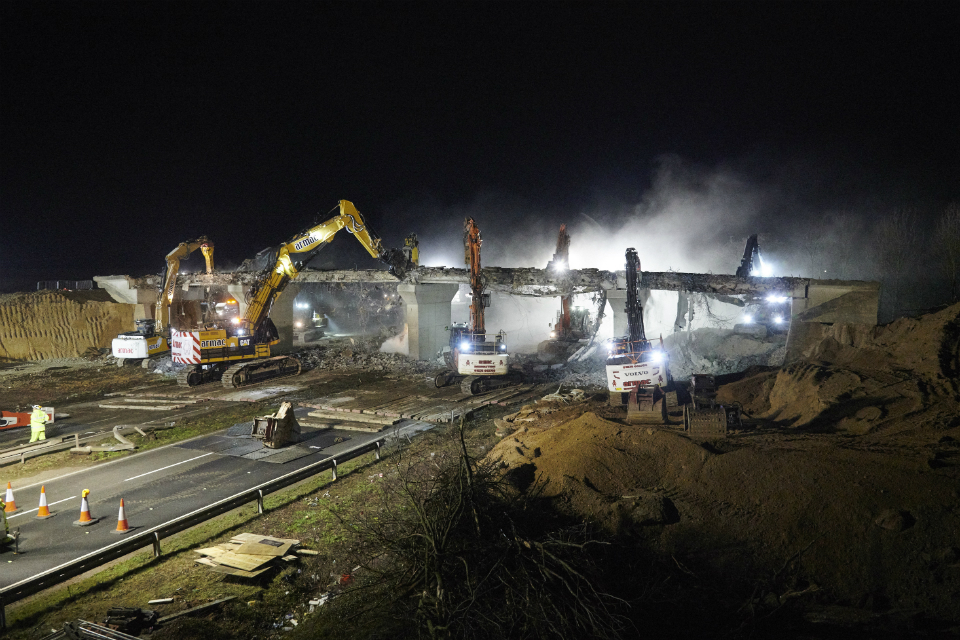
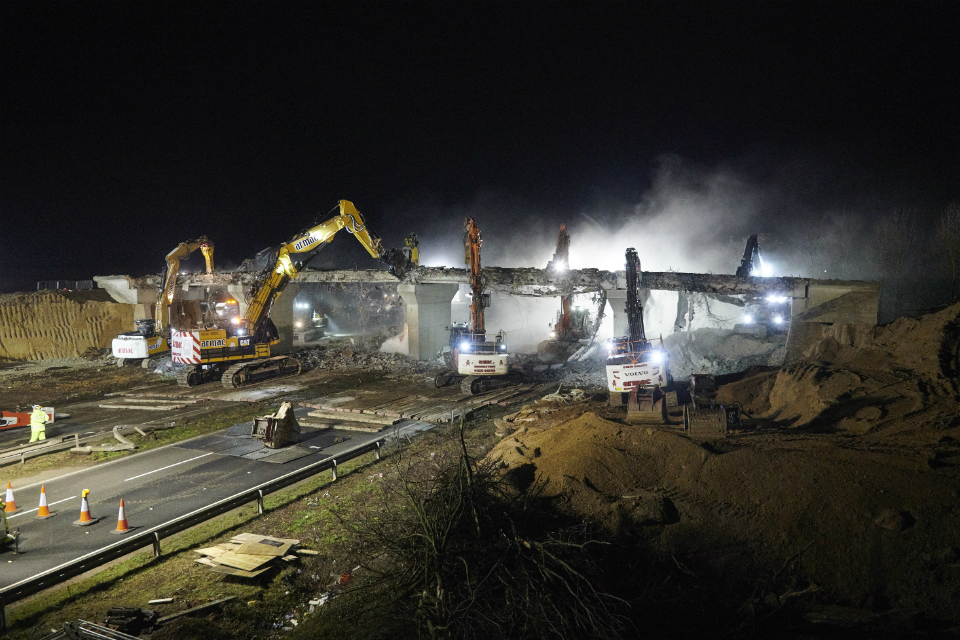
And a second bridge was opened to traffic in February: the Brampton Road bridge over the A1, linking Brampton and Grafham. The old bridge it replaces was demolished that same week in just under 19 hours.
We will start the new earth works season as soon as the weather turns milder and drier.
By the time the project is completed at the end of 2020, we will have moved ten million cubic metres of earth across site, equivalent to 4,000 Olympic swimming pools, to build the foundations for the new road. Last year, we moved a quarter of that amount.
This second year of construction will see yet more project milestones reached as well as work starting on new sections of the scheme’s 21 miles of road upgrade. A crucial but challenging part of the project will be the redesign of the Bar Hill junction, on which we will start work after Easter.
We need to build a completely new junction which will span eight lanes of A14 traffic as well as link with the future local access road – at the exact location of the old bridge, which is still being used by traffic every day. This will mean some disruption to local residents at times, though we are planning the work to minimise impact as much as possible and will make sure people are kept informed so they can plan ahead.
More information about work at the Bar Hill junction will be available in the coming weeks.
Other work planned for the coming months includes the installation of beams across the A14 at Swavesey as part of the redesign of the Swavesey junction, where the current path of the A14 veers off to the south marking the start of the future Huntingdon southern bypass.
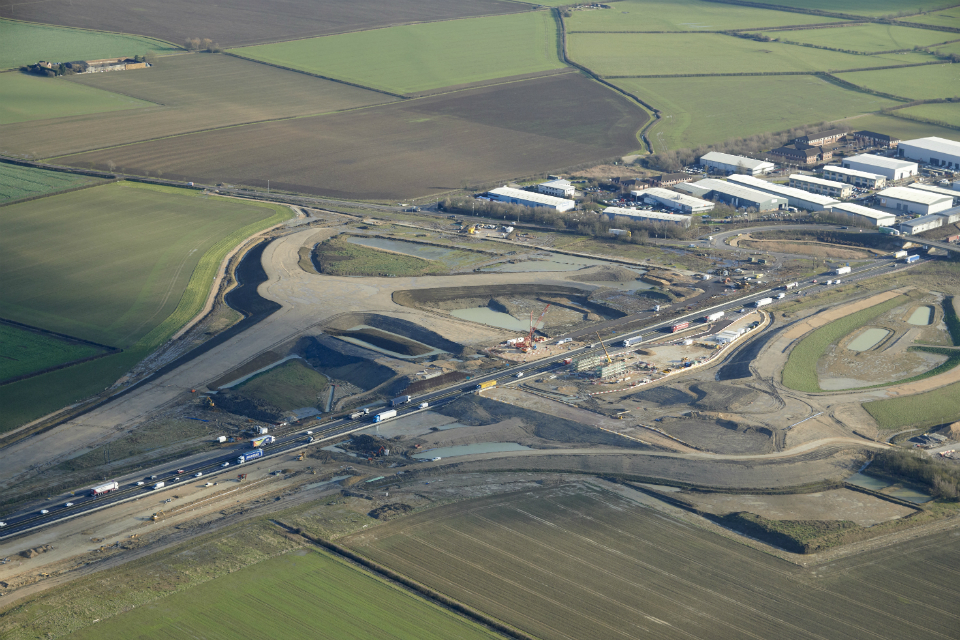
Work to widen the A1 from two to three lanes in each direction near Alconbury has also been progressing well and a section of the new southbound carriageway is planned to open to traffic by Easter.
David concludes:
Once again, I’d like to take this opportunity to thank all the roads users and local residents who use or live near the A14 for their patience.
We’re continuing to make great progress and the support we are getting from people locally means a lot to us.
The improvements we are delivering between Cambridge and Huntingdon are vital for the local area and for the country’s economy and we’re doing our best to make sure they are delivered to the highest standard, leading the way and showcasing best practice for future road investment projects as well as building a positive legacy for when the project is completed.
For the latest information about the A14 Cambridge to Huntingdon improvement scheme, including job and training opportunities, visit the scheme web page follow @A14C2H on Twitter and like our Facebook page at www.facebook.com/A14C2H/.
Members of the public should contact the Highways England customer contact centre on 0300 123 5000.
Journalists should contact the Highways England press office on 0844 693 1448 and use the menu to speak to the most appropriate press officer.
Link: Press release: Second year opens on a high for A14 Cambridge to Huntingdon upgrade
Source: Gov Press Releases

The company is using its presence at the Big Bang Fair 2018 to encourage young people to take up three challenges to test their engineering skills.
One is a gaming challenge asking 11-14 year olds how they would connect two separated communities.
A second invites young Fair visitors to try their hand at being a Traffic Officer, and the third tests their maths skills to work out the right speed limits to use on motorways to keep traffic moving smoothly.
Highways England’s Early Talent Specialist Charlotte Potter said:
Engineering is an exciting career and we are encouraging more children to become the engineers of the future. Our three challenges on our stand at the Big Bang Fair show the variety of work we do, from major projects to connect communities to the daily job of keeping our roads flowing. We hope young people will be inspired by the variety of roles we offer and look to Highways England as an employer.

The Big Bang UK Young Scientists & Engineers Fair, taking place until 17 March at the NEC, Birmingham, is a celebration of science, technology, engineering and maths (STEM) for young people in the UK, attracting thousands of visitors each year.
Highways England needs a continuing pipeline of young engineers to help deliver the massive investment planned for the country’s motorways and major A-roads, benefitting the economy and improving people’s lives. Over the next few months the company will be taking on 75 apprentices and 35 graduates.

The Highways England driver simulator will test participants’ awareness skills as they use this technology and real-life scenarios to experience life on the road. Could they make it as a Traffic Officer to access the incident safely and quickly?
Highways England has developed a gaming challenge for children to try and solve. The task is a classic engineering problem; connecting two separated communities with either a bridge or tunnel. But how will they do it?
Highways England has devised a maths-based activity around traffic flow data to demonstrate how variable speed limits are needed on motorways to smooth the flow of traffic.
To find out more about the roles, apprenticeships or graduate placements within Highways England, and sign up for e-mail alerts visit Highways England’s careers homepage.
Members of the public should contact the Highways England customer contact centre on 0300 123 5000.
Journalists should contact the Highways England press office on 0844 693 1448 and use the menu to speak to the most appropriate press officer.
Link: Press release: Highways England encourages young people into engineering
Source: Gov Press Releases
Dstl, part of the Ministry of Defence, has teamed up with UK Naval Engineering Science and Technology (UKNEST) and the Women’s Engineering Society (WES) to pilot the STEM Returners programme. The programme is aimed at giving experienced science, technology, engineering and maths (STEM) professionals the confidence to step back into their careers after time taking off or the opportunity to transfer into another field.
Natalie Desty from the STEM Returners programme, said:
The science and engineering industry has a shortage of skilled workers, but many highly qualified and experienced people are struggling to get back into work. We want to change employers’ perceptions of CV gaps, remove barriers to returning to work and ensure the widest possible pool of talent is being considered for jobs.
For example, female professionals returning from career breaks are often underemployed, with three in five likely to move into lower-skilled or lower-paid roles.
The Dstl pilot is open to any gender and offers individuals a paid 12-week placement, where they will work on challenging projects that make a real difference to the UK’s defence and security. Successful applicants could work in areas such as platform systems, cyber and information systems, or defence and security analysis. Placements are also available with the Defence and Security Accelerator, which manages the £800 million Defence Innovation Initiative.
As well as contributing to exciting and rewarding projects, the programme offers
1-to-1 mentoring, networking opportunities and further career support.
Helen Christie, Dstl Resourcing Specialist said:
We’re thrilled to be involved in the STEM Returners programme and help break down barriers people face when coming back to work. Dstl has long been committed to a flexible and supportive workplace so that talented people of all backgrounds and circumstances can thrive here and contribute to our country’s national security.
While we can’t guarantee a permanent position with Dstl at the end of the placement, it’s equally important that the wider science and engineering community is full of skilled and experienced people. About half of Dstl’s work is delivered externally through industry, universities, and small-and-medium-sized enterprises, so we rely on being able to collaborate with STEM workers all over the UK. We hope by participating in the programme, we can help grow the STEM workforce.
Dstl is also part of the STEM Futures consortium, which is proud to embrace the STEM Returners programme as part of its overall intent to develop talent while actively championing diversity and inclusion.
Interested? Apply now.
Link: Press release: Return-to-work placements for scientists and engineers at Dstl
Source: Gov Press Releases
As we near the end of British Science Week, we’re sharing how the Institute of Safety in Technology and Research’s (ISTR) commitment to managing risk and keeping pace with change as part of their contribution to Help GB Work Well, has led to the delivery of internationally-significant research.
Link: Help GB Work Well case study highlights ISTR’s new research for working with arthropods
Source: Health and Safety
Data Protection Bill [HL]: Committee Debate: 3rd sitting
Link: Publication: Committee Debate: 3rd sitting
Source: Data Protection Bill
Data Protection Bill [HL]: Committee Debate: 4th sitting
Link: Publication: Committee Debate: 4th sitting
Source: Data Protection Bill
A No 10 spokesperson said:
The Prime Minister spoke to the Prime Minister of Australia, Malcolm Turnbull, this morning about the attack on Sergei Skripal and his daughter and the reckless endangerment of the British public through the use of a military grade nerve agent developed by Russia.
Prime Minister Turnbull said he joined the Prime Minister in her condemnation of the appalling act and expressed his complete solidarity with the UK and its response to the attack.
The Prime Minister explained how she had visited the site at Salisbury yesterday and reiterated how the act represented an unlawful use of force by the Russian state against the UK.
On the UK’s response, she explained how it will expel 23 Russian diplomats who have been identified as undeclared Russian intelligence officers, develop new legislative powers to harden our defences against such hostile activity and suspend all planned high-level contacts between the UK and the Russian Federation.
She thanked Prime Minister Turnbull for his strong support and they agreed on the importance of the international community coming together to take a stand against this despicable act.
Link: Press release: PM call with Prime Minister Turnbull: 16 March 2018
Source: Gov Press Releases
Debate begins with the Refugees (Family Reunion) (No. 2) Bill
Link: Commons Private Members' Bills: 16 March 2018
Source: Parliamentary News