
Press release: £29 million extra to boost councils’ support for vulnerable children

Councils in England will receive an additional £29 million to boost their support for unaccompanied asylum seeking children (UASC) and care leavers, Secretary of State for Housing, Communities and Local Government Sajid Javid confirmed today (16 January 2018).

Today’s funding builds on the work government is already doing through its safeguarding strategy to address the specific challenges faced by some of the most vulnerable children in society, and the professionals who care for them.

This funding will enable some councils to step up their support by providing homes for asylum seeking children that are currently resident in other local authorities that are operating at full capacity.

It will also allow councils to reduce local resource pressures to the benefit of their wider communities.

Communities Minister Lord Bourne said:

We have a proud history of hosting, supporting and protecting those in need, including some of the most vulnerable children. This new funding will enable more councils across England to provide support to those children who need a place to call home.

The funds will also bring a range of benefits to the whole community by increasing the number of foster carers available and reducing pressures on existing services.

We are grateful to councils who continue to provide care and support to vulnerable children, and it’s encouraging to hear of the enthusiasm among councils in welcoming more children to their areas, especially where they haven’t had an opportunity to do so previously.

Today’s announcement of £29 million will increase capacity to support asylum-seeking children and builds upon government’s existing projects around refugees and migration, including:

  • The £100 million Controlling Migration Fund to alleviate pressures on local services such as housing, education and health services resulting from recent migration. Many of the projects funded also support migrants to integrate into their communities, for example by providing English language classes. £16 million from the Controlling Migration Fund is included in the total announced today.
  • We increased the funding we provide to local authorities by 20% for unaccompanied asylum seeking children under 16, and by 28% for unaccompanied asylum seeking children aged 16 or 17. We also increased the funding we provide for former unaccompanied asylum seeking children who go on to attract leaving care support by 33%.

Case studies

Shropshire

Shropshire will use £170,000 of funding to welcome more children into the area, in part to reduce pressures on neighbouring local authorities. Council leaders are developing specialist support to achieve this, including training for foster carers and expanding English language teaching across the county. In 2016 to 2017 the county supported 14 unaccompanied asylum seeking children, with an ambition to welcome an additional 42 children in the coming months.

North Yorkshire

A groundbreaking new approach to welcoming asylum-seeking children in North Yorkshire will provide young people with a chance to integrate fully with their communities through an intensive 12 week programme involving introductions to the region and British culture, fast tracked English language lessons and peer mentoring.

Devon

Devon will use £145,000 to support community volunteers and local residents who want to help welcome child refugees to their communities

Croydon

Croydon propose specialist training and support for over 360 existing foster carers to help them understand cultural barriers and to promote the integration of vulnerable children into British society.

The government is currently conducting a review of the funding arrangements for England’s 4,560 unaccompanied asylum seeking children in partnership with local authorities.

Further information

The Controlling Migration Fund is designed to support local areas facing pressures linked to recent immigration.

See further details of the successful bids for funding being announced today in the
Controlling Migration Fund unaccompanied asylum seeking children successful bids table
(PDF, 106KB, 6 pages)

See further information on the additional funding allocation to help local authorities build their capacity to care for these vulnerable children in the
UASC additional funding allocations table
(PDF, 55.8KB, 6 pages)

The £28.9 million announced today includes £19 million announced by the Secretary of State for Housing, Communities and Local Government Sajid Javid in the House of Commons on 19 December 2017.

£9 million has been allocated today towards specific projects from the Controlling Migration Fund, the additional £20 million will be shared between all local authorities currently supporting more than 10 asylum seeking children.

This government believes we must do more to make sure nobody is excluded and everyone has the opportunity to fulfil their potential. Bringing the country even closer together is a shared responsibility. For its part government is fully committed to helping people in more isolated communities to engage with the wider world, help new arrivals to this country to learn about and respect British culture and values and help more people to learn English. We will be bringing forward our strategy to further strengthen community integration shortly.

The National Transfer Scheme was launched in July 2016 to ensure a fairer allocation of unaccompanied asylum seeking children across the UK. A significant number of local authorities from all regions in England have participated in the scheme so far. As a result the National Transfer Scheme has successfully transferred a large number of children away from local authorities with a disproportionate number of unaccompanied children in their care.

The next wave of allocations from the Controlling Migration Fund will be announced in the coming months.

Local authorities who look after unaccompanied asylum seeking children receive £41,610 a year for under 16 years old, and £33,215 a year for those aged 16 and 17. We also provide local authorities with £200 per week for former unaccompanied asylum seeking children who go on to leaving care leavers support.

Office address and general enquiries

2 Marsham Street

London
SW1P 4DF

Media enquiries

Link: Press release: £29 million extra to boost councils’ support for vulnerable children
Source: Gov Press Releases
Press release: Girls’ education to be central pillar of UK foreign, development and defence policy

Championing girls’ education to promote global stability will be at the heart of UK foreign, development and defence policy to positively transform the lives of women and girls in conflict settings, senior ministers have agreed.

At an event today (16 January) at the Foreign Office, International Development Secretary Penny Mordaunt, Minister of State for the FCO and the PM’s Special representative on Preventing Sexual Violence in Conflict Lord Ahmad of Wimbledon and Defence Minister Mark Lancaster will launch the UK’s fourth National Action Plan (NAP) on Women, Peace and Security. The plan sets out how the UK will support women in conflict zones around the world to play an active role in ensuring peace and security in their communities.

International Development Secretary, Penny Mordaunt said:

From Somalia to Syria, and from Burma and Afghanistan, women have been instrumental in the development of the UK’s National Action Plan on Women, Peace and Security.

It’s a sad truth that women suffer disproportionately all around the world during times of crisis. It’s essential to harness the huge potential of the next generation to work towards a more secure, more prosperous future. We know that women can be agents of change which is why DFID is placing women at the very heart of its peace, security, education, and humanitarian programmes.

Minister of State for the FCO and the PM’s Special representative on Preventing Sexual Violence in Conflict, Lord Tariq Ahmad of Wimbledon said:

Conflict affects whole communities, but women and children are often the worst affected.

This year the Foreign Secretary and I will focus on ensuring that girls in the poorest countries in the world receive at least 12 years of quality education because this is the single most powerful spur to development and progress.

Without question women must have a seat at the table. We know that when women and girls participate in political processes, conflict resolution and mediation their contribution helps to build a more sustainable peace.

Defence Minister, Mark Lancaster said:

Protecting human rights goes to the very heart of who we are as a nation, and our Armed Forces are leaders in this on an international level.

Our National Action Plan sets out to create a better future for women across the globe: in which there is zero tolerance for sexual exploitation and abuse, and in which women and men make a full contribution to the peace and security of all.

Women and girls are disproportionately affected by conflict and crisis and they are part of the solution. For example, evidence shows that when women participate meaningfully in peace agreements they are 35% more likely to last at least 15 years.

This NAP sets a bold new direction, putting women and girls at the heart of Britain’s work to prevent and resolve conflict for the next five years.

Three new countries have been added to the plan Nigeria, South Sudan, Iraq in addition to DRC, Somalia, Libya, Syria, Burma and Afghanistan. The NAP sets out that to build sustainable and lasting peace and create stable societies, women around the world must be able to participate in peace processes and peacekeeping missions.

Read the nap here

Notes to Editors:

  • The NAP will focus on seven strategic outcomes where the UK can really make a difference (decision making; peacekeeping; gender-based violence; humanitarian response; security and justice; preventing and countering violence extremism; and UK capabilities) which are linked to the four pillars of Women, Peace and Security (prevention, participation, protection, relief and recovery).
  • The NAP is part of HMG’s wider efforts on gender equality, which includes investing in teachers to provide quality education – making sure that children aren’t just in school but are learning the foundational skills they need for work and life.
  • The Ministry of Defence has been training and mentoring thousands of African, Kurdish and Iraqi forces on combatting sexual violence in conflict situations.
  • Through the NAP the UK will tackle violence against women and girls, and will ensure security and justice actors are held accountable to all the populations they serve including women. The UK support is also helping to drive up women’s political participation in some of the most challenging contexts across the world.
  • As part of the Women, Peace and Security agenda, DFID’s work is designed to meet the needs of women and girls and insist partners engage with women at all stages of design and delivery.
  • UK aid for the Rohingya crisis in Bangladesh for example is helping provide: access to female bathing cubicles and sanitary items for more than 35,000 girls and women; counselling and psychological support for over 10,000 women suffering from the trauma of war and over 2,000 survivors of sexual violence; and medical help for over 50,000 pregnant women to give birth safely.

Link: Press release: Girls’ education to be central pillar of UK foreign, development and defence policy
Source: Gov Press Releases

Press release: Appointments to the Board of the Environment Agency

Secretary of State for Environment, Food and Rural Affairs, Michael Gove, has appointed Judith Batchelar OBE, Robert Gould, John Lelliott OBE and Caroline Mason CBE for first terms to the Board of the Environment Agency. He has also reappointed Lynne Frostick and Gill Weeks OBE for second terms to the Board.

Robert Gould’s and John Lelliott’s appointments will run from 1 February 2018 until 31 January 2021. Judith Batchelar and Caroline Mason’s appointments will run from 1 April 2018 until 31 March 2021. Gill Weeks and Lynne Frostick’s reappointments run from 8 September 2017 until 7 September 2020 and 6 March 2018 until 15 March 2021 respectively.

Secretary of State Michael Gove said:

I am delighted to welcome John, Robert, Caroline and Judith. They will bring a strong and broad mix of skills and experience to the Environment Agency.

I am also thrilled that Gill and Lynne will be continuing to help us with meeting the challenges ahead.

Emma Howard Boyd, Chair of the Environment Agency said:

I am looking forward to working with John, Robert, Caroline and Judith on some of the greatest environmental challenges of our time. It was a highly competitive selection process and they will each bring a broad range of experience and expertise to the Environment Agency.

All appointments to the Environment Agency Board are made on merit and political activity plays no part in the selection process. The appointments comply with the Ministerial Governance Code on Public Appointments.

Board members provide non-executive leadership challenge and support to the Environment Agency’s executive through regular Board meetings, committees and groups. They also undertake individual lead roles on relevant issues and with local operational teams.

The Environment Agency is a Non-Departmental Public Body set up under the Environment Act 1995 to take an integrated approach to environmental protection and enhancement in England. It has major responsibilities in flood management, water resources and quality, climate change, land quality, chemicals, pollution prevention and control, waste, conservation and biodiversity, fisheries conservation, air quality and navigation.

There is a requirement for appointees’ political activity (if significant) to be declared. All the appointees have confirmed that they have not undertaken any significant political activity during the past 5 years apart from Robert Gould, who is a member of West Dorset District Council and a former leader of both Dorset County Council and West Dorset District Council.

Environment Agency Board members receive remuneration of £350 per day. Judith Batchelar, Robert Gould, John Lelliott and Caroline Mason will each receive £16,800 per year based on a time commitment of four days per month. Gill Weeks will receive £21,000 per year based on a time commitment of five days per month. Lynne Frostick will receive £25,200 per year based on a time commitment of six days per month.

Biographical details

Judith Batchelar OBE

Judith Batchelar is Director of Sainsbury’s Brand, Corporate Responsibility and Public Affairs at J Sainsbury plc, where she has worked since 2004. She previously worked for Safeway, Marks and Spencer, Mars Confectionary and Bass plc. Judith is also a Co-Chair of the Agri-food Technology Leadership Council, an Industrial Governor of the British Nutrition Foundation and an Ambassador for the Woodland Trust. Judith was appointed OBE in 2015 for services to farming and the food industry.

Lynne Frostick

Professor Lynne Frostick is both a chartered geologist and a geographer with an academic background in environmental science. She was Professor of Physical Geography at Hull University from 1996 to 2014 and is now Professor Emerita. She has published over 100 papers and books on environmental physics, modelling and hydraulic engineering. She was the first female Honorary Secretary (1988 – 1991) and second female President (2008-10) of the Geological Society of London. She was a member of the North East Regional Environmental Protection Advisory Committee (1997 – 2006) and a leading member of the 2007 independent Hull Flood Review Group. In 2009, she was named both Yorkshire’s environmental champion and Woman of Outstanding Achievement for leadership in Science, Technology, Engineering and Mathematics (STEM). She chaired the Government’s Expert Group for Women in STEM for 8 years and sat on the Athena Swan committee based in the Royal Society. She has been awarded an honorary DSc by both Royal Holloway University, London and the University of Hull. Lynne joined the Board of the Environment Agency in 2015.

Robert Gould

Robert Gould was Leader of Dorset County Council from 2014 to 2017 and a member from 2009 to 2017. He has been a member of West Dorset District Council since 2004 and was Leader from 2004 to 2014. Robert was a member of the Local Government Association’s Improvement and Innovation Board from 2015 to 2017. He previously managed the family farm after working in industry and property management.

John Lelliott OBE

John Lelliott retired as Chief Financial Officer of the Crown Estate in 2016. He is currently a Board Member of the Covent Garden Market Authority where he chairs the Audit and Risk Committee. He is also Chair of the Natural Capital Coalition and Non-Executive Director of the Royal Bournemouth and Christchurch Hospital Foundation Trust where he chairs the finance committee and is a member of the audit committee. John was appointed OBE in 2017 for services to the Crown Estate and the voluntary sector.

Caroline Mason CBE

Caroline Mason is Chief Executive of the Esmée Fairbairn Foundation, one of the UK’s largest independent grant-making foundations. She was previously Chief Operating Officer of Big Society Capital and Chief Operating Officer of Charity Bank. Before that she was co-founder and COO of Investing for Good, an enterprise offering social investment advice. Caroline is also a Board Member of the European Venture Philanthropy Association. Caroline was appointed CBE in 2013 for services to social investment.

Gill Weeks OBE

Gill Weeks is an industry expert within the field of waste and resource management. She is a Fellow of the Chartered Institution of Wastes Management and a Chartered Environmentalist. Gill joined the Board of the Environment Agency in 2014. She currently chairs the Environment and Business Committee and is a member of the Audit and Risk Committee. Gill is also the Board lead on waste and industrial processes. From 2006 to 2013 Gill was Regulatory Affairs Director at Veolia Environmental Services and was acting Policy Director at Environmental Services Association 2010-11. Gill was appointed OBE in 2011 for services to the waste management sector.

Link: Press release: Appointments to the Board of the Environment Agency
Source: Gov Press Releases

Press release: Professor Nick Hardwick responds to concerns about Worboys’ case

I believe public bodies should be open to scrutiny and accountable for their decisions.

So, I would welcome a decision by the Lord Chancellor to judicially review the Parole Board in the Worboys case and we will not stand in the way of such a review taking place. I hope such a review will provide assurance that the Parole Board itself has acted in accordance with the law and the evidence.

Public concern about the Worboys case is completely understandable and it is right that the anguish of his victims should be heard.

The Parole Board considers nearly 25,000 cases a year. Almost every one of those cases involves horrible offences with victims’ lives changed forever. There will be victims of offences that did not go to trial or result in a conviction and there will be others indirectly but painfully affected such as family members, witnesses and those who have to deal with the crime. The ripples from serious offences spread very wide.

That is the reality of the Parole Board’s work.

For prisoners like Worboys, once they have served the ‘tariff’ or the punishment part of their sentence set by a judge, they will be referred to the Parole Board by the Secretary of State and the Board must then determine if they are safe to release. The test that Parole Board’s 250 members must apply in deciding whether to release a prisoner is that ‘it is no longer necessary for the protection of the public that they should be detained’; in other words, the burden is on the prisoner to demonstrate they are safe to release, not the panel to demonstrate they are too dangerous to do so.

The law governing the Parole Board’s decisions is quite clear. We have to make decisions about future risk. We cannot re-assess the prisoner’s guilt or innocence or whether the original sentence was appropriate even if we would like to do so. The decision about future risk will be informed both by evidence of how the prisoner has changed and the robustness of plans to manage him or her in the community.

I do not make decisions on individual cases, but I have observed many hearing and am struck by the careful and sensitive way panels make their decisions. Do they always get it right? No. Less than one per cent of those we release commits a serious further offence and each is a terrible incident. But I would not be honest if I pretended risk could be eliminated completely. Parole Board members need to be confident a prisoner will not reoffend – but they cannot be certain. If certainty is required that needs to be reflected in the length of the original sentence.

The Parole Board Rules prohibit the Parole Board from disclosing details of individual cases. I do not think this is right. Justice needs to be seen to be done. If the parole system is closed and secretive we cannot complain if people do not understand it.

I welcome the government’s review of this area and hope it will be radical.

I don’t say this will be easy. Some victims tell us they want to put the offence behind them and fear that opening the system up would put them through the media mill again and expose them to prurient public interest.. So, while looking at all the options we should proceed carefully and make sure we do not do more harm than good.

Although we are prohibited from revealing details of the Worboys case I will say something about the processes followed.

First, I share the concerns that victims say they were not kept informed or consulted about licence conditions.

The law says victims do not have a say in whether a prisoner is released on parole or not – that happens at the original trial when the tariff is set – but they should have an opportunity to ensure the panel understands the impact the offence had on them and have a say in the licence conditions that apply after release. They can make a written statement, attend the start of a hearing to read their statement in person or say nothing at all.

Other than receiving and carefully considering their statements, the Parole Board has no role in contacting or liaising with victims. That is undertaken by the Victim Contact Service, part of the National Probation Service, on behalf of the Secretary of State. The Parole Board sought and received assurance on a number of occasions that victims who wanted to make a victim statement had the opportunity to do so and were informed about the outcome of the hearing.

There are very serious allegations that some victims who should have been kept informed were not and victims and the public deserve to know exactly what happened. There should be an independent investigation by someone outside the Parole Board and Ministry of Justice into this specific issue and I call on the Secretary of State to initiate this.

As for Worboys’ hearing itself, it was a three-member panel chaired by one of our most experienced women members. One of the other members was a parole board psychologist. The panel considered a dossier of 363 pages and heard evidence from four other psychologists, and prison and probations staff responsible for Worboys. The Secretary of State was represented at our request. Warboys himself was questioned in detail. The panel considered a written statement from one victim.

It is particularly concerning that other victims now state they did not have an opportunity to give their views. I know that some victims are frightened. The licence conditions are very detailed but can be varied. The probation service must now ensure that even at this stage victims have an opportunity to have any concerns about licence conditions considered and should apply to the Parole Board for licence variations where this is appropriate.

Finally, let me say this. The Parole Board is in effect a court. We should be open to legal challenge but I hope when people think about it, they will agree it is right we resist political interference in our decisions. Like any court, the Parole Board members must make independent decisions in accordance with the law and on the basis of evidence. It would be a bad day for us all if people’s rightful abhorrence of Worboys’ crimes or even justified concern about a Parole Board decision allowed these basic principles of justice to be overturned.

Link: Press release: Professor Nick Hardwick responds to concerns about Worboys’ case
Source: Gov Press Releases

The Animal Feed (Basic Safety Standards) (Wales) Regulations 2018 / Rheoliadau Bwyd Anifeiliaid (Safonau Diogelwch Sylfaenol) (Cymru) 2018

These Regulations transpose in Wales, in relation to animal feed, Article 21 of Council Directive 2013/59/Euratom laying down basic safety standards for protection against the dangers arising from exposure to ionising radiation, and repealing Directives 89/618/Euratom, 90/641/Euratom, 96/29/Euratom, 97/43/Euratom and 2003/122/Euratom (OJ No L 13, 17.1.14, p. 1).

Mae’r Rheoliadau hyn yn trosi yng Nghymru, mewn perthynas â bwyd anifeiliaid, Erthygl 21 o Gyfarwyddeb y Cyngor 2013/59/Euratom sy’n gosod safonau diogelwch sylfaenol ar gyfer amddiffyn rhag y peryglon sy’n deillio o ddod i gysylltiad ag ymbelydredd ïoneiddio, ac sy’n diddymu Cyfarwyddebau 89/618/Euratom, 90/641/Euratom, 96/29/Euratom, 97/43/Euratom a 2003/122/Euratom (OJ Rhif L 13, 17.1.14, t. 1).

Link:

The Animal Feed (Basic Safety Standards) (Wales) Regulations 2018 / Rheoliadau Bwyd Anifeiliaid (Safonau Diogelwch Sylfaenol) (Cymru) 2018

Source: Legislation .gov.uk

Press release: A14 Cambridge to Huntingdon nominated for top environmental award

The £1.5bn project is one of five finalists in the BBC Countryfile Magazines Awards 2018 in the Conservation Success of the Year category. The project will see 21 miles of A14 in Cambridgeshire upgraded to three lanes in each direction (four between Bar Hill and Girton) and is aiming to leave a positive footprint on the local environment when it is complete by the end of 2020.

Members of the public are able to vote for the project via the BBC Countryfile Magazine Awards website from Friday 19 January in a poll that stays open until Monday 5 March.

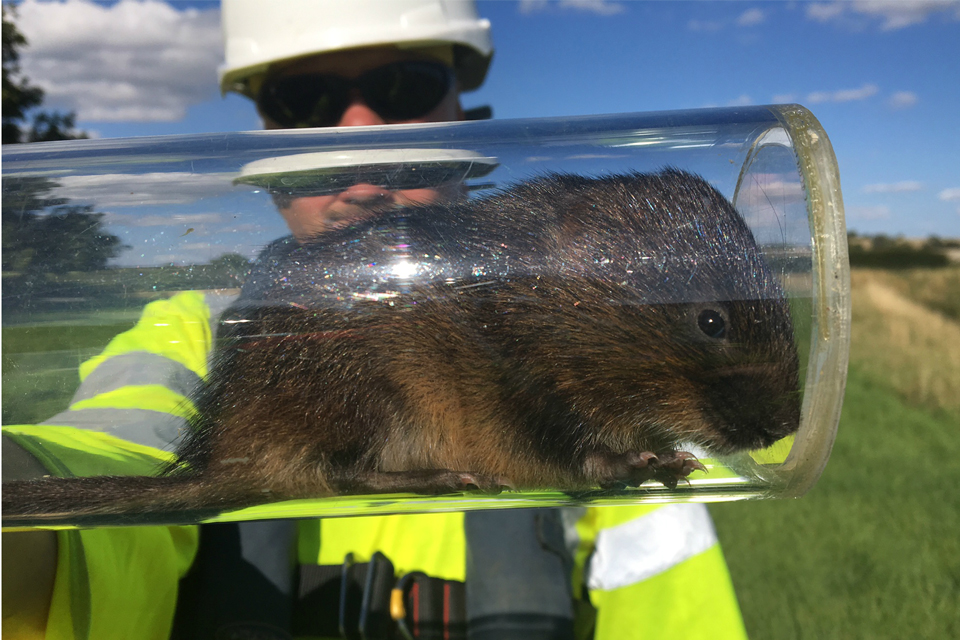
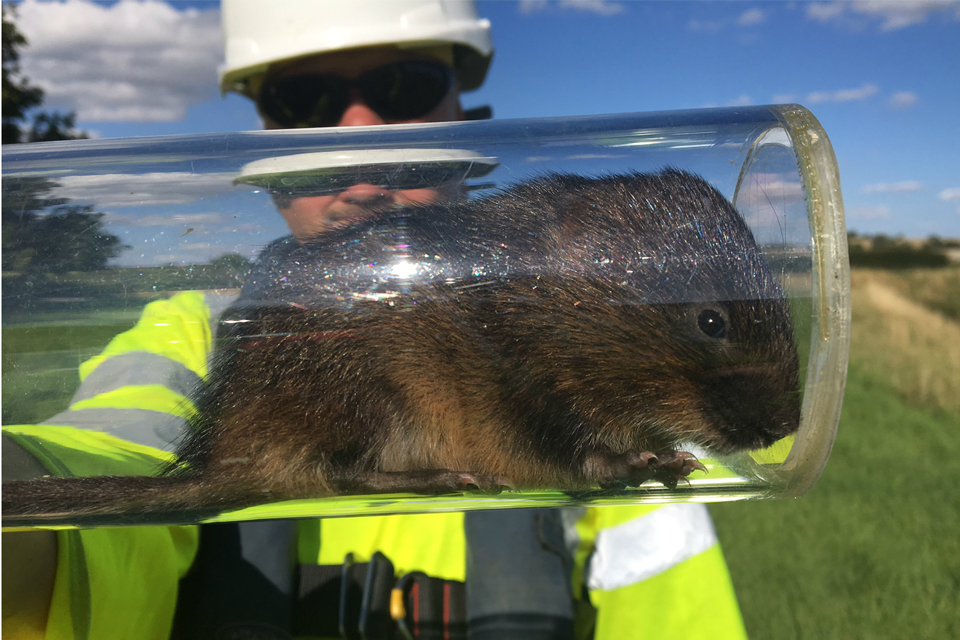
Image of ecologist at work releasing one of the water voles into their new habitat
One of the ecologists at work releasing some of the water voles into their new habitat in August 2017

Carol Hardingham, environmental lead for the A14 Cambridge to Huntingdon project for Highways England, says:

I am delighted that the environmental mitigation on the A14 Cambridge to Huntingdon upgrade has been selected as one of the five finalists for the BBC Countryfile Magazines Awards 2018 in the Conservation Success of the Year category.

Protecting the environment now and in the future is one of the golden threads that runs through all aspects of the scheme, from design to construction, project management to efficiency and delivering value for taxpayers’ money.

Our work sets the standard high in terms of reducing the overall impact of a road scheme on the local environment during construction and after the scheme completion.

We began thinking about the environment at a very early stage in the A14 project, and we will continue our work well after the construction of the road has been completed.

We are proud to be able to achieve this at the same time as building a road that will make it faster and safer for people to travel through South Cambridgeshire, leave a positive legacy for local communities and businesses and support the country’s economy.

The nomination was put forward by readers after an article about the industry-leading A14 environmental mitigation project was featured in BBC Wildlife Magazine’s January 2018 issue. A panel of five expert judges including nature journalists and authors selected the project among a long list of projects put forward for each category.

BBC Wildlife Magazine editor and awards judge Sheena Harvey says:

It’s a project that should lead the way in how to mitigate that damage done by infrastructure works – this is an example that needs to be out there for people to follow.

Since the A14 upgrade scheme was given the go ahead in May 2016, the A14 ecology team has been busy planning and creating new habitats and protecting wildlife during construction, as well as surveying the construction site for protected flora, gathering rare wildflower seeds and specimens to replant after the end of construction, and planning the tree replanting scheme once construction has been completed.

When the project is complete, 271 hectares of new, connected habitat for wildlife (equivalent to 269 rugby pitches) will have been created, and twice as many trees as were felled before the start of the scheme will have been replanted.

To find out more about the BBC Countryfile Magazine awards, the A14 project’s nomination and to vote, visit www.countryfile.com/awards. The winners will be announced in mid-March.

Work on building the £1.5bn upgrade to the A14 between Cambridge and Huntingdon started in November 2016. The project includes widening a total of seven miles of the A14 in each direction (across two sections), a major new bypass south of Huntingdon, widening a three-mile section of the A1 and demolition of a viaduct at Huntingdon, which will support improvements in the town.

For the latest information about the A14 Cambridge to Huntingdon improvement scheme, visit the scheme page,](http://www.highways.gov.uk/A14C2H) follow @A14C2H on Twitter and like our Facebook page.

General enquiries

Members of the public should contact the Highways England customer contact centre on 0300 123 5000.

Media enquiries

Journalists should contact the Highways England press office on 0844 693 1448 and use the menu to speak to the most appropriate press officer.


Link: Press release: A14 Cambridge to Huntingdon nominated for top environmental award
Source: Gov Press Releases

Press release: Headline speakers at Severn Growth Summit announced

Top business and regional leaders are backing the UK Government’s first Severn Growth Summit which will explore how links between the South Wales and South West England economies can be strengthened following the recent reduction and the abolition of the Severn Tolls later this year.

With less than a one week to go until the curtain rises on the sell-out event, Welsh Secretary Alun Cairns has today confirmed the line-up of prominent speakers that will take to the stage to address a 350-strong crowd alongside him at the Celtic Manor Resort event (22 January 2018).

Speakers have today been confirmed as:

  • Dylan Jones-Evans, Assistant Pro Vice Chancellor with responsibility for enterprise at the University of South Wales
  • Tim Bowles – Metro Mayor of the West of England
  • Katherine Bennett – Senior Vice President of Airbus UK
  • Katharine Finn – Regional Leader for PWC in the West and Wales
  • Professor Colin Riordan – Vice Chancellor Cardiff University member of the GW4 alliance
  • Cllr Andrew Morgan – Cardiff Capital Region
  • Grant Mansfield – Chief Executive, Plimsoll Productions

The Summit will bring together leading experts from local government, education, private and academic sectors from both sides of the Severn, to share their experiences of cross-border collaboration and discuss the vision for further growth opportunities in the future.

Secretary of State for Wales Alun Cairns said:

I’m delighted to be joined at this first Severn Growth Summit by such an esteemed roll call of speakers. They each represent businesses, authorities or industries that that have been at the forefront of cross border collaboration.

This event will provide the perfect opportunity for them to relay their experiences to a sell-out audience, all seeking to widen their horizons across the Severn estuary and beyond.

Taking his place in the six-strong panel of experts will be Tim Bowles, the first West of England Mayor. During his career, he has combined international business roles with public service in the region and will use the summit’s platform to share his knowledge to support businesses on both sides of the border to achieve their growth potential.

Tim Bowles, Metro Mayor of the West of England said:

I welcome the opportunity to take part in this event. The West of England and South Wales have strong connections and many shared goals – it’s important that we continue to work together for the benefit of all our residents.

Mr Bowles will be joined on the panel by Katherine Bennet, Senior Vice President of Airbus UK, a global company with significant presence in Bristol and Newport and considerable experience of cross-border working across the Severn estuary.

Katherine Bennett, Senior Vice President of Airbus UK said:

Having a strong regional ecosystem of suppliers, partners and academic collaborators is key to Airbus’ success. We must ensure that the regional strengths that exist in South Wales and the West of England, particularly around aerospace, defence and digital technologies are enhanced through collaboration and a clear strategy for regional growth.

Airbus welcomes the opportunity to help shape closer working relationships through this inaugural growth summit.

The Summit will include keynote speeches, panel sessions, living case studies, networking sessions and help generate a lasting economic legacy for Wales and beyond.

Link: Press release: Headline speakers at Severn Growth Summit announced
Source: Gov Press Releases

Press release: Consultation launches on A358 upgrade in Somerset

Highways England is launching a second consultation today, Tuesday January 16, on plans to upgrade the A358 between the M5 at Taunton and Southfields Roundabout on the A303 in Somerset.

The Government, as part of its £15 billion Road Investment Strategy, is committed to upgrading all remaining sections of the strategic A303/A358 corridor between the M3 and M5 to dual carriageway standard.

The plan for the A358 upgrade is to create a complete section of high quality dual carriageway, reducing congestion and leading to quicker journeys for motorists. The other two projects on this corridor in the Government’s first road investment period are the A303 Stonehenge scheme and the A303 Sparkford to Ilchester dualling scheme.

Responding to feedback from initial consultation last year, Highways England is now holding a new consultation until 27 February.

Highways England, project manager, David Stock said,

The A303/A358 is such a vital route that we need to be absolutely sure we find the best option for upgrading the section between the A303 and M5 at Taunton.

We had a huge response to the previous consultation and after reviewing all the feedback closely we understand how important it is to give people the chance to have their say on more options before taking the scheme to the next stage.

We urge everyone who is interested in the route to tell us what they think of the new proposals so we can be sure we deliver a scheme that will help to deliver growth and prosperity for the whole region.

Three options are being presented for the section between the M5 at Taunton and West Hatch, and more detail for the proposed dualling of the existing A358 between West Hatch and Southfields Roundabout on the A303.
The A358 is currently a mix of single and dual carriageway, carrying more vehicles than it was designed for.

This leads to delays, and the plan is to improve the route to a dual carriageway as well as improve connectivity and access for local communities and vulnerable road users such as cyclists, horse riders and pedestrians.

For further information on the consultation and public events taking place, go to the consultation page.

General enquiries

Members of the public should contact the Highways England customer contact centre on 0300 123 5000.

Media enquiries

Journalists should contact the Highways England press office on 0844 693 1448 and use the menu to speak to the most appropriate press officer.

Link: Press release: Consultation launches on A358 upgrade in Somerset
Source: Gov Press Releases

Press release: Business Secretary outlines departmental action following Carillion liquidation

  • Business Secretary Greg Clark confirms he has asked Insolvency Service to fast-track investigation into Carillion’s directors and broaden scope to include those directors previously employed
  • Business Secretary hosts meeting with leading business and construction trade bodies, representing Carillion’s sub-contractors

The Business Secretary Greg Clark has today (16 January 2018) outlined the steps the business department has taken following the liquidation of Carillion.

Following the appointment of the Official Receiver as liquidator, the Business Secretary has written to the Insolvency Service and the Official Receiver asking that the statutory investigation into the conduct of Carillion’s directors is fast-tracked and extended in scope.

This means the Official Receiver’s investigation will consider whether those who are, or were previously directors of the company may have caused detriment to those owed money, including workers and businesses affected.

Alongside this, the Business Secretary has also written to the chairman of the Financial Reporting Council (FRC), Sir Win Bischoff, and asked it to conduct an investigation into the preparation of Carillion’s accounts past and present, as well as the company’s auditors.

Greg Clark said:

It is important we quickly get the full picture of the events which caused Carillion to enter liquidation, which is why I have asked the Insolvency Service to fast-track and broaden the scope of the Official Receiver’s investigation.

In particular, I have asked that the investigation looks not only at the conduct of the directors at the point of its insolvency, but also of any individuals who were previously directors. Any evidence of misconduct will be taken very seriously.

The Business Secretary also chaired a meeting yesterday (15 January) with leading business and construction trade bodies, representing Carillion’s sub-contractors including representatives from the construction sector:

  • Build UK
  • Civil Engineering Contractors Association
  • British Constructional Steelwork Association
  • Building Engineering Services Association
  • Federation of Master Builders
  • Construction Products Association
  • Electrical Contractors’ Association
  • Specialist Engineering Contractors Group

Also invited were representatives of leading business bodies with the Federation of Small Businesses (FSB), the British Chambers of Commerce (BCC) and the Institute of Directors (IOD).

Later today, the Business Secretary will meet the General Secretaries of the TUC and Unite, Frances O’Grady and Len McCluskey, to discuss the impact on employees affected by Carillion’s insolvency.

The department has also outlined the resources open to those workers and businesses affected by Carillion’s liquidation who are seeking further information, including:

  • a web page set up by the Insolvency Service for those affected and seeking advice
  • a dedicated website set up by the Special Managers, PWC, as well as a dedicated helpline – 0800 063 9282
  • a hotline set up for any employee worried about their pension situation on these specific pension schemes – 020 7630 2715
  • for more general advice on business support, the BEIS Business Support Hotline can also provide information – 0300 456 3565
  • Jobcentre Plus, through its Rapid Response Service, also stands ready to support any employee affected by this announcement

Alongside this, the department’s network of 38 Local Growth Hubs, run in conjunction with the Local Enterprise Partnership (LEP), is also on hand to help businesses of all sizes and in all sectors to access support.

Letters

Link: Press release: Business Secretary outlines departmental action following Carillion liquidation
Source: Gov Press Releases