Press release: Call for tourism industry to do more to cater for disabled people

Minister for Disabled People, Sarah Newton, and Tourism Minister, Michael Ellis, urge all leisure attractions to “follow their lead” and ensure they are catering for disabled customers’ needs.

Tourism is booming across the UK and is now worth over £66 billion a year to the economy. The sector employs 1.6 million people and creates growth across the country, from beautiful beaches and activity parks, to hundreds of thousands of heritage sites.

If the sector is to continue flourishing, it needs to ensure that facilities are accessible to all its visitors. With one in 5 people in the UK living with a disability or health condition, there is a clear business case for ensuring that disabled people’s needs are catered to. Businesses can take actions including improving training on disability awareness for staff and adapting facilities to ensure they are accessible.

On a visit to Sandcastle Water Park in Blackpool, the Minister for Disabled People, Health and Work, Sarah Newton, said:

Enjoying all the experiences the UK has to offer with family and friends should be fun and enjoyable, but for many disabled people this can be a cause for disappointment and frustration.

Many leisure businesses are already doing the right things in making sure their facilities are enjoyed by disabled people, including Sandcastle Water Park in Blackpool. Things like designated opening times, a quiet room, open-ended day tickets and ramps can make all the difference. I’m calling on others in the tourism industry to follow their lead and put visitors’ needs at the heart of their services.

On a visit to Eureka! The National Children’s Museum in Halifax, the Minister for Arts, Heritage and Tourism, Michael Ellis, said:

All over the country, our tourism industry is booming and we are a world-leading holiday destination for visitors from both at home and abroad.

However if we are to maintain this reputation and its economic and social benefits, I urge all tourism venues to follow in the footsteps of these award winners and review whether they are doing enough to cater for disabled people, to ensure they are accessible to everyone.

Examples of tourist venues leading the way in this area, and highlighted by VisitEngland’s Inclusive Tourism Award, include:

  • the Roman Baths and Pump Room in Bath
  • Mylor Sailing and Powerboat School in Cornwall
  • Cottage in the Dales in Newbiggin
  • Sandcastle Waterpark in Blackpool
  • Eureka! The National Children’s Museum in Halifax

Adaptations made by the venues include:

  • making them wheelchair accessible
  • installing Changing Places toilets
  • providing accommodation for guide dogs

The Head of Business Support at VisitEngland, Ross Calladine, said:

Our Inclusive Tourism Award winners demonstrate that providing easy access for all makes sound business sense.

By taking steps to ensure staff are disability confident, making reasonable adjustments to facilities and providing information on venue accessibility, other businesses can benefit from this valuable market.

The government has a dedicated sector champion for tourism, who works with the industry to promote the benefits of being inclusive to its disabled visitors.

Chris Veitch, Chief Executive of Tourism for All and the government’s Sector Champion for Tourism, said:

Making tourism more accessible not only improves travel opportunities for disabled people and many others with accessibility requirements, it can improve the quality of the visitor experience for everybody and help make the UK tourism offer more competitive.

There are more than 11 million disabled people in the UK with a combined spending power of their households, ‘the purple pound’, standing at around £250 billion.

More information

Annual statistics released in July revealed that a record-breaking 39.2 million visits were made by overseas tourists to the UK in 2017, and the latest domestic tourism figures showed that residents across Great Britain took a total of 120.7 million overnight visits to destinations in England, Scotland and Wales in 2017.

2018 Inclusive Tourism Award winners can be found here: www.visitenglandawards.org/about-home/winners/awards-winners-2018.

Previous winners of the Inclusive Tourism Award can be found here: www.visitengland.com/plan-your-visit/access-all.

The Scope Extra Costs Commission report can be found here: www.scope.org.uk/Scope/media/Interim-report/Extra-Costs-Commission-Final-Report.pdf.

Further information on how venues can improve their accessibility can be found here: www.visitbritain.org/providing-access-all.

Contact Press Office

Press Office

Caxton House

Tothill Street
London
SW1H 9NA

Follow DWP on:

Link: Press release: Call for tourism industry to do more to cater for disabled people
Source: Gov Press Releases
Press release: Bathing water investigation continues

Investigations are continuing into the bathing water quality of a popular North East beach.

Cullercoats in North Tyneside is currently rated as ‘sufficient’, meaning it has passed bathing water quality standards. But work to understand the reasons for its decline in quality from ‘good’ are ongoing.

On Wednesday (22 August) Environment Agency Chief Executive Sir James Bevan visited the bay to hear about the work being done by the agency and its partners at Northumbrian Water and North Tyneside Council to investigate and understand the issues.

A number of factors can impact on bathing water quality, including the impact of humans, animals and birds, misconnections of pipes going into the sea, and heavy rainfall, which can result in run off from the land going into the sea and causing a temporary drop in seawater quality.

During recent years, the Environment Agency has seen that bathing water quality at Cullercoats deteriorates towards the end of the season. A partnership working group was set up in 2017 to investigate the issues and work has continued throughout this year.

The Environment Agency is carrying out additional monitoring at suspected sources of pollution and further microbial source tracking (MST) which through DNA analysis identifies the sources of bacteria predominantly present in the seawater.

Northumbrian Water is carrying out extensive investigations on the drainage network and is working with partners to resolve any issues found. This has involved checking a previously blocked up culvert owned by North Tyneside Council that was identified as having discharged poor quality water to the beach in 2011. The working group is also investigating potential misconnections from properties discharging into the surface water outlets rather than the sewer.

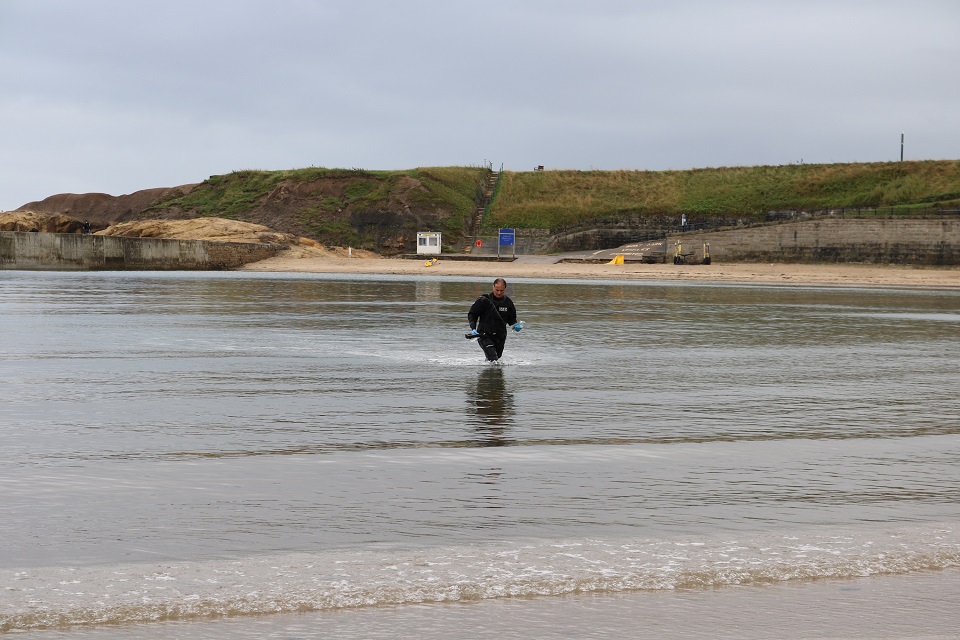
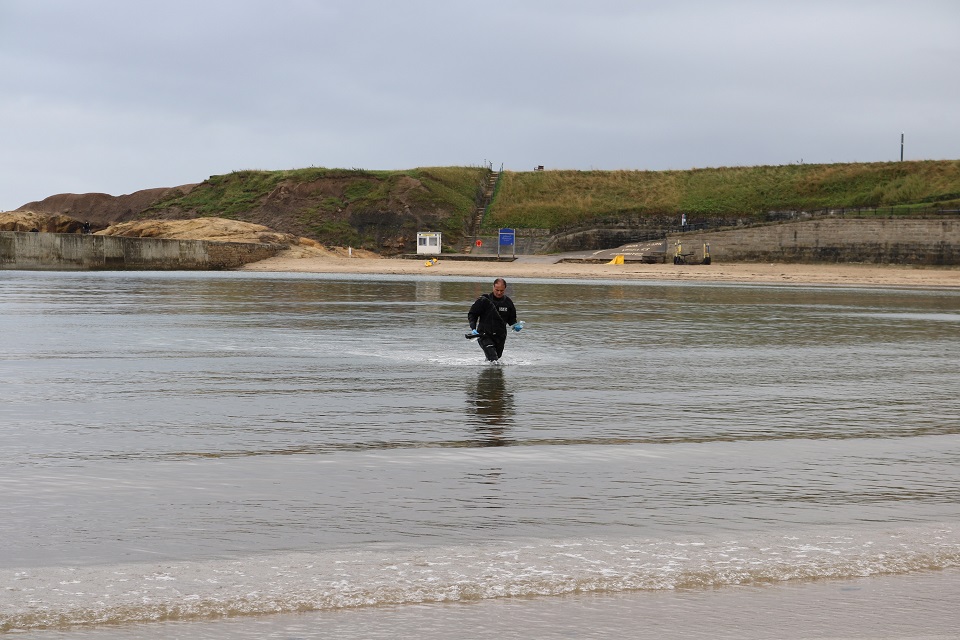
The image shows the Environment Agency's Mick Donkin collecting samples at Cullercoats
The Environment Agency’s Mick Donkin collecting samples at Cullercoats

‘Drastic improvements

The Environment Agency’s Gordon Reid, who leads on the Environment Agency’s activity in the North East, said:

The North East remains a beacon for bathing water excellence with a real success story of drastic improvements over the past 30 years. In 1988, nearly half of our bathing waters failed to meet mandatory standards, while in the most recent assessment they all passed. We’d encourage people to make the most of our wonderful coastline by getting out and enjoying it!

We work closely with our partners at local authorities and Northumbrian Water to understand what impacts on a particular bathing water’s quality and then carry out work to try to improve it, and such work has already taken place here at Cullercoats.

We remain committed to identifying all sources of pollution and a number of investigations are taking place to understand the type of bacteria in the water and where it is potentially coming from. It’s important to note that ‘sufficient’ status still means the bathing water has passed water quality standards.

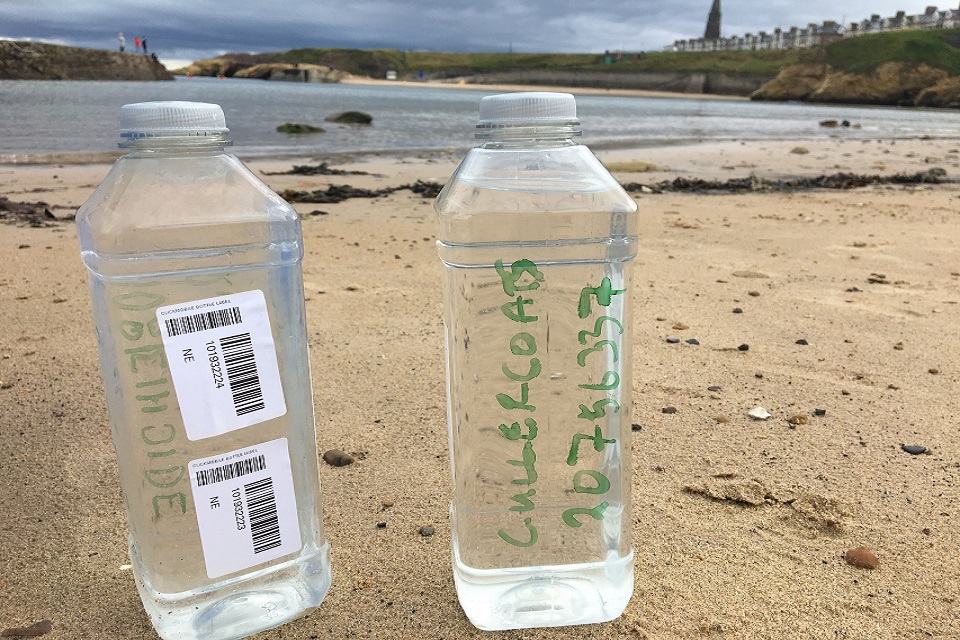
Image shows the samples collected at Cullercoats

Partnership working is important

All of the North East’s Bathing Waters passed water quality standards in the most recent assessment at the end of last year with 32 out of 34 being rated excellent or good and 2 being rated sufficient.

Compliance is based on the current and previous four years of sample data (a maximum of 80 samples per beach, from 2014 to 2017). The samples are taken by the Environment Agency between May and September each year to assess the bathing waters against the strict regulations.

Northumbrian Water’s wastewater director, Richard Warneford, said:

Looking after the environment is at the heart of what we do. We are extremely proud of the contribution we have made to protect and improve our region’s stunning coastline through both investment and partnership working and we appreciate the significant impact that beaches have on tourism, the economy and the leisure industry.

Partnership working is particularly important in understanding the issues affecting bathing water quality and to provide the improvements needed”.

Across the UK 98.3% of bathing waters tested at over 400 beaches and lakes passed tough water quality standards. Action plans are in place for all bathing waters in need of improvement.

The public have a key role to play in ensuring their local beaches are clean. They can do their bit by ensuring they #binit4beaches and take their litter home with them.

You can check for temporary warnings against bathing, or see the sampling results online

Read Mick Donkin’s blog on his role as Sampling and Collection Team Leader in the north east and his love of the north eats coast!


Link: Press release: Bathing water investigation continues
Source: Gov Press Releases

Press release: UKEF supports delivery of Rolls-Royce-powered aircraft to EL AL

The announcement comes days after the government launches its Export Strategy, setting out how the government will support businesses of all sizes to make the most of the opportunities presented by markets around the world.

International Trade Secretary, Dr Liam Fox, said:

The aerospace industry is a major driver of the UK economy and I am delighted that as we launch the government’s Export Strategy, UK Export Finance (UKEF) is backing this significant contract, which will support the continued international success of Rolls-Royce.

This delivery is part of Rolls-Royce’s contract to supply engines for 16 Boeing 787 Dreamliner aircraft for EL AL Israel Airlines – the largest single export deal the UK has had with Israel, and a marker of the strength of the trade relationship between the two countries.

British goods remain in global demand – this is the first time that UKEF has supported an aircraft delivery to EL AL and clearly shows the value of support from the UK’s award-winning export credit agency to the UK’s aerospace engineering sector.

UKEF has provided EL AL Israel Airlines with export credit support to finance the sale of a Rolls-Royce-powered Boeing 787 aircraft. This is the sixth aircraft to be delivered of a fleet of 16 Dreamliners with Rolls-Royce engines.

Dganit Palti, CFO, EL AL Israel Airlines said:

We are very delighted with the delivery of the sixth Boeing 787 Aircraft. The transaction was financed by Citibank and supported by UKEF. On the special event of Israel’s 70th independence and the company’s 70th anniversary, the aircraft’s retro livery commemorates the 70 years of EL AL’s performance as Israel’s leading Airline.

We are delighted that the UK government has chosen to support this financing as it showcases the continuing strong relationship between our two countries.

Dominic Horwood, Chief Customer Officer for Civil Aerospace at Rolls-Royce, said:

The UK Government’s support, through UK Export Finance, has played an important role in supporting this delivery for Rolls-Royce.

Citi’s Managing Director, Munawar Noorani, said:

UKEF has been at the forefront of supporting exports in innovative ways. Citi has a long-standing relationship with EL AL and we are delighted to have been selected by them for their first ever financing through UK Export Finance.

Extension of the programme is under consideration, with further support for future deliveries of Rolls-Royce-powered Boeing aircraft to EL AL.

Background

  1. UK Export Finance is the UK’s export credit agency and a government department, working alongside the Department for International Trade as an integral part of its strategy and operations.
  2. It exists to ensure that no viable UK export should fail for want of finance or insurance from the private market. It provides finance and insurance to help exporters win, fulfil and ensure they get paid for export contracts.
  3. Sectors in which UKEF has supported exports include: aerospace, construction, oil and gas, mining and metals, petrochemicals, telecommunications, and transport.
  4. UKEF has a regional network of 24 export finance managers supporting export businesses.
  5. Find UKEF’s latest country cover positions.
  6. UKEF supports exporters with a range of products that include:
  • Bond insurance policy
  • Bond support scheme
  • Buyer & supplier credit financing facility
  • Direct lending facility
  • Export insurance policy
  • Export refinancing facility
  • Export working capital scheme
  • Letter of credit guarantee scheme

Rolls-Royce

Rolls-Royce powered the very first Boeing 787 test flight in December 2009, the first 787-8 to enter service in October 2011, and the first 787-9 to enter service, in 2014. Rolls-Royce is the only engine manufacturer on the 787 to be supported by UKEF.

Media enquiries: Claire Lynch, Media Relations Officer

Link: Press release: UKEF supports delivery of Rolls-Royce-powered aircraft to EL AL
Source: Gov Press Releases

Press release: Commission announces class investigation into independent school charities

The Charity Commission, the independent regulator of charities in England and Wales, has opened a class statutory inquiry into The Martin Foundation (registered charity number 1110184), and The Collegiate Charitable Foundation (registered charity number 1012924). The inquiry was opened on 22 January 2018.

The charities provide bursaries to enable students to attend independent primary and secondary schools; provide advertising, facilities and equipment for the schools, and assist the local community, however The Martin Foundation is not currently carrying out any activity.

After receiving a complaint from the public and information from other regulators the Commission engaged with the charities in respect of a number of regulatory concerns. Our engagement established that there were clear and ongoing serious regulatory issues relating to the administration of the charities by the trustees. These included the management of conflicts of interest, protecting and properly accounting for the charities’ assets, and potential unauthorised trustee benefit.

The inquiry is examining:

  • The extent to which potential conflicts of interest and connected party transactions have been properly managed
  • The extent to which there has been any unauthorised trustee benefit
  • Whether the charities operated for exclusively charitable purposes

In order to protect the assets of the charities, the Commission has issued orders to the trustees and the charities’ bank under section 76(3) of the Charities Act 2011. These are temporary orders and will be reviewed on a regular basis in line with normal procedures.

Due to the seriousness of its regulatory concerns the Commission also appointed Geoff Carton-Kelly and Tom McLennan of FRP Advisory as joint interim managers of the charities on 13 August 2018.

The interim managers are appointed with all the powers and duties of trustees and will act to the exclusion of the current charity trustees. These are temporary appointments and will be reviewed on a regular basis in line with normal procedures.

It is the Commission’s policy, after it has concluded an inquiry, to publish a report detailing what issues the inquiry looked at, what actions were undertaken as part of the inquiry and what the outcomes were. Reports of previous inquiries by the Commission are available on GOV.UK.

Notes to Editors

  1. The Charity Commission is the regulator of charities in England and Wales. To find out more about our work see the about us page on GOV.UK.
  2. Search for charities on our check charity tool.
  3. Section 46 of the Charities Act 2011 gives the Commission the power to institute inquiries. The opening of an inquiry gives the Commission access to a range of investigative, protective and remedial legal powers.
  4. The Interim Manager appointment is a temporary and protective power that will be reviewed at regular intervals. It will continue until the Commission makes a further Order for its variation or discharge.

Press office

Link: Press release: Commission announces class investigation into independent school charities
Source: Gov Press Releases

Press release: Minister Field Statement on the Anniversary of the Rohingya Crisis

Minister Field Statement on the Anniversary of the Rohingya Crisis

“Today marks the anniversary of the Kofi Annan Commission recommendations for Rakhine. It is tragic that this was so closely followed by the brutal, disproportionate response of the Burmese military to a series of coordinated attacks by the Arakan Rohingya Salvation Army. We have been clear in our condemnation of both the initial attacks and the appalling military operations that followed, which we have consistently described as ethnic cleansing. Violence will not solve the long-standing issues in Rakhine.

“During his life, Kofi Annan was a constant advocate for human rights, international development and the rule of law. His vision of long-lasting peace for Burma was supported by investing time and energy into making sure every community in Rakhine State had a voice in their future. It is through implementing the recommendations outlined in his report we can ensure that Annan’s legacy and commitment to peace in Rakhine are honoured. We continue to believe this sets out the most viable path for resolving a decades-long conflict, ensuring stability and security for all.

“The underlying issues need to be addressed too if there is be sustainable progress. The Memorandum of Understanding between Burma and the UN is a step in the right direction. It should now be put into action. Most immediately, this means ensuring unfettered and effective access for the UN to northern Rakhine State. Without it, hundreds of thousands of vulnerable people remain without the aid and development assistance they urgently need. Over the border in Bangladesh, the desperate flight of hundreds of thousands of Rohingya has created a humanitarian crisis of unprecedented proportions.

“The UK Government has led the international response, both diplomatically and in terms of humanitarian support. We are one of the largest donors supporting the delivery of much needed humanitarian assistance, providing over £129 million to date. We remain steadfast in putting pressure on the Burmese authorities through direct discussions and at the UN Security Council, where we are using our Presidency to call a session on Burma on 28 August.

“We will continue to work towards bringing to justice the perpetrators of human rights violations, including sexual violence, through a transparent, independent and credible process.”

Further information

Follow Mark Field on Twitter @MarkFieldUK

Follow the Foreign Office on twitter @foreignoffice and Facebook

Follow the Foreign Office on Instagram, Youtube and LinkedIn

Subscribe to the announcements feed or email alerts to get our latest news and announcements

Media enquiries

For journalists

Link: Press release: Minister Field Statement on the Anniversary of the Rohingya Crisis
Source: Gov Press Releases

News story: Exmouth residents invited to tidal defence scheme drop-in event

Exmouth residents will have a chance to learn more about the benefits of the Environment Agency’s £12 million tidal defence scheme at a drop-in event next week.

The event is being held on Wednesday 5 September at Ocean on Queens Drive, EX8 2AY between 11am and 8pm.

Rob Butler, project manager for the Environment Agency, said:

We have listened to feedback from the consultation events held in 2015 and 2016. We have designed a scheme that reduces tidal flood risk for many in Exmouth from a 4% chance to 0.5% chance in any given year.

This public exhibition is a great opportunity to come and see the plans we have developed and discuss them with the project team.

The Environment Agency is working in partnership with East Devon District Council to deliver this important scheme.

Councillor Tom Wright, East Devon’s portfolio holder for the environment, said:

East Devon District Council is totally committed to working with our partners, the Environment Agency and Devon County Council, to ensure the future flood defences for Exmouth.

This is demonstrated in the urgent works we will be starting next month to reinforce the sea wall near Mamhead slipway. I urge all Exmouth residents to visit the exhibition.

The scheme is being designed and will be built by civil engineering contractor Team Van Oord. It will include:

  • Flood embankments and walls between the Withycombe Brook and Imperial recreation ground.
  • Raised defences between the Imperial recreation ground and Camperdown Terrace.
  • Strengthening the existing seawall, improving drainage for water to drain back out to sea, flood gates and new set-back defences along the landward side of the Esplanade.

Following the public exhibition a planning application will be submitted to East Devon District Council, the local planning authority, in late September. If permission is granted construction will begin early in 2019 and should be complete by 2021.

Link: News story: Exmouth residents invited to tidal defence scheme drop-in event
Source: Environment Agency

Press release: Mark Field visits Vientiane for UK-Laos political dialogue

Foreign & Commonwealth Minister of State Mark Field is visiting Laos today (24 August) at the conclusion of a six-country tour of Southeast Asia.

While in Vientiane, Mr Field will hold bilateral discussions with Minister of Foreign Affairs Saleumxay Khommasith, Minister of Education and Sports Sengdeuane Lachanthaboun, and Minister of Industry and Commerce Khemmani Pholsena.

He will also lead the UK delegation for the second biannual UK-Laos political dialogue, and meet a range of non-governmental organisations working on good governance, civil society, unexploded ordnance and wildlife management.

Commenting on his visit, the Minister said:

I’m delighted to visit Laos and to hold face-to-face discussions about the business and investment environment between our two countries.

I look forward to leading the UK delegation for our political dialogue, as it offers an important forum in which we can identify new areas of bilateral cooperation and build on existing areas of strength.

Minister Field’s tour of Southeast Asia included visiting the Philippines, Brunei, Indonesia, Thailand and Cambodia to discuss bilateral relations and the UK’s post-Brexit relationship with the Association of South East Asian Nations (ASEAN), and its members.

Further information

Media enquiries

For journalists

Link: Press release: Mark Field visits Vientiane for UK-Laos political dialogue
Source: Gov Press Releases

Press release: New projects announced to protect cultural heritage overseas

  • £30 million Cultural Protection Fund supports conservation of international cultural heritage sites threatened by conflict
  • University of Glasgow project will preserve archaeological heritage in a region suppressed by Saddam Hussein’s forces

A project to preserve unique archaeological sites in Iraqi Kurdistan dating back up to 10,000 years is to receive investment from the UK Government’s £30 million Cultural Protection Fund, Heritage Minister Michael Ellis announced today.

This is one of nine major overseas projects that will benefit from the Cultural Protection Fund which exists to safeguard heritage of international importance threatened by conflict in countries across the Middle East and North Africa.

The Garmian region was part of the front line during the Iran-Iraq War, suffered damage under Saddam Hussein’s repression of the Kurds in the 1990s and is only kilometres away from ISIS’ 2014 front line. The recent conflicts have led to the damage and destruction of sites containing key information and artefacts from ancient Mesopotamia’s civilisations.

The University of Glasgow is constructing a team to document and monitor the damage in Garmian using satellite and aerial imaging, before recommending how the site can be best preserved. The team, which has received more than £300,000 from the Cultural Protection Fund, will also train local archaeologists and work with school teachers in the area to highlight cultural heritage in their classrooms.

Michael Ellis, UK Minister for Heritage, said:

These sites tell the story of human history and show how our early ancestors first farmed and cultivated food. Their protection is therefore not only important to Kurdistan, but to all of humankind.

This project is just one example of how our Cultural Protection Fund is providing essential support to countries where internationally important heritage has been damaged or threatened by war, conflict and terrorism.

Tragically we have seen some of the world’s greatest cultural treasures destroyed in recent years. It is important, and right, that we share our expertise and support communities around the world to help preserve art, culture and heritage of global significance.

Stephen Stenning, Head, Arts and Society at British Council, said:

Important cultural heritage – from archives of music to ancient archaeological sites – is at risk of significant degradation or simply being lost forever.

British Council’s work managing the Cultural Protection Fund provides vital support to organisations on the ground working to protect and preserve heritage. This latest round of funding for innovative and ambitious projects, extends valuable and ongoing conservation work, training, and education. By employing local people, developing skills and building capacity, this work also benefits the local economy.

Since its launch, The Cultural Protection Fund has supported work on 41 projects to restore and protect heritage sites in each of the 12 countries it operates in.

Notes to editors:

The Cultural Protection Fund, established by the UK Government and the British Council in 2016, is designed to safeguard heritage threatened by conflict in countries across the Middle East and North Africa.

The University of Glasgow team is led by archaeologist Dr Claudia Glatz. She said:

Our project is unique in Iraq and the Middle East in its approach to cultural heritage protection. We combine research-led archaeological practice as part of the ongoing survey and excavations of the Sirwan Regional Project with knowledge-exchange, capacity building in both practical skills and the social and political implications of interpretation and cultural narrative, and the creation of inclusive museum and community-driven educational resources.

The nine projects have been supported in this round of the Cultural Protection Fund are:

  1. Action for Hope Music Schools for Refugees, Lebanon – £290,073
    Led by Action for Hope (ASBL), this project aims to enhance the recognition of traditional Syrian music within a population of 20,000 refugee and host communities in Lebanon and Jordan.
  2. Archaeological practice and heritage protection in the Kurdistan Region of Iraq – £301,178
    Led by University of Glasgow, this project will document and monitor site damage to the archaeological heritage of Garmian in the Kurdistan region of Iraq, as well as increasing the capacity of local heritage professionals through skills workshops and field training, and engaging local communities with their cultural heritage.
  3. Community Museums of Western Sudan: Omdurman, El Obeid, Nyala, Sudan – £997,000
    Led by the International Centre for the Study of the Preservation and Restoration of Cultural Property (ICCROM), this project will restore three museums after decades of conflict and provide for the educational and cultural needs of their communities, visitors and tourists.
  4. An Ark for Iraq: Emergency response programme for the endangered watercraft heritage of Iraq – £99,246
    Led by Safina Projects CIC, this year long project expands Safina Projects’ ongoing work to revitalise and document the endangered watercraft heritage of traditional boats in central and southern Iraq.
  5. Planning the future of Amedi: building community capacity & management frameworks for the protection of the historic town, Iraq – £100,000
    Led by World Monuments Fund Britain Ltd, this project aims to enhance and document built heritage in the historic town of Amedi in Iraq.
  6. Assessing the condition of the Afghan national art collection, Afghanistan – £50,000
    Led by the Foundation of Culture & Civil Society, this project will carry out a preliminary needs assessments and restoration work on 150 paintings within the Afghan National Collection, which were destroyed by the Taliban.
    Building the capacity to protect Palestinian land and heritage through museology, Occupied Palestinian Territories – £94,650
  7. Led by The Palestine Institute for Biodiversity and Sustainability at Bethlehem University, this project will document Palestinian ethnographic heritage, paying particular attention to agricultural practices along the cultural route of ‘Abraham’s path’ in the Occupied Palestinian Territories.
  8. “The Life Jacket”: The Revitalisation and Development of Rural Jerusalem, Occupied Palestinian Territories – £1,018,470
    Led by RIWAQ – Centre for Architectural Conservation, which will work with local communities and the Ministry of Tourism and Antiquities to restore the historic centres of Al Jib, Qalandiya, Jaba’ and Kafr ‘Aqab
  9. Preserving the Living Memory of the Pastoral Routes and Heritage of the Bedouin in Lebanon – £100,000
    Led by The Institute for Heritage and Sustainable Human Development, this project will aim to collect, archive and share the skills and traditions of the Bekkaa Valleys Bedouins in the Lebanon. The Bedouin are a group of nomadic peoples who have traditionally inhabited areas of the Levant, North Africa and the Arabian Peninsula.

Link: Press release: New projects announced to protect cultural heritage overseas
Source: Gov Press Releases

BS EN IEC 60376:2018 Specification of technical grade sulphur hexafluoride (SF6) and complementary gases to be used in its mixtures for use in electrical equipment .

Sulfur hexafluoride
Determination of content
Electrical insulating materials
Safety measures
Impurities
Materials handling
Properties
Gases

Link: BS EN IEC 60376:2018 Specification of technical grade sulphur hexafluoride (SF6) and complementary gases to be used in its mixtures for use in electrical equipment .
Source: BSI Standards