
These Regulations amend regulations which make provision relating to the enforcement of Council Regulation (EU) 2017/1509 of 30th August 2017 (OJ L 224, 31.8.2017, p1) concerning restrictive measures against the Democratic People’s Republic of Korea and repealing Regulation (EC) No 329/2007 (“the 2017 Council Regulation”).
Link: The Democratic People’s Republic of Korea (European Union Financial Sanctions) (Amendment) (No. 4) Regulations 2017
Source: Legislation .gov.uk
Press release: Priti Patel will double the next £2 million of public donations to the Disasters Emergency Committee appeal for people fleeing Burma
In response to the staggering public support for the Disasters Emergency Committee (DEC) Appeal for people fleeing the violence and destruction in Burma, the UK Government will match pound for pound the next £2 million raised, the International Development Secretary Priti Patel announced during a visit to the DEC today (Thursday 12 October).
This is in addition to the £3 million in public donations already matched by the UK, which has helped Britain raise £9 million.
The new support will double the impact of the public’s own donations and ensure that charities working on the ground can reach even more innocent men, women and children who have been forced to flee the relentless violence and atrocities in Burma, and make the treacherous journey to Bangladesh to seek refuge.
Moved by the scale of the crisis and the generosity of the British public, Ms Patel visited the DEC headquarters today where she met with British aid workers who have recently returned from Cox’s Bazar where they have been helping to save the lives of Rohingya victims of persecution and brutality.
International Development Secretary, Priti Patel said:
The generosity of the British public and the speed in which they have responded to this appeal is overwhelming. Every penny raised is making a significant difference for victims of the ethnic cleansing being inflicted by the Burmese military.
The UK Government is working at every level to ensure that lifesaving aid reaches those in dire need right now. Thousands of shelter kits, sleeping mats and thermal blankets have already been distributed in Cox’s Bazar and more aid is on the way to support the half a million people forced to leave everything behind in Burma and make the perilous journey to Bangladesh.
The British public has played a remarkable role and they should know that their donations are saving lives. Malnourished children on the brink of death will now be able to eat, families who have been forced to live out in the open after their villages were burned will get shelter and much needed clean drinking water will be provided to help stop the spread of disease.
It has been a privilege to meet brave British aid workers who have returned from Cox’s Bazar, supporting innocent people who are grieving the loss of loved ones and are uncertain what their futures hold.
The humanity they and the British public have shown is a stark contrast to the inhumanity of the Burmese authorities. They need to stop the inhumane violence, allow people to return to their homes safely and ensure immediate access into northern Rakhine so that UK aid can provide a lifeline to those suffering.
This brings the UK’s contribution to £5 million over the course of the DEC appeal and will provide vital and life-saving emergency supplies. Today’s new support is on top of support that the UK is already providing to people who are in desperate need of food, water and shelter.
Notes to editors
- The DEC brings 13 leading UK aid charities together in times of crisis: ActionAid, Age International, British Red Cross, CAFOD, CARE International, Christian Aid, Concern Worldwide, Islamic Relief Worldwide, Oxfam, Plan International UK, Save the Children, Tearfund and World Vision; all collectively raising money to reach those in need quickly.
- As of Wednesday 11 October, £9 million has been raised of which £3 million has been aid matched by the UK Government. DFID aid matches public donations from British taxpayers, but others can contribute including non-British taxpayers and businesses.
- The UK is appalled by the violence taking place in Rakhine State, particularly by the hundreds of thousands of people fleeing that violence and the reports of grave human rights violations taking place. Britain urgently calls upon the Burmese military to end the violence in Rakhine and the Government of Burma to allow immediate and full humanitarian access and support for the people and communities affected.
- As of Sunday 8 October, 519,000 people have fled the violence into neighbouring Bangladesh as a result of Burmese military and militia violence. This looks like ethnic cleansing; we need to see these people able to return to their homes in Burma safely. The Burmese and Bangladeshi authorities are discussing a refugee return process. But we will need to see this agreed and implemented and the Burmese authorities need to show the Rohingya will be safe when they return.
- The UK has been a leader in responding to the crisis – in speed and size – to help meet the urgent humanitarian needs of vulnerable men, women and children in both Bangladesh and Burma.
- Prior to the latest violence which began on Friday, 25 August 2017, we committed £5.9 million to meet the needs of the most vulnerable refugees and the host communities who support them. In response to the latest influx we have provided a further £30 million of humanitarian support.
- Our existing work in the region meant that we were already in position to provide life-saving support when the crisis flared – without this, aid would have taken much longer to reach those in need. And we are sending more aid to Bangladesh.
- Through our partner, the International Organisation for Migration (IOM) 10,000 shelter kits, 10,500 mats and 20,000 blankets were distributed recently. Emergency shelter for up to 26,355 people has already been provided since the first refugees made their way to Bangladesh.
- In Rakhine State in Burma, aid workers have been getting British-funded humanitarian assistance to many tens of thousands of people. DFID’s partners are ready to provide emergency food to 30,000 people and to treat more than 3,000 severely malnourished children and pregnant women, but the Burmese authorities must stop refusing to grant access.
ENDS
General media queries
Email
mediateam@dfid.gov.uk
Telephone
020 7023 0600
Follow the DFID Media office on Twitter – @DFID_Press
Link: Press release: Priti Patel will double the next £2 million of public donations to the Disasters Emergency Committee appeal for people fleeing Burma
Source: Gov Press Releases
Press release: Landmark package to tackle homelessness and rough sleeping in Manchester
Greater Manchester will receive almost £3.8 million to develop a new city region-wide approach to preventing homelessness and reducing rough sleeping, Communities Secretary Sajid Javid confirmed today (12 October 2017).
The funding will be used to develop new services and resources across all 10 boroughs of the region. This will include making hub-based services open 24 hours a day across Greater Manchester, to provide high quality support for people when they need it the most, and the adoption of a social letting agency approach across Greater Manchester to help those struggling to find secure accommodation.
These measures will enable the 10 boroughs of Great Manchester to work better together with clear systems in place to prevent homelessness and rough sleeping from happening in the first place.
Visiting Manchester today, the Prime Minister Theresa May also announced that progress was being made on a housing deal with Greater Manchester to accelerate the delivery of new homes. This reaffirms this government’s commitment to the Northern Powerhouse.
Communities Secretary Sajid Javid said:
One person living on the street or without a home to call their own is too many. This package supports this government’s aims to transform the way we prevent homelessness and rough sleeping.
Greater Manchester has always been at the forefront of devolution and this is a landmark moment – the first devolved homelessness package.
I’m confident that the proposed plan will reach the needs of the city’s most vulnerable people and set a precedent for what other ambitious city regions can do.
The Greater Manchester package builds upon the government’s commitments to reducing homelessness and rough sleeping. These include:
-
investing £550 million to 2020 for support and prevention programmes
-
implementing the Homelessness Reduction Act, requiring local authorities to provide support earlier to prevent those at risk from becoming homeless
-
investing a further £2 billion for affordable housing funding, bringing total investment to around £9 billion for a new generation of council and housing association homes
Andy Burnham, Mayor of Greater Manchester said:
We very much welcome this announcement by the government. This extra help is well-timed, much-needed and good news for Greater Manchester. It is a recognition of the innovative work underway here to help people sleeping rough, bringing together our public, private and voluntary sectors in a ground-breaking partnership.
This support from the government will help us go further and faster in achieving our goal of ending rough sleeping in Greater Manchester by 2020.
In addition to 24-hour hub services and a social letting agency, the package will:
-
develop a shared ICT and database system – this will help to share data across the 10 local authorities so they can better able respond to homelessness and rough sleeping crises
-
rollout the Greater Manchester Homelessness Action Network – this will support practitioners in the sector, connecting the many homelessness organisations across Greater Manchester
-
build on the devolution agreement around health – this includes offering tailored health services for homeless people
Further information
The funding for the Greater Manchester homeless package will form part of the Greater Manchester Reform Investment Fund, the outcome of a government commitment to support Greater Manchester to establish an investment fund to support the vulnerable towards a brighter future.
The housing white paper committed to agreeing bespoke housing deals with authorities in high demand areas, which have a genuine ambition to build.
Greater Manchester has already been awarded up to £1.8 million as part of DCLG’s Social Impact Bond fund to provide personalised support for long-term rough sleepers on a payment-by-results basis.
Office address and general enquiries
2 Marsham Street
London
SW1P 4DF
Contact form
http://forms.communiti…
General enquiries: please use this number if you are a member of the public
030 3444 0000
Media enquiries
Email
newsdesk@communities.gsi.gov.uk
Please use this number if you’re a journalist wishing to speak to Press Office
0303 444 1209
Social media – DCLG
Link: Press release: Landmark package to tackle homelessness and rough sleeping in Manchester
Source: Gov Press Releases
Press release: Traffic officers’ bike challenge is a real spin-off for charity
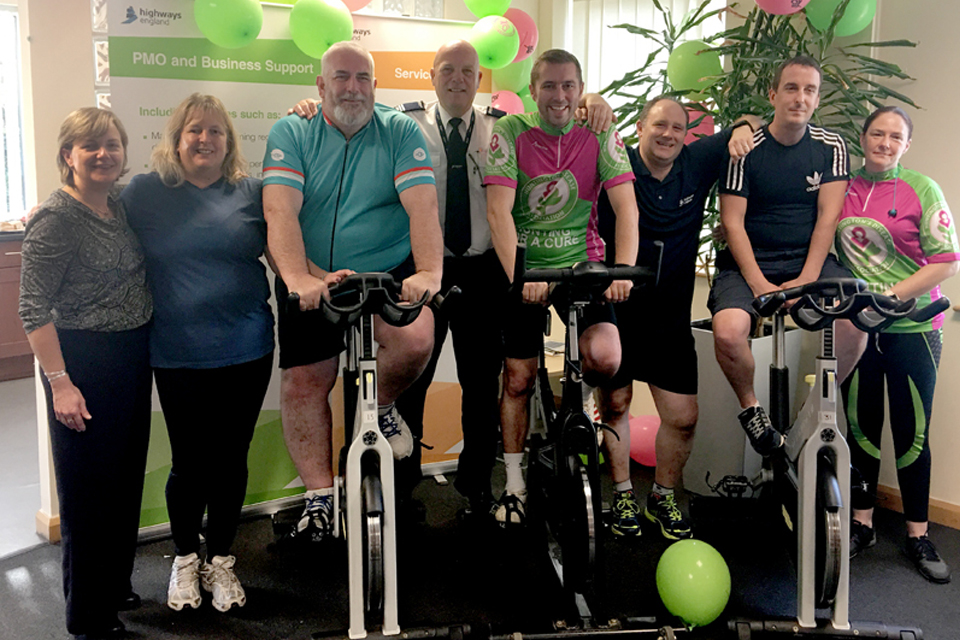
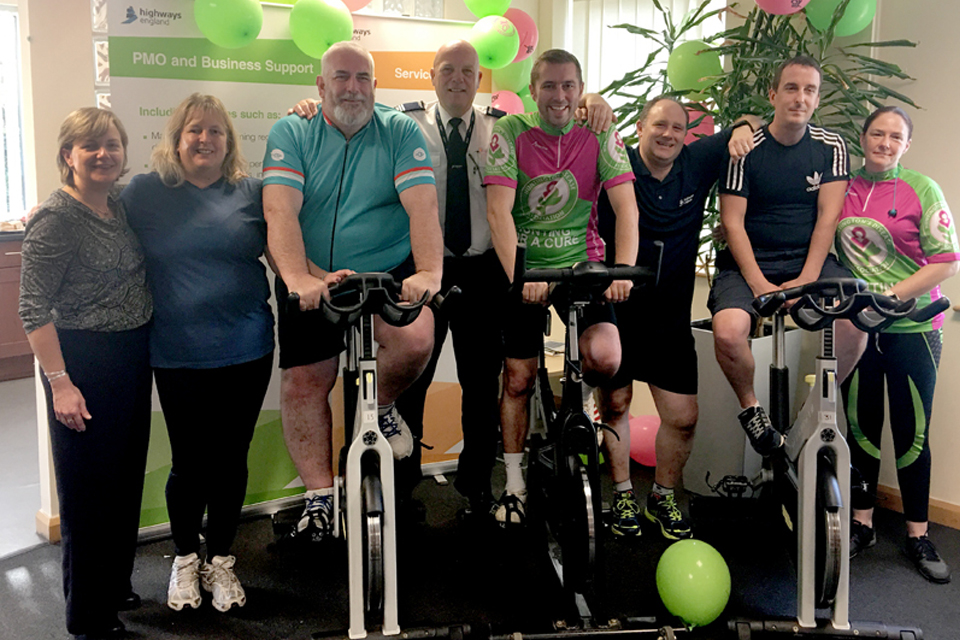
The South West-based traffic officers had set a target of covering 350 miles in a 24-hour spin bike challenge, equivalent to the distance of motorway and major trunk road they patrol in the region – all in aid of the Huntington’s Disease Association.
The team, receiving social media support along the way from the likes of actor and TV presenter Shane Richie and singer Tony Hadley, smashed that target by pedalling their way to a total of 502 miles over 24 hours at the South West Regional Operations Centre at Avonmouth.
The team of nine traffic officers, all based at Highways England’s Almondsbury Outstation, were Clarke Hobbs, Andy Watts, Lou Stout, Anthony Reeves, Alan Sludden, Barry Thomas, Jolene Britton, Alistair Steel and Lou Quinton.
Splitting the tasks in shifts, and aided by fellow Highways England staff, they reached their target, and more, between 4pm on Monday 9 October and 4pm on Tuesday 10 October – raising an impressive total of £1,640 in the process.
Avonmouth-based operations manager Sean Dowding said:
The Huntington’s Disease Association is a charity close to our hearts and we really wanted to do something to raise awareness of the disease.
We’re delighted to raise the amount we did, and also the support we received from our colleagues in the South West and further afield, and also from the the Bradley Stoke Leisure Centre, who kindly donated two of the bikes.
We tweeted updates over the 24 hours, which created a bit more interest, and it was really nice to get some social media support, particularly the retweets from Shane Richie and Tony Hadley.
Huntington’s Disease is a hereditary disorder of the nervous system that over time causes serious cognitive, emotional and psychological changes. It affects, on average, 12 people in every 100,000 in the UK. For more information go to the Huntington’s Disease Association website.
General enquiries
Members of the public should contact the Highways England customer contact centre on 0300 123 5000.
Media enquiries
Journalists should contact the Highways England press office on 0844 693 1448 and use the menu to speak to the most appropriate press officer.
Link: Press release: Traffic officers’ bike challenge is a real spin-off for charity
Source: Gov Press Releases
Press release: Universities and Science Minister calls on universities to do more to commercialise UK research and innovation
- new proposals to develop a Knowledge Exchange Framework to compare how effective universities are at business engagement and knowledge exchange are outlined
- the Minister also announced the first successful projects from the £100m Connecting Capability Fund and the successful regions selected for the third wave of the Science and Innovation Audits
Universities and Science Minister Jo Johnson today (12 October 2017) outlined his vision to secure the UK’s status as a pioneering nation and called for universities to secure more return from the research conducted by institutions across the UK.
Speaking at the Higher Education Funding Council for England’s (HEFCE) annual conference, Jo Johnson reinforced the importance of science and innovation in the Industrial Strategy and urged universities to deepen collaborative relationships with businesses to ensure the UK’s innovative strength has real-world and economic impact.
As part of this, new analysis published today by HEFCE of the Higher Education Business and Community Interaction Survey highlights the progress already being made in improving knowledge sharing between UK universities and the commercial sector, which has continued to grow in 2015-16, with income reaching a record £4.2 billion. Despite this progress, the UK still lags behind comparable countries like the United States in terms of intellectual property income per research resource and the number of successful spin-off companies.
Jo Johnson said:
Universities have a vital role to play in their local communities and in the national economy. Given the record levels of public investment in R&D, it is essential that universities engage with businesses and communities to make the most of their knowledge and research.
There are great examples of this across the country but the system needs to find a new gear. University income from business engagement is growing more slowly than the economy as a whole, with British universities producing fewer spin-outs and less licensing income per pound of research resource than US counterparts. As a greater proportion of R&D takes place in universities in the UK than in other countries, it’s especially important that we get this right.
To help close this gap, the Science Minister announced plans to ask Research England within the new UK Research and Innovation body to consult the sector on the development of a new, public Knowledge Exchange Framework (KEF) to benchmark the performance from university-business collaboration and knowledge exchange. This builds upon the work undertaken by the knowledge exchange steering group led by Professor Trevor McMillan, and complements his proposal that the sector should develop clear statements of purpose in order to increase the effectiveness of engagement with business and the wider community.
Alongside the Research Excellence Framework and the Teaching Excellence Framework, the KEF will act as a benchmark for universities to ensure they are making the most of the opportunities available and help ensure that the UK benefits from the research, skills and knowledge in the higher education sector.
Additional funding for the Rutherford Fund:
The Government has been clear on its ambition to foster greater international collaboration in science and innovation, recently signing a Science and Technology Agreement with the United States and outlining plans to seek an ambitious science and innovation agreement with the EU. Celebrating the important contribution international scientists and researchers make to UK innovation, the Science Minister pledged an additional £18 million for the Rutherford Fund budget to attract the brightest minds to the UK. The funding is on top of the £100 million the Government has already invested and will enable an additional 200 fellowships to start this year, ensuring the UK remains the go to place for innovation and scientific discovery.
Connecting Capability Fund:
Jo Johnson also announced the first four projects to receive funding from the £100 million Connecting Capability Fund. Focused on university collaborations to boost the commercialisation of research, the first round will see groups of universities from England share £20 million to address areas such as age-related diseases, access to finance for spinouts, and support for SMEs as they scale-up.
Science and Innovation Audits Wave 3:
Emphasising the value of greater collaboration to further innovation, Jo Johnson confirmed the next 12 regions that will undertake a Science and Innovation Audit (SIA) to map their local research, innovation, and infrastructure strengths. Now in its third wave, the SIA process has already brought together businesses, universities, Local Enterprise Partnerships and the Devolved Administration equivalents to identify the opportunities for inward investment and regional growth, and will explore strengths in a number of sectors and disciplines across the UK including the marine economy in the Highlands and Islands and applied digital technologies in the North East of England.
NOTES:
The twelve consortia that will be part of the 3rd wave of the Science and Innovation Audits are:
- Cyber Resilience Alliance (led by Worcestershire LEP with support from The Marches, Gloucestershire and Swindon and Wiltshire LEPs)
- Maximising the Marine Economy of the Highlands & Islands (Led by Highlands and Islands Enterprise)
- North West Nuclear Arc Consortium (led by Bangor University with support from Welsh Government and North West England LEPs)
- North West Coastal Arc Eco-Innovation Partnership (led by Lancaster University with support from North West England LEPs and the Welsh Government)
- Northern Powerhouse Chemicals & Processing Science (led by Tees Valley Combined Authority with support from North East, Humberside, and Liverpool City Region LEPs)
- Northern Powerhouse in Health Research (led by Northern Health Science Alliance and includes LEPs, universities and teaching hospitals from across the Northern Powerhouse)
- The South Wales Crucible (led by Swansea University)
- Upstream Space (led by UKSA/Scottish Enterprise comprising Scotland; Leicester; Belfast and a corridor between Cambridge and Portsmouth)
- Precision Medicine Innovation in Scotland (led by the University of Glasgow)
- Applied Digital Technologies (led by North East LEP)
- Sustainable Airports (led by Brunel University, looking at Heathrow)
- The Knowledge Quarter, London
The first four funding projects within the Connecting Capability Fund are:
- East of England – Essex University, University of East Anglia and University of Kent will collaborate on a project which aims to address the region’s productivity challenges by supporting company development and entrepreneurial skills growth
- North of England – Higher Education Institutions in Manchester, Leeds, and Sheffield will collaborate on a project which aims to establish an investment fund to improve access to finance for university spinouts
- South of England – this will be an extension of an existing collaboration between the universities of Bath, Bristol, Exeter, Southampton and Surrey (the SETsquared Partnership) which aims to better support SMEs as they scale-up
- The universities of Oxford, Birmingham and Dundee, and the Francis Crick Institute are collaborating on a project which aims to support the development of new therapeutics to tackle age-related diseases
Knowledge Exchange Framework:
Following the Innovation & Science Strategy 2014, HEFCE sought to increase the effectiveness of university knowledge exchange by establishing a knowledge exchange (KE) framework and steering group. The Vice-Chancellor of Keele University, Trevor McMillan, was asked to champion this within the sector. A number of tools and good practice guides for KE (such as “Good practice in tech transfer”) have already been developed and have been used by Higher Education Institutions (HEIs) when developing their KE strategies.
Extensive data is already collected about universities’ KE performance via the Higher Education Statistics Agency’s (HESA) annual Higher Education Business Community Interaction Survey, and Research England will consult the sector as to how this data can be used to develop a balanced scorecard. Other recommendations from the McMillan Group are being taken forward, including the sector developing a set of common principles for effective KE, and the leadership of HEIs committing to adopting these principles.
Link: Press release: Universities and Science Minister calls on universities to do more to commercialise UK research and innovation
Source: Gov Press Releases
Press release: Scottish Secretary: Banging the drum for Scottish exports
- Scottish Secretary joins President of the Board of Trade Dr Liam Fox at the first new Board of Trade today in Bristol.
- First meeting attended by representatives from Scotland, Wales and Northern Ireland.
- Advisers from across the United Kingdom present – including two from Scotland – to provide expertise on trade and investment.
Secretary of State for Scotland, David Mundell, will today [12 October] take his place at the table of the new Board of Trade, convened to help boost exports, attract inward investors and ensure the benefits of free trade are spread equally across the country.
The new UK Government Board of Trade will bring together prominent figures from business and politics from each part of the UK to provide expertise and guide the Board on trade and investment matters.
David Mundell will be joined two expert business advisers from Scotland: Brian Wilson and Ian Curle.
Secretary of Scotland David Mundell said:
As the UK leaves the EU and we create an ambitious new trading relationship with the world, it is imperative that the voices of Scottish businesses are at the very heart of our planning.
I will be joining Cabinet colleagues in Bristol today as part of the UK Government’s new Board of Trade to bang the drum for Scottish businesses. The UK Government is committed to driving prosperity, supporting Scottish businesses and ensuring everyone feels the economic benefits as we build a truly global Britain.
I am very pleased that Brian Wilson and Ian Curle are joining us in this effort. Together, we will be a strong voice for Scotland, as we aim to help more Scottish businesses export overseas.
President of the Board of Trade Dr Liam Fox said:
There is a world of opportunity out there for UK businesses and the Board of Trade will help identify and unlock new export markets and encourage further inward investment.
The advisers on the Board will act as the ‘eyes and ears’ of the modern businesses community to ensure the benefits of free trade are spread equally across the country.
Brian Wilson was a Labour MP from 1987 until 2005 and is a former UK Trade Minister and Energy Minister. He is currently the chairman of Harris Tweed Hebrides and a director of Celtic plc. In 2012, he was named UK Global Director of the Year by the institute of Directors and in 2014 was the author of a report on Scottish exporting. Brian is also a Visiting Professor at the University of Strathclyde.
Ian Curle has served as CEO of the Edrington Group since 2004, having joined the company in 1986. Edrington is one of Scotland’s leading premium spirits companies and produces internationally recognised brands such as The Famous Grouse. The company has annual sales of over £500m. Ian is also chairman of the North British Distillery and former chairman of The Scotch Whisky Association.
Link: Press release: Scottish Secretary: Banging the drum for Scottish exports
Source: Gov Press Releases
The Policing and Crime Act (Financial Sanctions) (Overseas Territories) Order 2017
Link: The Policing and Crime Act (Financial Sanctions) (Overseas Territories) Order 2017
Source: Legislation .gov.uk
Press release: Draft Tariff Cap Bill published by government
- Draft legislation designed to place a temporary cap on energy prices will be scrutinised by Parliament
- Publication comes as regulator announces a further million vulnerable consumers are to be protected by its existing price cap this winter
- Government remains committed to putting an end to households being charged excessive prices for their energy
Draft legislation that would see rip-off energy prices capped for millions of households has been published by the government today (Thursday 12 October).
The Department for Business, Energy and Industrial Strategy has outlined measures in the draft bill that would limit the cost of standard variable tariffs (SVTs) and other default tariffs that customers are moved onto at the end of a fixed-term deal.
Around two-thirds of energy consumers in Great Britain are currently on this type of tariff – that is around 18 million customer accounts, four million of which are on pre-payment meters and are already protected by a price cap.
As Ofgem announced yesterday, a further million vulnerable households will be protected from unfairly high bills this winter, meaning five million people this winter will be protected by price caps.
This has been welcomed but the government believes no-one should be overcharged by their energy company. It is now up to the energy companies and Ofgem to act – if they fail to act, the legislation will ensure customers get a fair deal.
The government will ask the Commons’ Business, Energy and Industrial Strategy Select Committee to scrutinise the Draft Domestic Gas and Electricity (Tariff Cap) Bill. The proposed legislation would mean a cap would run until 2020 at which point the independent regulator, Ofgem, would recommend to government whether it should be extended on an annual basis, up to expiry in 2023.
The Prime Minister said:
I have been clear that our broken energy market has to change – it has to offer fairer prices for millions of loyal customers who have been paying hundreds of pounds too much.
Today’s publication of draft legislation is a vital step towards fixing that, and in offering crucial peace of mind for ordinary working families all over the country.
Business and Energy Secretary Greg Clark said:
People who show loyalty to well-known brands are paying hundreds of pounds a year too much on standard variable tariffs and I am determined that this practice should end.
We have published draft legislation today, sending a clear message to the industry that we will protect the interests of their customers if they do act now to tackle the detriment found by the Competition and Markets Authority.
As the Competition and Markets Authority review of the retail energy market found last year, customers of the Big Six suppliers on standard variable tariffs and other default tariffs face a £1.4bn-a-year detriment. The government is determined to tackle this detriment, including through the introduction of smart meters that will enable consumers to see the cost of their energy usage and more easily find the best tariff for them.
Link: Press release: Draft Tariff Cap Bill published by government
Source: Gov Press Releases
The Repatriation of Prisoners (Overseas Territories) Order 2017
Link: The Repatriation of Prisoners (Overseas Territories) Order 2017
Source: Legislation .gov.uk
The Counter-Terrorism and Security (Jersey) Order 2017
Link: The Counter-Terrorism and Security (Jersey) Order 2017
Source: Legislation .gov.uk