
Press release: Scottish Secretary: Banging the drum for Scottish exports

  • Scottish Secretary joins President of the Board of Trade Dr Liam Fox at the first new Board of Trade today in Bristol.
  • First meeting attended by representatives from Scotland, Wales and Northern Ireland.
  • Advisers from across the United Kingdom present – including two from Scotland – to provide expertise on trade and investment.

Secretary of State for Scotland, David Mundell, will today [12 October] take his place at the table of the new Board of Trade, convened to help boost exports, attract inward investors and ensure the benefits of free trade are spread equally across the country.

The new UK Government Board of Trade will bring together prominent figures from business and politics from each part of the UK to provide expertise and guide the Board on trade and investment matters.

David Mundell will be joined two expert business advisers from Scotland: Brian Wilson and Ian Curle.

Secretary of Scotland David Mundell said:

As the UK leaves the EU and we create an ambitious new trading relationship with the world, it is imperative that the voices of Scottish businesses are at the very heart of our planning.

I will be joining Cabinet colleagues in Bristol today as part of the UK Government’s new Board of Trade to bang the drum for Scottish businesses. The UK Government is committed to driving prosperity, supporting Scottish businesses and ensuring everyone feels the economic benefits as we build a truly global Britain.

I am very pleased that Brian Wilson and Ian Curle are joining us in this effort. Together, we will be a strong voice for Scotland, as we aim to help more Scottish businesses export overseas.

President of the Board of Trade Dr Liam Fox said:

There is a world of opportunity out there for UK businesses and the Board of Trade will help identify and unlock new export markets and encourage further inward investment.

The advisers on the Board will act as the ‘eyes and ears’ of the modern businesses community to ensure the benefits of free trade are spread equally across the country.

Brian Wilson was a Labour MP from 1987 until 2005 and is a former UK Trade Minister and Energy Minister. He is currently the chairman of Harris Tweed Hebrides and a director of Celtic plc. In 2012, he was named UK Global Director of the Year by the institute of Directors and in 2014 was the author of a report on Scottish exporting. Brian is also a Visiting Professor at the University of Strathclyde.

Ian Curle has served as CEO of the Edrington Group since 2004, having joined the company in 1986. Edrington is one of Scotland’s leading premium spirits companies and produces internationally recognised brands such as The Famous Grouse. The company has annual sales of over £500m. Ian is also chairman of the North British Distillery and former chairman of The Scotch Whisky Association.

Link: Press release: Scottish Secretary: Banging the drum for Scottish exports
Source: Gov Press Releases
Press release: Draft Tariff Cap Bill published by government

  • Draft legislation designed to place a temporary cap on energy prices will be scrutinised by Parliament
  • Publication comes as regulator announces a further million vulnerable consumers are to be protected by its existing price cap this winter
  • Government remains committed to putting an end to households being charged excessive prices for their energy

Draft legislation that would see rip-off energy prices capped for millions of households has been published by the government today (Thursday 12 October).

The Department for Business, Energy and Industrial Strategy has outlined measures in the draft bill that would limit the cost of standard variable tariffs (SVTs) and other default tariffs that customers are moved onto at the end of a fixed-term deal.

Around two-thirds of energy consumers in Great Britain are currently on this type of tariff – that is around 18 million customer accounts, four million of which are on pre-payment meters and are already protected by a price cap.

As Ofgem announced yesterday, a further million vulnerable households will be protected from unfairly high bills this winter, meaning five million people this winter will be protected by price caps.

This has been welcomed but the government believes no-one should be overcharged by their energy company. It is now up to the energy companies and Ofgem to act – if they fail to act, the legislation will ensure customers get a fair deal.

The government will ask the Commons’ Business, Energy and Industrial Strategy Select Committee to scrutinise the Draft Domestic Gas and Electricity (Tariff Cap) Bill. The proposed legislation would mean a cap would run until 2020 at which point the independent regulator, Ofgem, would recommend to government whether it should be extended on an annual basis, up to expiry in 2023.

The Prime Minister said:

I have been clear that our broken energy market has to change – it has to offer fairer prices for millions of loyal customers who have been paying hundreds of pounds too much.

Today’s publication of draft legislation is a vital step towards fixing that, and in offering crucial peace of mind for ordinary working families all over the country.

Business and Energy Secretary Greg Clark said:

People who show loyalty to well-known brands are paying hundreds of pounds a year too much on standard variable tariffs and I am determined that this practice should end.

We have published draft legislation today, sending a clear message to the industry that we will protect the interests of their customers if they do act now to tackle the detriment found by the Competition and Markets Authority.

As the Competition and Markets Authority review of the retail energy market found last year, customers of the Big Six suppliers on standard variable tariffs and other default tariffs face a £1.4bn-a-year detriment. The government is determined to tackle this detriment, including through the introduction of smart meters that will enable consumers to see the cost of their energy usage and more easily find the best tariff for them.

Link: Press release: Draft Tariff Cap Bill published by government
Source: Gov Press Releases

Press release: PHE urges those at highest risk of flu to get vaccinated

People who are the most vulnerable to flu are being urged to get their free vaccination from today (12 October 2017), ahead of the winter period when the virus is most common.

This year, Public Health England (PHE) is offering the vaccination to more people than ever – around 21 million people in total. Children in school year 4 will be offered the vaccine for the first time and children over age 4 in reception year can get their vaccine in school.

The national drive marks the start of ‘Stay Well This Winter’, an initiative from PHE and NHS England to help the most vulnerable people prepare for winter and avoid having to visit hospital due to common winter illnesses.

Professor Paul Cosford, PHE’s Medical Director, said:

This year we are offering the nasal spray vaccine to more children than ever. Ensuring children get vaccinated is extremely important not only to protect them from flu but also to stop then spreading it to vulnerable groups they come in to contact with. For someone with a long term health condition like asthma or COPD, flu has the potential to turn very serious. We want as many eligible people as possible to get their jab, as it is the best way to protect everyone from flu and minimise the burden on the NHS during the season when it faces the most pressures.

Around 6.3 million people under 65 in England have a long-term health condition and are more at risk of suffering potentially fatal complications from flu. Last year, uptake amongst high risk groups increased by 3.5% amongst eligible people.

Those who are eligible for the free flu vaccine include:

  • adults over 65
  • pregnant women
  • children aged 2 and 3 as well as pupils in reception class and school years 1 to 4
  • people with long-term health conditions (including asthma, COPD and cardiovascular issues)

Another way of protecting vulnerable adults is to vaccinate children, who are ‘super-spreaders’ of the vaccine. For healthy children aged 2 and 3 the flu vaccine is in the form of a nasal spray, administered by a health professional. Parents of over 3 million children in reception class and school years 1, 2, 3 and 4 will be asked to agree to have their children vaccinated in school.

Last year’s flu vaccination programme reduced the risk of flu in children who received the vaccine by 65.8% compared to those that didn’t.

Dr. Rosemary Leonard, GP and broadcaster, said:

Young children’s bodies can find it hard to cope with flu, so it is especially important to protect them with the vaccine. The nasal spray is a quick, effective and painless alternative to needles.

Once ill, children also tend to spread infection more than adults. The vaccine helps to reduce the spread of flu to other more vulnerable family members, such as grandparents.

To get your vaccine or find out if you are eligible, contact your GP, pharmacist or midwife for more information. Visit nhs.uk/staywell for more details on how to help you and your family to stay well this winter.

Background

  1. Public Health England exists to protect and improve the nation’s health and wellbeing and reduce health inequalities. It does this through advocacy, partnerships, world-class science, knowledge and intelligence, and the delivery of specialist public health services. PHE is an operationally autonomous executive agency of the Department of Health. Follow us on Twitter @PHE_uk.

  2. The national flu campaign will also encourage pregnant women to protect themselves against flu in the run up to winter. Pregnancy naturally weakens the body’s immune system and as a result, flu can cause serious complications for the mother and baby.

  3. For the first time, year 4 children will be offered the vaccine in a school setting, along with year groups 1, 2 and 3. Evidence shows this method ensures greater uptake of the vaccine, and consequently offers greater population protection through herd immunity.

Public Health England press office

Link: Press release: PHE urges those at highest risk of flu to get vaccinated
Source: Gov Press Releases

Press release: New £48 billion funding for Britain’s railways

  • government unveils latest stage of multi-billion pound investment in railways across the country
  • record level of funding to continue from the last 5 years of investment, but greater focus on efficiency
  • new focus on everyday services will see billions more invested in renewing existing infrastructure to improve punctuality and reliability to deliver a high-quality service to passengers

Transport Secretary Chris Grayling today (12 October 2017) unveiled the latest stage in the government’s record investment in Britain’s railways.

He set out the next round of rail funding, announcing that around £48 billion will be spent on the network over a 5 year period, from 2019 to 2024, including more maintenance and a huge uplift in renewals to increase reliability and punctuality for passengers.

The funding comes on top of record rail funding over the past 5 years as the government delivered the biggest rail modernisation programme for over a century.

And the Transport Secretary confirmed there will also be a new funding process for major upgrades and enhancements which will provide more rigour in investment decisions to make sure public spending best meets the needs of passengers and freight.

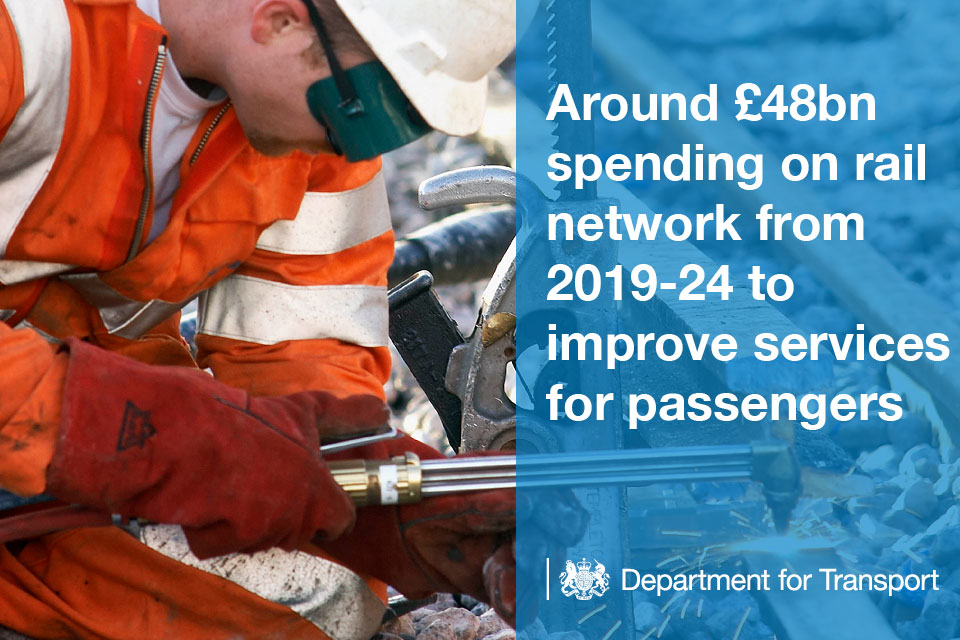
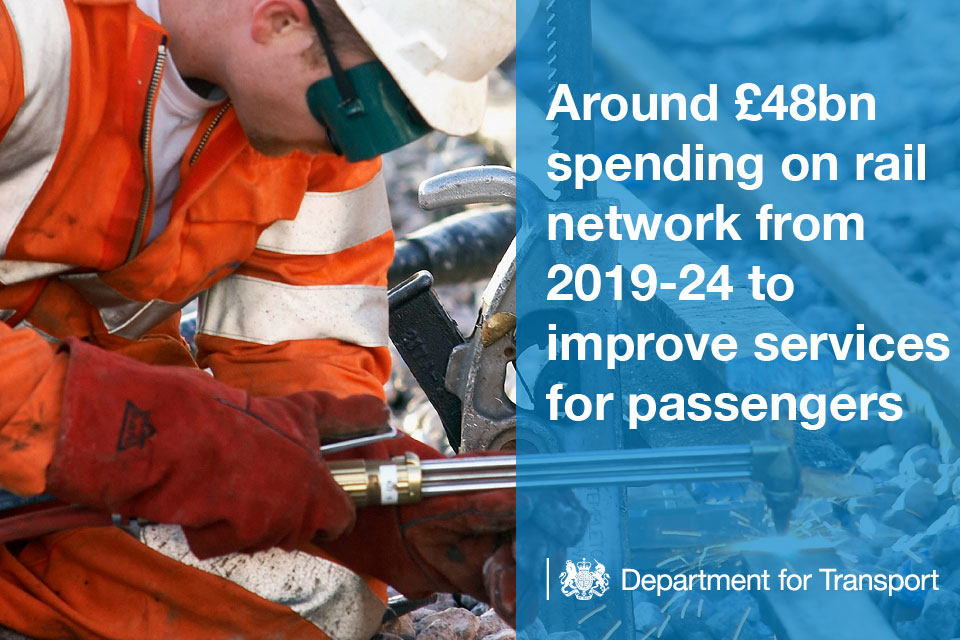
Around £48 billion will be spent on railways from 2019 to 2024 to improve passenger services

Transport Secretary Chris Grayling said:

This government is continuing its record funding in Britain’s rail network.

As a commuter, I know how frustrating it is to be delayed by problems on the line. Passengers want a railway they can rely on and that’s where this huge investment will make a real difference to their everyday lives – by renewing more tracks earlier and increasing maintenance to deliver far better services.

This investment is about boosting reliability and punctuality for millions of journeys, and we will do this alongside building major upgrades around the country and delivering new, faster, more comfortable trains.

The Statement of funds available for the rail industry continues the government’s record investment with a direct grant of up to £34.7 billion for spending between 2019 and 2024. Total spending will be around £47.9 billion once Network Rail’s expected income is calculated and added to the pot.

Today’s announcement includes funding for the early stages of developing new rail schemes. But, in a departure from the previous approach, the government will allocate funds separately for major upgrades following a new process to ensure they are deliverable and secure the best value for money for the tax payer. This new process will be set out in more detail later this year.

Rail media enquiries

Link: Press release: New £48 billion funding for Britain’s railways
Source: Gov Press Releases