These Regulations are made in exercise of the powers conferred by section 8(1) of the European Union (Withdrawal) Act 2018 (c. 16) in order to address failures of retained EU law to operate effectively and other deficiencies (in particular under section 8(2)(d)(ii)) arising from the withdrawal of the United Kingdom (“UK”) from the European Union (“EU”).
The government has started distributing an estimated £400 million to remove and replace unsafe aluminium composite material (ACM) cladding systems on social sector high-rise housing in England owned by social landlords.
Twelve local authorities and 31 housing associations are being told today (17 October 2018) that they have been allocated the money they need to cover the cost of removing and replacing unsafe ACM cladding from social, residential buildings they own which are 18 metres or higher.
This funding will enable local authorities and housing associations to get on with the job of making their buildings safe without having an impact on other vital services. As work is ongoing, costs are subject to change, and that is why the government will be closely monitoring progress.
Secretary of State for Communities, the Rt Hon James Brokenshire MP said:
There is nothing more important than ensuring people are safe in their homes and that is why I am pleased the £400 million funding has started to be released.
We are doing the right thing by residents and fully funding the replacement of unsafe ACM cladding in social housing buildings 18 metres or above.
In the private sector, I want to see landlords protect leaseholders from these costs. I am pleased that a number have stepped forward to do so, including Barratt Developments, Legal & General, Taylor Wimpey, Mace and Peabody. However, there are some who are not engaging in this process. If they don’t, I have ruled nothing out.
The latest figures from the Ministry of Housing, Communities and Local Government show that over 75% of social housing buildings with unsafe ACM cladding have completed remediation or are currently removing and replacing the cladding, with plans in place for the remaining 25%. Interim fire safety measures are in place in all affected buildings to keep residents safe until the cladding has been replaced.
Following the Grenfell Tower tragedy, the government established a comprehensive building safety programme that included an independent review of fire safety and building regulations.
The government published its response to this review and, following consultation, has confirmed that it is banning the use of combustible materials on all residential high-rise buildings above 18 metres so that people are safe in their homes now, and in the future. Full details of the ban and how the recommendations of the Hackitt review will be implemented will be published later this year.
Further information
Application process and distribution of funds
Applications for 159 buildings have been received to date and 135 applications have been approved in this first tranche of funding.
Twelve applications were not eligible for funding because they didn’t meet the application criteria – for example the buildings are below 18 metres, owned by commercial freeholders or the cladding is not ACM.
Twelve applications have been deferred while building owners provide further information so that we can confirm eligibility.
There is nothing more important than ensuring people are safe in their homes and so the department has taken the view that applications received after the 31 August deadline will still be reviewed.
The government is paying 80% of the estimated eligible costs up front when work starts, with the remaining 20% when the work is complete and final costs are known. The funding allocated so far comes to £248 million.
Latest building safety data
The government publishes the latest building safety data it holds on a monthly basis, showing how many buildings are in the process of removing and replacing unsafe ACM cladding.
These Regulations amend the Environmental Noise (England) Regulations 2006 (S.I. 2006/2238) to implement Commission Directive (EU) 2015/996 establishing common noise assessment methods according to Directive 2002/49/EC of the European Parliament and of the Council (OJ No L 168, 1.7.2015, p 1).
The Coal Authority outlined how this legacy is now playing its part in the drive for green energy, clean growth and sustainability.
A number of initiatives are now helping to save costs, generate income and support sustainable energy as part of the government’s Clean Growth Strategy.
Lisa Pinney MBE, Chief Executive, Coal Authority, said:
We’re delighted to support Green GB Week and committed to working with the Department for Business, Energy and Industrial Strategy to promote the government’s Clean Growth Strategy and Heat Networks Investment Project.
We’re committed to changing our mind set from one focused on dealing with the problems of Britain’s mining legacy to one that focuses on the opportunities of our mining heritage.
To fully realise these opportunities we’re thinking differently, working with others and being bold in our approach.
Low carbon energy and water supply resilience
Work is already underway to make the most of these opportunities for the nation. In a surprising role reversal, abandoned coal mines are now being considered as a potential new low carbon heat source.
Exciting developments such as ground based solar installations and power efficiencies on former
colliery sites are also saving the Coal Authority £0.7 million this year alone.
Water from mine water treatment schemes, and water stored in abandoned mines, could play an important role in balancing water supplies for consumption or the environment in future: mines themselves could play a role in storing water during flood conditions.
Innovations in mine water treatment
New uses for by-products from coal mine water treatment are also among the ‘green’ innovations developed by the Coal Authority.
Ochre used to be classed as waste but has been developed as a pigment for the fine arts market. It can also be used to remediate contaminated land.
Iron removed from mine water during the treatment process is also being used to remove phosphorus as part of the sewage treatment process. This helps to improve water quality and support river ecology.
Claire Perry, Minister for Energy and Clean Growth, said:
The UK has led the world in cutting emissions whilst growing our economy – with clean growth driving incredible innovation and creating hundreds of thousands of high quality jobs.
Ten years on from the Climate Change Act, the first ever Green GB week is a time to build on our successes and explain the huge opportunities for business and young people of a cleaner economy.
I’m delighted to see how many more businesses and organisations such as the Coal Authority are seizing this multi-billion pound opportunity to energize their communities to tackle the very serious threat of climate change.
Discover more
Coal mines may no longer be the feature of Britain’s landscape that they once were, but their legacy is now revealing new opportunities for our generation to explore.
The Coal Authority will publish its latest Sustainability Report soon, which highlights its sustainability performance in 2017-18, during which time it:
recycled over 3,700 tonnes of reedbed waste, reducing the environment impacts associated with landfill
increased its portfolio of solar arrays, taking its renewable generating capacity to 712 kW
reduced its carbon footprint, as part of its efficiencies programme
won a prestigious edie Sustainability Leaders Award 2018, for its work in finding new ways to reuse waste products, and was shortlisted for Sustainable Business of the year
Making Tax Digital for VAT will make it easier for businesses to manage their tax and will save them, and their agents, time which can instead be devoted to maximising business opportunities, encouraging growth and fostering good financial planning.
From 1 April 2019, under Making Tax Digital, around 1 million businesses registered for VAT with a taxable turnover above £85,000 will need to keep their VAT records digitally and file their returns using Making Tax Digital-compatible software.
The pilot opens today for around half a million businesses whose affairs are up to date and straightforward, and will extend to most other business types over the coming months. HMRC has also listened to concerns and will give a small group of customers with more complex requirements a further 6 months to prepare. This will ensure there is sufficient time for testing the service with them in the pilot before they are required to join.
HMRC is transforming the tax administration so that it’s more effective, more efficient and easier for taxpayers. Today’s announcement means that around half a million businesses will be able to join Making Tax Digital and start filing their VAT returns online, making it easier to get their tax right first time.
More and more businesses use digital tools every day to help them operate – tax shouldn’t be different. This is a major step towards bringing VAT into the 21st century.
Theresa Middleton, Director for Making Tax Digital for Business, said:
Millions of people are already banking, paying bills and interacting with their suppliers and customers online. Using digital tools to help businesses manage their business income and expenses and get their tax right builds on this momentum and will also help them get more control over their finances.
Eligible businesses and agents shouldn’t leave preparations to the last minute and are encouraged to join the pilot as soon as they can. Read more information on Making Tax Digital.
Background
HMRC’s ambition is to become one of the most digitally advanced tax administrations in the world and Making Tax Digital is making fundamental changes to the way the tax system works – transforming tax administration so that it is:
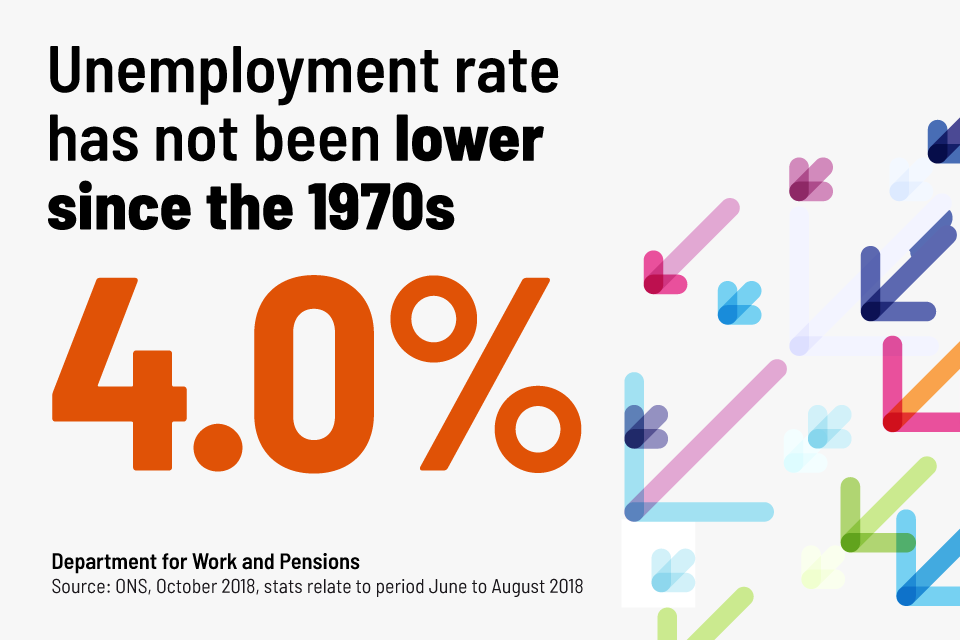
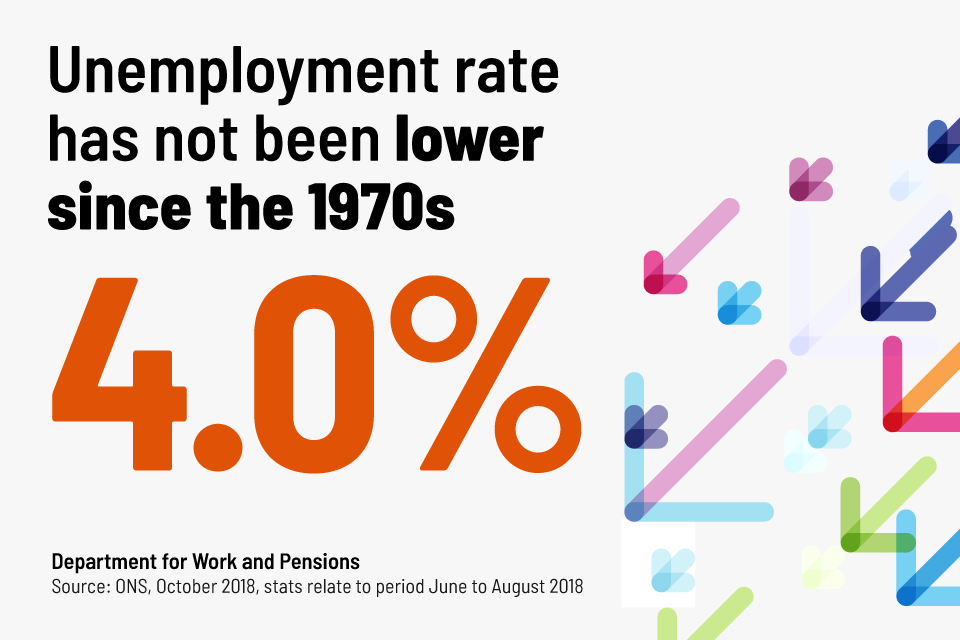
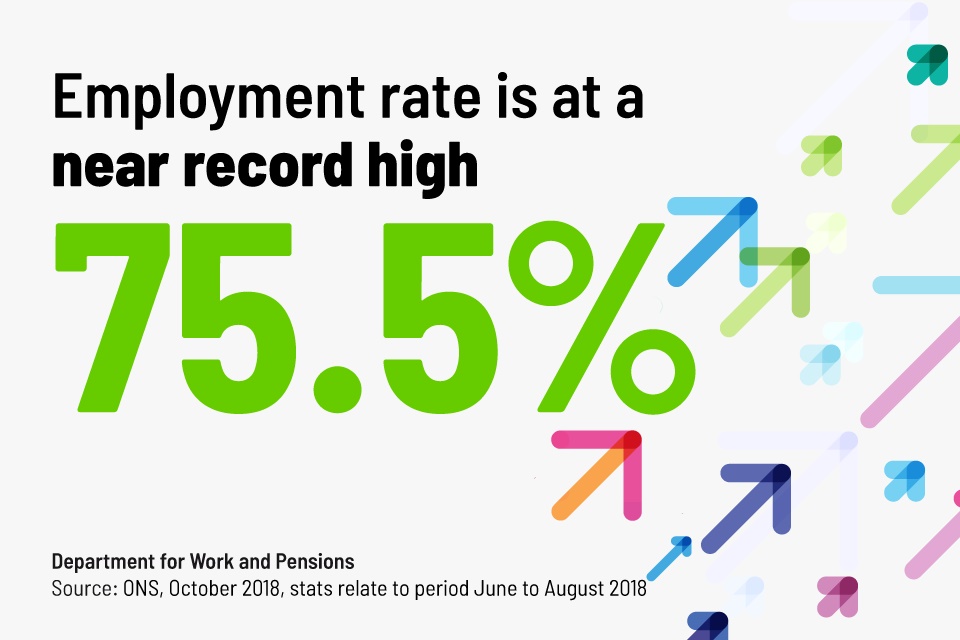
The figures also show that the unemployment rate of 4.0% has not been lower since 1975. Real wages are up for the seventh month in a row, rising by 0.7% above inflation and employment remained high at 75.5%, up 0.4% points on the year.
The proportion of young people who are unemployed is at a new record low, as more than 120,000 more young people have a job than in 2010. At the same time, fewer children are now growing up in a home without any adults in work than ever before. There are 637,000 fewer children in this position than in 2010, helping inspire more young people into work themselves.
It comes as over 3.3 million more people have entered work since 2010, meaning an average of 1,000 more people in work every day.
The UK saw a seventh month of real terms pay increases, with regular wages up by 3.1% in August, or 0.7% against CPIH inflation.
On top of this, figures show the majority of jobs created since 2010 are full time, permanent roles that are in higher skilled occupations, which typically bring higher earnings – all ambitions of the government’s Industrial Strategy which seeks to create better, well-paying jobs fit for the future.
Unemployment has fallen across all regions of the UK since 2010, with today’s figures showing that the West Midlands, London and Wales in particular have seen the largest employment growth in work in the last year.
Work and Pensions Secretary Esther McVey said:
This month’s figures show youth unemployment has fallen by 50 percent since 2010, down to a new record low, showing our welfare reforms are working and giving young people a better future.
We want to empower young people; open up new career opportunities – deliver a brighter future for them.
Minister of State for Employment Alok Sharma said:
I am particularly encouraged that wages continue to be on the up, outpacing inflation for the seventh month in a row with regular pay up 3.1% on the year – the fastest growth in almost a decade.
And with unemployment at its lowest since the 1970s, since 2010 there are more people with the security of a job, more people with a regular salary, and more people able to support their families – and that is thanks to action this government has taken to build an economy that works for everyone.
The government is helping even more people benefit from a well-paid job by:
backing businesses to create good jobs with our modern Industrial Strategy, while ensuring they play by the rules, so we are closing tax loopholes, strengthening workers’ rights, and tightening the rules big businesses must follow
investing in the infrastructure, training and apprenticeships we need for our future, with public investment at the highest sustained level in 40 years
introducing Universal Credit which is helping people move into work faster and stay in it longer (separate figures out today show that 430,000 people are now receiving Universal Credit)
helping people stay in work longer with our Fuller Working Lives strategy, which supports employers to recruit, re-train and retain older workers
tackling inequalities in employment highlighted by the Race Disparity Audit, through targeted support in 20 areas around the country and £90 million announced by the Prime Minister to help young people
We are also arranging work experience sessions for students through Jobcentre Plus, in over 1,400 schools. The scheme is being rolled out across the country, to ensure young disadvantaged kids aged 12 to 18 get opportunities, including work experience, to learn about the world of work and consider future career options. So far, the partnership between Jobcentre Plus and local schools has resulted in around 12,000 sessions for pupils, parents and teachers helping to prepare pupils for the world of work.
Contact Press Office
Media enquiries for this press release – 020 3267 5162
Press Office
Caxton House
Tothill Street London SW1H 9NA
London Press Office (national media and London area enquiries only – not questions about personal claims)
020 3267 5144
Out-of-hours (journalists only)
07623 928 975
England and Wales (local media enquiries)
029 20 586 then 097 or 098 or 099