Press release: Unemployment rate lowest in over 40 years

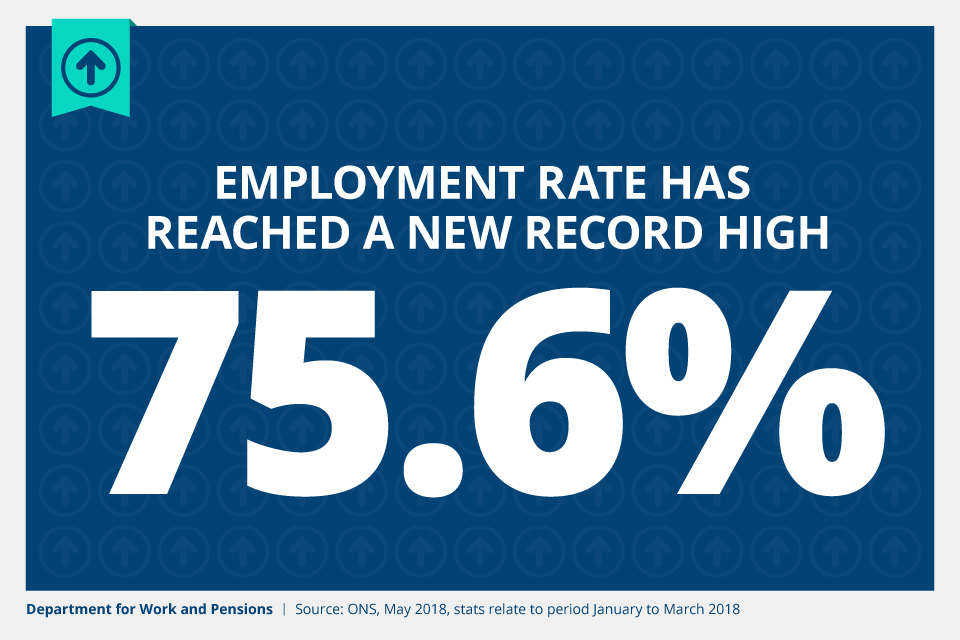
Today’s figures also show the employment rate has remained at a record 75.6%, with 197,000 more people in work compared to October to December 2017.

And with the number of black, Asian and minority ethnic (BAME) people in work up 475,000 since 2015, the government is making rapid progress on its commitment to increase BAME employment by 20% by 2020.
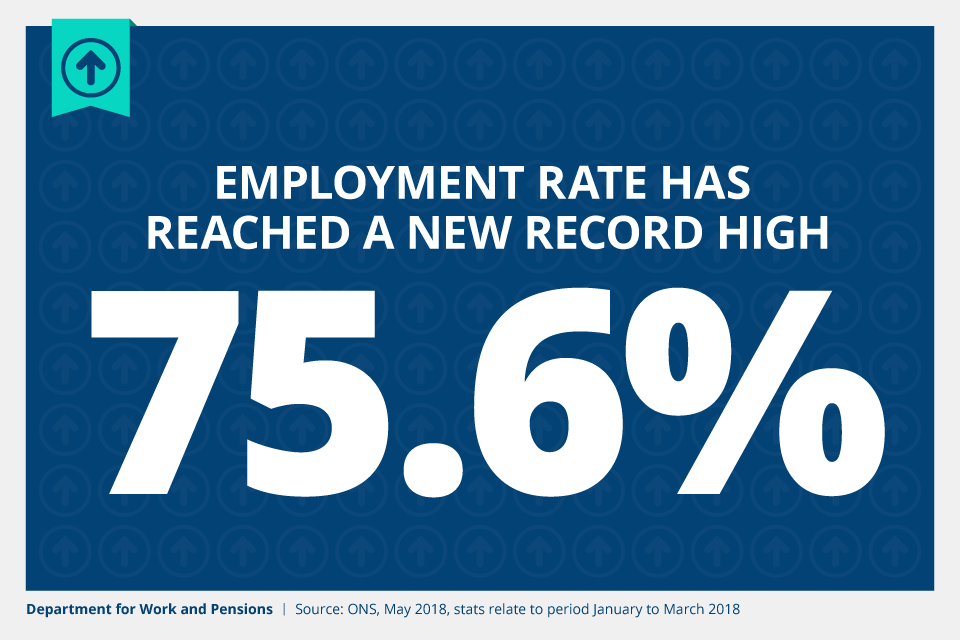
The employment rate has reached a new record high of 75.6%. Source: Office for National Statistics, May 2018, stats relate to period January to March 2018.

The Secretary of State for Work and Pensions, Esther McVey, said:

Since 2010 we have seen more than 3.2 million people move into work right across the UK. Youth unemployment has fallen by over 40% and the unemployment rate has not been lower since 1975.

Today’s figures once again cement that turnaround, with a new employment rate record of 75.6%, and on average over 1,000 people each and every day, since 2010, getting a job.

With wages growing faster than inflation and increases in the personal tax allowance, not only are more people bringing home a pay packet but they are keeping more of their hard earned money for themselves and their families.

Figures also show:

  • the BAME employment gap has closed to just 10.1 percentage points, a decrease of 1.3 percentage points since 2015 and the lowest the gap has been since the series began in 2001
  • the number of people in employment has increased by over 3.2 million since 2010
  • there are 806,000 vacancies in the economy at any one time
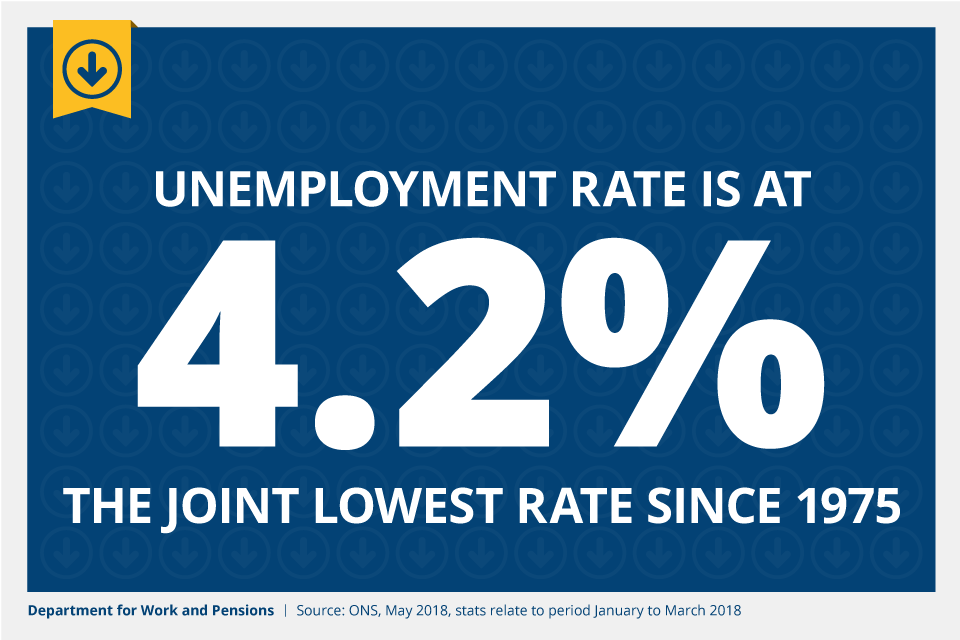
The unemployment rate is at 4.2% - the joint lowest rate since 1975. Source: Office for National Statistics, May 2018, stats relate to period January to March 2018.

This comes as we have reformed welfare to make work pay, backed businesses to take more people on, and built a stronger, fairer economy. But we want to help even more people benefit from a well-paid job. That’s why we are:

  • improving the welfare system with Universal Credit, which helps people move into work faster and to stay in work longer than under the old system
  • introducing a modern industrial strategy to help businesses create better, higher-paying jobs in every part of the UK
  • helping people stay in work longer with our Fuller Working Lives strategy, which supports employers to recruit, re-train and retain older workers
  • tackling inequalities in employment highlighted by the Race Disparity Audit, through targeted support in 20 areas around the country and £90 million announced by the Prime Minister to help young people

Also, the Department for Work and Pensions launched a new ‘Find a job’ service this week to support thousands of jobseekers into work. The site will continue to allow jobseekers to search for work 24 hours a day, 7 days a week, and will offer jobseekers and employers a simpler and more streamlined way to log in and access their information.

Separate figures out today showed that 870,000 people are now on Universal Credit as the rollout of the new benefit continues. Of these, 36% were in employment (320,000). Through Universal Credit, people are keeping more of their earnings as their Universal Credit payment gradually adjusts when their income climbs.

More information

Read the Labour Market Statistics – May 2017 from the Office for National Statistics.

Contact Press Office

Press Office

Caxton House

Tothill Street
London
SW1H 9NA

Follow DWP on:


Link: Press release: Unemployment rate lowest in over 40 years
Source: Gov Press Releases

Press release: Taunton boss handed suspended sentence after pocketing £100,000

Andrew Reed (53) was the director of APR Media, formerly known as APR Video, where he produced and duplicated recordable media since it was first incorporated in 1996.

However, when the company began to make a loss and after 16 years of trading, Andrew Reed instructed insolvency practitioners in October 2012 to place APR Media into creditors’ voluntary liquidation with a total deficiency of just over £800,000.

During the initial investigation into the company’s affairs, the insolvency practitioners could not account for around £125,000 which had been transferred out of APR Media’s accounts just a couple of months before it was placed into liquidation.

Further enquiries by the Insolvency Service found that Andrew Reed fraudulently transferred money out of APR Media in the full knowledge that the business was insolvent in order to avoid paying his creditors.

In August 2012, Andrew Reed paid himself a £100,000 dividend and in September 2012, he transferred £25,250 to M5 Audio & Events, a company where his wife was a director.

Andrew Reed pleaded guilty to two fraud charges and on 27 April 2018 he was sentenced to 15 months in prison, suspended for two years, while also being ordered to complete 120 hours of unpaid work and pay £7,500 in costs.

The sentence was handed down despite the fact that Andrew Reed had paid back over £200,000 to the estate once the wrongful payments had been identified by the insolvency practitioner.

Glenn Wicks, Deputy Chief Investigation Officer of the Insolvency Service, said:

Andrew Reed knew his company was failing and unscrupulously ripped off his creditors by transferring money to his other company. The court has shown anyone doing this stands a serious chance of going to prison.

Notes to editors

APR Video Limited (Company number: 03239812) was incorporated on 20 August 1996 before it changed its name to APR Media in 2006.

On 19 March 2018 Andrew Reed pleaded guilty to two charges contrary to section 207(1)(a) of the Insolvency Act 1986 of undertaking transactions in fraud of APR Audio Limited’s creditors at Taunton Crown Court.

Insolvency Service

The Insolvency Service, an executive agency sponsored by the Department for Business, Energy and Industrial Strategy (BEIS), administers the insolvency regime, and aims to deliver and promote a range of investigation and enforcement activities both civil and criminal in nature, to support fair and open markets. We do this by effectively enforcing the statutory company and insolvency regimes, maintaining public confidence in those regimes and reducing the harm caused to victims of fraudulent activity and to the business community, including dealing with the disqualification of directors in corporate failures.

BEIS’ mission is to build a dynamic and competitive UK economy that works for all, in particular by creating the conditions for business success and promoting an open global economy. The Criminal Investigations and Prosecutions team contributes to this aim by taking action to deter fraud and to regulate the market. They investigate and prosecute a range of offences, primarily relating to personal or company insolvencies.

The agency also authorises and regulates the insolvency profession, assesses and pays statutory entitlement to redundancy payments when an employer cannot or will not pay employees, provides banking and investment services for bankruptcy and liquidation estate funds and advises ministers and other government departments on insolvency law and practice.

Further information about the work of the Insolvency Service, and how to complain about financial misconduct, is available.

Contact Press Office

Media enquiries for this press release – 020 7637 6498 or 020 7596 6187

Press Office

The Insolvency Service


4 Abbey Orchard Street
London
SW1P 2HT

This service is for journalists only. For any other queries, please contact the Insolvency Enquiry line on 0300 678 0015.

For all media enquiries outside normal working hours, please contact the Department for Business, Energy and Industrial Strategy Press Office on 020 7215 1000.

You can also follow the Insolvency Service on:

Link: Press release: Taunton boss handed suspended sentence after pocketing £100,000
Source: Gov Press Releases

Press release: Bonus beaches leads to record number of swimming spots

As the bathing water season begins this week, visitors to the seaside will have 422 bathing spots to choose from after nine new beach locations have been designated as official bathing waters along the south coast.

The Environment Agency tests water quality at every official bathing water to ensure it is maintained and improved. Last year, water quality remained high with 98.3% of bathing waters in England meeting the tough standards. 92% of these locations achieved the top rating of Excellent or Good.

Beach-goers can check out the water quality at their nearest bathing water spot by visiting the Environment Agency’s online map at the Bathing Water Data Explorer website.

Helen Wakeham, Deputy Director of Water Quality at the Environment Agency, said:

It is wonderful news that more beaches have been given bathing status in time for the start of the 2018 season. Water quality has improved at English beaches giving locals and tourists a better experience as well as benefiting the environment.

Water quality tests are published online, me and my family will certainly be searching the online map before heading off to enjoy time at the beach this summer.

The Environment Agency will continue to work with water companies, councils and local communities to keep our beaches clean, reduce pollution and protect our environment. We are working to achieve the goal in Defra’s 25 Year Plan to minimise the harmful bacteria in our bathing waters by 2030.

During the bathing water season environment officers will take up to 20 samples at each location, from now until the end of September. Samples will be tested in Environment Agency labs for cleanliness. This year, in addition to sampling water quality, Environment Agency teams will also carry out surveys of plastic pollution on beaches. This data will help target our work and support community action.

Dramatic improvements have already been made over the last two decades to prevent pollution ending up in the sea, but there is always more to do.

Pollution from sewage and from agriculture are generally recognised as the two most significant sources but there are some local variations. Surveys have shown that around a third of bathing water pollution is caused by agriculture. This year the Environment Agency is rolling out new rules for farmers to ensure best practice is followed and pollution from farms is reduced.

Water companies have done a lot over the last two decades to improve infrastructure investing over £2.5 billion on projects that have improved water at swimming beaches.

To go further the Environment Agency are advising water companies on the investment they should be making to protect the environment, these include measures to protect water quality as well as being more resilient to flooding and potential water shortages. Environment Agency proposals include that water companies should improve 24 bathing waters between 2020-2025.

All members of the public can help keep water clean by taking all rubbish with them after visits to the beach, not leaving dog mess on the beach and at home never flushing wet wipes or pouring fats down drains.

Heavy rain is likely to reduce water quality in the short term, even at Excellent beaches. Information on the Bathing Water Data Explorer website may advise against swimming and there could be temporary signs at beaches.

The nine new beaches have become official bathing waters following suggestions from councils, feedback from public consultations and a decision by the Department for Environment, Food and Rural Affairs.

All the new bathing waters will have signage to show they are official swimming spots and the Environment Agency will test water quality regularly.

One of the new beaches is in Bournemouth, Manor Steps beach. Eight of the new locations are in Cornwall: South Fistral beach in Newquay, Booby’s Bay near Trevose Head, Mexico Towan, Upton Towan and Godrevy, all situated on a long stretch of dunes in St Ives Bay, Northcott Mouth beach to the north of Bude, Gwynver Beach which forms part Whitesand Bay and Tregonhawke in Whitesand Bay.

Link: Press release: Bonus beaches leads to record number of swimming spots
Source: Gov Press Releases