I will not pretend to regret Mugabe’s downfall: but this can now be a turning point, a moment of hope for this beautiful country, full of potential. The immediate priority is to ensure that Zimbabwe has a legitimate government, appointed through free and fair elections in accordance with the constitution.
That’s what the UK wants to see and together, with our international friends and partners in the region, we stand ready to support Zimbabwe in this goal.
The resignation of Robert Mugabe provides Zimbabwe with an opportunity to forge a new path free of the oppression that characterised his rule. In recent days we have seen the desire of the Zimbabwean people for free and fair elections and the opportunity to rebuild the country’s economy under a legitimate government.
As Zimbabwe’s oldest friend we will do all we can to support this, working with our international and regional partners to help the country achieve the brighter future it so deserves.
This morning I met the leaderships of Sinn Fein and the Democratic Unionist Party to discuss the ongoing political stalemate in Northern Ireland.
I made clear the determination of this Government to re-establish the fully functioning, inclusive devolved administration that works for everyone in Northern Ireland.
I also reiterated our steadfast support for the Belfast Agreement and its successors. For their part both the DUP and Sinn Fein expressed their commitment to seeing Stormont back up and running.
From our discussions it is clear that the issues dividing the parties are relatively small in number, focusing mainly around culture, legacy, identity and the future stability of the devolved institutions.
While not in any way underestimating the challenges involved, I believe that a way forward can be found and an agreement reached.
It is therefore imperative that the parties re-engage in intensive discussions next week aimed at resolving the outstanding issues so that the Assembly can meet and an Executive be formed.
The regulator has to date received 192 responses to the consultation, which concludes on Friday (24th), and has engaged with a further 70 charities as part of targeted user testing of the new system.
This saw the Commission identifying groups of charities most likely to be affected by proposed changes and proactively seeking their help in testing the new digital system that supports the Annual Return. The testing was conducted by individuals who will be responsible for completing the annual return on behalf of their charities.
The Commission says that this testing is a vital way of assessing the practical impact of new questions, including to what extent they represent an additional regulatory burden.
The regulator also held round-table discussions with groups of charities likely to be affected by proposed changes, such as charities with links overseas.
The Commission is yet to conduct a full analysis of consultation responses, but says that early indications are that the feedback is largely positive, with some users pointing to practical issues in responding to proposed new question areas.
David Holdsworth, Registrar of Charities for England and Wales and Deputy Chief Executive at the Charity Commission, says:
Over the past 12 weeks, we have, for the first time, combined modern digital user testing with more traditional consultation methods to achieve better quality engagement than ever before in an Annual Return consultation.
The user testing has enabled those who would complete any future return to test how easy it is to complete and to notify us of any practical issues that they encountered.
As a result of this approach, we have received an extensive range of constructive feedback and responses about our proposed changes to the annual return and the digital service that supports it. I’m very pleased with this level of engagement and the information we’ve gathered during the consultation gives us a sound evidence base as we develop the annual return for 2018.
We’re already beginning to analyse the responses and will take on board the feedback we receive. I encourage charities that have not yet had their say on the new annual return questions to do so before the consultation comes to a close this Friday
The regulator says it will publish a full analysis of consultation responses before the end of February 2018; it expects to make the new Annual Return available during the first half of 2018.
All charities with annual incomes of over £10,000 are required to complete an Annual Return, and the regulator has been consulting on a new, more dynamic system for 2018, which will be more targeted and easier to use for charities. As part of the new system, smaller charities and those with simpler operations will be required to answer fewer questions. The Commission has also proposed new question areas.
A Leeds-based house building company has been fined £120,000 for illegally polluting a watercourse from a Huddersfield construction site.
Harron Homes Limited was sentenced yesterday (20 November) at Leeds Magistrates’ Court after admitting one charge of causing illegal discharges from its Farriers Croft estate in 2015.
The Environment Agency prosecuted the firm after investigating reports of contaminated run-off which was entering a tributary of Grimescar Dyke.
Rosalind Emsley-Smith, prosecuting for the Environment Agency, told the court that an officer visited the site on 20 November 2015 and saw polluted water flowing out of the entrance of the construction site. The company was also pumping silt contaminated water from site excavations which also entered the watercourse.
Following the Environment Agency’s visit, Harron Homes attempted to control the silt run-off by setting up settlement tanks. However, further incidents of pollution were reported in November and December 2015 and subsequent inspections revealed that this system was inadequate. Silty water was found to be discharging, resulting in further pollution.
Samples taken from the discharges showed that they were having a significant impact on the water quality in the watercourse up to three kilometres further downstream. Some samples showed there to be nearly 35,000 milligrams of suspended solids per litre of water, whereas a healthy watercourse is expected to have a concentration lower than 30 milligrams per litre.
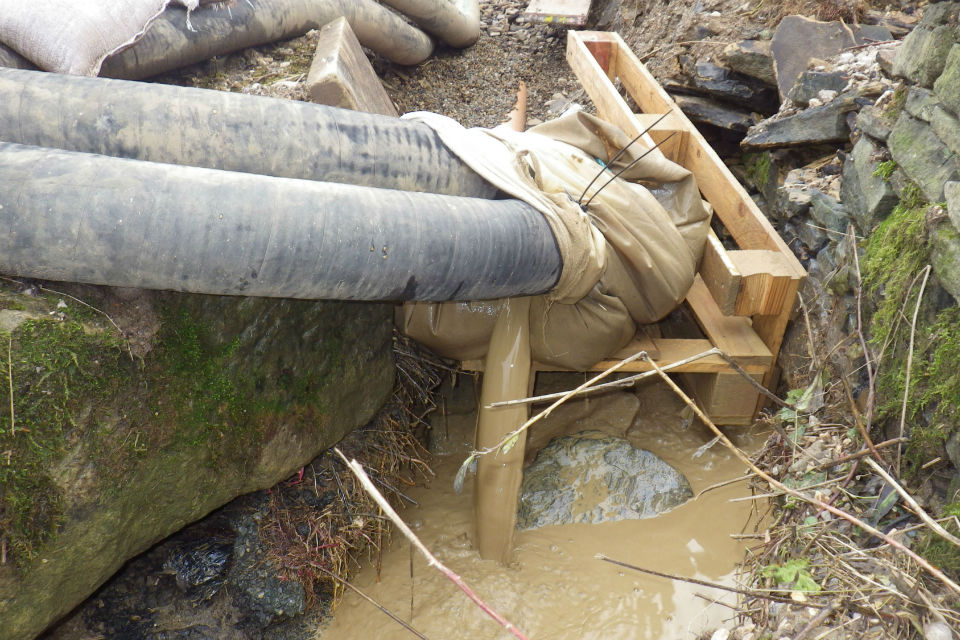
The firm’s attempt to contain the muddy water was inadequate; silt was seen flowing off the site
Mark West, environment management team leader at the Environment Agency, said:
These pollution incidents had a significant impact on the water environment over a number of weeks, and were entirely avoidable. In West Yorkshire there has been a worrying increase in the number of pollutions incidents reported to us that on investigation are attributable to the construction sector.
Construction companies should consider the potential environmental impact of developments they undertake at the initial planning stage and must adhere to environmental permitting rules and invest in appropriate management systems to prevent their activities from affecting the local environment.
If anyone spots pollution of this kind, they are urged to contact the Environment Agency’s incident hotline on 0800 807060 so we can investigate.
In mitigation, Harron Homes told the court that it had now put procedures in place to prevent future pollution incidents.
In addition to the fine, the company was ordered to pay £8,706.71 in legal costs and a £120 victim surcharge.
HM Land Registry completed more than 1,740,000 applications to change or query the Land Register
the South East topped the table of regional applications with 407,148
The transaction data shows HM Land Registry completed 1,740,068 applications in October compared with 1,586,987 in September and 1,532,007 last October, of which:
408,685 were applications to update existing titles compared with 363,990 in September
823,267 were applications to obtain an official copy of a register compared with 747,090 in September
226,488 were official searches compared with 210,805 in September
26,260 were postal applications from non-account holders, compared with 24,136 in September
Transaction Data is published on the 15th working day of each month. The November Transaction Data will be published at 11am on Thursday 21 December 2017 at HM Land Registry Monthly Property Transaction Data.
The monthly Transaction Data showing how many applications for new titles, leases, splitting titles, updating existing titles, official copies of the register and searches were completed, reflects the volume of applications lodged by customers using an HM Land Registry account number on their application form.
Completed applications in England and Wales shown by region and by local authority include postal applications as well as those sent electronically.
Transaction Data excludes pending applications, withdrawn applications, bankruptcy applications, bulk applications and discharge applications.
Transactions for value are applications lodged involving a transfer of ownership for value. Discharge applications remove a charge, for example a mortgage, from the register. For an explanation of other terms used, see abbreviations used in the transaction data.
Most searches carried out by a solicitor or conveyancer are to protect the purchase and/or mortgage. For example, a search will give the buyer priority for an application to HM Land Registry to register the purchase of the property. This can give an indication of market activity.
Reasonable skill and care is used in the provision of the data. We strive to ensure that the data is as accurate as possible but cannot guarantee that it is free from error. We cannot guarantee our data is fit for your intended purpose or use.
Transaction Data is available free of charge for use and re-use under the Open Government Licence (OGL). The licence allows public bodies to make their data available for re-use.
HM Land Registry’s mission is to guarantee and protect property rights in England and Wales.
HM Land Registry is a government department created in 1862. It operates as an executive agency and a trading fund and its running costs are covered by the fees paid by the users of its services. Its ambition is to become the world’s leading land registry for speed, simplicity and an open approach to data.
HM Land Registry safeguards land and property ownership worth more than £4 trillion, including more than £1 trillion of mortgages. The Land Register contains more than 24 million titles, which show evidence of ownership, covering more than 84% of the land mass.