Press release: Foreign Secretary comment on UN Security Council Presidential Statement on Burma

Foreign Secretary Boris Johnson said:

I am pleased that today (6 November) the United Nations Security Council (UNSC) has spoken with one voice on the appalling situation in Rakhine State, Burma. More than 600,000 Rohingya refugees have fled to Bangladesh, amidst horrifying reports of gross human rights violations. The humanitarian situation remains desperate.

The UK has repeatedly called on the Burmese security forces to protect all civilians and act now to stop the violence and allow humanitarian aid to urgently reach all those who need it. The UNSC has today joined us in that call, with this historic Presidential Statement on Burma.

I am encouraged to see State Counsellor Aung San Suu Kyi making important steps forward, including establishing a domestic body to deliver humanitarian and development assistance in Rakhine, and making efforts to promote interfaith and intercommunal harmony, including a recent visit to northern Rakhine. The UK will be watching closely to ensure that the Burmese security forces do not attempt to frustrate these efforts.

I also applaud the work of the Bangladesh government, which is working hard to ensure the refugees receive urgent aid. The recent agreements between Burma and Bangladesh are welcome, and I hope they can now make swift progress on the voluntary, safe, and dignified returns of refugees to Burma. The Burmese security forces must take steps to ensure the right conditions are in place for refugees to return.” 

Further information

Follow the Foreign Secretary on Twitter: @BorisJohnson and Facebook.

Follow the Foreign Office on Facebook & Twitter.

Follow the Foreign Office on Instagram, YouTube and LinkedIn
 

Media enquiries

For journalists

Link: Press release: Foreign Secretary comment on UN Security Council Presidential Statement on Burma
Source: Gov Press Releases

Press release: Communities Secretary takes action on council publications

Communities Secretary Sajid Javid has today (6 November 2017) issued directions to 2 councils to stop publishing their newspapers so frequently, or risk court action.

The London Boroughs of Hackney and Waltham Forest are currently publishing their respective newspapers on a fortnightly basis despite the Publicity Code recommending that councils do not put out a newspaper more than quarterly.

The Publicity Code sets out a series of principles to which all councils must have regard when producing publicity material. The vast majority of councils follow the Code in relation to the frequency of publication.

Ensuring council newspapers are released no more than quarterly aims to protect local democracy by making sure the independent local press do not face unfair competition.

Communities Secretary Sajid Javid said:

An independent free press is vital for local democracy and it’s important that we support them in holding local leaders to account.

Councils shouldn’t undermine local democracy by publishing their own newspapers more often than quarterly.

While the majority of councils abide by the Publicity Code, Hackney and Waltham Forest have ignored repeated requests to stop publishing their council newspapers so frequently. In the interests of local democracy, I will therefore use my powers to require them to do so.

Protecting the press, protecting democracy

Waltham Forest and Hackney have previously received written notices from the Communities Secretary indicating his intention to issue directions requiring them to comply with the Publicity Code around the frequency of publication of council newspapers.

Since then, the Communities Secretary has carefully considered all the representations from them about their free fortnightly newspapers. In doing so, he had regard to the Equalities Statement on enforcing the Publicity Code before coming to his decision to issue directions to both borough councils.

Once a direction has been issued the council is required to take the necessary decision to comply within 14 days or could face court action.

Further information

The Publicity Code sets out 7 key principles for local authority publicity. It notes any publicity should:

  • be lawful
  • be cost-effective
  • be objective
  • be even-handed
  • be appropriate
  • have regard to equality and diversity
  • be issued with care during periods of heightened sensitivity

In 2011, the Code of Recommended Practice on Local Authority Publicity – the Publicity Code – was updated, and approved by Parliament, to make clear that no council newspaper or magazine should be published more than 4 times a year. The legislation on the Code was strengthened by the Local Audit and Accountability Act 2014.

The Communities Secretary has the power to issue a direction requiring a specified authority to comply with some, or all, of the Publicity Code. Sections 4A and 4B were inserted into the Local Government Act 1986 via provisions in the Local Audit and Accountability Act 2014 which gave the Secretary of State this power.

Office address and general enquiries

2 Marsham Street

London

SW1P 4DF

Media enquiries

Link: Press release: Communities Secretary takes action on council publications
Source: Gov Press Releases

Press release: Graduate game developers win Government grants

Mochi Mode from Cardiff (University of South Wales) and Shuttershade Studios from Huddersfield (University of Huddersfield) are the winners of Tranzfuser, a graduate talent competition funded by the Government’s UK Games Fund, that saw startup video game studios from across the country battling it out for grants.

The two winning teams, both receiving £25,000, have joined the prestigious portfolio of professional games development studios working with the UK Games Fund community.

Matt Hancock, Creative Industries Minister, said:

The UK games industry is a fantastic success story and we want to see it continue to grow from strength to strength. The Tranzfuser programme is aimed at identifying and supporting the talented young games developers and the original and innovative games they are producing right here in the UK.

Last year’s Tranzfuser alumni went on to publish their own game and I wish this year’s winners the same success in turning their creativity into a reality for us all to enjoy.

Over the summer, Tranzfuser tasked 23 teams with just ten weeks to take their idea for a great game from concept to playable demo to be showcased in front of 80,000 games fans and a panel of expert judges at the UK’s most popular video games festival, EGX. The teams developed all manner of fun and innovative games, from single-player puzzles to multiplayer room-scale Virtual Reality experiences.

Awarded a grant of £5,000 from UKGF, the teams developed their games with invaluable support provided by a nationwide network of Tranzfuser Local Hubs based at some of the best universities for video game design and development.

Mochi Mode wowed the judges and public alike with their game of bright visuals and simple one touch gameplay that sees players controlling a herd of cows. The setting changes to different locations across the Wild West but the goal is the same: players must guide the herd to safety through a host of colourful obstacles in this fun arcade game.

Laura Wells, Team Leader at Mochi Mode said:

After graduating, it’s tough to know what steps will help you ‘breakthrough’ into the games industry. That was especially true for us with the aspiration to start up our own studio. Tranzfuser has given us guidance at a crucial point of our development. Most importantly, it has allowed us to make a little magic!

Shuttershade Studios is a team of graduates from the University of Huddersfield. The small group of four individuals created a virtual reality game, VR Party Ware, primarily consisting of a collection of various minigames. Players can compete globally through an online leader board system or locally with their own friends in a casual competitive environment.

Marcus Nichols from Shuttershade Studios said:

Winning Tranzfuser has had a life changing effect on both me and the entire Shuttershade Studios team. We’re now able to do our dream jobs which is to have very little sleep but to have a tonne of fun developing our own video games. It’s the most varied job that we’ve all had and we wouldn’t change it for the world.

New for 2017 is the Tranzfuser Accelerator, a unique programme where the runner-up teams from the competition receive tailor-made consultancy packages to give them the best chance of successfully applying to the UK Games Fund.

The UK Games Fund and Tranzfuser are both funded as part of the £4m UK Government programme of games development and talent funding announced in 2016, run by UK Games Talent and Finance Community Interest Company (UKGTF).

Paul Durrant, UKGTF’s founder, said:

All of the teams worked hard after securing their place on Tranzfuser 2017. Each of the 23 teams has put in a huge effort and each has benefitted significantly from real-world learning throughout. The winning teams are the ones that best managed the scope of their projects, had a shared creative objective across the team and better understood the target audience for their particular games.

ENDS

Notes to Editors:

  1. Many startup studios lack the capital to help develop their ideas and attract private investment. Now in its second year, Tranzfuser was created to help bridge that gap and allow developers to take their ideas from the drawing board to production.
  2. The Mochi Mode studio is comprised of four members – team leader and designer Laura Wells, programmer Liam Jones, artist Thomas Woodward, animator Amy Baldwin and level designer Kevin Ho. They aim to develop small, engaging games for app markets.
  3. Also at the ceremony was an exclusive screening of the first ever Tranzfuser documentary; a broadcast-quality 30 minute long film charting the summer-long competition and the competitor’s journey from applicant to professional games developer.
  4. The Tranzfuser competition is unique in being a UK-wide talent programme linked directly to a prototype fund allowing new teams to benefit from grants and peer to peer interaction with a host of other early stage games development companies. 85% of the UK Games Fund and Tranzfuser’s spend to date has been outside London.
  5. Teams that secured support from UKGF in the first Tranzfuser in 2016 are now successful studios. Cold Sun Studios and Miracle Tea Studios are both working towards release of their funded projects.
  6. Outside of Tranzfuser, the UK Games Fund supports young start-ups who can apply for funding. Companies such as White Paper Games (based in Manchester) and Coatsink (based in Sunderland) are both excelling as established indie games developers.

Additional quotes

Since first being selected for funding, Coatsink has grown significantly with nearly 50 employees in the business and further growth plans to take that number up in the next couple of quarters. Their latest VR title, the critically-acclaimed Augmented Empire, was released in July.

Eddie Beardsmore, Chief Operations Officer at Coatsink said:

Coatsink expanded rapidly over the last year. Due to our current project roster of over a dozen titles – all in various stages of development – we’re looking to employ a further 15 to 20 developers by April next year.

We continue to develop for multiple platforms and recently announced a partnership with Nintendo to bring our much-loved platformer Shu to the Nintendo Switch later this year. The UK Games Fund has provided a huge amount of support for the studio and we wouldn’t be in this amazing position without them.

White Paper Games, a team of graduate colleagues who were supported by YEAR (the predecessor to the UK Games Fund) is doing incredibly well with the imminent release of a much-anticipated game The Occupation.

Pete Bottomley, Co-Founder of White Paper Games said:
> Working with the UKGF has been a great experience. The fund afforded us the additional time to push the quality and design of the game which ultimately allowed us to announce it in a strong position. This was instrumental to The Occupation’s early success and interest and without this, I don’t believe we would be in the position we are now. I can’t recommend and praise the fund enough.

The 23 participating teams and hubs this year were:

Teesside Launchpad, Teesside University (North East England)

Fox Byte Games


Futureworks Media School (North West England)

Broken Pixel Studios, Foxtrot 203


University of Bradford* (West Yorkshire) 


Gebba Games


University of Huddersfield, Enterprise Team (West Yorkshire)

Giant Games, Nocturnals, Shuttershade Studios

Sheffield Hallam University (South Yorkshire) 


Final Forge, Inside Out Games, Grim Inc 


Brunel University (London)

A Loaded Teaspoon, Drift, Slime Time Studios

Slime Time Studios 
Eastern Enterprise Hub (South East England) 


IndieByte

Wrexham Glyndwr University (North Wales) 


Ethereal, Round Square Studios, Static Shell Studios 


University of South Wales (South Wales) 


Mochi Software, Dark Planet Studios 


Filthy Fresh 
Northern Ireland Screen (Northern Ireland) 


No Piknik


Abertay University (East Scotland)

Pocket Sized Hands

Glasgow Caledonian University (West Scotland)

Pioneer Games

Link: Press release: Graduate game developers win Government grants
Source: Gov Press Releases

Press release: Multi-agency exercise to test temporary barriers at Beales Corner in Bewdley

The Environment Agency’s field team, along with support from Hereford & Worcester Fire and Rescue Service, Bewdley Town Council and other partners, will be testing out the deployment of temporary flood barriers and the local community flood plan.

The exercise, which will start at 09:00am, will provide an opportunity to test our barrier deployment plan and procedures in this training exercise. We will be testing our working arrangements with partners and the local Community Flood Group, so the barriers can be quickly and safely erected when needed during a flood, with minimum disruption to residents and businesses.

Pedestrians and traffic will be unable to use this section of road and pathway between Millside Court to where it joins with Kidderminster Road, via the Stourport Road. Access to Bewdley Bridge and the town will remain fully accessible by using the Kidderminster Road.

Mark Bowers, Flood Risk Manager said:

This is a test of our operational equipment and local community flood plan. Although we have carried out numerous barrier deployment exercises at our training depots, doing it on location will give our field team invaluable experience.

It’s important to remember that we can never protect 100% against flooding, and we can’t guarantee that specific communities will always have access to temporary barriers.

Local residents and businesses should be prepared by checking their flood risk, signing up to flood warnings and finding out what they can do to protect themselves and their property by visiting the Prepare for Flooding page on GOV.UK or calling Floodline on 0345 988 1188.

Nick Farress, Bewdley Town Council Clerk added:

This will be a vital practice run to test our new community led flood plan which has been developed to support the Environment Agency in retaining the temporary barrier at Beale’s Corner. The Town Council are very grateful to our band of volunteers who have put themselves forward to help with this vital work”.

The temporary barrier deployment is also being supported by Hereford & Worcester Fire and Rescue Service who is a key partner in the project. Wyre Forest Station Commander, Daryl Justice, said:

Our involvement with the Bewdley Flood Barrier response is new arrangement that will see our Firefighters add even more value to the Wyre Forest community.

When flooding is predicted our on-call firefighters will be given a period of notice which will minimise the impact on their primary employment and, although deployed under the direction of the Environment Agency, they will remain available for life threatening emergencies.

This is one of the first initiatives of its type in the UK and is a great example of how fire crews can add value in other areas. It also supports Hereford & Worcester Fire and Rescue Service’s wider vision of ‘Saving More Lives’.

Environment Agency staff and Community Flood Group members will be available during the exercise to provide the public with information about access restrictions, alternative routes and general flood advice. The exercise is likely to conclude around 13:00pm.

Link: Press release: Multi-agency exercise to test temporary barriers at Beales Corner in Bewdley
Source: Environment Agency

Press release: Bees’ Needs Champions awards celebrate pollinator heroes

A ‘Bee City’ and a successful reintroduction scheme for the short-haired bumblebee are among the innovative projects highlighted today by Defra Minister Lord Gardiner as inspirational examples of action to protect our pollinators.

The annual Bees’ Needs Champions awards, hosted at the Royal Botanic Gardens, Kew, celebrated 17 bee boosting projects from volunteers, schools, charities and councils across the country which are helping pollinators thrive both in the countryside and in our towns and cities.

From buzzing bumble bees to beautiful butterflies, the UK’s 1,500 species of pollinators play a crucial role, helping our flowers, fruit trees and crops to grow and contributing £400-680million per year due to improved productivity.

Speaking at the Bees’ Needs Champions Awards, Minister for Rural Affairs and Biosecurity Lord Gardiner said:

We must all be thankful for our essential pollinators who do such vital work on our behalf, flying from crop to crop, tree to tree, helping us to grow our food. The champions I had the pleasure to meet today are doing exceptional things to return the favour and look after our pollinators. We must not leave them to it. We can all play a part.

Whether it is leaving grass uncut to give bees a home over winter, or inspiring young people to be the pollinator protectors of the future, our combined efforts make a real difference.

Among the champion projects creating a buzz were the Bumblebee Conservation Trust’s short-haired bumblebee re-introduction scheme and the Secret Garden project in Salisbury with their ‘Bee City’ and ‘Bee Trail’.

Goldthorpe Primary School in Barnsley and St Albans Primary School in Havant also featured for their pollinator-encouraging enterprises, including building bee hotels, creating wildlife meadows and campaigning in the local community. St Albans school has set up a ‘pollinator promise’ to get the local community involved, too.

Outdoor education teacher at St Albans Primary School, Julie Newman, said:

By working together as a community, Pollinator Promise is about inspiring others to give hungry and homeless bees food and shelter. Each small individual change adds up to make a big difference to pollinators and people.

Friends of the Earth Bee Cause campaigner, Paul de Zylva, said:

This year’s Bees’ Needs Champions show how anyone anywhere can help our bees and other vital pollinators not just to survive but to thrive.

The ten year National Pollinator Strategy is now in its fourth year and relies on action by businesses, community groups, farmers, land owners and local councils to improve conditions for pollinators. Doing so is essential to restore nature across the nation.

With winter fast approaching, bees need our help more than ever to provide them with the food and shelter they need to survive the cold.

Everyone can follow our three top tips on how we can all help pollinators this winter. You do not have to be an expert gardener to make a difference: from installing urban window boxes to planting the right bulbs, everyone can play their part to ensure bees have food and a home.

  • Plant flowers, shrubs and trees that thrive in winter. The evergreen mahonia is excellent winter food for bees, while the pendant bells of winter flowering clematis can give pollinators a sugary energy boost. Ivy plants are also an ideal source of food for bees in late autumn – avoid cutting them down.
  • Leave suitable places for hibernation undisturbed. Letting areas of a lawn grow long until the spring can provide a hibernation home while cool, north-facing banks are ideal places for bees to burrow. The hollow tubes of dead stems of plants in borders can also serve as a great nesting spot.
  • Planting early flowering bulbs like crocus, primrose, snowdrop or coltsfoot that flower in February and March to help support bees and pollinators looking for an early feed. Winter is also the perfect time to plant bee-friendly trees, such as acacia, blackthorn and hazel.

Link: Press release: Bees’ Needs Champions awards celebrate pollinator heroes
Source: Gov Press Releases

Press release: Lorry driver with foot on dashboard among 4,000 caught by unmarked HGV cab

The driver, stopped by Humberside Police, was travelling from the M18 onto the M62 near Goole.

The footage is available to watch at

Another driver pulled over by Devon and Cornwall Police was found to have sent 10 replies to 10 texts within one hour; a driver in Surrey was seen trying to put toothpaste on a toothbrush; and a driver in the East Midlands was spotted steering with his knees while he ate his lunch and used his mobile phone.

The offenders were among more than 4,000 dangerous drivers on England’s roads caught by a single unmarked HGV cab over the past two years.

Latest statistics show that mobile phone use is a factor in an average of two deaths on the roads every month, with 124 people losing their lives over the past 5 years and 521 suffering a serious injury.

Richard Leonard, Highways England’s Head of Road Safety, said:

The HGV cab, which is funded by Highways England, has been patrolling motorways and major A roads over the past couple of years with the aim of improving road safety.

We’ve found that the vast majority of drivers are sensible behind the wheel but a few have got into bad habits, or are simply ignoring the law and putting themselves and others at risk.

It’s shocking that around two thirds of the drivers that were stopped were using their phones when the statistics show that mobile phone use contributes to two deaths every month on the roads.

The footage of the driver with his foot up on the dashboard is particularly alarming, and I dread to think what would have happened if he had needed to brake suddenly. We will continue to use the cab to tackle deaths and serious injuries and to encourage people to improve how they drive.

The elevated position of the cab allows police officers to film unsafe driving behaviour by pulling up alongside vehicles on motorways and major A roads. Drivers are then pulled over by police cars following behind.

Nearly two thirds of the drivers who were stopped were illegally using a mobile phone while driving, putting themselves and others at risk.

National Police Chiefs’ Council Lead for Roads Policing, Chief Constable Anthony Bangham said:

Police forces are committed to keeping our roads safe and partnership with Highways England is absolutely crucial for that, as we can see from the thousands of offences detected by the HGV cab. Together with targeted local action by police officers, this has become an important element of our intelligence-led operations against dangerous driving.

Driving whilst distracted is completely unacceptable and police are also making use of the tougher new penalties to stop this dangerous behaviour by ensuring that offenders face the full weight of law.

People have to think about the consequences of their actions – a moment’s distraction can change innocent lives. It is never a risk worth taking.

Image of driver with foot on the dashboard

In total, 28 police forces have taken part in the HGV cab safety initiative since it began in April 2015, pulling over 4,176 drivers in relation to 5,039 offences.

Officers gave verbal advice to 388 drivers, issued 838 fixed or graduated penalty notices, and filed 3,318 traffic offence reports – usually requiring attendance at a driver education course. There were also 113 prosecutions for more serious offences.

Reasons for stopping drivers included:

  • using mobile phones – 2,508
  • not wearing seatbelts – 901
  • not in proper control of vehicles – 253
  • speeding – 249

Earlier this year, the government doubled the penalty for drivers caught using their phones at the wheel. Motorists now receive 6 points on their licence and a £200 fine – up from the previous 3 points and £100 fine.

A new THINK! road safety video was also launched last month, directed by the team behind the video for Pharrell Williams’s hit song Happy, to highlight the dangers of using your phone while driving.

It uses innovative filming, is shot in the style of a music video with an edgy soundtrack from celebrated musician Aphex Twin, and includes numerous pink kittens to highlight how much drivers miss if they are distracted by looking at their handheld phone.

The video is available to watch at

More details about the law on mobile phone use are available the Using mobile phones when driving page.

General enquiries

Members of the public should contact the Highways England customer contact centre on 0300 123 5000.

Media enquiries

Journalists should contact the Highways England press office on 0844 693 1448 and use the menu to speak to the most appropriate press officer.


Link: Press release: Lorry driver with foot on dashboard among 4,000 caught by unmarked HGV cab
Source: Gov Press Releases

Press release: Rare Ben Jonson book at risk of leaving the UK

Arts Minister John Glen has placed a temporary export bar on a rare book with unique annotations to provide an opportunity to keep it in the country.

Workes, an annotated collection of writings by Ben Jonson, is at risk of being exported from the UK unless a buyer can be found to match the asking price of £48,000.

Ben Jonson (1572-1637) is hailed as the most important writer of the English Renaissance after Shakespeare, having lived and worked in an age of great social change that produced some of the finest works of English literature.

This extraordinarily rare volume is the only known example of a document showing how a play by Ben Jonson was prepared for performance. Material that tells us about the performance of pre-Restoration plays is extremely scarce.

This volume occupies a unique place among surviving materials because of the nature and range of its annotations to Epicoene, or The Silent Woman – including stage directions, details of props, and textual corrections – which collectively do not fall into any category previously known to scholars of seventeenth-century theatre. The volume is therefore of outstanding interest to the study of English theatrical history.

A product of a period when plays were seen not as finished pieces, but as perpetual works in progress, this volume has the potential to change scholars’ understanding of how plays were transmitted from the page to the stage and back again.

Arts Minister John Glen said:

This fascinating book shows how Ben Jonson’s works evolved and were translated to the stage.

I hope that we can keep it in the UK to enrich the study of English theatrical history and learn more about the performances of his work.

The decision to defer the export licence follows a recommendation by the Reviewing Committee on the Export of Works of Art and Objects of Cultural Interest (RCEWA), administered by The Arts Council.

RCEWA member Peter Barber said:

The annotations in this volume shed uniquely detailed light on how one of the hit comedies of the seventeenth century might actually have been performed.

Samuel Pepys thought The Silent Woman ‘the best comedy that ever was wrote’ and this book enables us to go the theatre with him. It must remain in this country.

The RCEWA made its recommendation on the grounds of the annotated volume’s outstanding significance for the study of English theatre in the seventeenth century and, in particular, for the study of Ben Jonson’s plays in performance.

The decision on the export licence application for the book will be deferred until 5 February 2018. This may be extended until 5 May 2018 if a serious intention to raise funds to purchase it is made at the recommended price of £48,000.

Organisations or individuals interested in purchasing the book should contact the RCEWA on 0845 300 6200.

A photo of the book can be downloaded via our flickr site.

ENDS

For media information contact:
Yasmin Kaye
Senior Communications Officer
Department for Digital, Culture Media and Sport
Tel: 0207 211 6489
Email: yasmin.kaye@culture.gov.uk

Notes to editors

  1. Details of the book are as follows:
    A second edition of volume 1 of Ben Jonson, The Workes of Benjamin Jonson (first published c1620; this edition 1640, published in London by Richard Bishop to be sold by Andrew Crooke). The volume has been rebound in plain sprinkled calf, probably around 1900. It measures (cm) 30 x 19 x 6. There are some small tears, repairs, and staining, but the book is generally in good condition.
  2. The Reviewing Committee on the Export of Works of Art and Objects of Cultural Interest is an independent body, serviced by The Arts Council, which advises the Secretary of State for Digital, Culture, Media and Sport on whether a cultural object, intended for export, is of national importance under specified criteria.
  3. The Arts Council champions, develops and invests in artistic and cultural experiences that enrich people’s lives. It supports a range of activities across the arts, museums and libraries – from theatre to digital art, reading to dance, music to literature, and crafts to collections. www.artscouncil.org.uk.

Link: Press release: Rare Ben Jonson book at risk of leaving the UK
Source: Gov Press Releases

Press release: £5 million B road opens as A556 bypass legacy

A £5 million upgrade of the old A556 between Knutsford and Bowdon in Cheshire has officially been handed to local communities as a new B road – complete with a dedicated route for the area’s cyclists, pedestrians and horse riders.

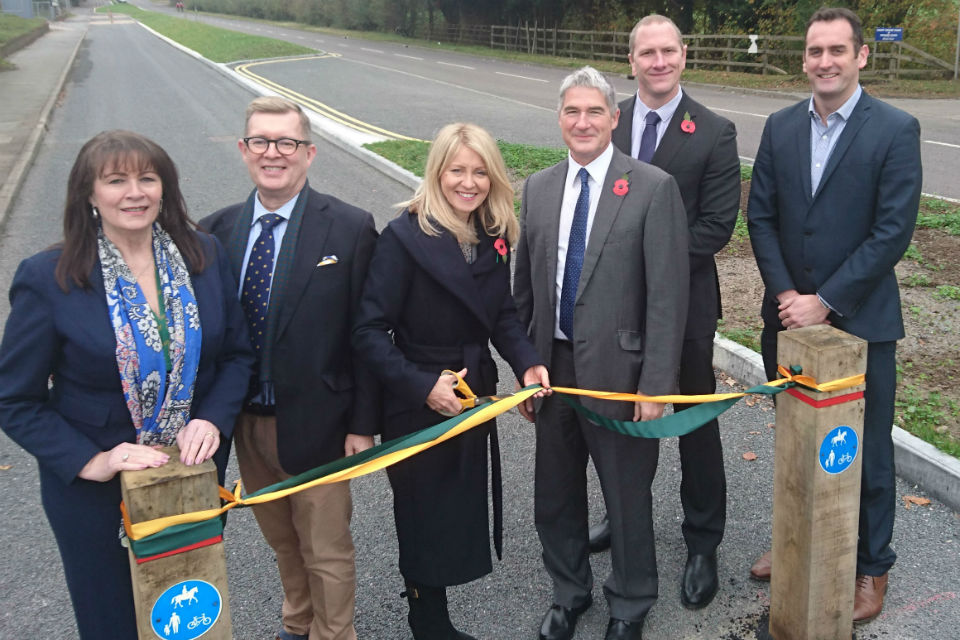
image showing Cheshire East councllors and the A556 project
Left to right – Cheshire East councllors Olivia Hunter and Jamie Macrae, Tatton MP Esther McVey, Highways England’s Tim Gamon (delivery director for the North West) and A556 project manager Paul Hampson, and Richard Stuart from Costain.

Highways England has converted the old A556 Chester Road – which has been replaced by the £192 million Knutsford to Bowdon bypass – into the B5569, a new 5.4km B road which will now be operated by Cheshire East Council.

The road was formally ‘detrunked’ and handed over to the council at a special ribbon-cutting ceremony near Mere crossroads this morning, attended by key officials from Highways England, Cheshire East Council, parish councillors and Tatton MP Esther McVey.

Highways England project manager Paul Hampson said:

This is a significant milestone for the Knutsford to Bowdon project – a result of our determination to deliver a lasting legacy for local people following the completion of the new dual carriageway in March.

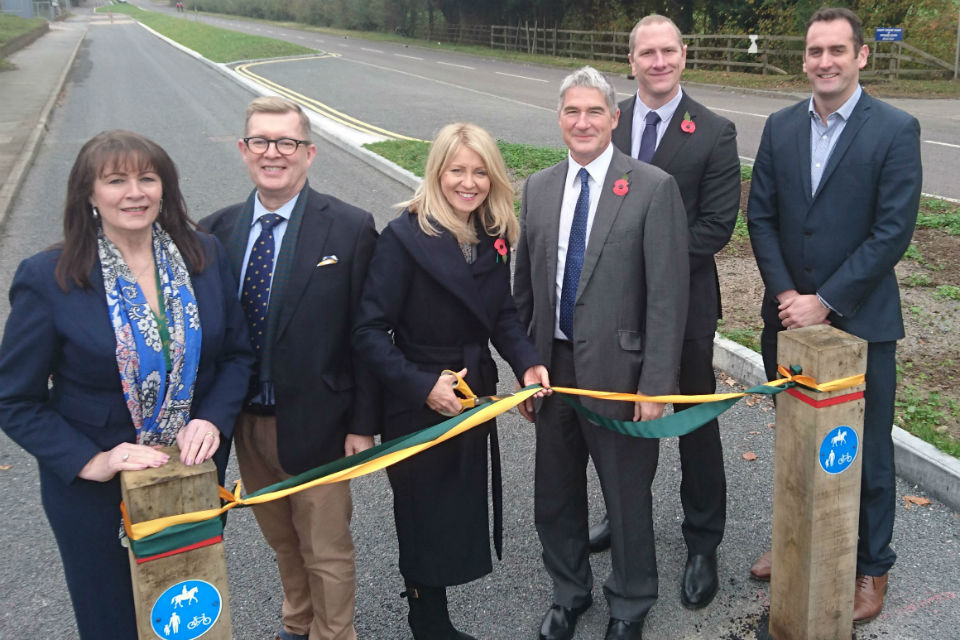
image showing Bucklow Hill and Mere junctions
The conversion work includes new arrangements at Bucklow Hill (above) and Mere junctions

Su Russell, Chairlady of CycleKnutsford, said she was delighted the group had been invited to the opening of what she described as a ‘landmark’ designated cycleway – the first in Cheshire – and hoped it would lead the way to further cycling initiatives in the county.

She said:

Highways England and its main contractor Costain have kept CycleKnutsford informed throughout the process and taken into consideration cyclists and the environment generally at every possible opportunity.

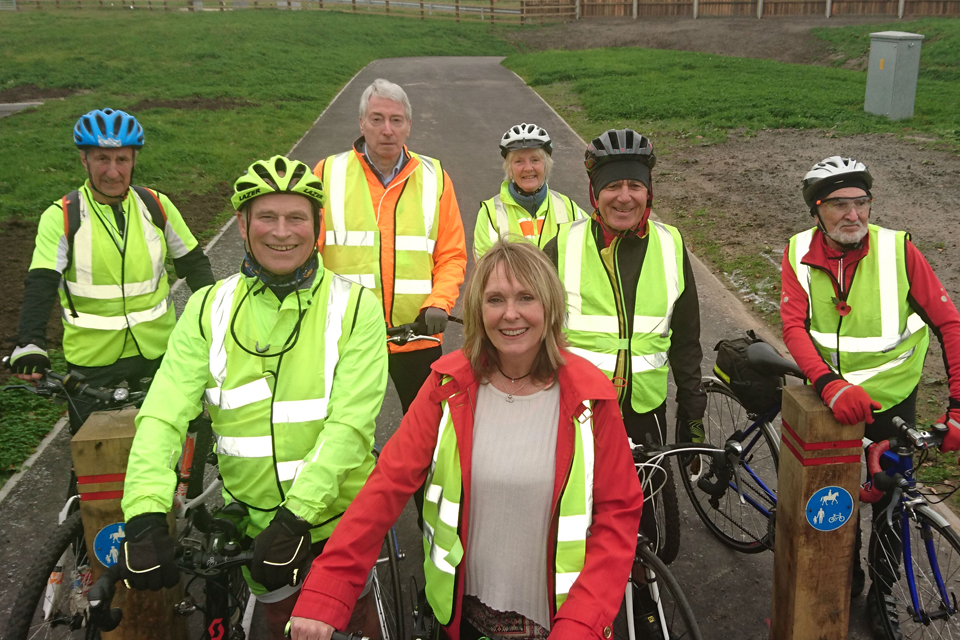
Image showing new cycle friendly green route and cyclists
Thumbs up for the new cyclist-friendly green route from CycleKnutsford (Su Russell, chair, centre)

CycleKnutsford members can’t wait to get out on their bikes and explore the new safe segregated cycleway.

Since the new A556 opened to drivers in March, work to convert the old road has included:

  • turning the old northbound 2 lane carriageway into a dedicated, segregated green route for pedestrians, cyclists and horses riders – 4 metres wide and separated from the new B road by a wide border planted with a wild flower mix
  • converting the old 2 lane southbound carriageway into a new B road with as single lane in each direction
  • installing brand new drainage along the new route as well as totally resurfacing the re-arranged layout
  • providing totally new junction layouts at Bucklow Hill/Chapel Lane and Mere junctions giving priority to the A5034 and A50 traffic
  • installing a signalised Pegasus crossing – specifically designed to assist horse riders – at the junction between the green route and the A50 at Mere
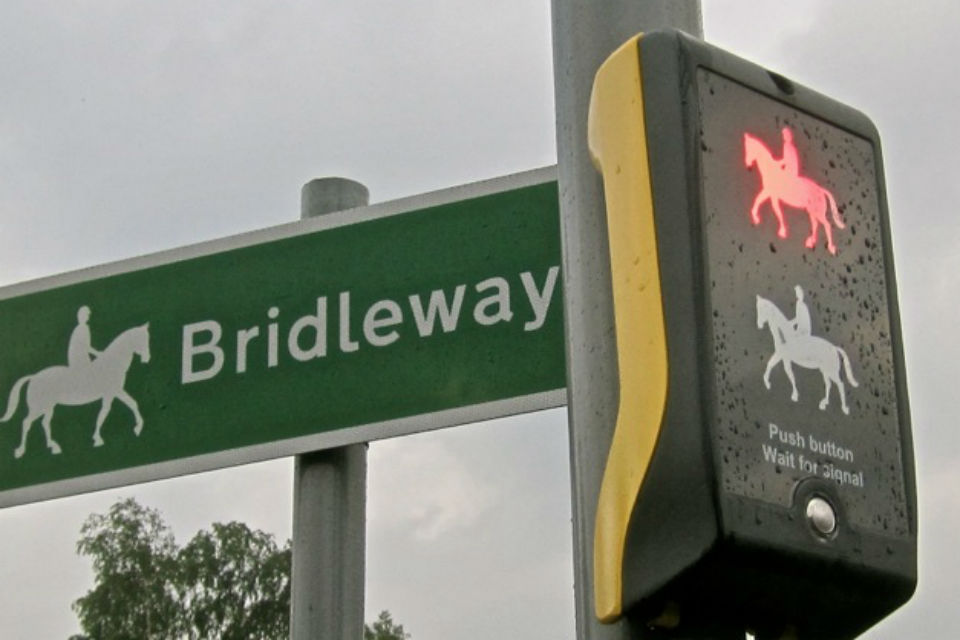
Image showing Pegasus system
The green route even has a Pegasus system to allow safer crossing over junctions for horseriders

The green route even has a Pegasus system to allow safer crossing over junctions for horseriders

Mr Hampson said:

We would like to thank local people for their patience since March when the conversion work started in earnest. We hope they agree the new dedicated route for pedestrians, cyclists and horse riders as well as the new single carriageway B road and new junction arrangements at Bucklow Hill and Mere have been well worth the wait.

General enquiries

Members of the public should contact the Highways England customer contact centre on 0300 123 5000.

Media enquiries

Journalists should contact the Highways England press office on 0844 693 1448 and use the menu to speak to the most appropriate press officer.


Link: Press release: £5 million B road opens as A556 bypass legacy
Source: Gov Press Releases