The Secretary of State for Business, Energy and Industrial Strategy, Greg Clark, has today (24 October 2017) appointed Fiona Dickie as Deputy Pubs Code Adjudicator (DPCA) who will support the Pubs Code Adjudicator, Paul Newby, in enforcing the Pubs Code.
Pubs Code Adjudicator Paul Newby said:
I am delighted to welcome Fiona Dickie to the team. Fiona’s 12 years’ judicial experience, including in complex and high-value cases, will be the perfect foundation to her role as Deputy Pubs Code Adjudicator. I look forward to working with her to improve conditions for tied tenants up and down the country.
Deputy Pubs Code Adjudicator Fiona Dickie said:
I am very proud to be appointed as Deputy Pubs Code Adjudicator. I look forward to using my legal background to offer a just and proportionate resolution to disputes, and to ensuring compliance with the Code to support a fair, thriving pubs industry and the local communities they serve. I encourage all interested parties to work with the Pubs Code Adjudicator.
Margot James, Parliamentary Under-Secretary of State for Small Business, Consumers and Corporate Responsibility, said:
The Pubs Code helps thousands of tied tenants across the country to secure a better deal and Fiona’s role will further strengthen this vital work.
Her extensive legal knowledge, dispute resolution skills and experience of complex cases will be invaluable assets in her new role.
Fiona Dickie will take up her role on 1 November 2017, working 4 days per week. She will be based in Birmingham.
Notes to editors
Fiona Dickie was called to the Bar in 1993. She has been a Vice President of the Valuation Tribunal for England since July 2009, and was appointed Judge of First-tier Tribunal (Property Chamber) in 2013 (after serving as a Lawyer Chairman of its predecessor tribunal from 2006). She was accredited as a Civil Mediator by the Alternative Dispute Resolution (ADR) Group in 2005. She was also appointed as a Road User Charging Adjudicator (RUCA) in 2004, and appointed as an Examiner of the Court in 2004.
This appointment is made in accordance with the code of practice for the Office of the Commissioner for Public Appointments (OCPA). The appointment is made for an initial term of 2 years.
The Pubs Code regulates the relationship between all businesses owning 500 or more tied pubs in England and Wales and their tied tenants. The Deputy Pubs Code Adjudicator will support the Pubs Code Adjudicator and will have the same powers as the Adjudicator to arbitrate individual disputes about breaches of the Pubs Code (including disputes on rent and market rent only options), investigate suspected systemic breaches of the Code more widely across the sector, provide advice and guidance about the Code and report on unfair business practices.
The Statutory Pubs Code was introduced in May 2016. In the first year the Pubs Code Adjudicator has accepted 156 cases for arbitration and made 48 arbitration awards. Anyone with a stake in the pub business is encouraged to work with the Pubs Code Adjudicator and Deputy Pubs Code Adjudicator to raise the profile of the Code and improve relationships across the industry.
Highways England announced the preferred route for the dualling of a 30 mile section of the A303 between Sparkford and Ilchester.
The move for the £179 million scheme follows the recent announcement of the preferred route for the £1.6 billion upgrade of the A303 further up the road near Stonehenge.
Transport Secretary Chris Grayling said:
The government is taking the big decisions for Britain’s future and investing in the biggest roads upgrade in a generation.
Our major upgrade to the A303, linking the M3 in the south-east and the M5 in the south-west, will create an expressway to boost the regional economy and provide better transport links.
As part of this work, the £179 million upgrade between Sparkford and Ilchester will cut congestion, reduce journey times and improve safety for all road users.
Jim O’Sullivan, Highways England chief executive, said:
The A303 is a vital route between the South West and the rest of the country and this upgrade is absolutely necessary to provide much needed capacity and to relieve the congestion which drivers have suffered for years.
People who responded to our consultation earlier this year demonstrated strong support for option one, which closely follows the route of the existing A303 and so would have less impact on the rural setting.
We now look forward to continue to work with our partners and the local community to develop more detailed proposals to start construction in 2020.
In the meantime, we invite visitors to our planned drop-in sessions where we can discuss the preferred route with those interested.
As part of its £15bn investment in motorways and main ‘A’ roads the Government is committed to upgrading all remaining sections of the A303 between the M3 and M5 to dual carriageway standard, starting with three schemes: those on the A303 at Stonehenge and between Sparkford and Ilchester, and the third on the A358 between Taunton and Southfields.
Two options for the three-mile section between Sparkford and Ilchester were consulted on earlier this year. The preferred route will support the local economy to grow by making the area more accessible for both
tourism and business.
The proposed route will offer a high quality dual carriageway with new two-level junction access with local roads and communities. The proposal will protect biodiversity and road users would benefit from the shorter route.
It will improve local access for pedestrians, equestrians and cyclists.
Formal consultation is due to take place early next year along with the submission of a development consent order planning application.
Two public drop-in events where people can view the preferred route and talk to our project experts will be held at:
Haynes Motor Museum, Wolverlands, Sparkford, Yeovil BA22 7LH Tuesday 7 November 2017 3pm to 7pm
Haynes Motor Museum, Wolverlands, Sparkford, Yeovil BA22 7LH Friday 10 November 2017 3pm to 7pm
Information points
Copies of the preferred route plans and supporting reports will also be available at the following local information points from Tuesday 24 October:
Be prepared for the unexpected is the stark warning from volunteer flood wardens in Calderdale.
Katie Kimber is one of two Environment Agency flood wardens in a newly formed group set up to help protect residents and businesses in Luddenden Foot and they are looking to recruit more this Autumn.
She lives a row of houses at the bottom of the Calder Valley that has a canal running at the front and a river behind them, with their gardens protected by a high wall. Until Boxing Day 2015 they had never been flooded.
Katie said:
I was completely unprepared. I had only just moved to the area and even though the damage I suffered was minimal compared to houses just a stone throw away it made me determined to be ready for the next time.
The mother of two children, aged 12 and 15, now has a flood plan for her own property and has helped set up a flood container for her local community kitted out with sandbags, Floodsax, brushes, spades, gulley cleaners, wheelbarrows, gloves and hand hygiene gel – all the provisions needed for clean-up operations.
Katie has recently attended a sessions with Calder Valley Search and Rescue where the team demonstrated the dangers of water and how to keep safe during a flood event. She has worked with her husband to develop an app called Flood Aware for tracking water levels in the local area. Her role is to work with the Environment Agency to provide them with valuable local knowledge about what is happening on the ground and to support her community in the event of a flood – particularly older and vulnerable people living in the hamlet.
Her advice to all residents is to make sure they have measures in place to protect their own property, sign up for the Environment Agency weather warnings and flood alerts available by email, text and phone, check what the warnings mean and what they should do, keep a close eye on the weather outside and the levels of nearby rivers, particularly during prolonged, heavy rain.
Katie, whose day job is working for Watermark Flood Fund Calderdale, a Community Foundation For Calderdale project which raises money to provide grants in case of future flooding and provides public relations support for Landlines and Watermarks – a unique community arts project with a water theme – said:
Expect the unexpected, have FloodSax or something similar ready under your sink and an emergency bag full of essentials such as a change of clothes, wellies, mobile phone, snacks. Even if you feel silly knock on your neighbour’s door if you have any concerns.
A positive to come out of the recent flooding incident is we have become a very close-knit community, we know and look out for each other.
Karl Boggis, father of two young boys, joined the Mytholmroyd flood group shortly after there were two flood events just two weeks apart in his village in 2012. The group has developed from being a small local pressure group to being the ‘eyes and ears’ of organisations such as the Environment Agency (EA) with 22 active volunteer wardens covering eight zones. The flood wardens receive early warnings of bad weather on the horizon from the EA’s duty officer and one of group’s first tasks is to set up a communications cell in one of their living rooms to provide people of Mytholmroyd with regular updates using their Facebook Group about all flood related activity.
Karl is part of the Mytholmroyd flood group
They communicate with each other using radios, visit neighbours to ask them to move any cars at risk and move property upstairs to safety, help evacuate local schools if necessary and will direct traffic to keep it out of flood water.
Karl, a town councillor and former town Mayor, said:
We know all the hot spots now, which areas are more at risk of flooding so we visit them first to check everything is OK and make them aware of the likelihood of bad weather. We have evacuation plans for some houses, check drains and gullies to make sure they are not blocked. When necessary, we will open up the cabin store in Mytholmroyd for people to collect sandbags.
A lot of our work is through effective communications and making sure people don’t panic. We ask people to stay at home, turn their radios on and if they have elderly neighbours please check on them.
As part of my role I visit people in my local community to introduce myself as their flood warden so they know who to contact if they have a problem. Most of our hard work is actually to help people clear up after a flood.
Karl, a property developer who also works part-time in a utility warehouse distributor, had six of his seven properties badly damaged during the Boxing Day floods with water reaching 10ft in his own house. He said:
Sometimes we do get alerted to bad weather and it doesn’t materialise which does make people complacent. However, the effects of floods are so devastating it is much better to be warned and be safe than sorry.
All flood wardens in Calderdale are being encouraged to take part in an exercise to test their flood plans on the 20th October to coincide with the Upper Calder flood sirens being sounded as part an annual test.
When asked what qualities you need to be a flood warden Karl said:
You need plenty of community spirit, a desire to help and good local knowledge helps.
Jon Follows, flood resilience officer with the Environment Agency, said:
The local knowledge flood wardens can provide on the ground is invaluable. They complement our work by implementing their community action plans and offer a key point of contact for us to be able to warn and inform people.
These days with climate change our weather is becoming even more unpredictable and so it’s vital for communities at risk to protect themselves by signing up for free flood warnings, and prepare a flood plan.
1 in 6 properties in England are at risk of flooding – that’s almost 5 million people. A big worry is that only about half of the people who are in a flood risk area, actually know about it.
Jon’s advice is to start by taking three simple steps to help protect you, your family and home from the devastating effects flooding:
Check your flood risk – Use the Environment Agency maps to find out if you are at risk from flooding
If you are interested in becoming a flood warden or would like to ask questions, please email the flood resilience team at yorkshiresw.fim@environment-agency.gov.uk.
For the latest information on current flood warnings and the local weather forecast, Calderdale residents can visit the ‘Eye on Calderdale’ website – www.eyeoncalderdale.com
You can also stay up to date by following @EnvAgencyYNE and #floodaware on Twitter.
On Boxing Day 2015 around 370 properties were flooded in Mytholmroyd as extreme rainfall affected the upper Calder Valley. Since then, Environment Agency teams have carried out thousands of inspections, made crucial repairs and constructed temporary defences. A flood action plan for the town was published in May 2016 setting out plans for permanent improvements to flood protection.
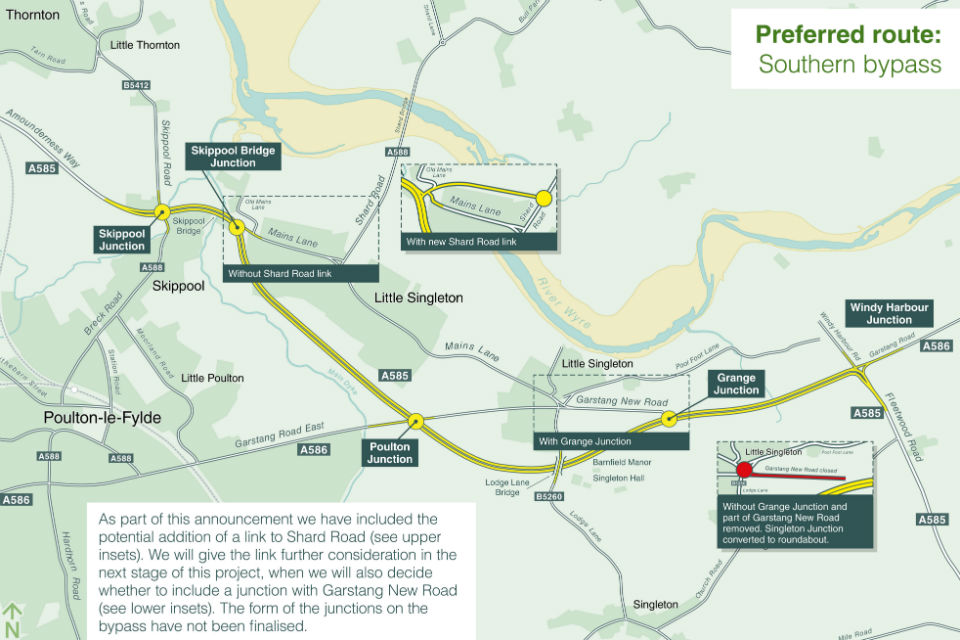
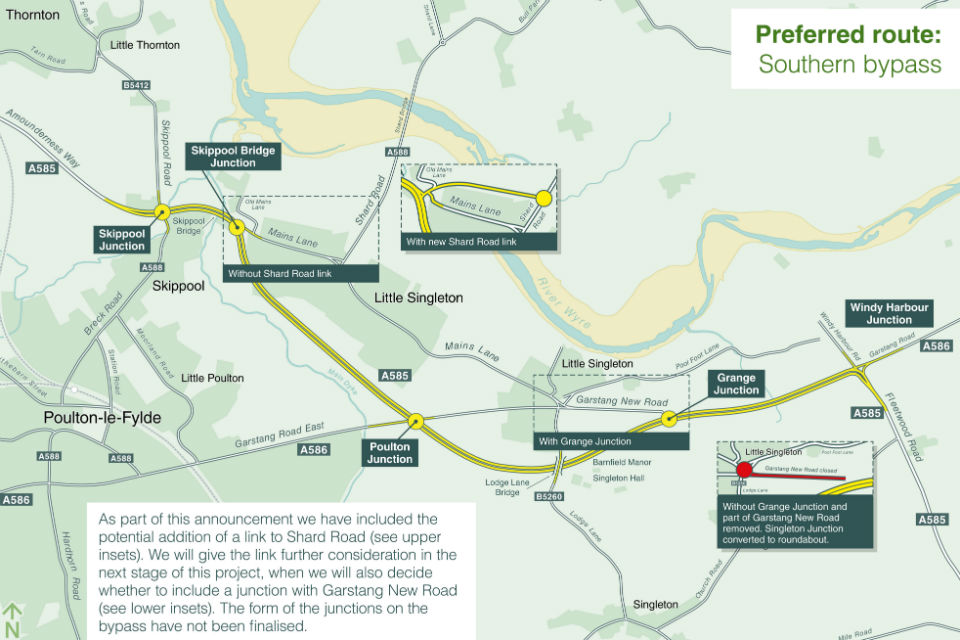
Plans for the new dual carriageway – between Windy Harbour and Skippool – were unveiled today as part of Highways England’s preferred route announcement (PRA) for the project which is part of the Government’s £15 billion Road Investment Strategy (RIS).
Roads Minister Jesse Norman said:
The Government is taking major decisions for Britain’s future and delivering the largest roads upgrade in a generation.
The £100 million new bypass along the A585 near Poulton-le-Fylde will boost the regional economy as well as reduce congestion and cut journey times for drivers.
The 2.7 mile Windy Harbour to Skippool section is one of the busiest and most congested along the 11.5 mile road which links Fleetwood to the M55. The Shard and Little Singleton junctions are particular congestion bottlenecks.
The announcement follows last year’s consultation – in which 78 percent of people and both Fylde and Wyre councils backed the bypass option over an alternative to improve the existing single carriageway road.
Highways England project manager David Hopkin said:
We are delighted to announce we have decided to take the Southern Bypass option forward. It was comfortably the most popular option in a consultation in which almost everyone agreed that something needs to be done about congestion along this section of the A585.
The new road will help secure and improve opportunities for housing and jobs in this part of Lancashire and contribute to improved connections to the whole of the motorway network.
Work to construct the new road could start in early 2020 but the bypass is subject to a statutory consultation.
Highways England also revealed today it is continuing to consider options for the Garstang New Road junction. Another idea to link the new bypass to Shard Road which was raised by local people during the consultation will also be investigated.
The Department for Education has today (24 October) announced a programme to recruit a team of high-performing leaders to provide specialist support to struggling FE colleges.
The National Leaders of Further Education (NLFE) will be comprised of experts from the FE sector who will work to improve colleges judged as “Requires Improvement” or “Inadequate” in their most recent Ofsted inspection.
Successful applicants will provide mentoring and support to develop the skills of senior staff at impacted colleges and will partner their colleges on the delivery of improvement programmes.
They will also work with other NLFE as part of a network and share best practice with institutions across their region.
Apprenticeships and Skills Minister Anne Milton said:
This country has fantastic leaders across the FE sector and we want to harness their ability to raise standards across the FE Sector.
We want to make sure that improvements to schools are replicated in colleges. The National Leaders of Further Education, which will sit alongside the Strategic College Improvement Fund can ensure this happens. I look forward to welcoming these leaders into this exciting programme.
ENDS
Notes to editors
The NLFE programme is modelled on the highly successful National Leaders of Education scheme in schools.
Interested applicants should contact FE.leaders@education.gov.uk. Applications will close on 14 November 2017.
New steps will be taken to deal with litter louts and those few who mindlessly throw rubbish from their vehicles, Environment Minister Thérèse Coffey announced today.
Cleaning up our streets and countryside currently costs the taxpayer almost £800 million a year and so maximum on-the-spot fines for dropping litter will almost double from April next year – from the current limit of £80 to £150 – in order to deter and punish the anti-social minority who continue to drop rubbish.
In future councils will also be able to impose these fines on the owners of vehicles from which litter is thrown, even if it was discarded by someone else. The government is clear these fines should not be abused simply as a means of raising money, so guidance on how fines should be applied will be issued to councils.
Environment minister Thérèse Coffey said:
Littering blights our communities, spoils our countryside and taxpayers’ money is wasted cleaning it up.
Throwing rubbish from a vehicle is just as unacceptable as dropping it in the street and we will tackle this antisocial behaviour by hitting litter louts in the pocket.
These new fines will make sure the perpetrators, not the local community, bear the cost of keeping our streets and roads clean.
Today’s announcement means that:
From April next year, the maximum on-the-spot fine local authorities can issue for dropping litter will nearly double, from £80 to £150. The minimum fine will increase from £50 to £65, while the default fine will increase from £75 to £100.
For the first time, local authorities will also be able to apply these penalties for littering to vehicle owners if it can be proved litter was thrown from their car – even if it was discarded by somebody else.
The changes to fines for littering follow a public consultation as part of the launch of England’s first ever Litter Strategy in April 2017. These new findings showed the vast majority of respondents were in favour of increasing on-the-spot fines.
More than 85% were in favour of increasing fixed penalties for littering, while local authorities agreed that new penalties to tackle littering from cars would help to improve environmental quality in their area. The government is today confirming that it will proceed with these measures, with legislation introduced by the end of this year and the new fines in place by April next year, subject to parliamentary approval.
The government is clear however that councils must not abuse the power to impose fines. Councils should take into account local circumstances, like local ability to pay, when setting the level for these fines. Government guidance will be issued around the turn of the year to ensure the new powers are used in a fair and proportionate way by local authorities.
The sole registered director of AS Diamonds Limited in Arlington Court, Stevenage, has been disqualified from acting as a company director for six years failing to provide adequate company records, whilst also treating HMRC detrimentally in comparison to other creditors.
The Secretary of State for Business, Energy and Industrial Strategy accepted an undertaking from Gary Wright effective from 11 October 2017.
Although Gary Wright provided some accounting records to the liquidator they were inadequate and it was not possible in particular to verify the purpose of payments to himself of over £160,000 as well as cash withdrawals of £40,000 and the validity of a supplier invoice to the value of £33,000.
During the period of trading, Gary Wright caused AS Diamonds Limited to treat HMRC detrimentally in comparison to other creditors. Although AS Diamonds Limited charged VAT on its sales invoices, no VAT returns were ever submitted and HMRC therefore duly issued assessments totaling £123,922. An analysis of the company’s bank account revealed that in excess of £490,000 was paid out, of which, nothing was paid to HMRC in respect of its accruing VAT debt.
Additionally, during the period 11 December to 22 December 2014, £49,967 was transferred to Gary Wright’s personal bank account which was to the detriment of creditors in general.
Commenting on the disqualification, David Brooks, a Chief Investigator with the Insolvency Service said:
The period of this disqualification contained within the undertaking signed by Gary Wright sends a clear message to other company directors.
Company directors have a statutory duty under the Companies Act to keep adequate company records which should amongst other things satisfactorily explain payments.
Further, much of the public service is funded by the correct amount of taxes being paid. By not declaring and paying the correct amount of taxes, Gary Wright has ultimately deprived the public services and the public from receiving the services it deserves. The Insolvency Service therefore will not hesitate to remove them from the business environment in order to protect the public.
Notes to editors
Gary Wright, 37 – date of birth, December 1980, was a registered director of AS Diamonds Limited (Company No. 08514671), which was incorporated in May 2013 and traded as a wholesaler of watches and jewellery from Arlington Court, Stevenage.
Gary Wright, of Stevenage, has been disqualified for 6 years from 11 October 2017.
A disqualification order has the effect that without specific permission of a court, a person with a disqualification cannot:
act as a director of a company
take part, directly or indirectly, in the promotion, formation or management of a company or limited liability partnership
be a receiver of a company’s property
Disqualification undertakings are the administrative equivalent of a disqualification order but do not involve court proceedings.
Persons subject to a disqualification order are bound by a range of other restrictions.
The Insolvency Service, an executive agency sponsored by the Department for Business, Energy and Industrial Strategy (BEIS), administers the insolvency regime, and aims to deliver and promote a range of investigation and enforcement activities both civil and criminal in nature, to support fair and open markets. We do this by effectively enforcing the statutory company and insolvency regimes, maintaining public confidence in those regimes and reducing the harm caused to victims of fraudulent activity and to the business community, including dealing with the disqualification of directors in corporate failures.
BEIS’ mission is to build a dynamic and competitive UK economy that works for all, in particular by creating the conditions for business success and promoting an open global economy. The Criminal Investigations and Prosecutions team contributes to this aim by taking action to deter fraud and to regulate the market. They investigate and prosecute a range of offences, primarily relating to personal or company insolvencies.
The agency also authorises and regulates the insolvency profession, assesses and pays statutory entitlement to redundancy payments when an employer cannot or will not pay employees, provides banking and investment services for bankruptcy and liquidation estate funds and advises ministers and other government departments on insolvency law and practice.
Further information about the work of the Insolvency Service, and how to complain about financial misconduct, is available.
This service is for journalists only. For any other queries, please contact the Insolvency Enquiry line on 0300 678 0015.
For all media enquiries outside normal working hours, please contact the Department for Business, Energy and Industrial Strategy Press Office on 020 7215 1000.
Salahuddin Sahibzada and Muhammad Anjum have each been disqualified for six years having given disqualification undertakings to the Secretary of State for Business, Energy & Industrial Strategy, which commenced on 25 September 2017 and 3 October 2017, respectively.
Mr Sahibzada and Mr Anjum were the directors of New Lahore Express Limited, and on 18 April 2016 Home Office Immigration Enforcement Officers discovered that the company was employing five illegal workers.
The company went into liquidation on 17 August 2016 owing creditors £90,973. A penalty of £30,000 was imposed by the Home Office Immigration and Enforcement on 29 June 2016 for employing illegal workers which remained unpaid.
Commenting on the disqualification, Martin Gitner, Deputy Head of Investigations, West Midlands stated:
Illegal workers are not protected under employment law, and as well as cheating legitimate job seekers out of employment opportunities these employers defraud the tax payer and undercut honest competitors.
The Immigration, Asylum and Nationality Act 2006, makes employers responsible for preventing illegal workers in the UK. To comply with the law, a company must check and be able to prove documents have been checked prior to recruitment that show a person is entitled to work.
The public has a right to expect that those who break the law will face the consequences and this should serve as a warning to other directors tempted to take on illegal staff.
Notes to editors
Mr Salahuddin Sahibzada resides in Eastbourne and his date of birth is August 1973.
Mr Muhammad Anjum resides in Southend On Sea and his date of birth January 1963.
New Lahore Express Limited (CRO No. 06800253) was incorporated on 23 January 2009.
New Lahore Express Limited traded from 265 Bethnal Green Road, London E2 6AH and its registered office was at the same address.
Mr Sahibzada was a director from 29 September 2009 to the date of liquidation.
Mr Anjum was a director from 14 May 2014 to the date of liquidation.
The Company went to creditors voluntary liquidation on 17 August 2016 with as estimated deficiency of £90,973.
On 4 September 2017, the Secretary of State accepted a disqualification undertaking from Mr Sahibzada, effective from 25 September 2017, for a period of 6 years.
On 12 September 2017, the Secretary of State accepted a disqualification undertaking from Mr Anjum, effective from 3 October 2017, for a period of 6 years.
Following a visit from Home Office Immigration Officers in April 2016, a breach was discovered, New Lahore Express Limited was issued with a penalty notice in the sum of £30,000 which remained outstanding at the date of liquidation.
A disqualification order has the effect that without specific permission of a court, a person with a disqualification cannot:
act as a director of a company
take part, directly or indirectly, in the promotion, formation or management of a company or limited liability partnership
be a receiver of a company’s property
Disqualification undertakings are the administrative equivalent of a disqualification order but do not involve court proceedings.
The Insolvency Service, an executive agency sponsored by the Department for Business, Energy and Industrial Strategy (BEIS), administers the insolvency regime, and aims to deliver and promote a range of investigation and enforcement activities both civil and criminal in nature, to support fair and open markets. We do this by effectively enforcing the statutory company and insolvency regimes, maintaining public confidence in those regimes and reducing the harm caused to victims of fraudulent activity and to the business community, including dealing with the disqualification of directors in corporate failures.
BEIS’ mission is to build a dynamic and competitive UK economy that works for all, in particular by creating the conditions for business success and promoting an open global economy. The Criminal Investigations and Prosecutions team contributes to this aim by taking action to deter fraud and to regulate the market. They investigate and prosecute a range of offences, primarily relating to personal or company insolvencies.
The agency also authorises and regulates the insolvency profession, assesses and pays statutory entitlement to redundancy payments when an employer cannot or will not pay employees, provides banking and investment services for bankruptcy and liquidation estate funds and advises ministers and other government departments on insolvency law and practice.
Further information about the work of the Insolvency Service, and how to complain about financial misconduct, is available.
This service is for journalists only. For any other queries, please contact the Insolvency Enquiry line on 0300 678 0015.
For all media enquiries outside normal working hours, please contact the Department for Business, Energy and Industrial Strategy Press Office on 020 7215 1000.
Public Health England (PHE) has today (24 October 2017) published new child vision screening materials and guidance to help improve consistency and quality of sight tests for children in schools during their early years.
There are almost 25,000 blind and partially sighted children in the UK – around 2 in every 1,000 children. Vision screening is an important way to identify problems as early as possible, helping to prevent young children from completely or partially losing their sight.
Early detection of reduced vision means that effective treatment, such as glasses or patching, can be quickly offered. The tests are carried out in schools to help maximise screening coverage of 4 to 5-year-olds.
Vision screening for 4 to 5-year-olds is part of the healthy child programme, and the new materials will summarise best practice for commissioners and those who carry out the tests, including school nurses, to ensure screening is of a consistent high-quality across schools.
The materials were developed by an expert advisory group, including PHE, and are all evidence based. They include a leaflet for parents, which clearly explains:
the importance of vision screening
how the test is carried out
what support is offered if there is a problem
There is also guidance for vision screeners, outlining the expected requirements to ensure they carry out safe and effective tests.
Dr Anne Mackie, PHE’s Director of Screening, who chaired the expert advisory group to develop the new materials, launched the resources during her speech today at the Westminster Health Forum Seminar in London, which focused on eye care services and treating visual impairment.
Dr Anne Mackie said:
There are almost 25,000 blind and partially sighted children in the UK – 2 in every 1,000 children, which is why it is essential that all young children have their vision tested.
A child’s eyes are in constant use in the classroom and at play. If they have any undetected problems with their vision, their education and participation in activities and sports can suffer.
The child vision screening programme is the only chance for all children to get their vision tested formally so that problems can be identified and tackled quickly at the start of their school life – helping ensure they can reach their full potential.
These new resources will help ensure high-quality, local vision screening services in schools across England.
The UK National Screening Committee has recommended vision screening on a number of occasions, most recently in 2013.
Background
Public Health England chaired an expert advisory group, including professional organisations representing orthoptists, optometrists and ophthalmologists, academics and the Association of Directors of Public Health, to develop the resources, which includes public and parental information sheets, educational resources and commissioning guidelines. The documents were also the subject of a formal consultation.
Public Health England exists to protect and improve the nation’s health and wellbeing, and reduce health inequalities. It does this through world-class science, knowledge and intelligence, advocacy, partnerships and the delivery of specialist. Follow us on Twitter @PHE_Screening
An investigation by the Insolvency Service found Langton misappropriated £21,517 from three banks by making false claims for reimbursement of sums paid out of his account.
Mr Langton (24), employed, of Leicester, has agreed to be bound by the restrictions set out in insolvency law until 11 October 2025.
On 2 December 2016, a bankruptcy order was made after Mr Langton applied for his own bankruptcy. His total deficiency at the time was around £36,421.
Commenting on the case Gerard O’Hare, Official Receiver for Nottingham said:
Mr Langton falsely claimed reimbursements for money paid out of his account from three banks receiving £21,517. He knew he was not entitled to the money but claimed the reimbursements regardless of the consequences, which resulted in incurring debt.
This eight year restriction should act as a deterrent to him and others from acting in the same way.
Notes to editors
The bankruptcy order was made on 2 December 2016 following a petition presented on 1 December 2016.
Mr Langton’s date of birth is October 1993.
If the Official Receiver considers that the conduct of a bankrupt has been dishonest or blameworthy in some other way, he (or she) will report the facts to court and ask for a Bankruptcy Restrictions Order (BRO) to be made. The court will consider this report and any other evidence put before it, and will decide whether it should make a BRO. If it does, the bankrupt will be subject to certain restrictions for the period stated in the order. This can be from 2 to 15 years.
The bankrupt may instead agree to a Bankruptcy Restrictions Undertaking (BRU) which has the same effect as an order, but will mean that the matter does not go to court.
These are restrictions set out in insolvency law that the bankrupt is subject to until they are discharged from bankruptcy – normally 12 months and include that bankrupts:
must disclose their status to a credit provider if they wish to get credit of more than £500
who carry on business in a different name from the name in which they were made bankrupt, they must disclose to those they wish to do business with the name (or trading style) under which they were made bankrupt
may not act as the director of a company nor take part in its promotion, formation or management unless they have a court’s permission to do so
may not act as an insolvency practitioner, or as the receiver or manager of the property of a company on behalf of debenture holders
Additionally, a person subject to a bankruptcy restrictions undertaking may not be a Member of Parliament in England or Wales.
The Insolvency Service, an executive agency sponsored by the Department for Business, Energy and Industrial Strategy (BEIS), administers the insolvency regime, and aims to deliver and promote a range of investigation and enforcement activities both civil and criminal in nature, to support fair and open markets. We do this by effectively enforcing the statutory company and insolvency regimes, maintaining public confidence in those regimes and reducing the harm caused to victims of fraudulent activity and to the business community, including dealing with the disqualification of directors in corporate failures.
BEIS’ mission is to build a dynamic and competitive UK economy that works for all, in particular by creating the conditions for business success and promoting an open global economy. The Criminal Investigations and Prosecutions team contributes to this aim by taking action to deter fraud and to regulate the market. They investigate and prosecute a range of offences, primarily relating to personal or company insolvencies.
The agency also authorises and regulates the insolvency profession, assesses and pays statutory entitlement to redundancy payments when an employer cannot or will not pay employees, provides banking and investment services for bankruptcy and liquidation estate funds and advises ministers and other government departments on insolvency law and practice.
Further information about the work of the Insolvency Service, and how to complain about financial misconduct, is available.
This service is for journalists only. For any other queries, please contact the Insolvency Enquiry line on 0300 678 0015.
For all media enquiries outside normal working hours, please contact the Department for Business, Energy and Industrial Strategy Press Office on 020 7215 1000.