
The International Trade Committee examines the Government’s planned timetable for rolling over existing Economic Partnership Agreements
Link: Minister questioned on trade with developing countries
Source: Parliamentary News
The International Trade Committee examines the Government’s planned timetable for rolling over existing Economic Partnership Agreements
Link: Minister questioned on trade with developing countries
Source: Parliamentary News
The Charity Commission has today published the results of its latest monitoring reviews of charity trustees’ annual reports and accounts. The findings reveal a modest improvement in the quality of public reporting, but the regulator says that too many charities are still falling short in this area.
Public benefit reporting plays a key role in providing transparency so that the public can understand exactly what a charity does and how their donations are being used.
As part of its proactive monitoring work, the Commission scrutinised a random sample of 106 charity trustees’ annual reports and accounts filed with it to assess:
Trustees have a legal responsibility to comply with the Commission’s guidance on public benefit reporting. All registered charities must publish a trustees’ annual report, setting out the charity’s activities for the public benefit.
The Commission’s review found that 51% of the charities reviewed demonstrated a clear understanding of the public benefit reporting requirement – a 5% improvement from last year’s result.
The majority of annual reports also included key aspects of public benefit reporting, with 71% explaining who benefitted from the charity’s activities, and 62% including a public benefit statement.
Some trustees had expanded their statement to explain why they believed their charity’s activities provided public benefit, whilst others discussed the difference that they had made, particularly to beneficiaries.
The Commission examined whether the charities’ trustees’ annual reports and accounts as a whole met readers’ needs, based on a range of criteria.
For the sample of charities with incomes over £25,000, the Commission found that 74% of the trustees’ annual reports and accounts reviewed were of acceptable quality, meeting the basic benchmark set by the Commission.
The most common reason for inadequate reporting was that the trustees’ annual report did not explain the charitable activities the charity had carried out.
For the sample of small charities, the Commission found that 64% of the charities provided trustees’ annual reports and accounts of acceptable quality, meeting the regulator’s basic benchmark. The main reason for inadequate reporting was that the charity failed to provide one or both of the trustees’ annual report and the accounts.
The Commission has provided regulatory guidance to 89 charities included in the reviews in order to help the trustees improve the quality of future trustees’ annual reports and accounts.
“Our research into trust and confidence in charities shows that the public no longer give charities the benefit of the doubt; they want evidence that charities make a difference when using their money. Public reporting is an opportunity for charities to tell their story and explain to the public what they do and how they use charitable funds.
“Producing a trustees’ annual report and accounts is not an administrative box-ticking exercise. It is a chance to show how your charity is making an impact and how you are delivering on your core purpose.
“Today’s results show that too many charities are still not meeting very basic standards when it comes to making key information available to the public. I am encouraged to see that an increasing number of trustees recognise the value of public benefit reporting, but there is clearly more work to be done across the sector.”
The full reports are available on GOV.UK.
Ends
Email
pressenquiries@charitycommission.gsi.gov.uk
Press enquiries – office hours
0300 065 2123
Press enquiries – out of hours
07785 748787
Link: Press release: Charities must better communicate to the public through their annual reports and accounts, urges regulator
Source: Gov Press Releases
A steel company has today been sentenced for safety breaches after a worker fell into an open pit.
Link: Tata Steel fined after worker fell into open pit
Source: Health and Safety
Prison governors will today be able to have their say on a new approach to incentives which encourages prisoners to take responsibility for their own rehabilitation.
A consultation is being launched on the new Incentives and Earned Privileges policy, which would empower governors to design their own programme of incentives tailored to the specific challenges in their prison.
Those who behave well and engage in meaningful activities such as education and employment programmes could receive privileges such as more time in the gym or additional visits.
Crucially, governors will be able to tackle poor behaviour by taking away privileges – returning people to a more basic regime and living conditions – and will have greater freedom to decide how prisoners move up or down privilege levels.
Prisons Minister Rory Stewart said:
Prisons must be places of safety, decency and purposeful activity to turn around the lives of those in custody.
This new framework will give governors the tools to set clear behavioural standards for offenders under their watch, and the consequences should these not be met.
Research on behaviour change shows positive reinforcement is much more effective at shaping behaviour than punishment and, while sometimes necessary, punishment alone does not effectively change behaviour.
Many consider that the incentives system is not currently as effective as it could be, with governors having too little flexibility to establish incentives that their particular cohort of prisoners value.
We are therefore providing governors with more freedom to design their incentive scheme to take account of the
local needs of their prison population and the facilities available in their prison. This means a prison with a good gym, or a wing with a kitchen area, could better use these in its IEP system in future.
Governors could also choose to increase the amount of time out of cell an individual prisoner receives to engage in recreational activities or exercise alongside education and work programmes.
And to better assist them in preparing for life back in the community, governors could choose to incentivise prisoners by offering additional visits from family and friends, with more flexible timings.
We will retain sensible limitations on governors’ freedoms, so that, for example, no paid for TV channels or other inappropriate incentives are permitted.
And for those who don’t follow the rules, a strict system of adjudications and punishments will ensure that governors are able to deal swiftly with those who refuse to engage. Punishments range from the removal of privileges to harsher measures such as prosecution and additional prison time.
Link: Press release: New incentives framework to help prisoners turn their lives around
Source: Gov Press Releases
With above average temperatures and slightly lower than average rainfall likely over the next three months, the Environment Agency (EA) is warning of an increased risk of fire at waste sites, particularly end of life vehicle facilities, and urging operators to have Fire Prevention Plans (FPPs) in place.
The warning follows a number of severe waste fires recently including an incident which forced Coventry Airport to close temporarily and another fire in Witney resulted in the public being warned of the potential for asbestos debris being deposited.
Reports of fires at car breakers (end of life vehicle sites) has increased steadily in recent years. In 2017 the EA received reports of 24 fires at end of life vehicle sites and 21 reports in 2016.
The regulator is urging the operators to ensure they have FPP in place to minimise the risk to the environment, local communities and workers on site.
Malcolm Lythgo, Head of Waste Regulation at the Environment Agency said:
Fires on waste sites, particularly sites handling hazardous components, unfortunately happen all year round. However, dry, warm weather conditions bring an increased risk.
It’s really important that those handling end of life vehicles have Fire Prevention Plans in place and engage with the Environment Agency for advice and support on keeping their sites safe. This is not just good for businesses, but also helps to safeguard the environment and surrounding communities.
The EA’s Fire Prevention Plan guidance seeks to minimise the likelihood of a fire happening and advise on ways to minimise the spread of fire within the site and to neighbouring sites.
There are simple steps that can be taken to prevent the causes of fires. These include:
More information on FFPs is available on gov.uk
Link: Press release: Vehicle recyclers urged to put fire prevention plans in place
Source: Environment Agency
The House of Commons Library is open for tours on Saturday 13 October.
Link: House of Commons Library tours on Saturday 13 October 2018
Source: Parliamentary News
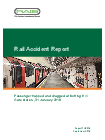

At about 16:00 hrs on Wednesday 31 January 2018, a passenger became trapped in the doors of a London Underground train as she attempted to board a westbound Central line service at Notting Hill Gate station while the doors were closing. The train departed and reached a maximum speed of 35 km/h before the emergency brakes were applied and the train stopped. The passenger was dragged for approximately 75 metres along the platform, and about 15 metres further into the tunnel. She suffered serious injuries and was taken to hospital, where she was treated for about a month. She has since been steadily recovering.
The accident occurred because the passenger’s bag became trapped in the doors as she attempted to board the train, the train’s door control system did not detect the presence of the bag trapped in the doors, and the train operator was not aware of the trapped passenger before initiating the train’s departure. It is likely that the train operator did not perceive the passenger because of a number of interacting factors associated with the nature of his task which caused him to not consciously process the available information. The view on the in-cab CCTV monitor did not adequately assist him to detect that a passenger was trapped in the doors and he relied on other cues to depart rather than making a thorough check of the in-cab CCTV monitor.
The investigation identified a probable underlying factor associated with training programmes for train operators, concerning scanning techniques for in-cab CCTV monitors and awareness of the limitations of door-traction interlocks.
The RAIB has made five recommendations and one learning point, all addressed to London Underground. The recommendations concern the detection of objects by the train’s door systems, how the design of the task, equipment and training can influence train operators’ attention and awareness, and the use of emergency stop facilities on platforms. While there is no evidence that the train operator was impaired by drugs or alcohol, the learning point concerns the importance of following procedures for drug and alcohol testing where relevant.
Link: Press release: Report 14/2018: Passenger trapped and dragged at Notting Hill Gate station
Source: Gov Press Releases
As the Cairncross Review heads to Brussels, polling has also revealed almost half of British adults (47%) believe that the quality of news available has declined in the last five years.
The fact-finding mission to Brussels, as part of the Review’s Call for Evidence, will enable Chair Dame Frances Cairncross to explore threats to the sustainability of the news industry as a Europe-wide problem.
Dame Frances Cairncross said:
The challenges facing the press are not unique to the UK and it is vital that my Review listens to the experiences of other countries. I look forward to learning more in Brussels about the questions industry and policy makers are grappling with and the solutions they are considering to ensure the future of the free press is protected.
The independent review, commissioned by the Prime Minister in January, has been tasked with looking at ways to safeguard the future of the UK’s free, independent and high-quality news in the digital age.
Dame Frances will seek to understand what European governments are doing to protect the creation and consumption of accurate and financially-sustainable journalism and will speak to key stakeholders, including from the European Publishers’ Council and representatives of the Digital Economy in the European Commission.
With her final recommendations to Government and industry expected in the new year, she is particularly keen to gauge views in Europe on the buying and selling of advertising online and whether this could be made more transparent, as well as the appetite in the EU for regulation to counter the disrupting influence of online platforms on the press industry.
An online YouGov survey of British adults’ newspaper habits has found that for the first time, more people are now regularly accessing content from national newspapers online, through apps and websites, than in print (28% to 22%). It also revealed:
The Review has previously highlighted how a quarter of all regional and local newspapers have closed in the past decade. And while the survey results show local or regional news is important to 76% of those who regularly access news, just 13% of adults said they access news via a printed local or regional newspaper, and 13% saying they access a local newspaper online. However almost two thirds (61%) said enough local news was provided for them where they live. This further emphasises the challenge posed to local newspapers – there is a disconnect between those who think local news is important, and those who seek out such news via a local paper.
The Review is calling for evidence and views from both consumers and the industry itself on the issues under consideration, including how to create and support the conditions that will enable high quality journalism to continue and flourish.
Link: Press release: Cairncross seeks views on threats to press
Source: Gov Press Releases
Welsh Secretary Alun Cairns will visit Bridgend-based PCI Pharma Services later today (Monday 3 September) to underline the UK government’s commitment to support the Welsh business community as the UK prepares to leave the European Union.
The visit follows the UK Government’s publication of its White Paper in July, outlining the future relationship between the United Kingdom and the European Union. Last week, the Government published a series of technical notices with information to allow businesses and citizens to understand what they would need to do in the unlikely event of a ‘no deal’ scenario.
During the visit, the Welsh Secretary will tour the site and speak to senior leaders and members of staff about how the White Paper proposal will ensure a deep and long future relationship with the EU, making sure that Wales and the rest of the UK is best placed to make the most of the opportunities ahead while taking back control of our laws, borders and money.
PCI Pharma Services (PCI) is a full-service provider of specialist outsourced drug manufacturing, clinical trial services, and commercial packaging to the global healthcare industry. PCI’s Bridgend site provides extensive services in support of Clinical investigational medicines, including secondary packaging and labelling expertise, storage and global distribution, coupled with its capability for supporting a considerable range of Cold Chain and Ultra Cold chain product needs, including the expertise and infrastructure to support preparation, storage and global distribution of advanced medicines with cryogenic temperature requirements down to -196ºC.
The company also has facilities in Hay on Wye, Tredegar and Treforest, as well as sites in Rockford and Philadelphia in the US, Dublin, Ireland and Melbourne, Australia. The Welsh Secretary met representatives from the US sites during a three-day visit to New York, New Jersey and Pennsylvania in February this year.
This Government is committed to delivering a Brexit that promotes jobs and prosperity, keeps our people safe and protects the precious Union between the four nations of the UK, while taking back control of our money, laws and borders.
PCI Pharma is a global leader in the pharmaceutical field, providing packaging and drug development expertise to companies around the world. It is an important employer in this region of Wales and makes a significant contribution to the Welsh economy. My ambition is for this to continue long after we leave the European Union.
Dr Fiona Withey, Vice Present of Global Clinical Strategy at PCI Pharma is a regular contributor on the Secretary of State’s Economic Advisory Board and Expert Panel, to advise on how Wales can capitalise on the benefits of the UK Government’s Industrial Strategy, as well as opportunities arising from leaving the EU.
PCI has followed the Brexit negotiations with great interest, as have our global pharmaceutical and biotech clients. As a provider of services supporting medicines destined to more than 100 countries around the world, PCI is uniquely positioned to ensure a seamless supply chain to our clients for all potential outcomes. We support lifesaving commercial medicines, as well as those for investigational Clinical studies, to patients all over the world.
We appreciate the time and attention Secretary Cairns has paid to facilitating dialogue and communication with companies like ourselves, as well as ensuring the parties reach an agreeable outcome, with focus on safeguarding the continuity of timely delivery for critical medication to patients.
Link: Press release: Alun Cairns: “The UK Government will carry out its duty to protect Welsh industries as we leave the EU”
Source: Gov Press Releases
Commuters could speed up their journeys by up to 10 miles per hour by starting and finishing work just one hour later, according to new research.
The study by Highways England was carried out on a 9-mile-stretch of the M62 which links the M6 near Warrington to the M60 near Manchester. The route is used by 120,000 drivers every day and construction work is currently taking place to upgrade it to a smart motorway, increasing its capacity by a third.
Commuters had previously faced speeds of just 36 miles per hour between 5pm and 6pm when almost 9,000 drivers take to the short section of motorway on their way home from work.
The study has found that drivers who set off for work after 9am are likely to get there much more quickly than those travelling during the two hours after 7am.
Drivers using this stretch of the M62 who wait until 6pm before leaving the office are also likely to travel 10 miles per hour faster than those leaving at 5pm, or 20 miles per hour faster if they wait until 7pm – cutting journey times by around a third.
Overall, the research found that commuters travelling 20 miles each way and working the traditional 9am to 5pm day could be spending almost an hour extra on the road every week, compared to those working from 10am to 6pm.
Mike Bull, Highways England’s smart motorways programme manager for the North, said:
We all know that our roads are at their busiest during the morning and evening commute but it’s surprising that shifting our working days by just one hour could have such a significant impact on journey times.
Many people won’t have a choice about the hours they work but if some are able to start and finish work an hour later then it could benefit everyone – and save some drivers around an hour each week.
We’re also doing our bit to improve journey times for drivers at Highways England by converting some of our busiest stretches of motorway into smart motorways, adding extra lanes and using technology to prevent tailbacks caused by sudden braking.
The hard shoulders on each new smart motorway will be converted into permanent extra lanes and new emergency areas will be created for drivers to use if they break down. New CCTV cameras will also provide 100% coverage of the routes.
One of the most important signals on a smart motorway – the red X – is used to identify when a lane is closed and indicates that drivers should move into an open lane to continue their journeys.
Driving in a closed lane is dangerous, as there could be debris in the road or an accident or breakdown up ahead. Keeping the lane clear gives the emergency services the access they need to help.
More details about how to drive on a smart motorway are available at https://www.gov.uk/guidance/how-to-drive-on-a-smart-motorway.
Members of the public should contact the Highways England customer contact centre on 0300 123 5000.
Journalists should contact the Highways England press office on 0844 693 1448 and use the menu to speak to the most appropriate press officer.
Link: Press release: Commuters’ perfect working day revealed
Source: Gov Press Releases