
Press release: £21m to boost UK’s world-class tech sector and spread the benefits across the country

The UK’s world-leading tech sector will go from strength-to-strength after plans unveiled today set out a £21m investment to create a new national network of regional tech hubs in areas across the country, including Cardiff.

Today (15 Nov) the Government announced that Tech City UK and Tech North are to become a national organisation, Tech Nation, to speed up the growth of the UK’s pioneering and innovative digital companies and clusters, helping spread the benefits even further.

Successful companies which have benefitted from Tech City UK’s work include Just Eat, Zoopla and Funding Circle.

Building on the organisation’s work helping to turn London’s Silicon Roundabout into a globally recognised tech hub, the funding will see the new Tech Nation work alongside existing tech partners and business organisations to accelerate the expansion already underway by rolling out its tech-hub model.

As part of the plans, Tech City UK will give more than 40,000 people the opportunity to develop the skills needed to start or grow a digital business and will offer support for up to 4,000 UK tech businesses through targeted growth programmes.

Secretary of State for Wales Alun Cairns said:

This is fantastic news for South Wales’ already thriving tech sector.

The digital sector has become an integral part of the Welsh economy and the rapid growth of many digital businesses across the country has confirmed our position as a hub of technological excellence.

Today’s announcement seals South Wales’ place as a regional centre of technology excellence, and the UK Government is committed to ensuring the continued growth of this sector across the country.

Minister for Digital, Matt Hancock, said:

This new funding is an important part of our plans to make the UK the best place in the world to start and grow a digital business, with the benefits spread right across the country.

This regional network will accelerate the growth of the digital tech sector, cement the pipeline of talent and spark the next generation of innovative firms to seize the future opportunities of digitisation – bringing jobs, skills and higher productivity to our regions.

Eleven regional hubs will form the backbone of a national network of digital excellence to reflect the country’s standing as a global powerhouse for tech industries and help the Government achieve aims outlined in the Industrial and Digital Strategies.

The funding will also help entrepreneurs in emerging tech sectors, such as Artificial Intelligence (AI) and Fintech, by connecting them to peers and potential investors in other hubs across the country and by offering tailored development programmes.

Gerard Grech, CEO of Tech City UK (soon to be Tech Nation), said:

We are thrilled the Government is backing our model which has played an important role in helping the country’s tech firms accelerate their growth.

Tech Nation will help transform the UK from a series of standalone tech clusters into a powerful national network that will reinforce the UK’s position at the top of global tech rankings.

This will ensure we continue to be at the forefront of digital innovation, developing tech talent and attracting international investment.

Eileen Burbidge, Chair of Tech City UK (soon to be Tech Nation), said:

We are delighted to hear that the Government wants to increase Tech City UK’s funding for the next four years.

Under the Tech Nation banner, this country that has brought so much innovation to the world and leads in sub-sectors such as fintech, cybersecurity, artificial intelligence, robotics and life sciences will build a national network of digital excellence so that the UK will continue to be recognised as one of the best places in the world to start or grow a digital tech business.

Britain is already a global tech powerhouse and the Government is determined to see that continue. More than 1.4 million people work in the UK’s digital tech sector and jobs are being created at twice the rate of other sectors in the economy.

Average advertised salaries are £50,000, 30 per cent higher than the national average.
The sector has a turnover of more than £118 billion and figures on foreign investment published in July found in the first half of 2017 there was a record £5.6 billion investment in tech in the UK.

In the face of international competition for this high-value employment industry, Tech Nation will help the UK accelerate the growth of the tech sector.

Successful Tech North programmes such as Founders Network and Northern Stars will be extended nationally, and existing national programmes such as Future Fifty and Upscale will be strengthened.

David Buttress, Partner at 83North and former CEO and co-founder of Just Eat, a Future Fifty alumni company, said:

Tech City UK and the Future Fifty programme have given fast-growing companies like ours a great opportunity to learn from our peers and exchange ideas.

They have also enabled us to get our voice heard in government, so that we can give our point of view on the way our working world is changing. That will continue to be extremely important for all emerging tech sectors.

Samir Desai, Funding Circle, a Future Fifty alumni company, said:

Tech City UK has been an excellent advocate for the tech sector, understanding the needs of start-ups and scaling businesses and representing this coherently to Government. The programme they deliver is comprehensive and has supported us across a range of issues and business priorities.

The first set of hubs to form Tech Nation will be located in:

  • Wales – Cardiff
  • Midlands – Birmingham
  • Scotland – Edinburgh and Glasgow
  • Northern Ireland – Belfast
  • Greater London – London

Link: Press release: £21m to boost UK’s world-class tech sector and spread the benefits across the country
Source: Gov Press Releases
Press release: PHE publishes elimination of HIV and HIV testing reports 2017

Today (15 November 2017), Public Health England (PHE) has published its annual elimination of HIV and HIV testing reports for 2017.

Commenting on the significant findings of the reports, Dr Valerie Delpech, Head of HIV Surveillance at PHE, said:

This year, there are 3 firsts in the 30-year history of the UK HIV epidemic. In London, all the global UNAIDS 90:90:90 targets have been met with 90% of people living with HIV infection diagnosed, 97% of people diagnosed receiving treatment and 97% of those receiving treatment virally suppressed. HIV transmission among gay and bisexual men has fallen, and the death rate among people with HIV who are diagnosed promptly and on treatment is now comparable to the rest of the population.

We celebrate these extraordinary achievements which are the result of a comprehensive response involving many key players and organisations. By continuing to invest in effective preventative measures including condom use, expanded HIV testing, prompt treatment and the use of PrEP, the elimination of HIV transmission, AIDS and HIV-related deaths could become a reality in the UK.

Bruce Sparrow

Senior Press Officer, National Infection Service
Public Health England

Background

Reports

Download the HIV Testing in England: 2017 report’ and ‘Towards elimination of HIV transmission, AIDS and HIV-related deaths in the UK: 2017 report’.

HIV: surveillance, data and management

The HIV in the UK Health Protection Report and annual HIV data tables comprise the number of HIV diagnoses, late HIV diagnoses and numbers accessing HIV care. Data can be interrogated and analysed at local authority level via an online tool allowing a range of outputs to be generated. The December 2016 edition of Health Matters, PHE’s resource for local authorities and health professionals, focuses on increasing HIV testing

Testing

It is easy to get tested for HIV. Testing is freely available through GP surgeries, local hospitals and sexual health clinics as well as on self-sampling and self-testing (see NHS Choices for further information). Using a condom with new or casual partners protects against HIV and other STIs, as well as getting tested.

Public Health England (PHE)

Public Health England exists to protect and improve the nation’s health and wellbeing, and reduce health inequalities. We do this through world-leading science, knowledge and intelligence, advocacy, partnerships and providing specialist public health services. We are an executive agency of the Department of Health, and are a distinct organisation with operational autonomy to advise and support government, local authorities and the NHS in a professionally independent manner. Follow us on Twitter: @PHE_uk and Facebook: www.facebook.com/PublicHealthEngland.

Link: Press release: PHE publishes elimination of HIV and HIV testing reports 2017
Source: Gov Press Releases

Press release: Provisional decision to remove Rough gas storage undertakings

In June this year the facility’s operator, Centrica Storage Limited (CSL), announced that it intended to close the plant due to its age, physical deterioration and the associated safety risks, plus the high cost of refurbishing the facility to make it workable.

The facility’s owners, Centrica plc (Centrica) and CSL, requested that the Competition and Markets Authority (CMA) remove historic undertakings – designed to ensure competition in the sector – as part of the closure process.

These included the legal, financial and physical separation of CSL from Centrica, restrictions on Centrica’s access to capacity and ensuring non-discriminatory access to capacity for Rough’s customers.

Following a review, the CMA has provisionally decided to release CSL and Centrica from these undertakings. The companies will also need agreement from the Oil and Gas Authority to cease their storage operations.

Martin Cave, CMA chair, said:

CMA panel members made this provisional decision based on the age and degradation of the gas wells and other facilities at Rough, which mean that the assets are no longer capable of safe operation for gas storage without substantial refurbishment.

We also considered present and anticipated market conditions which meant that the level of investment required to meet the legal obligation to operate safely was not economically viable. This has led to our provisional finding that the undertakings are no longer required.

Further details, including the CMA’s provisional decision to remove the undertakings, can be found on the case page.

Notes for editors

  1. The CMA is the UK’s primary competition and consumer authority. It is an independent non-ministerial government department with responsibility for carrying out investigations into mergers, markets and the regulated industries and enforcing competition and consumer law. For CMA updates, follow us on Twitter @CMAgovuk, Facebook, Flickr and LinkedIn.
  2. The Rough undertakings were first given by Centrica Storage Ltd and Centrica plc following Centrica plc’s acquisition in 2002 of the Rough gas storage facility and have been subsequently amended following Competition Commission reviews in 2006 and 2011, and a further review by the CMA in 2016.
  3. The Rough undertakings were accepted by the Secretary of State under section 88 of the Fair Trading Act 1973. By virtue of paragraph 16 of Schedule 24 to the Enterprise Act 2002, and The Enterprise Act 2002 (Enforcement Undertakings and Orders) Order 2004 (SI 2004/2181), the CMA has the ability to supersede, vary or release certain undertakings accepted under the Fair Trading Act 1973; this includes the Rough undertakings. This power is exercisable in the same circumstances, and on the same terms and conditions as applied to the Secretary of State under the Fair Trading Act 1973; namely that by reason of any change of circumstances the undertakings are no longer appropriate and need to be varied, superseded or released.
  4. The group of CMA panel members acting as decision-makers in the review are Martin Cave(Chair), Anne Fletcher, Jayne Scott and Jon Stern.
  5. Media enquiries to the CMA should be directed to press@cma.gsi.gov.uk or 020 3738 6798.

Link: Press release: Provisional decision to remove Rough gas storage undertakings
Source: Gov Press Releases

Press release: Independent Expert Working Group finds totality of scientific evidence does not support a causal association between the use of hormone pregnancy tests and birth defects

Following this extensive and rigorous review the overall conclusion, based on the totality of the available data, is that the scientific evidence does not support a causal association between the use of HPTs such as Primodos and birth defects or miscarriage.

HPTs such as Primodos were available in the 1960s and 1970s and were widely used to diagnose pregnancy. They were withdrawn from the market in the UK in the late 1970s.

In 2014, the government committed to an independent review and having thoroughly examined all the evidence, the conclusion of the review is that the use of HPTs, including Primodos, in early pregnancy was not responsible for the serious birth defects experienced by some people.

Science and clinical practice has moved on since the 1970s and far-reaching advances in the regulation of medicines have taken place. However, this was a valuable opportunity to make recommendations to further strengthen the systems in place for detecting, evaluating and communicating safety concerns with use of medicines in pregnancy.

The recommendations include:

  • a full genetic clinical evaluation offered to those who were given a HPT for diagnosing pregnancy and whose lives have been impacted by an adverse pregnancy outcome, to see if an underlying genetic cause can be identified
  • a Working Group to advise on better ways to collect, monitor and use data on the safety of medicines during pregnancy
  • electronic Yellow Card reporting to be made available at point of care, including at early scanning, to all those who suspect an adverse outcome of pregnancy with use of a medicine
  • a strategy to co-ordinate research on mechanisms of teratogenicity in early embryonic development to be taken forward with appropriate experts
  • improving the impact of safety messages, monitoring their effect, and ensuring healthcare professionals and patients receive the best available information and feel empowered to make informed decisions about medicines in pregnancy

Professor Stuart Ralston, Chair of the Commission on Human Medicines, said:

This was a comprehensive and wide ranging scientific review of all the available evidence on the possible association between HPTs and birth defects by internationally leading experts across a broad range of specialisms.

The report of the EWG was carefully reviewed and discussed by the Commission on Human Medicines CHM who fully endorsed the EWGs conclusions and recommendations.

Dr Ailsa Gebbie, Chair of the EWG, said:

Our recommendations will strengthen further the systems in place for detecting, evaluating and communicating risk with use of medicines in pregnancy and help safeguard future generations.

Many women use these same hormones on a daily basis for contraception and heavy periods who may experience an unintended pregnancy. So our findings are also very reassuring for them.

I wish to express my thanks to the group and to observers and invited experts, and my heartfelt thanks go especially to the families who shared their experiences in difficult circumstances.

Mr Nick Dobrik, an invited expert of the EWG, said:

As an invited expert I called for the Expert Working Group to consider what recommendations it could make to further strengthen existing systems to monitor and detect harms in relation to medicines that have the potential to disturb the development of the fetus.

The core of the recommendations made in the report are focused on doing just that and the outcome of this important scientific review will help to safeguard future generations.

What happens next to deliver these recommendations is therefore vitally important. Together these initiatives have the potential to make a real difference to the safety of future generations, and they will have my fullest backing.

Dr June Raine, MHRA’s Director of Vigilance and Risk Management of Medicines, said:

While the publication of this report cannot take away from the very real suffering experienced by these families, it helps shape the path to further strengthen existing regulatory systems relating to medicines used in pregnancy.

Our focus now will be how best to take forward these recommendations and to make sure, working closely and collaboratively with professional bodies, health system organisations and the ‘Association of Children Damaged by Hormone Pregnancy Tests’, that they are appropriately implemented.

Media enquiries

News centre
MHRA

151 Buckingham Palace Road

Victoria
London
SW1W 9SZ

Office hours are Monday to Friday, 8:30am to 5pm. For real-time updates including the latest press releases and news statements, see our Twitter channel at https://www.twitter.com/mhrapress

Link: Press release: Independent Expert Working Group finds totality of scientific evidence does not support a causal association between the use of hormone pregnancy tests and birth defects
Source: Gov Press Releases

Press release: Unemployment remains at 40-year low

The figures, released by the Office for National Statistics, also show that employment remains at a near record high, with 32 million people in work.

Increases in full-time and permanent work are behind the figures. In the last year the number of people on zero hours contracts has fallen by 20,000.

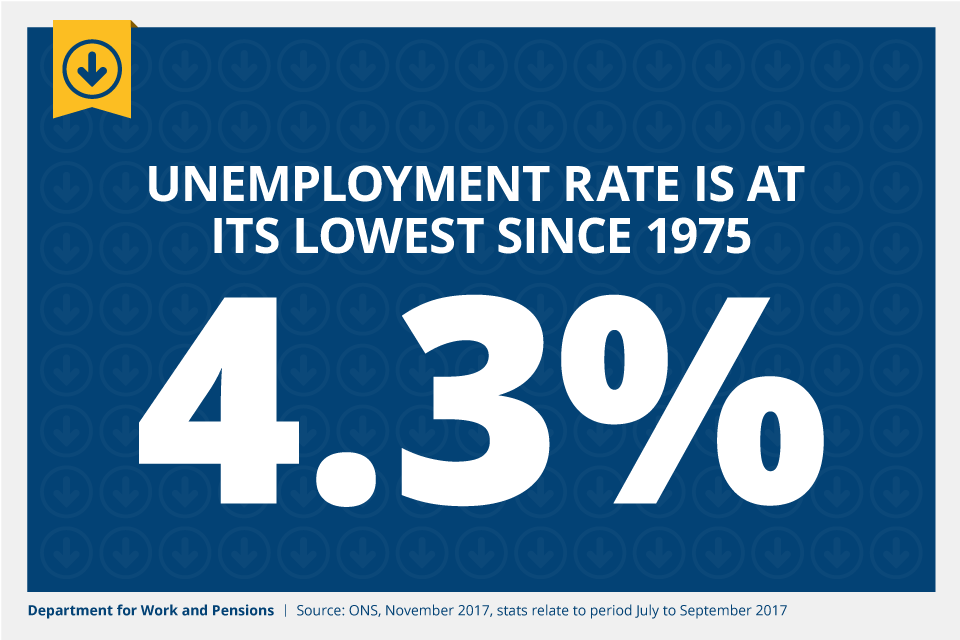
Unemployment is at its lowest since 1975 at 4.3%

Minister for Employment, Damian Hinds said:

The strength of the economy is driving an increase in full-time, permanent jobs and a near-record number of people are now in work thanks to the government’s welfare reforms.

When unemployment fell to 5% early last year, many people thought it couldn’t get much lower, and yet it now stands at 4.3%.

Everyone should be given the opportunity to find work and enjoy the stability of a regular pay packet. We’ve cut income tax for 30 million people since 2010, meaning people keep more of their money each month.

Today’s employment figures also show

  • the number of people in employment has increased by more than 3 million since 2010
  • the UK has the third highest employment rate in the G7
  • the number of workers aged 50+ has almost reached 10 million – a record level
  • youth unemployment has fallen by over 40% since 2010
  • there are a near record 780,000 vacancies in the economy at any one time
  • the proportion of young people who are unemployed and not in full time education remains below 5%

Read the Labour Market Statistics – November 2017 from the Office for National Statistics.

Separate figures out today show there are 630,000 people on Universal Credit, with 40% in employment.

Contact Press Office

Press Office

Caxton House

Tothill Street
London
SW1H 9NA

Follow DWP on:


Link: Press release: Unemployment remains at 40-year low
Source: Gov Press Releases

Press release: Highways England is geared up for winter

The company responsible for the country’s motorways and main A roads has more than 280,000 tonnes of salt, over 500 salt spreading vehicles ready around the clock to help drivers get to their destinations safely.

Roads Minister, Jesse Norman said:

It is essential to keep our road network running throughout the winter.

Highways England has informed us that they are well prepared for adverse weather, with enough salt to cover 610,000 miles of our motorways.

But the expert advice is clear: drivers need to make their own judgements about road conditions. If it doesn’t look safe then they should stay put and travel once weather conditions have improved.

Highways England’s national winter and severe weather team leader, Paul Furlong, said:

We care about people getting to their destinations safely and during any severe weather our teams will be working around the clock to keep traffic moving.

We’re asking drivers to make sure they and their vehicles are also prepared. Before you set out, check your vehicle, the road conditions and the weather forecast. If conditions are poor, and journeys are not essential, consider waiting until the weather gets better – this should improve journeys, and give our gritters a chance to treat the roads.’

To help keep traffic moving, Highways England has nearly 130 winter service depots across the country, and more than 250 environmental sensor stations that provide real-time monitoring of road weather conditions and temperatures.

Highways England is urging drivers not to use the hard shoulder to undertake gritters, risking a collision with a stationary vehicle and causing a hazard when gritters try to come off at junctions.

Drivers are asked not to take unnecessary risks this winter and only pass a gritter when it is safe to do so, avoiding using the hard shoulder and checking for hazards ahead.

During severe weather drivers are urged to follow this advice:

  • In snow and ice, drivers should stick to the main roads where they can and only travel if necessary
  • drivers are also encouraged to make sure they have a winter kit in their vehicle, including an ice scraper and de-icer, warm clothes and blankets and sunglasses to cope with the low winter sun
  • In high winds, there’s a particular risk to lorries, caravans and motorbikes, so drivers should slow down and avoid using exposed sections of road if possible
  • In heavy rain, drivers should keep well back from the vehicle in front, gradually ease off the accelerator if the steering becomes unresponsive, and slow down if the rain and spray from vehicles makes it difficult to see and be seen
  • In fog, drivers should switch on their fog lights and not use lights on full beam as the fog will reflect the light back – if you really cannot see, you should consider stopping until it is safe to continue

Drivers are advised to follow messages on the overhead signs and listen to radio updates. Further information can be found by visiting our traffic information website or calling the Highways England Information Line on 0300 123 5000.

General enquiries

Members of the public should contact the Highways England customer contact centre on 0300 123 5000.

Media enquiries

Journalists should contact the Highways England press office on 0844 693 1448 and use the menu to speak to the most appropriate press officer.

Link: Press release: Highways England is geared up for winter
Source: Gov Press Releases

Press release: UK Government Minister Lord Bourne visits leading Welsh University

Marking his return as a Minister for the UK Government in Wales, Lord Bourne of Aberystwyth will visit the University of South Wales (USW) Newport campus today (15 Nov).

It follows the announcement of the university’s plans to deliver degrees to aerospace engineering students as a key partner at the UAE’s new Dubai South development.

The USW will accept its first students in Dubai South from September 2018 in a facility in the development’s existing Business Park.

The visit comes following the Secretary of State for Wales recent trade mission to Qatar, where he highlighted the wider opportunities markets in the UAE present for the whole of Wales. International Trade Secretary Liam Fox also visited the USW’s stand at the Dubai Airshow last weekend (12 Nov).

Lord Bourne said:

The University of South Wales is quickly developing its status as a leading Welsh university with a strong international reputation.

Higher Education is a key export for the UK, and Dubai South will be one of the world’s leading aerospace hubs.

We want to provide our higher education institutions with the platforms to share their expertise and skills worldwide. USW is a dynamic university bridging the gap between industry and academia and the UK Government is committed to supporting its progress.

Lord Bourne will also tour USW’s National Cyber Security Academy where the university is piloting a specialist degree, accredited by GCHQ. The degree aims to train and develop expertise within cyber security, contributing to a developed workforce and plugging a shortage of skills within the sector. He will also take the opportunity while in South Wales to visit Newport’s St Woolos Cathedral.

More information on USW’s presence at Dubai South is at www.southwales.ac.uk/dubai

Link: Press release: UK Government Minister Lord Bourne visits leading Welsh University
Source: Gov Press Releases

Press release: Government backs British talent with £2.4 million funding for music exports

  • UK artists receive £2.4 million funding boost for music exports
  • a total of 162 UK acts were supported through Government’s Music Exports Growth Scheme (MEGS)
  • DIT and the BPI award further £181,944 to help UK artists achieve success in international markets

The country’s up-and-coming music acts are being encouraged to set their sights on the world stage thanks to a government export scheme.

In the latest round of funding, 12 UK music acts have received grants including Public Service Broadcasting, twice-mercury nominated Ghostpoet, Folk Rock duo Zervas & Pepper and 5 piece pop punk band ROAM, who all hope to maximise their chances of going global or further increasing their international exposure.

In total so far, 162 acts have received more than £2.4 million of funding in their bid to become the next Adele or Ed Sheeran through the Music Export Growth scheme (MEGS). The scheme which is jointly run by the DIT and the UK record label association, the BPI, helps raise the international profile of developing British artists and their music companies.

To further promote UK music talents abroad, the Government is launching a trade mission to India at the start of February 2018 (1st to 7th). Based in Mumbai, it will help connect music talent with record labels and talent scouts and presents a significant export potential in the world’s seventh largest economy.

Minister for Trade and Export Promotion, Baroness Rona Fairhead said:

The UK is a world leader in music exports and recognised for its exceptional home-grown talent around the globe. Through the music exports scheme, we help to nurture the talent of the future to explore new global markets.

As an international economic department, we are launching a trade mission to India to connect music artists with investors in one of the world’s largest economies, ensuring the strengths of our creative industry sector reach audiences at home and abroad.

Chris Tams, BPI Director of International overseeing the MEGS programme, said:

The Music Exports Growth Scheme gives a diverse range of artists who have the talent, but not always the means to realise its full potential, the opportunity to grow their fanbase in key international markets.
In the process it helps to promote the profile of British music overseas and, crucially, helps to boost our exports – so far to the tune of a 10 -1 return on investment for each Pound put in by the UK Government.

Obaro Ejimiwe, the artist known as Ghostpoet, said:

It’s truly amazing to be selected for funding, this money will really help to make in-roads into mainland Europe. It’s been a while since I toured over there properly and this cash injection is not only timely but very much appreciated.

MEGS recipient Public Service Broadcasting said:

We’d like to thank MEGS once again for continuing to help us with what often prove to be very expensive overseas tours. On a limited budget such as ours (as is the case with almost every band in the independent sector, who need this kind of support), it really makes a difference. We’ll carry on working hard at our end to justify the investment and make the most of the opportunity

To date, UK music exports were worth £2.5 billion in 2016 and through the scheme, the country has seen a return of £10 for every £1 invested.

The Department for International Trade (DIT) , in partnership with AIM (The Association of Independent Music) and BPI (British Phonographic Industry), is launching the UK music trade mission to Mumbai, India, which will take place from 1st to 7th February 2018 and help connect music businesses and presents a significant export potential in the world’s seventh largest economy.

The grants, ranging from £5,000 to £50,000, are available to eligible UK based-music companies with a turnover of less than €50 million and fewer than 250 employees, providing them with an opportunity to enhance their profile in overseas markets, as well as develop their commercial potential.

Applications for the next round (12) of MEGS funding will be open for applications from the 8th January 2018 and will close on 5th Feb 2018. For details or to download an application form please visit the MEGS page on the BPI website.

Full list of MEGS recipients in the eleventh round of funding:

  • ALA.NI
  • Broken Witt Rebels
  • Bruno Major
  • Charlie Cunningham
  • Ghostpoet
  • Jane Weaver
  • Matthew Herbert
  • Public Service Broadcasting
  • ROAM
  • Shopping
  • The Wombats
  • Zervas & Pepper

Export revenue for the UK music industry was £2.5 billion in 2016 (source: Measuring Music, September 2017).

About the BPI (British Phonographic Industry)

BPI champions the UK’s recorded music industry, safeguarding the rights of its members and of the artists, performers and label members of collecting body PPL. BPI’s membership consists of over 400 independent labels and the UK’s 3‘majors’, which account for 85 per cent of legitimate domestic music consumption.

BPI promotes British music overseas through its trade missions and the Music Exports Growth Scheme. It provides insights, training and networking with its free masterclasses, Innovation Hub, Insight Sessions, and reports. The BPI administers the Certified Awards, co-owns the Official Charts, organises The BRIT Awards and is also home to the Mercury Prize.

Further information

Contact the DIT Media and Digital Team on 020 7008 3333

Follow us: @tradegovuk, gov.uk/dit

Contact the BPI at gennaro.castaldo@bpi.co.uk

Link: Press release: Government backs British talent with £2.4 million funding for music exports
Source: Gov Press Releases

BS EN ISO 15378:2017 Primary packaging materials for medicinal products. Particular requirements for the application of ISO 9001:2015, with reference to good manufacturing practice (GMP) Particular requirements for the application of ISO 9001:2015, with reference to good manufacturing practice (GMP)

Quality assurance
Medical equipment
Packaging materials
Packaging
Drugs
Packages
Sterilization (hygiene)
Consumer-supplier relations
Quality management
Pharmaceutical technology
Quality

Link: BS EN ISO 15378:2017 Primary packaging materials for medicinal products. Particular requirements for the application of ISO 9001:2015, with reference to good manufacturing practice (GMP) Particular requirements for the application of ISO 9001:2015, with reference to good manufacturing practice (GMP)
Source: BSI Standards